



Bariatric surgery marketing: the complete practice guide
Bariatric surgery marketing is the systematic process of attracting qualified patients through digital channels calibrated to the weight loss surgery decision timeline. For most practices, the problem is not awareness. Patients are researching. What breaks down is the path from that first Google search to a booked consultation. The strategies that consistently close that gap combine bariatric SEO, structured paid advertising, and content that addresses the emotional weight of the decision before a patient ever calls. Most practices get this wrong.
The structural gaps in most bariatric surgery marketing programs
Potential patients considering weight loss surgery carry real emotional weight: years of failed diets, body image concerns, and the social stigma still attached to obesity. They do not respond to the same ad formats that work for elective cosmetic procedures. That distinction matters enormously. They research for months. They revisit the same practice websites multiple times before making contact.
Generic digital approaches ignore that decision timeline. That is the first structural gap. The second is compliance: healthcare advertising restricts outcome language, before/after presentation, and testimonial formats in ways that catch practices off guard when they scale their spend. A bariatric marketing agency that does not understand those constraints will drain your budget on disapproved creative and policy violations.
Three failure points stall growth most reliably:
- Trust deficit: patients who found you during research but encountered no credible social proof at the decision point.
- Weak local search presence: competitors ranking above you for the exact terms your future patients type.
- No nurture system: inquiries that arrived but received no follow-up before those patients booked elsewhere.
How do you market bariatric surgery effectively?
Effective bariatric surgery marketing runs on three parallel tracks: search visibility, paid patient acquisition, and long-cycle lead nurture. Each addresses a different stage of a decision that typically spans six to eighteen months from first search to booked procedure.
Start with the organic foundation. Your Google Business Profile, local directory listings, and on-page bariatric SEO determine whether you appear when someone searches for a weight loss surgeon in your city. Practices that rank in the local 3-pack capture the majority of high-intent clicks at no marginal cost per inquiry. Free traffic compounds fast. The full optimization checklist for local search visibility for bariatric practices covers every step of building that foundation.
Paid advertising then accelerates what organic search builds over time. Structured Google Ads campaigns for bariatric advertising require tightly themed ad groups and thorough negative keyword lists to prevent wasted spend on informational queries. Social media ads work differently: they reach your patient demographic before those patients search at all. Both channels are necessary at different funnel stages.
Remarketing ties both together. Most visitors do not convert on first contact. Serving targeted ads to people who viewed procedure pages but did not book builds recall and draws them back when they are ready to act.
Bariatric SEO: ranking where your patients actually search
Bariatric SEO works across two content layers. The first is local: city-level pages optimized for procedure and geography queries, backed by consistent business data across directories. The second is educational: detailed answers to the questions patients type during research, covering procedure comparisons, recovery expectations, and risk profiles.
Google rewards pages that answer specific patient questions with clinical depth and clear structure. Thin pages listing procedure names without substantive content do not rank against competitors who have built proper educational architecture. That standard applies equally to service pages, procedure pages, and blog content.
Technical SEO is the baseline: page load speed under three seconds, mobile-responsive design, and proper schema markup for medical providers. These factors determine whether your content gets indexed competitively against other bariatric medicine marketing programs in your market. The website itself is the technical foundation the entire patient acquisition system runs on. Booking flow architecture, page load time, and site structure determine how much of the traffic your marketing generates actually converts to consultation requests. Marketing channels amplify what the site can do; a site built for launch but not for conversion limits every channel running above it.
What digital marketing strategies work best for bariatric practices?
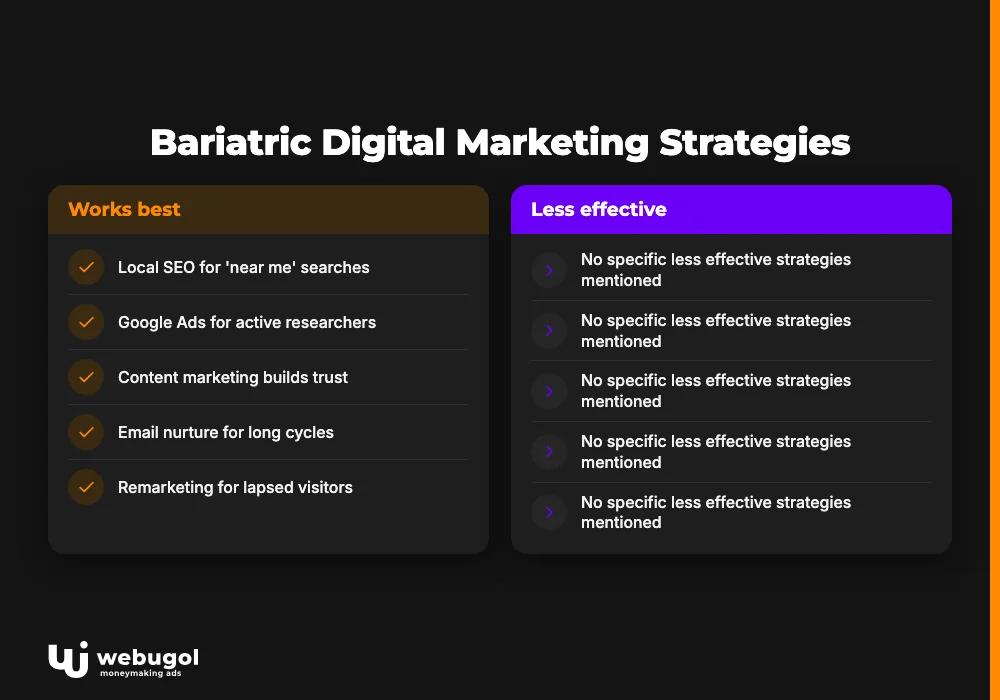
The bariatric digital marketing channels that generate the highest consultation volume share one characteristic: they meet patients at the stage where the decision is forming.
| Strategy | Primary function | Decision stage |
|---|---|---|
| Local SEO | Organic visibility | High-intent "near me" searches |
| Google Ads | Paid intent capture | Active procedure researchers |
| Content marketing | Trust and education | Long-cycle decision makers |
| Bariatric social media marketing | Awareness and community | Early-stage explorers |
| Email nurture | Lead follow-up | Unbooked inquiries |
| Remarketing | Re-engagement | Lapsed site visitors |
Content marketing forms the backbone of bariatric practice marketing. Educational blog posts answering real patient questions and patient testimonials placed at the consultation decision point address the hesitation that blocks conversion. Video walkthroughs of the surgery process and documented before/after outcomes build the evidence patients need before they call.
Documented outcomes work especially well paired with live formats. That combination converts well. Webinars and Q&A sessions let a single surgeon build trust with dozens of prospective patients in one session.
Email is one of the highest-ROI channels in the bariatric digital marketing mix because the decision cycle is long. A prospective patient who downloads a procedure guide in January may book in August. An email nurture sequence for unconverted bariatric leads keeps your practice in view through the entire window without requiring additional paid acquisition spend.
Which social media platforms work best for bariatric marketing?
Facebook and Instagram generate the most consistent patient inquiries for bariatric surgery practices. Facebook's demographic and interest targeting lets campaigns reach people within specific age ranges, geographic radius, and health interest categories. Instagram supports visual content: patient transformation journeys, surgeon introductions, and procedure education that builds familiarity before a first call.
TikTok has grown as a health discovery platform, particularly among patients under forty. Short educational videos explaining how procedures work or addressing common fears produce organic reach that extends a practice's exposure beyond paid campaigns.
For a structured look at how each platform shapes the patient decision process, the guide to healthcare social media trends and platform targeting breaks down the key differences across patient demographics.
Across all platforms, bariatric social media marketing content must comply with advertising policies covering health outcome claims and testimonial language. Patient video testimonials require explicit written consent. Running high-volume social campaigns without legal review creates account suspension risk that can cut off an entire acquisition channel.

How do you get more patients for weight loss surgery?
Getting more patients requires fixing the pipeline, not just adding spend. The typical bariatric funnel loses qualified prospects at two predictable points: after the first website visit before inquiry, and between inquiry and consultation booking.
At the first drop-off, the fix is trust infrastructure. Strong patient testimonials above the fold on procedure pages, surgeon credentials presented in plain language, and a friction-free booking flow reduce early abandonment. Clear answers to "what does a first consultation involve" remove the uncertainty that stops patients from contacting you.
At the second drop-off, the fix is response speed. Practices that follow up with new inquiries within one hour convert meaningfully more consultations than those responding same-day. An automated first-response combined with a human follow-up inside that window captures patients who would otherwise research a competitor while waiting. Speed decides this outcome.
Measuring bariatric surgery marketing performance
Three metrics determine whether bariatric surgery marketing is producing real growth:
Cost per consultation: total spend divided by completed consultations, not leads. This number connects marketing spend directly to practice revenue.
Consultation-to-surgery conversion rate: what share of consultations proceed to scheduled procedures. A low rate often signals a follow-up process problem, not a marketing problem. Diagnose before you spend. Diagnosing the right bottleneck prevents wasted spend on more acquisition before the conversion gap is closed.
Channel attribution by lead source: which campaigns, keywords, and platforms generate completed consultations. Multi-touch attribution matters because a patient may click a paid ad, read a blog post, and then call from an organic search three weeks later. Practices that review attribution monthly reduce cost per patient acquired faster than those checking quarterly.

Build the patient acquisition system your practice is missing
A bariatric practice on a growth plateau is not missing awareness. It is missing the connected system that converts awareness into consultations at a predictable, scalable cost. Bariatric SEO, paid acquisition, content, and nurture need to run as one integrated program, not as separate vendors each optimizing their own metric in isolation. That same constraint, a site built for launch but not designed to convert, is the bottleneck that limits growth for any service business owner watching patient acquisition numbers stall.
Webugol builds and grows bariatric practice websites, then runs the patient acquisition system on top of them. That bundled approach means the technical foundation and the marketing program are built together from the start, not patched together by separate vendors. Contact us to review your current patient acquisition numbers and identify where the system is leaking.
FAQ
How do you market bariatric surgery effectively?
Effective bariatric surgery marketing combines local SEO to capture high-intent procedure searches, paid advertising for active researchers, and educational content that builds trust through the long decision cycle. Remarketing keeps your practice visible to visitors who did not book on first contact. These channels need to run as an integrated program to produce consistent consultation volume.
What digital marketing strategies work best for bariatric practices?
Local SEO, Google Ads, content marketing, and email nurture sequences consistently generate the highest consultation volume for bariatric practices. Social media advertising builds patient awareness at the top of the funnel. The key is matching each channel to the decision stage it addresses rather than running all channels without a clear conversion goal.
How do you get more patients for weight loss surgery?
Increasing patient volume requires fixing the two most common pipeline drop-off points: between the first website visit and inquiry, and between inquiry and booked consultation. Strong social proof, fast inquiry response, and an email nurture system for unconverted leads address both gaps. Adding ad budget before fixing these leaks produces more wasted spend, not more patients.
Which social media platforms work best for bariatric marketing?
Facebook and Instagram generate the most consistent patient inquiries, with Facebook offering detailed demographic targeting and Instagram supporting visual patient journey content. TikTok is a growing secondary channel for practices targeting patients under forty with short educational video. All platform ads must comply with healthcare policies covering outcome language and patient testimonial consent.
How much does bariatric surgery marketing cost?
Bariatric surgery marketing costs vary by market, channel mix, and practice scale, so no single number applies across programs. What matters more than total spend is cost per completed consultation. Practices that track and optimize this metric consistently reduce their acquisition costs over time, regardless of starting budget.

