



DTC telehealth acquisition: the operator growth playbook
DTC telehealth acquisition is the process of reaching and enrolling patients through paid and organic channels without employer networks or payer referrals routing volume to you. Every patient your practice enrolls is a patient you paid to reach. That structure makes cost per acquisition a permanent line in your cost of revenue. Operators running past $500K per month who are still treating rising CPA as a creative problem are solving the wrong thing.
What makes DTC telehealth acquisition structurally different
In a payer-network practice, referral flow grows without proportional growth in marketing spend. In employer-sponsored telehealth, acquisition cost sits inside a contract negotiation cycle, not a real-time ad account. DTC operators have neither structure. Volume and acquisition cost scale together from the first campaign, which is why unit economics must be understood before any budget goes live.
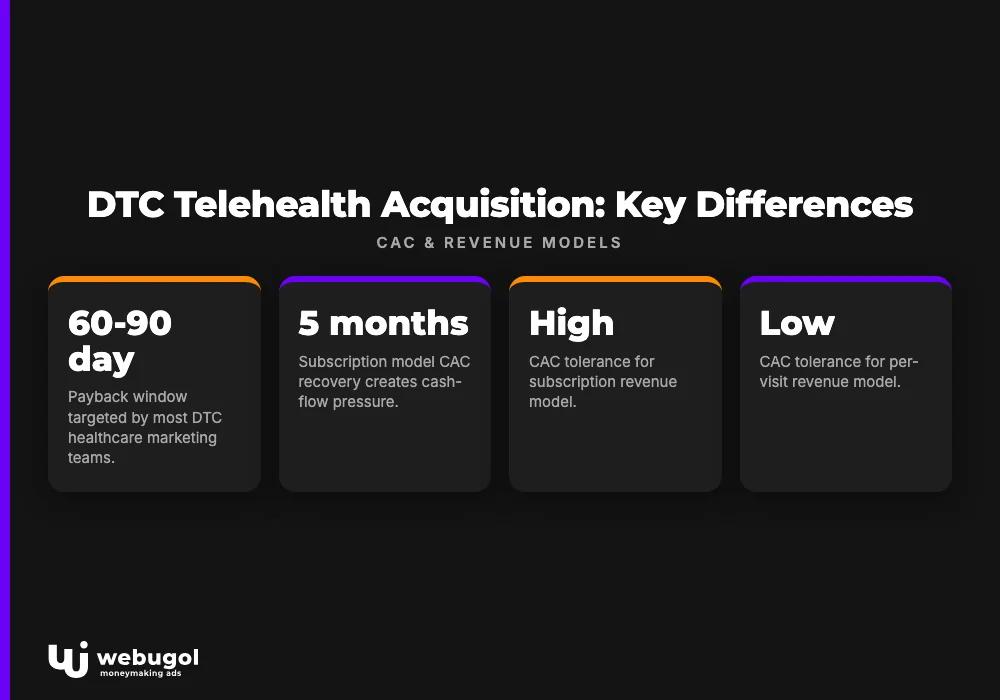
The revenue model determines how much CAC the business can absorb and on what timeline.
| Model | CAC tolerance | LTV window | Churn risk | Scale ceiling |
|---|---|---|---|---|
| Subscription | High | 6–24 months | High if onboarding is weak | Churn-constrained |
| Per-visit | Low | Single visit | Low | Volume-constrained |
| Hybrid | Moderate | 3–12 months | Moderate | Attribution-constrained |
The 60- to 90-day payback window is the benchmark most direct to consumer healthcare marketing teams target. A subscription model that takes five months to recover CAC creates cash-flow pressure that consistently gets misread as an ad performance problem. The real issue is churn.
How do DTC telehealth companies acquire patients?
DTC telehealth acquisition runs from paid ad impression to booked consultation, through intake and clinical decision, into a prescription program or membership, and back through retention and renewal. Each handoff is a potential leak point. Most operators diagnose a rising CPA as an ad problem and refresh creative or adjust bids. The break is downstream in most cases.
The five structural stages of the DTC healthcare funnel are: ad impression and click; landing page and offer; booking and intake; clinical enrollment; and retention. A break in any stage inflates the CPA the ad platform reports, even when the ad performs within expected ranges.
The ad account is the most visible part of the system. It is rarely the only broken part.
Why is telehealth patient acquisition more expensive than other digital categories?
DTC telehealth CPA is structurally higher because operators advertise health services to cold audiences under platform restrictions that do not apply to general e-commerce. No warm referral flow, no employer-subsidized enrollment, and healthcare ad compliance requirements make reaching health-intent audiences more expensive than almost any other digital category.
Four constraints compound at the top of the funnel:
- Meta special ad categories: health and wellness advertisers face restricted audience targeting, disabled lookalike optimization based on health condition signals, and limited retargeting from condition-specific content engagement.
- Google Health Ads Policy: condition-specific targeting is restricted for telehealth advertisers, certain health claims require advance certification, and content involving specific diagnoses faces additional review before going live.
- HIPAA-compliant tracking: standard Meta Pixel and Google Tag implementations that pass health-related URL parameters or form field data to ad platforms create HIPAA exposure. Understanding how HIPAA shapes your analytics and ad tracking setup is a prerequisite before scaling any health-adjacent campaign.
- Consent-mode impact: the privacy signal required to operate within current platform requirements structurally reduces remarketing audience sizes, creating a floor under CPA that optimization alone cannot lower.
Operators who scale before resolving these constraints build acquisition data on a broken foundation.
What is a good CAC for telehealth?
There is no universal telehealth patient CAC benchmark because acceptable cost depends on the revenue model, average order value, and payback window the business targets. The operating principle is straightforward: CAC should recover within 60 to 90 days from the recognized revenue of the enrolled patient. For subscription programs with low churn, a higher initial CAC is sustainable. For per-visit or hybrid models, a lower threshold is required to hold margin.
What separates operators who sustain a telehealth scaling strategy from those who hit a ceiling is how they attribute cost end-to-end. If your setup passes health-adjacent data to ad platforms without a compliant implementation, the CAC number you are optimizing against is wrong. Fixing how your CRM and acquisition data connect for end-to-end revenue attribution often reduces reported CAC before a single campaign change.
What does the Senate investigation mean for DTC telehealth operators?
In 2025, Senator Dick Durbin released an investigation into DTC telehealth companies focused on subscription transparency, compounded medication advertising practices, and physician oversight documentation. The report documented practices that had become normalized across the category: subscription terms buried in checkout flows, outcome language implying guaranteed results, and physician oversight that existed on paper without documentation adequate for external review.
Before increasing ad spend, run a structured review across five areas:
- Subscription disclosure language: every checkout flow should state the recurring billing amount, billing frequency, and cancellation steps above the payment button, not in footnotes below it.
- Outcome claim audit: every active creative and landing page headline should be reviewed for language implying guaranteed results; replace with qualified outcome language.
- Compounded drug copy: advertising for compounded medications should reflect current FDA and FTC guidance, including explicit disclosure of compounded status in the creative itself.
- HIPAA tracking consent: confirm that no health-adjacent data passes from client-side pixels to ad platforms without a compliant consent mechanism in place.
- Ad copy review cycle: establish a documented approval cycle with a compliance reviewer in the chain and version history on record.
FTC enforcement patterns and what they signal for your ad copy
The Federal Trade Commission increased enforcement activity against DTC subscription health companies through 2025 and 2026. The consistent triggers across documented actions: undisclosed subscription terms at checkout, outcome guarantees in ad creative for weight loss and men's health programs, compounded medication claims without clinical framing, physician oversight documentation gaps, and pricing opacity in multi-tier checkout flows. Each of those maps directly to a review item for any active DTC telehealth campaign.
Where DTC telehealth funnels break
When CPA rises, the default response is to change creative, test a new offer, or adjust bid strategy. Wrong direction. The diagnostic pattern across scaling telehealth practices is consistent: the break sits in offer architecture, intake response time, or booking flow design, not in the ad.
Speed-to-lead is the time between a new lead submitting a form and receiving first contact from the practice. A five-hour response lag does not just reduce telehealth funnel conversion. It transfers the lead to a competitor who responded in minutes, and by the time the practice follows up, the patient has already booked elsewhere. That problem belongs to operations, not marketing, which is exactly why it goes unfixed. Marketing sees rising CPA and tests new creative. Operations sees no ticket and makes no change.
Show rate behaves the same way. A no-show is consumed acquisition spend with no return. The ad platform never sees it. When telehealth booking workflows reduce no-shows and cut friction from the intake process, that improvement registers as a CPA drop without touching a single campaign. Most operators track show rate as a support metric. That is where the earliest warning signal for CAC deterioration disappears.
Offer temperature mismatch is the third common leak. A single offer presented to a mixed-temperature audience trains the algorithm on low-quality engagement signals that degrade targeting efficiency across the entire account.
Cold audiences need low-commitment entry points: a free consultation, an educational quiz, or an assessment that captures intent without requiring payment. Warm audiences, those who engaged with content or visited the site, respond to single-visit programs or trial-access offers. Hot audiences, prior purchasers and active leads, convert on membership enrollment and continuity upsells.
How do you scale a DTC telehealth business past $500K per month?
At $500K per month and above, adding budget amplifies structural problems rather than compounding wins. Below that threshold, the ad is the lever. Above it, the system the ad feeds into is the lever.
The telehealth scaling strategy that holds at this revenue level is tracking-first, ops-first. End-to-end revenue attribution from ad click to recognized revenue must be established before any budget increase.
Intake benchmarks, including speed-to-lead, answer rate, show rate, and close rate, must be measured before any diagnosis can locate the actual constraint. Operators who work through this sequence consistently find that the first phase produces CPA improvements before any new spend is added. The downstream leaks were inflating cost-per-acquisition the entire time. The ad account was not the problem.
Paid acquisition resets every month. At $500K per month, operators with no compounding acquisition channel are structurally fragile. One ad account suspension or one compliance-forced creative pause can remove the majority of new patient volume with no lead time. Organic search compounds over months. Email lifecycle flows run at near-zero marginal cost once built. Referral programs generate acquisition at a fraction of paid CPA. These channels do not replace paid spend. They create a floor under patient volume that paid spend builds on top of.
Subscription renewal rates become the highest-leverage metric at this stage. Strong retention reduces the new patient volume required to hit revenue targets, which raises the sustainable CAC threshold proportionally. Treating churn as a support metric rather than a marketing metric is the structural mistake that separates fragile scaling from durable DTC telehealth acquisition growth.
Stop losing revenue to a funnel you cannot see end-to-end
Rising CAC without a clear diagnostic is almost always a structural problem, not a creative one. Webugol builds tracking-first, conversion-led acquisition systems for US healthcare operators, starting with a full diagnostic of the revenue path from ad click to recognized revenue before any budget increase.
The Healthcare Growth System is a 90-day sprint: month one covers market intelligence, funnel structure, and landing page foundations; month two delivers the tracking layer, performance dashboards, and Google and Meta campaign launches; month three moves into daily optimization, nurture flows, and renewal sequencing. Weekly growth calls, always-on optimization, and direct Slack access throughout.
Book a Strategy Call to map what is blocking your next growth phase.
FAQ
What is DTC telehealth acquisition?
DTC telehealth acquisition is the process of reaching and enrolling patients through paid and organic channels without employer networks or insurance routing. The operator owns and funds the full acquisition funnel, making CAC a permanent cost of revenue rather than a marketing overhead line item.
What is a good CAC for telehealth?
There is no single benchmark because acceptable CAC depends on the revenue model and payback window. The operating standard for DTC telehealth is CAC recovery within 60 to 90 days from the recognized revenue of the enrolled patient. Subscription models tolerate higher initial CAC; per-visit models require lower thresholds to maintain margin.
Why is telehealth patient acquisition more expensive than other digital categories?
DTC telehealth operators advertise to cold audiences under platform restrictions that do not apply to general e-commerce. Meta special ad categories, Google Health Ads Policy, and consent-mode requirements each reduce effective audience sizes and targeting precision, creating a structural floor under CPA that optimization alone cannot lower.
What does the 2025 Senate investigation mean for DTC telehealth operators?
The 2025 Durbin investigation identified subscription transparency gaps, compounded medication advertising practices, and physician oversight documentation as active regulatory concerns. Operators should audit subscription disclosure language, outcome claims in active ad creative, compounded drug copy, and clinical review documentation before increasing ad spend.
How do you scale DTC telehealth past $500K per month?
Scaling past $500K requires fixing the system before increasing budget. Establish end-to-end attribution from ad click to recognized revenue, measure intake benchmarks including speed-to-lead, show rate, and close rate, and validate offer architecture against audience temperature. The CPA improvement typically arrives before any new spend is added.

