



Healthcare Programmatic Advertising: A Performance Guide for Clinic Owners
Healthcare programmatic advertising is automated real-time ad buying matched to target audiences through a demand-side platform. It expands patient acquisition into display, video, and native placements across thousands of publisher sites beyond Google Search and Meta. It delivers ROI after your core paid channels have proven cost-per-lead benchmarks, your HIPAA-compliant tracking stack is in place, and your post-click funnel converts programmatic traffic at acceptable rates. Launch without those conditions and programmatic inflates CAC.
What is healthcare programmatic advertising?
Programmatic advertising automates real-time bidding for digital ad inventory, including display, video, native, and connected TV, across publisher networks through a demand-side platform (DSP). Unlike Google Search, which captures existing patient intent, programmatic creates demand by matching your audience criteria to available inventory across the open web.
The "automated" label does not mean hands-off. A DSP requires audience definition, bid caps, placement exclusions, and brand safety monitoring. The automation handles individual impression decisions; strategy, compliance, and the programmatic advertising healthcare funnel remain your responsibility.
Why clinic owners waste programmatic budgets
Most programmatic ROI failures happen before the first impression. Two structural errors destroy returns before optimization can work. Most teams skip this.
The HCP-vs-patient targeting mistake
Most programmatic healthcare advertising inventory was built for HCP engagement. It was designed for pharmaceutical brands reaching prescribers, not patients seeking a telehealth consultation. When a clinic operator uses HCP-grade inventory for patient acquisition, the audience is wrong, the KPI is wrong, and the CPL will show it. Prescriber reach measures scripts influenced; patient acquisition measures booked consultations, and buying one inventory type for the other produces predictable waste. Results differ dramatically.
What platform policies actually block
Google Display Network and most major DSPs restrict healthcare campaign targeting independently of HIPAA. Knowing what is off-limits before launch sets realistic expectations for addressable audience scale:
- Condition-based interest targeting (diabetes, mental health, oncology, chronic disease)
- Health app retargeting tied to symptom logging or diagnostic data
- Diagnosis-code inference audiences
- Medication keyword audiences, prescription or OTC
- Sensitive health category placements (addiction treatment, fertility, STI testing)
- Lookalike audiences built from health-condition signals
Programmatic advertising for healthcare remains viable within these constraints. The audience is built from what survives the policy filter, not from what a pharma DSP would use.
Is healthcare programmatic advertising legal and HIPAA-compliant?
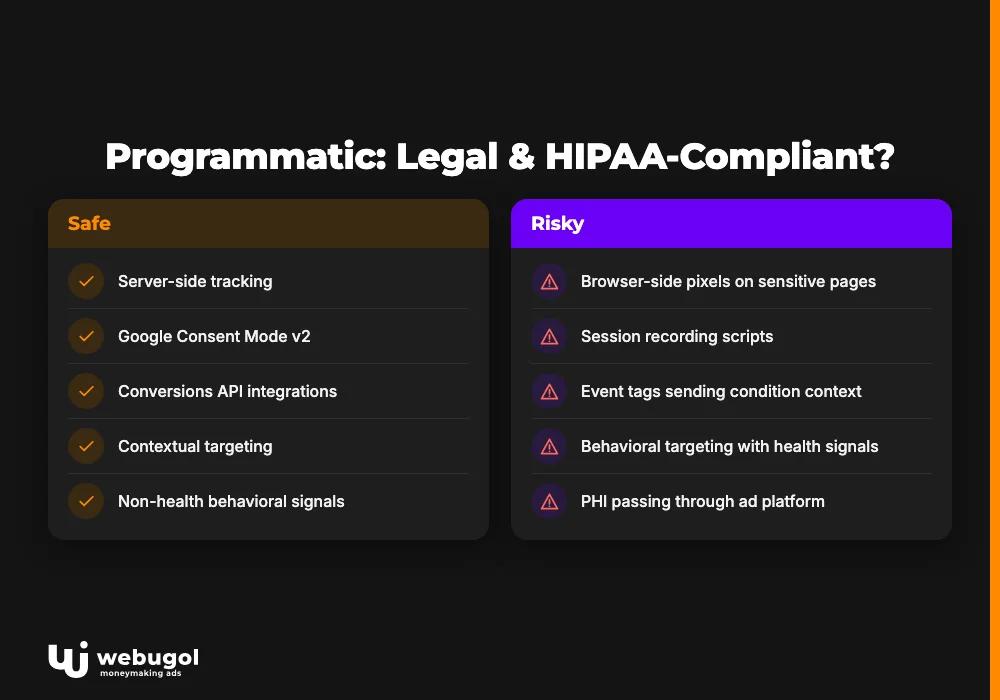
Yes. Healthcare providers can run programmatic advertising legally, provided no protected health information passes through the ad platform and audience targeting excludes protected health categories. Compliance depends on how the stack is configured, not whether the channel is used at all. That changes everything.
Which tracking pixels are safe in a healthcare programmatic stack
Standard browser-side pixels create PHI risk when they fire on condition-specific landing pages, intake forms, or appointment confirmation screens. The safe architecture replaces these with server-side tracking, Google Consent Mode v2, and Conversions API integrations that pass conversion signals without exposing user-level health data to the ad network.
Tags that introduce exposure include session recording scripts that capture intake field content and event tags that send condition-category page context to the network. Both require server-gating or removal before the campaign launches, not after weeks of spend.
Banned targeting and consent mode: what it costs your reach
| Targeting type | Compliance risk | Relative CPM | Addressable scale | HIPAA exposure |
|---|---|---|---|---|
| Contextual (placement-based) | Low | Lower | High | None |
| Behavioral (health condition signals) | High | Higher | Restricted | Significant |
Consent Mode v2 removes a meaningful portion of addressable audience in healthcare because consent rates run lower on health-sensitive sites. Contextual targeting bypasses this constraint entirely by targeting placements rather than users. Compliance enables scale. Behavioral targeting stays viable only using non-health signals such as geography, device type, and general content consumption patterns.
If your tracking stack is not ready to support a new acquisition channel safely, a system audit is the right first step before any new spend goes live. The Healthcare Growth System builds that compliance foundation before adding programmatic to your channel mix.
Targeting options that work for telehealth and clinics
With compliance architecture in place, two audience approaches produce patient bookings within a legal setup.
First-party data audiences vs. third-party segments
CRM-matched audiences, including past consult inquirers, email subscribers, and patients with explicit consent, outperform third-party health segments on both conversion rate and compliance defensibility. A hashed first-party list uploaded server-side to a DSP does not expose PHI at the match layer. This is the highest-leverage starting audience for telehealth operators because intent is already established.
Before adding programmatic to your channel mix, your core paid channels need to be producing at target CPL. The telehealth advertising strategies that establish those benchmarks on Google and Meta are the prerequisite, not the parallel track.
Contextual vs. behavioral targeting in a compliant stack
Contextual targeting places ads on health-adjacent content, such as weight management articles, longevity publications, and men's health sites, without attaching any health signal to the user profile. It scales well across telehealth verticals: weight loss, TRT, GLP-1 programs, advanced blood work, longevity services. Behavioral targeting layers in after first-party audiences are established, using only non-health signals.
For clinic and telehealth operators diversifying beyond Google and Meta, programmatic advertising offers the broadest compliant publisher reach available. YouTube and TikTok healthcare campaigns face enforcement constraints that significantly limit addressable scale for patient-acquisition goals.

After the click is where programmatic CPL gets destroyed
Post-click funnel failures are the primary reason healthcare programmatic advertising CAC runs high for clinics, not the targeting or the CPM. A click landing on a four-step booking flow or a twelve-field intake form converts at a fraction of its potential. Audit these variables before scaling spend:
- Booking flow step count: three steps is a ceiling, not a target
- Intake form length: collect only what the first consultation requires
- Speed-to-lead: first contact within five minutes of form submission
- Calendar sync: automated confirmation active before the patient exits the flow
- No-show prevention: reminder sequence triggered at booking, not the day before
Speed matters here. Measuring whether a programmatic click becomes booked revenue requires attribution that survives HIPAA. The healthcare marketing ROI framework connects ad spend to actual appointments, not platform-reported clicks.
How to measure programmatic results without breaking HIPAA
Standard pixel-to-cookie attribution chains create PHI exposure in healthcare. The compliant setup uses offline conversion imports, Conversions API event matching, and a CRM-to-platform export that passes hashed identifiers, with no patient names, appointment categories, or condition data reaching the DSP. The numbers confirm it.
Webugol builds this infrastructure as part of a complete patient acquisition system, not as a standalone tracking engagement. One team owns the path from impression to booked revenue, which is where CAC accountability either holds or breaks down.
Ready to scale with programmatic without rebuilding your CAC?
Programmatic advertising is a proven patient-acquisition channel for telehealth and clinic operators. It belongs after your Google and Meta foundation is producing at target CAC and your tracking stack is HIPAA-compliant. If that baseline is in place, the Healthcare Growth System adds the programmatic layer as a structured expansion, compliance-audited, conversion-tracked, and managed by one team that owns the outcome from impression to booked revenue.
[Book a Strategy Call](/programs/healthcare-growth-system/)
Frequently Asked Questions
Is programmatic advertising allowed for healthcare providers?
Yes. Healthcare providers can run programmatic advertising without violating HIPAA, provided no PHI passes through the ad platform and audience targeting excludes condition-based or diagnosis-inferred segments. The legal exposure is in the tracking setup and audience construction, not in the channel itself.
How much does healthcare programmatic advertising cost?
CPM and CPL vary by vertical, targeting approach, and audience type. Contextual placements in health-adjacent content generally run at lower CPMs than behavioral segments, and telehealth verticals like weight loss and men's health can reach per-booking cost benchmarks comparable to paid search once campaigns are optimized. Plan for a test phase before hitting target CPL, since programmatic optimizes on a longer cycle than search.
Can you retarget patients with programmatic ads?
Retargeting is permitted under conditions: you can retarget users who visited non-condition-specific pages if consent was collected and the list was built without health-signal data. Retargeting users who visited condition-specific pages or submitted intake forms creates PHI exposure and requires server-side list management and a Business Associate Agreement with your tracking vendor.
What is the difference between programmatic and display advertising in healthcare?
Display advertising refers to banner placements bought directly from publishers or through Google Display Network with standard audience targeting. Programmatic advertising for healthcare uses a demand-side platform to purchase inventory across multiple exchanges in real-time auctions, offering broader publisher reach, more granular audience controls, and a more complex compliance architecture than standard display.
How do I track conversions from programmatic ads without violating HIPAA?
Use server-side tracking and offline conversion imports rather than browser-based pixels on health-sensitive pages. Pass hashed identifiers from your CRM to the ad platform via API, keeping all PHI within your systems and sending only anonymized match keys to the DSP. This setup requires a Business Associate Agreement with your CRM and tracking vendor, plus an audit of every tag firing on post-click pages.

