



The IV therapy marketing system that fills your schedule and keeps it full
IV therapy marketing that fills schedules requires four components working together: compliant paid acquisition, conversion-optimized landing pages, end-to-end attribution, and automated retention. Most clinics run one or two of these and optimize them in isolation, which is why performance plateaus. Revenue leaks at the handoffs. Slow intake, broken tracking, and no rebooking flow are where most of that revenue disappears. This article gives owners and marketing leads the full acquisition system and a diagnostic framework for finding exactly where their current setup is losing patients it already paid to acquire.
Why IV therapy is harder to market than most medical services
IV therapy sits at an unusual intersection: elective in pricing, perceived as medical in context, and episodic in demand. Owners who apply a standard healthcare marketing playbook run into compliance walls and economics that do not add up until the offer structure is right.
How do I advertise IV therapy on Google without violating health policies?
Google and Meta both restrict health-condition-based targeting and standard pixel-based remarketing for IV therapy, so a default paid-media setup violates platform policy without any visible warning.
What triggers silent flags: targeting audiences built on medical conditions as health signals, placing standard website event pixels on booking pages where PHI could be transmitted, and running remarketing audiences derived from health-intent behavior. Each can result in ad account restrictions or HIPAA exposure without immediate notification.
HIPAA-compliant tracking for IV therapy requires server-side conversion APIs to replace browser-based pixels, consent mode configured so ad platforms receive anonymized signals, and event payloads containing no personally identifiable information. A compliant account is structured this way from day one, not retrofitted after a policy rejection.
Signs your current tracking setup has a HIPAA exposure:
- Standard Meta Pixel fires on pages where patients enter contact information
- Google Ads conversion tags run via GTM without server-side filtering
- Remarketing audiences include visitors to condition-specific service pages
- Booking confirmation events pass session-level data to ad platforms without anonymization
Episodic demand vs. membership economics
A single-session model makes IV therapy look marginal on a cost-per-lead basis. As a rough illustration, a $75 CPL against a $150 session leaves almost no room for operations. The math changes when a membership or protocol offer is part of the acquisition flow: a patient committing to a monthly wellness protocol justifies a substantially higher acquisition cost and shifts the channel from marginal to profitable.
This is an offer structure question before it is an ad optimization question. Owners working through the full financial model for a retention-first structure will find the business economics in the guide to building a sustainable IV hydration operation.
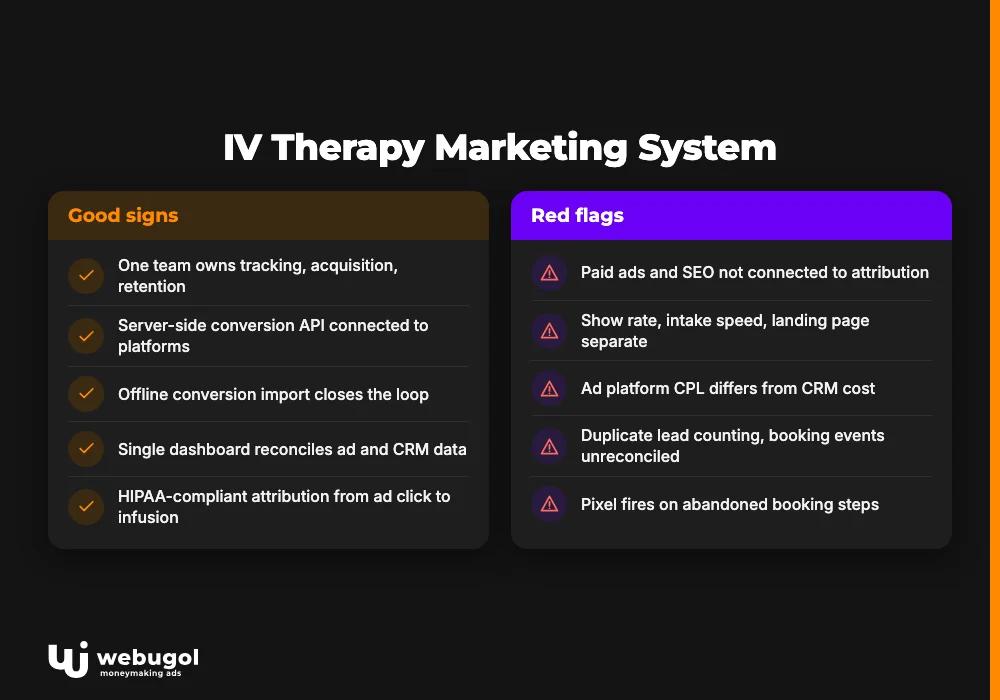
What a complete IV therapy marketing system looks like
Most clinics run paid ads and local SEO in parallel but have never connected them to a single attribution model. Show rate, intake speed, and landing page conversion live in separate dashboards, if they are tracked at all.
The result is that every component looks acceptable in isolation while cost per completed infusion is quietly poor. This fragmentation is the structural problem Webugol builds against: one team owns the handoffs between tracking, acquisition, and retention so the revenue path stays intact.
| Channel | Primary use | Cost profile |
|---|---|---|
| Google Search | In-market intent, high booking intent | Higher CPL, strong CPA for completed infusions |
| Local Services Ads | Map Pack visibility, trust signals | Lowest cost per booked appointment for fixed clinics |
| Meta (Facebook/Instagram) | Membership offers, retargeting | Lower CPL, higher no-show and intake friction |
Tracking from ad click to booked infusion
End-to-end HIPAA-compliant attribution connects ad click to CRM record to completed infusion through server-side events and offline conversion import. A standard pixel setup does not close this loop.
Broken attribution has a recognizable pattern. For example: the ad platform reports a $45 CPL, the CRM shows $180 cost per completed appointment, and no one can explain the gap. The most common causes are duplicate lead counting, booking-confirmed events that never reconcile against show or no-show status, and pixel fires on abandoned booking steps that platforms count as conversions.
Minimum viable tracking stack: server-side conversion API connected to both Google and Meta, offline conversion import that closes the loop when an appointment is completed in the CRM, and a single dashboard reconciling ad platform data with CRM records.
What marketing channels work best for IV therapy clinics?
Google Search and Local Services Ads capture in-market intent at the highest conversion rate. The Map Pack delivers the lowest cost per booked appointment for fixed-location clinics. Meta performs best for membership offers and retargeting, not cold single-session demand.
For clinics in competitive metro markets, geo-targeted iv therapy marketing campaigns with location-level ad groups, including builds targeting iv therapy marketing chicago searches, typically outperform broad metropolitan targeting by converting higher-intent proximity searches. The full SEO layer of this system is covered in the IV therapy SEO playbook for clinics and mobile operators.
Conversion-focused landing pages: what actually moves the needle
Three variables consistently lift booking rate: a protocol menu framed around outcomes rather than ingredient lists, a trust stack above the fold with credentials and a HIPAA compliance note, and a booking flow under three steps. Mobile-first is not optional for a service frequently booked on impulse.
What to remove from most existing pages: generic contact forms that delay booking, price-hidden menus that force a discovery call, and symptom copy that drifts into medical claims territory. These add friction the patient does not tolerate on a competitor's page.

What is a good cost per lead for IV therapy?
There is no universal benchmark for a good IV therapy CPL: Google Search CPL shifts with local competition, service mix, and offer structure, so the useful comparison is your own trend over time and what your session or membership economics can absorb. Meta runs lower CPL than Search, but with higher no-show and intake friction. The number that matters most is cost per completed infusion, which most clinics do not track because the booking confirmation pixel fires but the CRM never closes the loop.
Consider the math: a clinic with a reported $45 CPL and a 40% no-show rate has an effective cost per completed session that is nearly double the stated number. No bid adjustment fixes that. Reframing the CPL conversation around attribution integrity changes what you fix first.
Speed-to-lead: the hidden CPL multiplier
A lead contacted promptly after inquiry converts at a materially higher rate than one reached hours later. Most IV clinic intake runs on hourly or end-of-day follow-up. The practical effect is that ad spend generates leads, the leads go cold, and the channel gets blamed for poor quality.
The fix is CRM routing with an SMS trigger that fires on new lead creation: immediate text, assignment to an available team member, and a short follow-up sequence if no contact is made within 15 minutes.
Intake friction points that inflate CPL without showing up in ad platform data:
- New lead submissions enter a manual review queue before any follow-up
- No immediate SMS or call trigger fires on new lead creation
- Intake qualification questions filter leads before a booking conversation begins
- Phone routing sends calls to voicemail during peak inquiry hours
Show rate as a marketing metric, not an ops metric
No-show and cancellation rates directly inflate CPA. The same ad spend produces fewer completed infusions, yet most clinics assign show rate to operations and never connect it back to marketing budget decisions.
A pre-visit confirmation sequence sent 24 hours and 2 hours before the appointment, with a one-tap reschedule link rather than a cancellation link, moves show rate without adding staff time. Track it in the same dashboard as CPL: when show rate drops, effective CPL rises even if the ad account looks unchanged.
If your CPL is trending up and the ad platform looks clean, the problem is usually tracking, intake speed, or show rate. The Healthcare Growth System diagnostic starts there. Book a strategy call to find out where your funnel is leaking.

IV therapy retention marketing: the revenue you're leaving behind
Every patient who does not rebook is an acquisition cost that never fully paid out. A meaningful improvement in rebooking rate reduces the effective CPL from acquisition without changing the ad account, because the revenue per acquired patient increases. The complete analysis of patient retention economics, including the lifetime value calculations that make the retention investment case, is in the patient retention guide for clinic operators.
Rebooking sequences that run without you
A three-touch post-infusion automation recovers a predictable share of one-time patients. The sequence runs in GoHighLevel or ActiveCampaign: day 1 wellness check, day 7 rebooking prompt framed at the protocol level rather than referencing the specific infusion administered, day 21 protocol reminder if no booking has been made. Health-adjacent messaging requires explicit opt-in and cannot reference the specific service administered or imply a health condition in the follow-up.
Retention sequence timeline:
- Day 1: wellness check and soft engagement
- Day 7: rebooking prompt, protocol-level framing only
- Day 21: protocol reminder if no booking made
- Day 45: offer or value add with membership framing
- Win-back trigger: 90-plus days since last visit with no active booking
Win-back economics for lapsed patients
A patient who has not booked in 90 days costs less to re-engage than to replace with a paid acquisition lead. Lapsed patients respond to a simple reminder. Fully churned patients require an offer that reactivates without conditioning them to wait for discounts.
Offer framing that reactivates without discount-conditioning: a new protocol addition, a seasonal relevance hook, or a priority booking window framed as VIP access. Platform compliance guardrails apply regardless of channel: respect opt-in status, avoid referencing specific health conditions, and include a clear unsubscribe path.

How to scale IV therapy marketing without burning budget
The plateau pattern runs the same way across IV therapy clinics. Early campaigns work. Spend scales. CPL climbs. The channel gets blamed. The actual cause is a bottleneck in intake, show rate, or landing page conversion that scales proportionally with budget. More spend through a leaking funnel produces more leak.
The checklist before increasing spend
Five conditions must be true before adding budget:
- CPL trend is stable across at least three weeks, not a single strong week driven by one high-intent search cluster
- Show rate is at or above benchmark, tracked in the CRM and reconciled against completed infusions
- Intake response time is under five minutes for new leads arriving through paid channels
- Conversion tracking is verified end-to-end against CRM data, not just platform-reported events
- Landing page CVR is at or above the channel benchmark for paid health services
If any of these five are unverified, adding budget amplifies the problem rather than the results.
Multi-location and mobile IV: what changes in the playbook
A second clinic location or mobile service launch requires a restructured paid-media setup: separate Google Business Profile listings, geo-fenced campaigns with location-specific copy, and local landing pages with location-specific trust signals. Copying the first-location account structure is the most common mistake operators make, and it results in cannibalized impression share and attribution confusion.
The three errors that consistently appear at second-location launch: a single shared GBP listing that dilutes review signals, a single ad account with targeting set to "presence or interest" rather than "presence only," and landing pages that reference the first location's address in the trust stack.
How to evaluate an IV therapy marketing agency
Most iv therapy marketing agency evaluations focus on case studies and retainer pricing. Neither tells an owner whether the agency owns the outcome or just reports on activity. For clinics scaling ad spend significantly, being the integration layer between an ad agency, CRM vendor, and developer is expensive in both time and performance. The structural case for integrated ownership versus fragmented vendor management is covered in the in-house vs. agency marketing framework.
5 questions that reveal whether an agency owns the outcome
Ask these before signing with any agency:
- Who owns tracking setup and ongoing verification? If the agency cannot name a specific person and a verification cadence, tracking integrity erodes within 60-90 days of launch.
- Does the contract define CPL and CPA targets or only activity deliverables? Activity commitments mean the agency owns the campaign. Outcome commitments mean they own the result.
- Who is responsible if show rate drops post-launch? This reveals whether the agency sees itself as owning the revenue path or only the campaign layer.
- Does the agency run HIPAA-compliant infrastructure or use standard pixels? A standard pixel setup on a healthcare client is a compliance exposure, not a technical preference.
- What is the diagnostic process when CPL climbs after 60 days? An outcome-oriented answer covers funnel audit, intake speed, and show rate. An activity-oriented answer covers creative refresh and bid adjustments.
Build the system that fills your drip slots without discounting
Three fixes account for most of the gap between a half-full schedule and a consistent booking flow: compliant tracking that closes the attribution loop, an intake and confirmation sequence that cuts no-shows, and retention automation that makes the second booking predictable.
Webugol builds and operates the full acquisition system so you stop losing patients at the handoffs: between the ad and the intake, between the first visit and the rebook, between tracking data and budget decisions. The Healthcare Growth System runs as a 90-day sprint: tracking foundation and funnel audit in month one, conversion assets and campaign launch in month two, retention automation and scale in month three.
FAQ
How much does IV therapy marketing cost?
A realistic IV therapy marketing budget for a single clinic runs $3,000-$8,000 per month in ad spend, plus agency or management fees depending on scope. Total investment varies by market competitiveness, service mix, and whether tracking and landing pages need to be built from scratch.
What marketing channels work best for IV therapy clinics?
Google Search and Local Services Ads produce the highest-intent leads for fixed clinics; the Map Pack delivers the lowest cost per booking for local demand. Meta performs well for membership offers and retargeting site visitors who did not book, not for cold single-session demand.
How long does it take to see results from IV therapy marketing?
Tracking and funnel fixes typically surface quick wins in weeks one and two; meaningful CPL and booking-rate improvements appear in weeks three through six once conversion data is clean. Scaling with confidence requires six to twelve weeks of verified performance data before budget increases are justified.
Do I need a specialized IV therapy marketing agency, or can I handle it in-house?
An in-house marketer can manage paid campaigns, but HIPAA-compliant tracking setup, server-side conversion infrastructure, and CRM-to-ad-platform attribution require technical depth most in-house teams lack. The risk is not in the ad management itself; it is in the compliance and attribution layer that determines whether the data you are optimizing against is accurate.

