



Testosterone clinic marketing: strategies for TRT growth
Testosterone clinic marketing covers paid search ads, local SEO, Meta Ads, and website conversion strategy for practices offering testosterone replacement therapy. An effective program captures high-intent patients on Google, builds awareness through Meta, ranks in the local map pack, and converts site visitors into booked consultations. The channels work together under a single attribution system that tracks cost per enrolled patient.
How do you market a testosterone clinic?
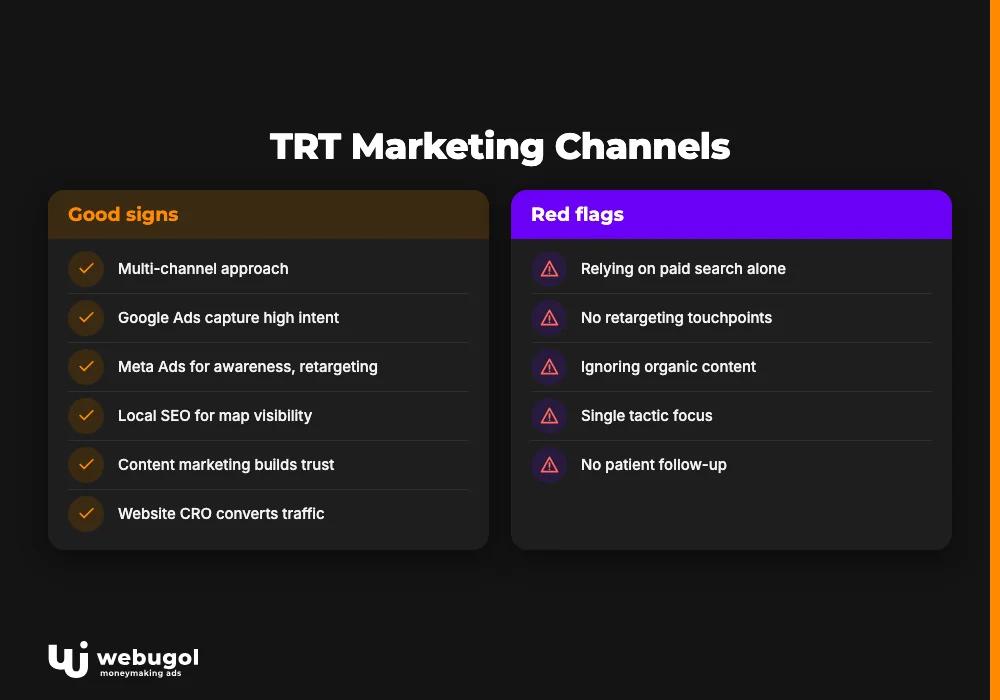
Successful testosterone clinic marketing runs multiple channels at once. No single tactic closes patients on its own. A new inquiry typically requires two to eight weeks and several touchpoints before a patient books.
The channels and what each one does:
| Channel | Primary function | Time to results |
|---|---|---|
| Google Ads (search) | Capture high-intent searches | Days to weeks |
| Meta Ads | Awareness and retargeting | 4-6 weeks to optimize |
| Local SEO | Map pack visibility | 3-6 months |
| Content marketing | Organic trust and rankings | 6-12 months |
| Website CRO | Convert existing traffic | Immediate |
Low t clinic marketing that relies on paid search alone leaves most of the market untouched. A prospect who sees a search ad but isn't ready to call needs a retargeting touchpoint or an organic content piece before booking. Multi-channel programs fill schedules faster.
What Google Ads policies apply to TRT advertising?
Google restricts testosterone therapy advertising as a sensitive healthcare category. Specific outcome claims and condition-based audience targeting are prohibited. The rules are strict. Campaigns that ignore them collect disapprovals and account strikes before a single lead arrives.
The compliance framework for Google Ads TRT campaigns:
- Ad copy: "Provider-supervised testosterone optimization" and "board-certified physicians" pass review. Hormone level claims and outcome guarantees do not.
- Landing page content: Treatment information and consultation offers are allowed. Clinical claims that cross Google's healthcare ad policies are not.
- Audience targeting: Demographic and behavioral signals pass. Condition-based targeting inferred from health status does not.
- LegitScript certification: Required for certain ad types. Campaigns that need it cannot launch until the certification is complete.
Building accounts correctly from the start avoids months-long delays that policy violations create. Our compliance-first PPC guide for TRT practices covers ad structure and bidding in detail.
Testosterone clinic marketing through paid search
Google Ads reaches patients at peak purchase intent. Someone searching "testosterone clinic near me" or "low T doctor [city]" has identified a problem and is actively comparing providers. That intent signal separates search advertising from every other paid channel.
Keyword strategy for TRT campaigns
Build campaigns around treatment-specific, location-modified terms rather than broad symptom searches:
- High intent: "TRT clinic [city]," "testosterone therapy near me," "low testosterone treatment [state]"
- Moderate intent: "testosterone replacement therapy," "low T treatment," "TRT consultation"
- Negative keywords: "what is TRT," "TRT side effects," "free testosterone testing" prevent informational queries from consuming budget
Phrase and exact match on a tightly managed list delivers qualified patients at a cost per click that supports positive return on ad spend. Broad match without aggressive negatives burns budget fast.
Ad copy and landing page alignment
Every testosterone clinic marketing campaign needs a dedicated landing page built for one action: booking a consultation. Sending traffic to a homepage loses a substantial share of clicks before a patient sees a provider credential.
Ad copy frameworks that consistently clear policy review:
- "Personalized testosterone protocols" instead of specific hormone level claims
- "Supervised by board-certified physicians" rather than before/after language
- Symptom-recognition headlines that mirror patient self-identification without making clinical claims
Call extensions, location extensions, and sitelinks to treatment pages improve conversion volume. See Google Ads best practices for healthcare for the full ad structure framework.
How do testosterone clinics attract more patients online?
Paid search captures patients who are already searching. Meta Ads reach patients who haven't started yet. Those two audiences don't overlap. Hormone therapy marketing that skips Meta leaves an entire acquisition segment empty.
Meta Ads for TRT awareness and retargeting
Meta Ads work the awareness and retargeting layers that Google Search doesn't reach. Patients in the consideration phase are reachable on Facebook and Instagram before they start comparing providers. That's the gap search ads can't fill.
Effective audience structures for Meta TRT campaigns:
- Demographic targeting: men 35 to 65, health-conscious behavioral signals, radius targeting around clinic locations
- Lookalike audiences: built from existing patient email lists, website visitors, and consultation form submitters
- Retargeting sequences: website visitors who didn't convert, video viewers at 50% completion or more, and patients who reached a booking page but didn't submit
Creative formats that perform in this category:
- Short provider videos (30 to 60 seconds) outperform static images by 2 to 4x for male health patient engagement, based on Webugol client campaign data
- Educational carousels covering symptoms and treatment overviews that inform without crossing policy lines
- Lifestyle imagery centered on energy and activity consistently outperforms clinical photography
Cold prospecting, warm nurturing, and direct-offer retargeting require different creative and different conversion benchmarks. Run all three layers at once.
What does TRT clinic SEO involve?
TRT clinic SEO covers two areas: local search visibility and organic content authority. Both compound over time. Neither delivers results in weeks.
Local SEO for the map pack
The map pack dominates local healthcare searches. Testosterone replacement therapy SEO that skips local optimization hands high-visibility placement to competitors. Key ranking factors:
- Google Business Profile: Complete GBP with accurate NAP, TRT-specific service categories, keyword-rich description, and regular photo updates. See how to optimize your healthcare Google Business Profile for the steps that move rankings.
- Citation consistency: Practice name, address, and phone number must match across Healthgrades, Zocdoc, RateMDs, and other healthcare directories.
- Review velocity: Consistent authentic patient reviews signal ongoing practice health to Google's local algorithm.
- Location pages: Multi-location practices need dedicated pages targeting each city and surrounding area.
The complete ranking methodology is in local SEO strategies for healthcare practices.
Hormone therapy marketing through content
Educational content creates a trust advantage that paid ads cannot replicate. Patients who find a clinic through a well-researched article before comparing providers are more likely to book with that clinic when they're ready to act.
High-performing content types for TRT practices:
- Symptom-focused guides that target the awareness stage and position the clinic as an educational authority
- Treatment comparison content for patients evaluating options
- Provider expertise articles and videos that build trust before the consultation
- FAQ pages that address pre-consultation questions and improve organic rankings
Website conversion and attribution
Traffic without conversion is wasted spend. The website is the primary conversion point for every testosterone clinic marketing channel, whether a patient arrives from paid search, organic, or referral.
High-converting TRT clinic sites share these characteristics:
- Provider credentials visible above the fold on every landing page
- A single primary call to action per page: phone number, booking form, or consultation request
- HIPAA-compliant intake forms with minimal fields and clear privacy language
- Mobile-first design: the majority of TRT patient searches happen on mobile
- Patient testimonials focused on the care experience rather than specific clinical outcomes
Complete attribution connects every channel to patient revenue: call tracking per campaign and keyword group, GA4 conversion events for every form submission and booking confirmation, and a cost-per-enrolled-patient dashboard. Most testosterone clinic marketing programs underperform not because the tactics fail but because the attribution doesn't connect spend to outcomes.
As a digital marketing agency, Webugol builds attribution before spending a dollar on advertising. Every program runs against patient revenue metrics, not impressions.
Webugol's men's health marketing practice works with testosterone clinics across competitive markets and understands what the full acquisition system requires.
Start your testosterone clinic marketing program
Ready to build a patient acquisition system that connects every channel to enrolled patients? Contact Webugol to discuss your practice goals and get a custom acquisition plan.
FAQ
How do you market a testosterone clinic effectively?
Testosterone clinic marketing works best as a multi-channel system: Google Ads for high-intent search, Meta Ads for awareness and retargeting, local SEO for map pack placement, and content marketing for organic trust building. Running all channels under a single attribution system lets you allocate budget based on what actually produces enrolled patients.
What Google Ads policies apply to TRT advertising?
Google classifies testosterone therapy as a restricted healthcare category. Specific outcome claims, before/after imagery, and condition-based audience targeting are prohibited. Compliant campaigns use copy frameworks like "provider-supervised protocols" and "board-certified physicians," require appropriate landing pages, and in some cases need LegitScript certification before certain ad types can launch.
How much does Google Ads cost for a testosterone clinic?
Costs depend on local competition, keyword bids, and Quality Score. Practices in major metro markets pay more per click than those in less contested areas. A properly structured testosterone clinic marketing campaign tracks cost per consultation and cost per enrolled patient rather than cost per click to determine whether spend is delivering return.
What does TRT clinic SEO involve?
TRT clinic SEO covers Google Business Profile optimization with TRT-specific categories, citation building across healthcare directories, consistent review acquisition, location-specific service pages, and educational content targeting city-specific keywords. Local SEO determines map pack placement; organic content builds long-term patient trust. Results typically appear over three to six months.
Why does a testosterone clinic need a specialized marketing agency?
Testosterone therapy sits in a restricted category on both Google and Meta. Campaigns require compliant copy frameworks, appropriate landing pages, and sometimes LegitScript certification. An agency without TRT-specific experience runs into repeated disapprovals and account strikes that delay results and cost the practice in lost patient revenue.