



Hormone clinic marketing: how to build a patient acquisition system
Hormone clinic marketing is the coordinated set of strategies a practice uses to attract new patients, convert them into booked consultations, and retain them over time. It covers paid advertising, SEO, content, website performance, and email automation working together as a single system. The global hormone replacement therapy market is on track to exceed $28 billion by 2027, according to industry projections, and that growth brings real competitive pressure: telehealth startups, national medspa chains, and primary care networks are all targeting the same patients your clinic depends on. A clinic without a deliberate HRT marketing strategy doesn't lose slowly. It loses to whoever has one.
Why hormone clinic marketing differs from general healthcare advertising
Most healthcare marketing advice assumes urgent care patterns: a patient needs something today, they search, they call, they show up. Hormone therapy doesn't work that way.
A prospective patient discovering possible low testosterone or perimenopause symptoms might spend weeks reading, comparing providers, and watching clinic introduction videos before booking anything. Pushing aggressive "schedule now" prompts early in that process doesn't accelerate decisions. It sends patients to a competitor who took the time to earn trust first.
The second difference is regulatory complexity. Both Google and Meta restrict testimonial-style claims, before/after imagery, and condition-specific audience targeting for testosterone therapy, estrogen replacement, and hormone optimization campaigns. Accounts built without those policies as a starting constraint see ad disapprovals within hours of launching, not after weeks of testing.
The third difference is Google's content quality bar. Hormone therapy falls into Google's most scrutinized content category, where every page is evaluated not just for keyword relevance but for demonstrable medical authority. Content without physician credentials simply doesn't compete here.
How do you market a hormone therapy clinic?
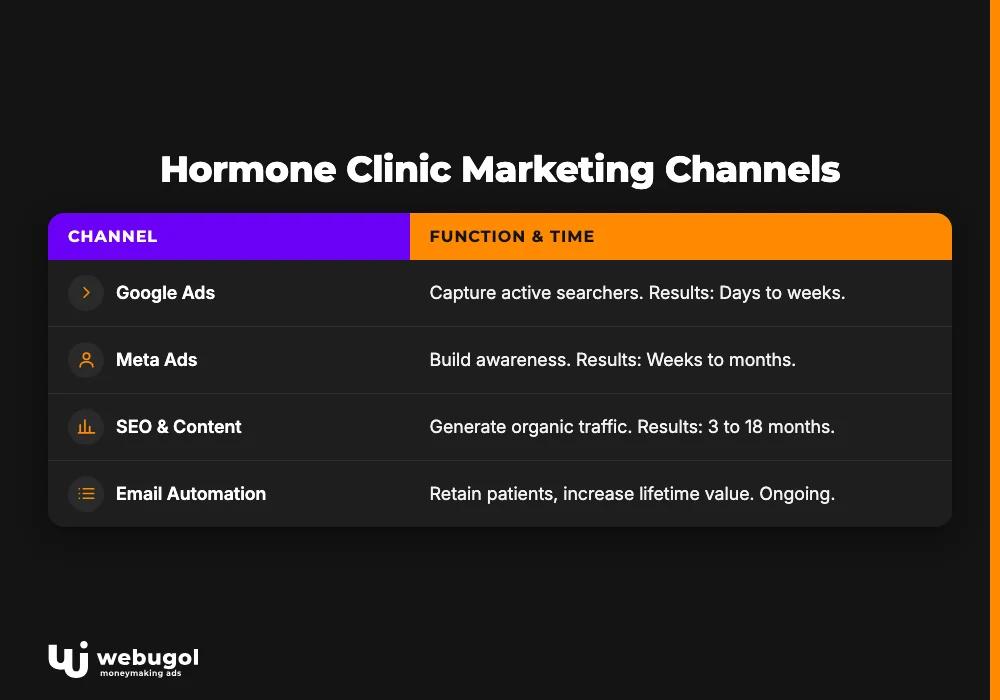
Effective hormone clinic marketing runs four channels in parallel, each reinforcing the others.
| Channel | Primary function | Time to results |
|---|---|---|
| Google Ads | Capture patients actively searching for treatment | Days to weeks |
| Meta Ads | Build awareness before the search begins | Weeks to months |
| SEO and content | Generate compounding organic traffic | 3 to 18 months |
| Email automation | Retain patients and increase lifetime value | Ongoing |
No single channel covers the full patient journey. Paid search captures intent but stops when spending stops. SEO compounds over time but takes months to build traction. Meta Ads reaches patients who haven't started searching yet.
Email keeps retained patients active and returning for protocol adjustments and follow-up consultations. Practices consistently filling appointment calendars run all four channels, with unified attribution that tracks what actually produces bookings rather than guessing.
What advertising platforms work for HRT clinics?
Google Ads for hormone clinics
Search advertising captures patients at peak intent. Someone searching "hormone therapy clinic near me" or "low testosterone treatment [city]" is already problem-aware and provider-shopping. Google Ads is the fastest channel in any testosterone clinic marketing or HRT marketing strategy for generating consistent new patient flow.
What separates effective campaigns from wasted spend:
- Treatment-specific, location-modified keywords convert. Broad match targeting pulls irrelevant clicks at high cost.
- Compliant copy phrases like "provider-supervised" and "clinically guided" work. Guaranteed outcomes do not.
- Every campaign needs a dedicated landing page built for one action: booking a consultation. Sending traffic to the homepage converts poorly.
- Healthcare ad certification applies to certain hormone therapy ad categories. Build this requirement in before launch, not after a disapproval.
Meta Ads for hormone clinics
Meta Ads work the upper funnel, reaching patients who match your profile but haven't started actively searching yet. Short provider introduction videos and patient education clips consistently drive 2 to 4x better engagement than static images in this category, based on campaign performance data from hormone therapy advertisers.
Retargeting sequences are essential in medspa digital marketing. Patients in a sensitive health category rarely convert on first contact. Retargeting with educational content and provider stories builds trust across multiple touchpoints before a consultation request arrives. Lookalike audiences built from your existing patient list extend that reach to your highest-probability new prospects.
How do ad restrictions affect hormone therapy campaigns?
Both Google and Meta restrict medical claims, before/after imagery, and certain audience targeting for hormone therapy ads. Clinics that partner with a team experienced in healthcare clinic advertising sidestep this problem entirely. Pre-approved campaign structures, compliant copy frameworks, and LegitScript certification where required mean campaigns go live correctly the first time. That is the difference between reaching patients this month and spending weeks in appeals while a competitor captures every relevant search.
How does Google evaluate hormone therapy content?
Google applies its highest scrutiny to "Your Money or Your Life" content, and hormone therapy qualifies. Every article, service page, and FAQ on a clinic website is evaluated for demonstrable medical authority, not just keyword relevance.
Content that lacks physician credentials, skips clinical citations, or reads like repurposed marketing copy does not compete against specialized practices that have built genuine expertise into their digital presence. What ranks here is physician-reviewed writing with verifiable author bios, peer-referenced sourcing, and a site architecture that signals an operating healthcare practice.
Technical requirements carry equal weight:
- Physician-authored or physician-reviewed content with credentials displayed on every article.
- Medical schema markup covering MedicalOrganization, MedicalClinic, Physician profiles, and FAQPage.
- Core Web Vitals compliance: sub-3-second load times on mobile. Over 60% of healthcare searches happen on mobile, making mobile-first performance non-negotiable.
- HTTPS across the entire site, including booking systems and intake forms.
For a deeper look at how organic search rewards medical authority over time, the wellness SEO guide for long-term search visibility is worth reading before building a content plan.
Local SEO for hormone clinics
Hormone therapy is a local business. Patients search by city, sometimes by neighborhood. Ranking in the local map pack requires a fully optimized Google Business Profile, consistent citations across healthcare directories, and location-specific content on your website.
Wellness clinic SEO priorities that move rankings:
- Complete every Google Business Profile field: services, attributes, description, Q&A, and regular posts. The most complete, most active profiles rank above the most-reviewed ones.
- Review velocity matters: top local clinics run systematic post-appointment review requests via SMS or email, because volume and recency both affect ranking position.
- Location pages: each city or service area needs a substantive, unique page. A template with only the city name swapped out doesn't rank and doesn't convert.
The local search ranking fundamentals for hormone practices covers the full citation and Google Business Profile process in detail.
What is the best way to attract new patients to a wellness clinic?
Medical spa patient acquisition depends on matching the right message to the right stage of the decision process. Most hormone therapy patients begin their journey with symptom searches, not clinic searches. They type queries like "signs of low estrogen in women over 40" or "low testosterone symptoms in men" long before they are ready to book.
Educational content answering those early questions builds trust and positions your clinic as the authority before a patient is ready to consult. Each piece should link to your service pages and include a consultation CTA. This is the content foundation of any effective hormone clinic marketing strategy, and it is where most clinics underinvest relative to the return it generates.
Your website is where every channel sends patients. If it doesn't convert, every upstream investment loses value. High-converting hormone clinic websites share these attributes:
- Clinical credibility on first glance: clean layout, professional photography, and provider credentials visible without scrolling.
- Treatment-specific pages with descriptions, provider bios, expected outcomes, and a single clear CTA per page.
- HIPAA-compliant forms and booking that patients in a sensitive health category feel safe using.
- Pages that load in under 3 seconds on mobile, or the majority of visitors leave before reading begins.
Custom web design ensures the site performs in both search and conversion, not just visually.
Patient retention as a revenue driver
Hormone therapy is an ongoing relationship, not a one-time visit. Quarterly labs, protocol adjustments, and follow-up consultations make each retained patient worth significantly more than the initial acquisition cost. Most clinics invest heavily in acquisition and almost nothing in retention.
Email automation for ongoing hormone therapy care closes that gap through post-consultation education sequences, lab reminder workflows, and re-engagement campaigns for patients inactive for six or more months. The investment is small relative to what it recovers in patient lifetime value.
Analytics and attribution for hormone clinic marketing
Clinics investing in multiple channels often reach a point where traffic looks healthy and leads are arriving, but budget decisions still come down to intuition rather than data. That gap costs real money every month.
A proper analytics setup requires:
- GA4 with full event tracking: form submissions, phone calls, booking completions, and consultation requests tracked as conversions, not just page views.
- Call tracking: hormone therapy patients frequently call rather than fill out forms, and attribution breaks without call data tied to the traffic source.
- Cross-channel attribution: understanding which combination of touchpoints produces booked consultations, not just traffic.
- Looker Studio dashboards showing real-time cost per lead, cost per consultation, and patient acquisition cost by channel.
At Webugol, the analytics infrastructure is built before the first ad goes live. Every dollar of spend is accountable from day one. Our advanced analytics approach reports on patient revenue, not impressions, which is what makes it possible to scale the channels that actually produce consultations.
Ready to build your hormone clinic marketing system?
A full hormone clinic marketing program covers paid search, social advertising, SEO, website performance, and patient retention in one coordinated system. Contact Webugol to start building a patient acquisition system that reports on real results.
FAQ
What is hormone clinic marketing?
Hormone clinic marketing is the full set of strategies a practice uses to attract, convert, and retain patients for estrogen replacement, testosterone optimization, thyroid support, and related programs. It covers paid advertising, SEO, content, web design, email automation, and analytics working together as a coordinated system.
How much does hormone therapy clinic marketing cost?
Most established clinics invest between $10,000 and $30,000 per month, covering ad spend and agency management. The right budget is driven by patient lifetime value and target acquisition cost, both of which require proper tracking to calculate accurately.
Which marketing channels work best for hormone clinics?
Google Ads captures patients actively searching for treatment. SEO builds organic visibility that compounds over time. Meta Ads reaches qualified audiences earlier in the decision process. Email marketing retains patients and increases their lifetime value. The strongest programs run all four channels with unified attribution.
Can hormone clinics run ads on Google and Meta?
Yes, with restrictions. Both platforms limit medical claims, before/after imagery, and certain audience targeting in the healthcare category. Google may require LegitScript certification for specific services. Working with an agency familiar with these policies prevents account suspensions and ensures campaigns stay live.
How long before SEO produces results for a hormone clinic?
Most clinics see measurable organic traffic growth within 3 to 6 months. A clinic 18 months into a consistent SEO program typically has 3 to 5 times the organic traffic of one that just started, at a fraction of the cost per patient compared to paid advertising alone.

