



Testosterone clinic ads: a compliance-first PPC guide for TRT practices
Testosterone clinic ads run on Google and Meta as restricted healthcare campaigns requiring compliant copy, appropriate landing pages, and in some cases LegitScript certification before going live. Both platforms prohibit outcome claims, before/after imagery, and condition-based audience targeting for hormone therapy advertising. Practices that fill their TRT schedules through paid search use a compliance-first framework that satisfies platform policies and converts high-intent patients at a predictable cost per consultation.
For broader context on how paid media programs are structured across medical verticals, see how advertising for healthcare campaigns are built.

Why testosterone clinic ads need a specialized approach
Testosterone therapy advertising operates at the intersection of healthcare compliance, male patient psychology, and platform policy. Treating TRT clinic marketing like standard healthcare PPC produces campaigns that fail approval, get suspended, or attract clicks that don't convert at a return worth scaling.
The male patient decision cycle adds complexity. Men evaluating TRT typically research symptoms for weeks before acknowledging a clinical cause, then spend additional time comparing providers before booking. Effective TRT ad campaigns match format and message to each stage of that research process.
Platform restrictions at a glance
| Platform | Category status | Key restrictions |
|---|---|---|
| Google Ads | Restricted healthcare | Outcome guarantees, unqualified medical claims |
| Meta Ads | Special ad category | Condition-based targeting, before/after imagery |
| Both | Copy-level enforcement | Specific result claims, guarantee language |
Knowing which words get Google medical ads disapproved before writing a single headline prevents the account strikes that can set a new TRT campaign launch back by weeks.
Can you run Google Ads for testosterone therapy?
Yes. Testosterone therapy falls under Google's restricted healthcare category, and campaigns can run with the right setup: compliant copy, appropriate landing page content, and LegitScript certification where required. Medical Google Ads for TRT clinics that skip these requirements encounter automated disapprovals and policy strikes that delay results.
Google Search remains the highest-intent channel for TRT clinic marketing. Patients actively searching for testosterone clinics have already moved past early-stage research and are evaluating specific providers, which is where Google Ads investment produces the most direct return in new patient consultations.
What keywords should testosterone clinics target in paid search?
The keyword strategy for TRT Google Ads separates consultation-intent traffic from informational queries that consume budget without producing appointments.
High-intent keywords to target:
- Target "testosterone clinic [city]," "TRT clinic near me," and "low T treatment [state]" for location-based consultation intent.
- Include "board-certified TRT physician" and "testosterone doctor near me" for provider comparison searches.
- Add treatment-specific terms such as "testosterone pellet therapy" and "testosterone injections near me."
Negative keywords to exclude (required):
- Block "what is testosterone," "normal testosterone levels," and "testosterone side effects" to filter informational intent.
- Exclude "free testosterone test" and all non-commercial research queries that will never produce a consultation.
A disciplined negative keyword list matters as much as positive keyword selection. Without it, TRT ads spend budget against queries that produce research traffic, not patients.
How do you get testosterone ads approved on Google?
Compliant ad copy avoids specific outcome claims, before/after language, and guarantee-based messaging. Headlines that consistently pass review combine symptom recognition ("Low energy? Decreased drive?"), provider credibility ("Board-certified physicians," "Provider-supervised protocols"), and access-focused CTAs ("New patient consultations available," "Same-week appointments"). All call extensions, location extensions, and sitelinks should point to specific treatment pages rather than the clinic homepage.
What are Meta Ads policies for TRT clinics?
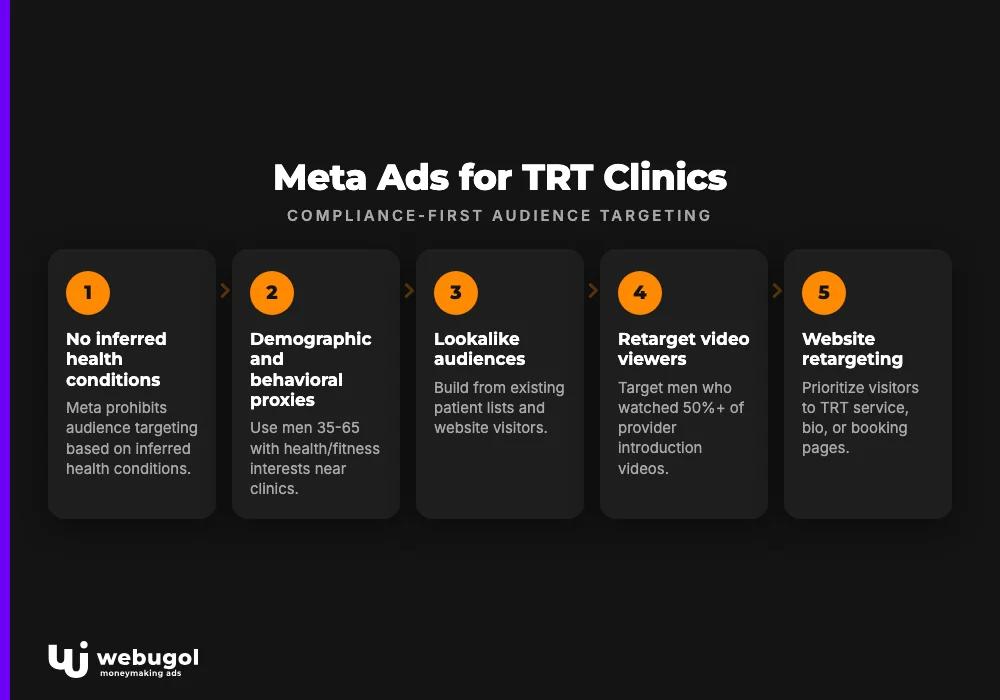
Meta prohibits audience targeting based on inferred health conditions, which means TRT campaigns on the platform cannot use condition-based segments. Compliant meta ads healthcare programs use demographic and behavioral proxies instead: men 35 to 65 with health and fitness interest signals, within a defined radius of each clinic location.
Healthcare practices running Meta Ads reach male patients before they start searching, providing the awareness and retargeting layers that separate consistently booked practices from those dependent on search volume alone. For context on how social channels work alongside paid search in medical marketing, see the role of social media in healthcare marketing.
Audience segments that work within Meta policy:
- Build lookalike audiences from existing patient email lists and from website visitors who spent meaningful time on treatment pages.
- Retarget men who watched 50% or more of a provider introduction video, since these audiences convert at higher rates than cold prospecting.
- Prioritize website retargeting for visitors to the TRT service page, provider bio, or booking page who haven't yet converted.
Creative formats that perform for hormone therapy advertising:
- Short provider introduction videos (30 to 60 seconds, physician speaking directly to camera) outperform static images by 2 to 4x for this category, based on Webugol's managed account data.
- Educational carousels covering symptom overviews, treatment comparisons, and common questions keep prospective patients engaged longer before they're ready to book.
- Lifestyle imagery showing men in their 40s and 50s active in daily life outperforms clinical or procedural imagery for this demographic.
How much does it cost to advertise a TRT clinic on Google?
Testosterone clinic ads in competitive metro markets typically require $5,000 to $12,000 per month in Google Search spend to generate meaningful consultation volume, based on Webugol's managed account benchmarks. Patient lifetime value for TRT, commonly $3,000 to $8,000 in the first year of treatment, makes this investment straightforward to justify against a defined cost-per-acquisition target.
A practical budget split for most TRT practices:
- Allocate 60 to 70% of total paid budget to Google Search, where patients are actively seeking TRT providers.
- Direct 25 to 30% to Meta Ads for awareness and retargeting audiences at the consideration and decision stages.
- Reserve 5 to 10% for display or YouTube if provider brand awareness is a secondary objective.
Start with manual CPC or target impression share while campaigns accumulate conversion data. Google's Smart Bidding algorithms improve materially once an account reaches 30 or more conversions per month. Local Services Ads for healthcare can complement search campaigns and reduce cost per lead in certain markets.
Landing pages for testosterone clinic ads
TRT ads pointing to the clinic homepage convert at a fraction of the rate of ads linked to a purpose-built page. Every ad group needs its own landing page optimized for a single conversion action.
High-converting TRT landing pages share these elements:
- Single above-fold CTA: Place the phone number, booking form, or both where patients can see them without scrolling.
- Provider credentials front and center: Display board certification, years of experience, and clinic accreditation within the first screen.
- Short HIPAA-compliant intake form: Collect name, phone, and preferred contact time. Every additional field reduces conversion rate.
- Headline consistency: Mirror the search query or ad copy that brought the patient to the page. Disconnect between ad message and landing page headline increases bounce rate and lowers quality score.
- No exit navigation: Dedicated landing pages perform materially better without full site navigation, since every outbound link is a potential consultation lost.
Webugol's web design team builds TRT landing pages with healthcare PPC compliance requirements built in from the start.
Attribution and tracking for TRT clinic marketing
Most TRT advertising underperforms not because campaigns don't work but because attribution is broken. Without proper tracking, budget decisions rely on incomplete data, and campaigns that appear to underperform may be driving phone calls that never connect to their source ad or keyword.
A complete attribution setup requires four components:
- GA4 conversion tracking on every form submission, call button click, and booking confirmation, recorded as conversion events rather than page views.
- Call tracking with unique numbers assigned per campaign and ad group, so phone consultations map directly to source keywords.
- Cross-channel attribution connecting the first Meta impression to the final Google search click for each booked consultation.
- Real-time dashboards tracking cost per lead, cost per consultation, and cost per enrolled patient through advanced analytics.
Webugol builds tracking infrastructure before any ad spend is committed. Every campaign is held accountable to patient revenue outcomes, not impressions.
Get testosterone clinic ads that fill your schedule
Our team builds TRT paid media campaigns on a compliance-first framework: compliant copy, approved landing pages, and full attribution configured before a single dollar of spend is committed. For a fuller look at how TRT practices approach broader digital strategy, see our guide to marketing for testosterone clinics.
Contact Webugol to discuss your testosterone clinic ads strategy.
Frequently asked questions
What makes testosterone clinic ads different from other healthcare ads?
Testosterone therapy is a restricted category on both Google and Meta, requiring compliant copy, appropriate landing pages, and in some cases LegitScript certification. Without healthcare PPC compliance expertise, accounts encounter repeated disapprovals and policy strikes that delay results and risk suspension.
How long before testosterone clinic ads produce results?
Google Search campaigns targeting treatment-specific, location-modified keywords typically produce patient inquiries within the first two weeks when landing pages are configured correctly. Meta Ads take four to six weeks to exit the learning phase, and full attribution clarity across all channels typically requires 60 to 90 days of campaign data.
What ad formats work best for TRT clinic marketing?
On Google, text search ads targeting high-intent local keywords consistently produce the strongest consultation volume. On Meta, short provider video content outperforms static images by 2 to 4x for this demographic, based on Webugol's managed account data. Retargeting warm audiences with direct consultation offers converts at lower cost per lead than cold prospecting.
Do testosterone clinic ads require LegitScript certification?
Some hormone therapy advertising categories require LegitScript certification through Google's Healthcare and Medicines program. The specific requirement depends on the treatments advertised, claims made, and ad formats used. A healthcare advertising specialist assesses certification requirements before campaign launch to avoid approval issues after campaigns are built.