



How longevity clinic SEO drives rankings and new patient growth
Longevity clinic SEO is the practice of optimizing a preventive health or longevity medicine website to rank in Google for the specific terms prospective patients use when researching biomarker testing, hormone optimization, or healthy aging programs. Done well, it generates a consistent stream of new patient inquiries without ongoing ad spend. Done generically, it disappears among thousands of near-identical wellness websites. This guide covers the strategies that move rankings and patient volume for longevity and preventive health practices, from keyword mapping and dedicated service pages to local signals and technical foundations.
What makes SEO for longevity clinics different from general healthcare SEO?
Longevity clinic SEO is structurally different from general healthcare SEO because the patient research journey is longer, more specific, and more comparison-heavy. A patient booking urgent care does a quick search and calls the nearest option. A patient considering a longevity membership, peptide protocol, or comprehensive biomarker panel spends weeks comparing clinics, reading clinical explanations, and evaluating credentials before making contact.
That difference has two practical consequences for any healthcare SEO strategy. First, a longevity practice needs a wider set of specific, high-intent search terms. A single "Services" page cannot rank for the dozens of distinct searches a prospective patient runs across a months-long research journey. Second, the content has to demonstrate real clinical expertise. Patients who have spent time researching longevity protocols recognize vague or unattributed content, and so do search engines under current health-content quality standards.
General healthcare SEO built for family practice or urgent care does not address either of those needs. Longevity medicine marketing requires its own approach: a keyword map that spans the full research journey, a dedicated page for each protocol, and content grounded in actual clinical knowledge rather than generic wellness messaging.
What keywords do longevity medicine patients search for?
Patients researching longevity care search across three distinct intent layers. A complete biomarker clinic content strategy maps keywords to all three rather than concentrating only on bottom-funnel terms closest to conversion.
| Intent layer | Example searches | Best content type |
|---|---|---|
| Awareness | what is biomarker testing, healthy aging programs, preventive health screening | Educational blog posts and guides |
| Comparison | longevity clinic vs primary care, best longevity clinic near me | Service pages, comparison content |
| High intent | hormone optimization clinic [city], NAD+ therapy near me, longevity membership program | Service pages, local landing pages |
Effective keyword research for healthcare starts with the specific language patients actually use: exact biomarker names, peptide names, and protocol names alongside broader phrases like preventive health screening or healthy aging clinic. Practices that only target their own brand name miss the much larger pool of patients who do not yet know which clinic to choose.
One structural risk to identify early: when multiple pages on the same site target the same search intent with overlapping language, search engines cannot determine which page should rank for a given query. This problem, keyword cannibalization, costs ranking positions before a practice even realizes it is happening. Assigning one primary keyword per page, grounded in a complete keyword map, prevents it.
Supporting terms like "longevity medicine marketing" and "preventive health website ranking" belong in the keyword map as well. These phrases reflect how prospective patients describe what they are looking for once they move past general awareness into active clinic comparison.
On-page SEO for longevity medicine websites
Dedicated service pages, not one catch-all page
Each core protocol or program needs its own page. A dedicated page for hormone optimization, a separate page for biomarker testing, and a separate page for a longevity membership program each have a real chance to rank for their own specific searches.
A single page trying to cover every treatment competes against itself and rarely ranks well for any individual protocol. This is where longevity clinic SEO diverges most sharply from what many practices do by default. Consolidating everything under one "Services" page keeps the site simple to maintain but limits organic search traffic to whatever that one page can win, which is typically very little.
Clinician-authored content builds trust and rankings
Longevity treatments are still unfamiliar to many prospective patients. Content needs to do real educational work: explaining what a protocol involves, what results are realistic, and how it differs from standard primary care. Content written or reviewed by an actual clinician aligns with what search engines reward under current health-content quality standards, which is a meaningful ranking advantage over generic, unattributed copy.
Preventive health website ranking depends on this more than most practices realize. Search engines evaluate health content against expertise, authoritativeness, and trustworthiness criteria. A clinician byline, accurate treatment explanations, and properly sourced claims signal exactly what those criteria reward. Generic wellness copy without clinical attribution does not.
Keyword placement that reads naturally
Primary keywords belong in the page title, H1, first paragraph, and two to three subheadings. Beyond that, the goal is regular, natural recurrence throughout the body. Search engines reward relevant keyword presence across a page and penalize mechanical repetition, so the standard is keywords that fit into sentences naturally, not keywords inserted at fixed intervals regardless of context.
What schema markup should a longevity clinic use on its website?
Longevity clinics should implement at minimum three types of structured data: MedicalBusiness or Physician schema for the practice itself, FAQPage schema for question-and-answer sections, and Service schema for individual treatment pages. These tell search engines what a page offers in a structured format that supplements on-page text.
MedicalBusiness schema communicates the practice name, address, phone number, hours, and specialties in a format search engines can read directly without parsing prose. This improves how the practice appears in knowledge panels and local search features. Physician schema works similarly for individual clinician profiles, reinforcing the medical clinic online visibility signals that come from well-structured content.
FAQPage schema on service or treatment pages can produce expanded results in Google that display the question and answer directly in search results, increasing click-through rates without any change in ranking position. For a longevity clinic answering common questions about treatment protocols, expected outcomes, and pricing, this schema type has practical value beyond technical compliance.
Adding Service schema to each dedicated protocol page reinforces the structural work done through keyword mapping and page architecture. The combination of correct structured data and well-built on-page content strengthens longevity clinic SEO across standard results, map pack features, and AI-generated answer surfaces.
How does local SEO help a longevity clinic attract new patients?
Local SEO places a longevity clinic in map pack results and Google Business Profile features when prospective patients search for clinics by location. For most practices, local search drives a significant share of new patient inquiries, even for clinics that also attract patients willing to travel from other cities.
An accurate, fully completed Google Business Profile is the foundation. Practice name, address, phone number, hours, and specialty category need to match exactly across all directory listings. Inconsistencies in that information undermine the signals local search rankings depend on, and they appear more often on longevity clinic websites than they should. The local SEO fundamentals for healthcare websites that apply to any medical practice apply equally here: category selection, review management, and consistent directory presence all affect local search placement.
Location-specific pages on the clinic website reinforce local signals further. A practice with multiple locations needs a dedicated page for each one rather than a single contact page listing all addresses. For a single-location practice, making the city and neighborhood visible in on-page content and metadata strengthens the local SEO medical practice signal without requiring additional pages.
Even for clinics whose patient base spans multiple states or includes patients who travel specifically for their programs, local SEO still matters. Those prospective patients often begin their research with a location-based query before widening their comparison to clinics farther away.
Technical SEO: what longevity clinic websites often get wrong
Fast page load times, mobile-friendly design, and a clean site structure are foundational to longevity clinic SEO, but they are where many practice websites quietly lose rankings. The medical clinic online visibility built through strong content and keyword strategy depends on the technical foundation working correctly underneath it.
The most common technical problems that appear in longevity clinic website audits:
- Page speed failures slow the experience for patients researching on mobile devices, who represent the majority of health-related searches. Large uncompressed images and unused third-party scripts are the most common causes and among the fastest to fix.
- Poor mobile rendering means a site that works well on desktop performs badly on the screen most prospective patients actually use. Mobile experience is a direct ranking input, not only a user experience concern.
- Crawlability problems prevent search engines from accessing and indexing pages correctly. Misconfigured robots.txt files, redirect chains, and broken internal links all create crawling failures that content quality alone cannot compensate for.
- Core Web Vitals failures place a ceiling on ranking potential regardless of content quality, because Google uses loading speed, layout stability, and interactivity as ranking inputs. Pages that fail these benchmarks face limits that stronger writing cannot overcome.
Fixing technical problems typically moves rankings faster than adding new content. Existing content that was already well-written can finally be discovered and evaluated correctly once the technical barriers are cleared.
Building a longevity clinic SEO strategy step by step
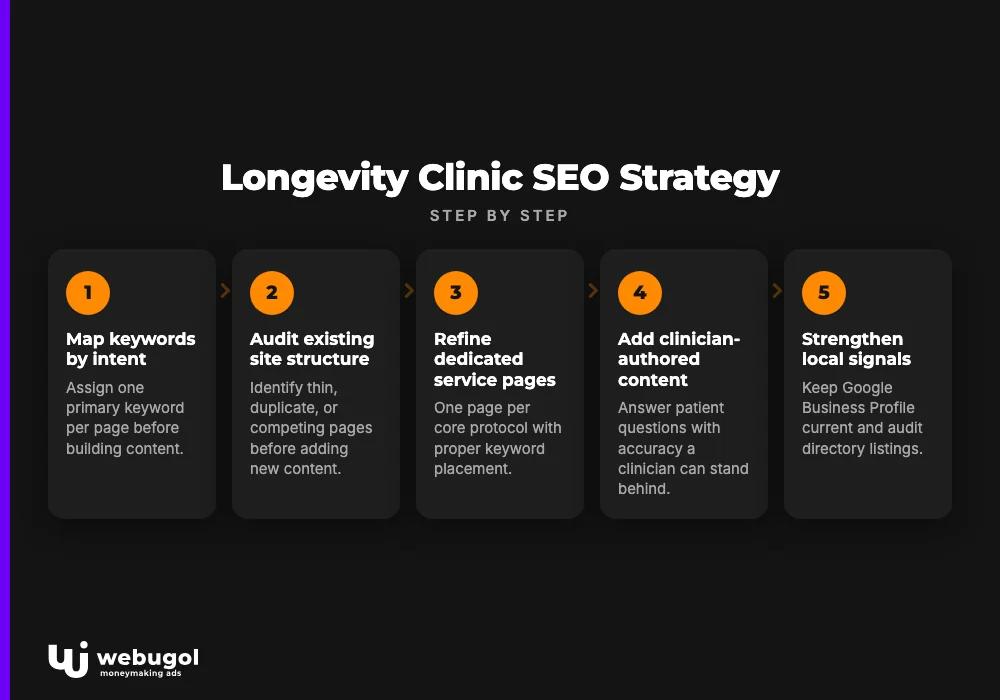
A complete longevity clinic SEO program follows a consistent sequence. Jumping to content production before the structural work is done produces results that stall quickly.
- Map keywords by intent. Separate high-intent treatment searches from broader awareness terms. Assign one primary keyword per page before building or editing any content.
- Audit the existing site structure. Identify thin, duplicate, or competing pages before adding new content. Fixing what is already there often produces faster gains than publishing new pages.
- Build or refine dedicated service pages. One page per core protocol, with proper keyword placement, schema markup, and internal links to supporting blog content.
- Add clinician-authored educational content. Answer the real questions patients search for across the research journey, with accuracy a clinician can stand behind.
- Strengthen local signals. Keep the Google Business Profile current and accurate. Audit directory listings for inconsistencies in name, address, and phone number across every major directory.
- Fix technical foundations. Address page speed, mobile experience, and crawlability before layering on more content.
- Track rankings and organic traffic monthly. Reinvest in what is working and fix what is not. Clean analytics and attribution connect organic traffic to actual booked consultations, which is the only measurement that matters.
Common mistakes longevity practices make with SEO
A few recurring gaps appear in almost every longevity clinic SEO audit:
- A single page covers every treatment instead of dedicated pages that let each protocol compete independently for its own searches. This is the most common structural problem and the one with the clearest fix.
- SEO is treated as a one-time project rather than an ongoing program. Rankings built on an initial push stall and erode without continued content development and technical maintenance.
- Content lacks clinical attribution and reads as generic wellness copy. This type of content does not build topical authority and does not meet health-content quality standards that now govern rankings for medical topics.
- Technical fundamentals go unaddressed. Slow load times and poor mobile experience create a ranking ceiling that strong content alone cannot break through.
- Local signals are incomplete. An outdated Google Business Profile or inconsistent directory listings undercut otherwise solid rankings, particularly for the local patient acquisition that most longevity practices depend on.
Fixing two or three of these gaps typically improves organic performance faster than adding an entirely new marketing channel.
How long does it take a longevity clinic to rank on Google?
Most longevity clinics see meaningful ranking improvements within three to six months of implementing a consistent longevity clinic SEO program, with compounding growth continuing well beyond that as content authority and referring domains build over time. The timeline depends on starting conditions: a newer domain with few existing indexed pages may take longer to rank for competitive terms than a site with an established content base.
High-intent, lower-competition searches, such as specific protocol names or city-plus-specialty combinations, often begin ranking within the first three months. Broader longevity medicine terms with more established competition typically take six to twelve months to reach the first page. Preventive health website ranking does not produce quick results, but the growth compounds in a way that paid advertising cannot replicate. Each piece of content and each link acquired builds on what came before, creating a return that grows as the program continues.
How Webugol delivers longevity clinic SEO
At Webugol, we have built longevity clinic SEO programs for preventive health and wellness practices including Valhalla Vitality, Your Slim Specialist, and LodyHealth. Each engagement follows the same structure described in this guide: keyword mapping by intent, dedicated service pages, clinician-informed content, schema implementation, and technical and local SEO foundations handled correctly from the start.
This work sits inside a broader health and wellness SEO practice built around measurable growth tied to patient inquiries. If why SEO matters for health and wellness businesses is still an open question for your practice, that piece covers the foundational case.
Ready to grow your longevity clinic's patient base through search?
If your longevity clinic is not capturing the search traffic its clinical programs deserve, the gaps are findable through a structured audit. We work through keyword mapping, on-page structure, local signals, schema, and technical foundations, then measure results against actual patient inquiries, not just ranking positions. Talk to our team about a longevity clinic SEO strategy built around your specific protocols and patient acquisition goals.
Frequently asked questions
What makes SEO for longevity clinics different from general healthcare SEO?
Longevity clinic SEO requires a wider set of specific, high-intent keywords and clinician-informed content because patients in this category research heavily and compare multiple providers before deciding. General healthcare SEO built for urgent care or family practice does not address this longer, more specific research journey.
How long does it take a longevity clinic to rank on Google?
Most clinics see meaningful improvements within three to six months of consistent SEO work, with compounding growth continuing beyond that as content authority builds. High-intent searches for specific protocols or city-plus-specialty combinations often begin ranking within the first three months.
What keywords do longevity medicine patients search for?
Longevity patients search across three intent layers: awareness terms like "what is biomarker testing," comparison terms like "best longevity clinic near me," and high-intent local terms like "hormone optimization clinic [city]." A complete keyword map assigns one primary keyword per page rather than targeting the same phrase across the entire site.
What schema markup should a longevity clinic use on its website?
The three most important schema types for longevity clinics are MedicalBusiness or Physician schema for the practice itself, FAQPage schema for question-and-answer sections, and Service schema for individual treatment pages. Together they help search engines understand what each page offers and improve eligibility for rich results.
How does local SEO help a longevity clinic attract new patients?
Local SEO places a clinic in map pack results and Google Business Profile features when prospective patients search by location. An accurate, fully completed Google Business Profile and consistent directory listings affect local search placement directly and are often the first thing a prospective patient checks before making contact.