



Website structure SEO: build site architecture that ranks
Good website structure SEO means organizing every page, folder, and internal link so search engines can find your content quickly and understand which topics carry the most weight. A well-built hierarchy distributes authority from the homepage down to your most valuable pages, keeps crawl paths short, and gives Google clear topical signals. Sites that skip this work rank slower, index incompletely, and lose organic traffic to competitors with leaner architectures.
Most business owners treat architecture as a developer concern. It is not. The same structural gaps that prevent a new site from getting indexed are exactly what keep an established business stuck at a traffic plateau despite months of content investment. Fix the architecture, and the content starts working.
What is website structure in SEO?
Website structure in SEO is the organization of pages through three overlapping layers: your navigation menus, your URL hierarchy, and your internal linking graph. Taken together, these layers form a map that search engine crawlers follow from the homepage outward.
A clean map communicates two things: which pages exist, and which ones matter most. An unstructured site communicates neither. The technical discipline behind this is information architecture (IA). When IA is done correctly, every page has a logical parent, every key topic has a clear hub, and no important content sits more than three clicks from the homepage.
Structure also controls authority flow. Pages that are deeply nested, disconnected, or missing from internal links accumulate little ranking strength regardless of how well the content is written. Website structure SEO is the scaffolding that makes every other optimization count.
How does site architecture affect SEO rankings?
Site architecture shapes rankings through three mechanisms. Fix all three and rankings move. Ignore one and the other two underperform.
Crawlability and indexation
Search engines use bots to crawl the web by following links from page to page. If a page has no internal links pointing to it, crawlers rarely find it, even if it appears in your XML sitemap. Google also allocates a finite SEO crawl budget to each domain: the resources its bots spend crawling your site in a given period.
A bloated structure wastes that crawl budget on low-value pages, such as tag archives, empty category pages, and duplicate URL parameters, before bots reach your most important content. For sites under 10,000 pages, crawl budget is rarely a limiting factor when the architecture is clean. For larger sites, or any site with faceted navigation, it becomes a hard ceiling on what gets indexed and ranked.
Internal link equity distribution
Every page on a site accumulates authority based on how many quality external links point to it. The homepage typically holds the most. In a well-designed website structure, that authority passes through category pages and down to the specific service or product pages where you actually need to rank.
A flat site with no hierarchy distributes authority diffusely across hundreds of pages. A tangled deep site traps authority at the top and never delivers it to pages four or five clicks down. The goal is controlled flow: homepage to hub to spoke, with equity reaching every page that needs to compete in search.
User experience and behavioral signals
Google monitors how users behave after clicking a result. If a visitor lands on a page and immediately returns to search, that pattern signals poor relevance. Unclear navigation is one of the most common causes: users cannot find what they came for, so they leave.
A logical website structure SEO setup guides visitors from landing page to related content to conversion without dead ends or confusion. Longer sessions and lower abandonment rates reinforce relevance signals that compound over months.
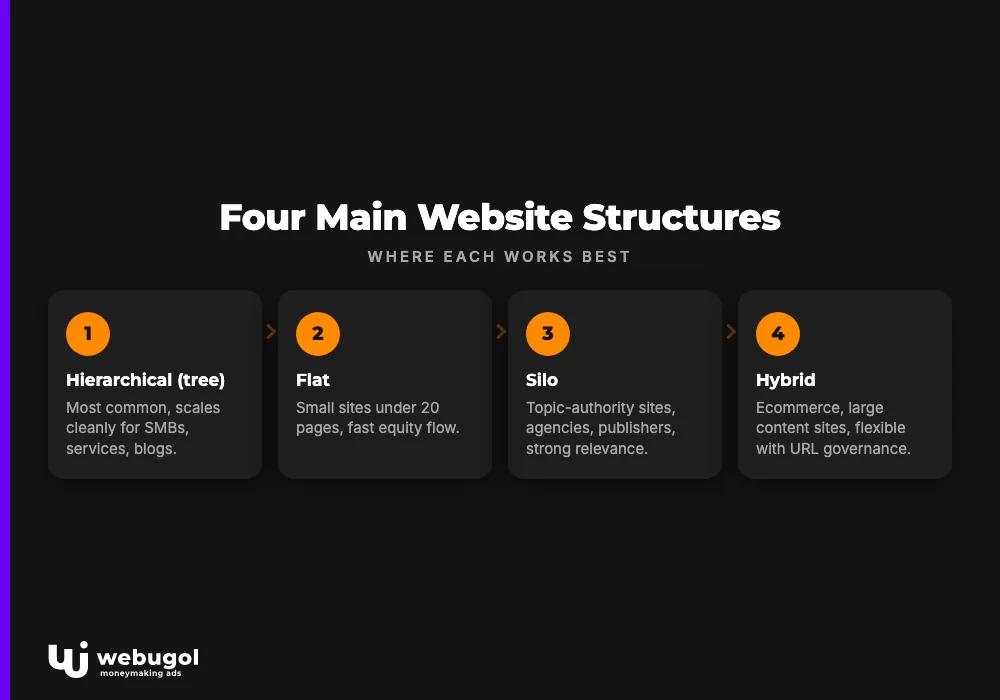
The four main types of website structure
Not every model fits every business. Here is a comparison of the four main types and where each works best.
| Structure type | Best for | SEO trade-off |
|---|---|---|
| Hierarchical (tree) | Most SMBs, service sites, blogs | Best for scalability and crawl efficiency |
| Flat | Small brochure sites, under 20 pages | Fast equity flow but does not scale |
| Silo | Topic-authority sites, agencies, publishers | Strongest topical relevance, requires strict maintenance |
| Hybrid | Ecommerce, large content sites | Flexible but requires clear URL governance |
Hierarchical structure
The hierarchical model is the most common and the most reliable approach to site architecture optimization. It functions like a pyramid: the homepage at the top, primary categories branching beneath it, subcategories branching from those, and individual pages at the leaf level.
This structure scales cleanly. Adding a new service or content cluster does not disrupt existing paths. Search engines read the hierarchy as a priority signal: a page at depth two carries more implied importance than a page at depth five. For most SMBs, website structure SEO begins and ends with getting this hierarchy right.
Flat structure
A flat structure keeps all pages one or two clicks from the homepage. It works for small sites with limited content, where fast equity distribution is the primary need. The disadvantage is clear: flat architecture provides little topical signal and breaks down under growth. Adding pages without a hierarchy creates an undifferentiated mass of content with no organizational logic that crawlers can use.
Silo structure
A silo structure groups content into strictly isolated topic clusters, with heavy interlinking inside each cluster and minimal cross-cluster links. The authority and relevance implications are significant enough to warrant their own section below.
Hybrid structure
Large ecommerce or publishing sites rarely fit a single model. A hybrid combines hierarchical organization at the category level with silo-style interlinking within topic clusters. URL governance is the critical factor for website structure SEO in this model: consistent path conventions prevent the structure from collapsing into disorganization as the site grows.
What is silo structure in SEO?
Silo structure is a strict form of hierarchical organization where content is grouped into isolated topic clusters. Pages within a silo link heavily to each other. Links between silos are intentional and infrequent.
The effect on topical authority is real. When a crawler enters a tightly linked cluster of pages on a single subject, it builds a strong semantic model of that topic. A marketing agency with silos for SEO, PPC, and content marketing, each with its own hub page and a set of supporting posts, signals deep expertise across all three areas simultaneously. The same result cannot be achieved through scattered, cross-topic linking.
Silo structure for SEO works best when you have substantial content coverage on a defined topic set. The tradeoff is rigidity. Every new piece of content needs a structural home at the planning stage, not after it is published. This is a discipline problem, not a technical one.
The most common silo mistake is creating the hub page first and then publishing supporting posts with no plan for how they connect. Structure should precede content. A cluster with a weak or missing hub page has nowhere for collective authority to concentrate.
URL structure best practices for SEO
URLs are the visible face of your architecture. A clean URL mirrors the folder hierarchy and gives both users and crawlers an immediate picture of page context.
A URL like example.com/services/digital-marketing/seo-audit communicates three facts: this is a service, within digital marketing, covering SEO audits. A URL like example.com/p=123 communicates nothing useful. The difference affects crawl path clarity and click-through rates: readable URLs in search results build more user trust than parameter strings.
Subfolders vs. flat URLs
Folder-based URLs outperform flat URLs in one practical way: they enable folder-level segmentation in Google Search Console and Analytics. Knowing that /services/ pages outperform /blog/ pages as a category helps you direct link-building and internal linking effort accurately. Flat URLs compress that signal into an undifferentiated list.
Keep path depth to three levels in most cases. Four is acceptable. Five or more signals over-nesting and creates click-depth problems for pages that need to rank.
Keyword placement and URL hygiene
Include the primary keyword in the URL slug. Keep it short, remove stop words, and match the slug closely to the H1 without copying it exactly. Avoid dynamic parameters in URLs for primary content pages: they generate near-duplicate versions that fragment link equity and confuse crawlers.
Changing URLs after a site has been live for any significant period causes ranking losses unless 301 redirects are properly configured. This is one of the most damaging errors in site migrations: a redesign resets the URL schema, redirects are partial or skipped, and years of accumulated authority disappear into 404 errors. The fix after the fact is expensive. A redirect map prepared before any structural change goes live prevents it.
URL parameters and faceted navigation
Session IDs, sort parameters, and filter combinations generate duplicate URLs at scale. Left unmanaged, these consume crawl budget and fragment equity across multiple versions of the same page. Canonical tags identify the primary version. Parameter exclusions in Google Search Console or rules in robots.txt prevent the duplicates from being crawled in the first place. This is where website structure SEO decisions compound: one poorly configured parameter type on a large ecommerce site can generate tens of thousands of low-value indexed URLs.

Internal linking strategy
Internal linking is the second structural layer after your navigation menus. Navigation creates the primary hierarchy. In-content links create a secondary graph that reinforces topic clusters and moves equity toward pages that need it most.
How many internal links does a page need for SEO?
There is no enforced minimum. Google has confirmed it does not set a hard cap on internal links per page. The practical standard is that every page should have at least one contextual internal link pointing to it from a related page, and high-priority pages benefit from three to five.
What matters more than count is relevance and anchor precision. A single link from a semantically related page with a descriptive anchor transfers more authority and topical context than five links from unrelated pages with generic anchors such as "click here" or "learn more." Audit your most important service and product pages periodically. Pages with zero or one internal link are structurally weak regardless of content quality.
Contextual authority
When a high-authority blog post links to a service page using descriptive anchor text, it transfers both authority and topical context. This is the core mechanism behind why content hubs outperform scattered blog archives. A topic-based content planning guide that ranks well and earns external backlinks functions as a distribution channel for the service pages it links to.
Anchor text precision matters. Generic anchors carry no topical signal to the destination page. Descriptive anchors like "local SEO audit checklist" or "site crawl configuration" tell the algorithm exactly what the linked page covers, which compounds the authority transfer.
Orphan pages
An orphan page exists on your server but has no internal links pointing to it. Crawlers can discover it via sitemap, but without internal links Google treats it as low-priority. Even technically indexed orphan pages accumulate little authority and rarely rank for competitive terms.
Orphan pages are a symptom of unplanned content growth. Each new page added without an established parent in the existing hierarchy creates one. The structural fix is simple: assign every page a home in the hierarchy at the planning stage, not after it is live and indexed.
How do I audit my website structure for SEO?
A website structure SEO audit follows three steps: map the current state, identify structural failures, and prioritize fixes by business impact.
Step 1: map the actual architecture
Use a crawl tool to generate a complete list of indexed URLs and their click depth from the homepage. Compare this against the structure you intended to build. Look for pages at depth five or deeper, pages with only one internal link, and sections of the site disconnected from the main navigation.
Visualize the results as a node graph. Tightly connected clusters are working silos. Isolated nodes are orphans or near-orphans. Both categories represent structural liabilities that suppress rankings without any obvious error message to flag them.
Step 2: identify crawl errors and redirect chains
Broken internal links cut crawl paths and waste budget on dead ends. Redirect chains, where one redirect points to another, degrade equity transfer with each additional hop. Both problems appear most often after redesigns or URL migrations.
An audit run immediately after a site change catches these issues before weeks of organic traffic loss accumulate. The longer broken redirect chains and dead internal links persist, the more authority drains away from pages that depend on them.
Step 3: analyze internal link distribution
Count the internal links pointing to each page. Identify high-authority pages with strong external backlink profiles that are not currently linking to any conversion-critical pages. Then identify conversion pages that are orphaned or near-orphaned.
Bridging these gaps with contextual internal links is one of the highest-return structural fixes available without creating new content. A full website architecture audit conducted at the start of an SEO engagement surfaces these gaps before content investment amplifies the underlying structural problems.
Site architecture optimization for different site types
Website structure SEO looks different depending on what a site sells, how it is built, and how many pages it manages.
Service-based businesses
Service sites should give each service its own dedicated page rather than stacking everything on a single page separated by anchor links. Each service page accumulates individual authority, ranks for its own queries, and can be supported by relevant blog content through contextual internal links.
If you serve multiple geographic markets, create a /locations/ folder and an individual page for each area. Each location page then accumulates its own local authority and can rank independently for geographically specific queries. A generic "areas served" page listing ten cities in one paragraph is not a structural solution: it concentrates no authority and targets no specific query.
Group services into logical categories if you offer more than five. A /services/ hub with links to /services/seo/, /services/ppc/, and /services/content/ distributes authority correctly and gives search engines a clear map of what the business does.
Content hubs and blogs
A chronological blog feed is not a structure. It is a list. Publishers who want to rank need to organize content into hubs: a pillar page covering a broad topic at the hub level, supported by cluster posts covering subtopics, with all cluster posts linking back to the pillar and to each other within the cluster.
This pattern concentrates authority on the pillar and signals comprehensive topic coverage to search engines. It also gives editorial teams a planning framework: every new piece either strengthens an existing cluster or starts a new one with a defined hub page before supporting content is written.
Ecommerce and headless architectures
Ecommerce sites face structural challenges that flat content sites do not. Faceted navigation generates thousands of near-duplicate URLs. Left unmanaged, these consume crawl budget and fragment equity across multiple versions of the same category page. Canonical tags identify the primary version. Breadcrumbs are essential for communicating product hierarchy to both users and crawlers, and breadcrumb schema markup makes that hierarchy visible in search result snippets.
Sites migrating to a headless CMS platform often see structural improvements as a by-product: headless architectures enforce clean URL schemas and separate content from presentation logic, which makes crawl path management more predictable than a traditional monolithic CMS. The separation also makes it easier to audit and correct website structure SEO issues without touching the frontend build.

Common website structure SEO mistakes
Most structural problems fall into a short, predictable list.
- Deep nesting: Pages buried more than four clicks from the homepage receive less crawl attention and rarely rank well. Google interprets excessive depth as a signal of low priority relative to shallower pages.
- Over-categorization: Creating category pages with one or two posts each produces thin archive pages that dilute topical authority rather than concentrating it.
- Tag bloat: Blog tag archives with a handful of posts each produce hundreds of low-quality indexed pages that consume crawl budget without contributing to rankings.
- JavaScript-only navigation: Menus built entirely in JavaScript are unreliable for crawlers. Sections of the site behind JavaScript-rendered navigation may be invisible to Googlebot entirely.
- URL migrations without redirects: Changing the structure without properly configured 301 redirects turns every old URL into a dead end. Authority built over years of link acquisition disappears.
- Neglecting mobile navigation: Google uses mobile-first indexing. A hamburger menu that does not expose the full category tree forces mobile Googlebot to navigate through an incomplete view of the site, which affects what gets crawled and ranked.
Best practices checklist: website structure SEO
Use this list when planning a new site or reviewing an existing one before a content investment.
- Map the hierarchy before building it in your CMS. Structural problems fixed at the planning stage cost nothing. The same problems fixed after publishing require redirects, content moves, and link updates across an existing site.
- Keep every priority page within three clicks of the homepage. Organize by commercial value, not by publication date.
- Add breadcrumb navigation on all pages below the homepage level. Configure breadcrumb schema markup so the hierarchy appears directly in search result snippets.
- Match URL slugs to the folder structure. Keep them short, lowercase, and keyword-relevant.
- Submit an XML sitemap to Google Search Console and verify that all priority pages are indexed and not marked noindex.
- Assign every new page a parent in the existing hierarchy before it is published. Publishing first and linking later creates a backlog of orphan pages that compounds over time.
- Audit internal link distribution at least once per quarter. Identify orphans and equity-starved priority pages before the problem compounds into a ranking plateau.
- Test mobile navigation against the full category tree. Mobile-first indexing means the mobile crawl path is the one that determines what ranks.
Fix your site architecture before the next content investment
If organic traffic has plateaued and new content is not moving rankings, architecture is the most likely constraint. New pages published into a structurally weak site compound the problem: more content, more orphans, more diluted authority, and no improvement in positions.
Webugol works with SMB owners and marketing directors to audit and rebuild site architecture as the foundation of an SEO program that compounds over time. The structural work comes first. Content investment follows a plan where every piece maps to a defined position in the hierarchy before a single word is written.
Request a site architecture review to identify the structural gaps limiting your organic growth.
FAQ
What is website structure in SEO?
Website structure in SEO is the organization of pages through navigation, URL hierarchy, and internal linking. It determines how crawlers discover content, how link authority flows across the site, and how clearly topical clusters communicate relevance to search engines.
How does site architecture affect SEO rankings?
Site architecture controls crawl access, link equity distribution, and user behavior signals. Pages that are hard to reach get less crawl attention. Pages that receive few internal links accumulate less authority. Both problems suppress rankings independent of content quality.
What is silo structure in SEO?
Silo structure is a content organization method where pages are grouped into strictly separate topic clusters, with heavy internal linking within each cluster and minimal linking between clusters. It concentrates topical authority within defined subject areas, which strengthens relevance signals for all pages in the cluster.
How do I audit my website structure for SEO?
Crawl the site to map all pages and their click depth from the homepage. Identify orphan pages, pages deeper than four clicks, broken internal links, and redirect chains. Then analyze internal link distribution to find high-authority pages not supporting conversion targets, and priority pages receiving too few links.
How many internal links does a page need for SEO?
There is no required minimum, but every page should receive at least one contextual internal link from a related page. High-priority pages benefit from three to five links with descriptive anchor text. Pages with no internal links are treated as low-priority by Google regardless of how well the content is written.

