



SEO content strategy: a practical guide to ranking well
A solid SEO content strategy maps what your audience searches for to content you publish, then optimizes each piece so search engines can find, index, and rank it. It combines keyword research, content planning, on-page optimization, and distribution into one repeatable system. Businesses that follow this system earn consistent organic traffic. Those that skip it write excellent content that nobody finds.
What makes an SEO content strategy effective?
An effective SEO content strategy rests on three foundations: knowing what your audience is searching for, creating content that answers those queries better than current competitors do, and making sure search engines can correctly interpret every page you publish.
The keyword research process comes first. Knowing which phrases your audience uses, and the intent behind each one, shapes every decision from headline structure to content depth. Researching trending topics within your industry or geographic market also surfaces ideas you would not find through keyword tools alone.
Quality outweighs quantity. Content that is unique, factually accurate, and informative in ways readers cannot easily find elsewhere holds rankings and keeps visitors engaged. One comprehensive post on a subject outperforms five thin pieces that each skim the surface. Search engines measure this through engagement signals: time on page, return visits, and the absence of a quick back-click to search results.
The six elements an SEO content strategy requires
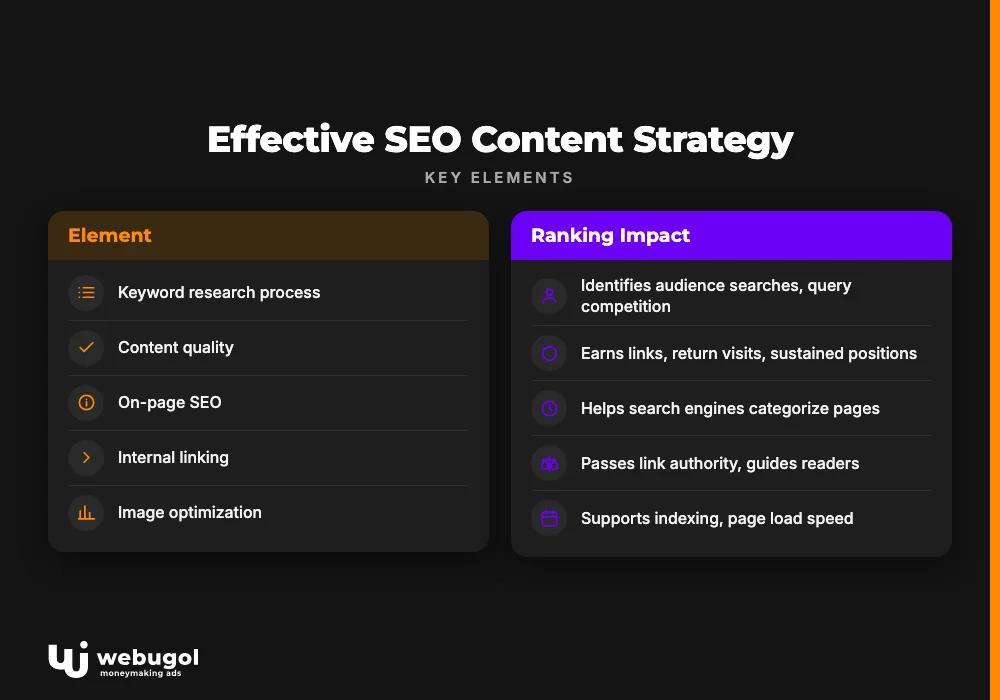
| Element | What it does for rankings |
|---|---|
| Keyword research process | Identifies what your audience searches for and how competitive each query is |
| Content quality | Unique, depth-first content earns links, return visits, and sustained positions |
| On-page SEO | Optimized titles, headers, and meta tags help search engines categorize each page |
| Internal linking | Passes link authority across your site and guides readers to related content |
| Image optimization | Descriptive alt text and compressed files support indexing and page load speed |
| Mobile responsiveness | More people search on phones than desktops, so mobile experience directly affects rankings |
These elements reinforce each other. A keyword research process without quality content produces pages that appear briefly, then slip. Strong content without on-page SEO tips applied consistently gets overlooked because search engines cannot easily categorize it. Understanding how SEO fits within a broader search strategy helps you allocate resources across channels effectively.
How do you build a content plan for SEO?
Blog content planning for SEO starts with identifying which topics your audience actively searches for, then organizing those into a realistic publishing schedule that builds topical authority over time.
Start with your audience. Before choosing a single keyword, understand who your readers are and what specific questions they bring to search engines. This goes beyond demographics. You need to know the exact language they use and what outcome they want from a search. Google Search Console reveals which queries already bring visitors to your site, giving you a starting point grounded in real behavior rather than assumption.
Group related queries into topic clusters. Instead of treating each keyword as its own isolated post, map groups of related queries to a central topic. Write one authoritative piece covering the topic in full, then create supporting pieces that address specific sub-questions. Each supporting piece links back to the main piece, signaling to search engines that your site has genuine depth on the subject.
Match format to intent. Not every query suits a long-form post. Some search intents are best served by a comparison table, a numbered guide, or a concise definition with examples. Matching the format to the way people phrase a query increases the chance your page satisfies both readers and search engines.
Prioritize realistic opportunities. A new site competing for high-volume generic keywords will struggle to gain ground quickly. Target specific, lower-competition queries first. As your domain earns more authority through consistent publishing and inbound links, move into more competitive territory gradually.
Running a structured content audit alongside your planning keeps the strategy grounded. A periodic content and performance review surfaces pages that have slipped in rankings, gaps in topic coverage, and opportunities to consolidate thin posts into stronger, more useful pieces. Without this discipline, even a well-planned calendar drifts.
Content quality and the content creation process
The content creation process should begin with a clear purpose for each piece: which specific query does this answer, who is the reader, and what should they do next.
High-quality content is unique, error-free, and covers a subject in ways readers cannot find as easily elsewhere. Headlines and subheadings should be precise. Search engines index headings as structural signals, and readers scan them to decide whether to stay. Both need clarity, not cleverness.
Format language for readability. Break long explanations into shorter paragraphs. Use headings to separate distinct topics within a long article. Include relevant images with descriptive alt text so both readers and search engines understand what each image shows. Without alt text, images are invisible to search crawlers and inaccessible to users who rely on screen readers.
Internal links connect pieces of your SEO content strategy across your site. A link from an established post to a newer one passes link authority and gives readers a path deeper into your content. For a detailed look at how businesses approach content creation in practice, those internal connections make a measurable difference in how far visitors explore a site before leaving.
What is keyword density and why does it matter?
Keyword density is the percentage of times a target phrase appears relative to the total word count of a page. For a primary phrase like "SEO content strategy," a density of 1.0 to 2.0 percent indicates relevance without triggering the over-optimization filters that search engines apply to keyword-heavy pages.
Placement matters as much as frequency. Use the primary keyword in the title, H1, the opening paragraph, one or two subheadings, and naturally across the body. Supporting terms such as content marketing strategy, content creation process, and on-page SEO tips should appear at roughly 0.3 to 1.0 percent density and be spread across headings, body sections, the FAQ, and the call-to-action.
Beyond exact phrases, related terms strengthen the semantic context of a page. The principle behind Latent Semantic Indexing (LSI) is that using words semantically related to your primary topic gives search engines additional signals about what the page covers. The more related queries your content accurately addresses through this semantic richness, the more likely the page is to appear for a range of searches beyond the primary keyword.
Write for your reader first. If a phrase fits naturally, use it. If a sentence needs to be contorted to fit a keyword, rework the phrasing until it reads clearly. Search engines now detect and discount visible keyword stuffing, so forcing exact phrases at the expense of clarity backfires.

Promoting and distributing your SEO content
Publishing is not the final step. An SEO content strategy without active distribution leaves organic reach unrealized.
Internal distribution comes first and costs nothing. Linking to a new post from relevant existing pages passes authority from established pages to newer ones within the same domain. It also guides readers toward related content, raising both time on site and the likelihood of conversion.
External promotion extends your reach to audiences who have not found you through search yet. The most commonly used tactics include link building, email newsletters, social media sharing, guest blogging, news releases, influencer outreach, and participation in relevant industry forums. Each channel reaches a different audience segment.
Use each channel for what it does well. An email newsletter reaches existing contacts who already trust your content, making it effective for nurturing leads who are not yet ready to act. A guest post on a relevant publication introduces your content to a new audience while earning an inbound link. Social sharing drives immediate traffic but fades quickly, so it works best paired with content that readers naturally share.
Consistency outweighs breadth. Sharing a piece once and moving on limits its long-term reach. Repurpose the core insights from a post across channels over several weeks so that people who missed the original still encounter the ideas.
How often should you publish new content for SEO?
There is no single correct publishing frequency. Consistency matters far more than volume.
A site that publishes two well-researched posts per month reliably will outperform one that publishes ten rushed articles one month and nothing the next. Search engines crawl and index sites that update regularly more often, so new content gets discovered faster. But the quality of each piece has a larger effect on rankings than the rate of publication.
Before adding more content to your schedule, ask three questions. Does each planned piece have a defined keyword target? Does it serve a clear audience? Does it offer enough depth to outperform what already ranks for that query? If the answer to any of these is no, invest the time in fewer, stronger pieces.
For most small and mid-sized businesses, one to two well-developed posts per week is a realistic and effective pace. Teams with established content creation processes and enough contributors to maintain quality can sustain higher output. Your analytics are the best guide: if existing content drives steady traffic and engagement, publishing more in the same format and depth is the logical next step.

What tools are used for SEO content creation?
The content creation process draws on tools at four stages: research, writing, on-page optimization, and performance tracking.
For the keyword research process, platforms that display search volume, keyword difficulty, and related queries help identify viable targets before committing time to writing. Google Search Console is a free starting point that shows exactly which queries already bring visitors to your site. This makes it the most grounded source of keyword data available to any team.
For on-page SEO tips and optimization, auditing tools check whether your target keyword appears in the title, H1, meta description, and opening paragraph. They also flag whether subheadings follow a logical hierarchy and whether internal links connect to relevant related content. Running this check before publishing catches structural problems that prevent otherwise good content from ranking.
For performance tracking, analytics platforms measure page views, bounce rates, and conversions. These three metrics together reveal whether a piece reaches the right audience and whether those readers take action. Bounce rate alone can mislead: a high rate on a page where readers found a complete answer and left satisfied is not a problem. Read the metrics in context.
Comparing your rankings to competitors for the same keyword set shows where your content marketing strategy is gaining ground and where it needs reinforcement. Over time, this benchmark becomes one of the most useful inputs for deciding what to publish next.
Tracking performance and refining your content plan
An SEO content strategy that is not regularly measured cannot be improved. The gap between teams that grow organic traffic steadily and those that plateau is almost always a review cadence.
Monitor the metrics that align with your goals. Page views show reach. Bounce rates reveal whether your content matches what visitors expected to find. Conversion rates show whether readers take a meaningful action after reading. Together, these signals tell you what to publish next, which posts need updating, and which keywords to prioritize.
Use data for two distinct purposes. First, identify new opportunities: queries bringing traffic to a page on a related topic suggest building a dedicated post on that specific sub-topic. Second, find underperformers: a page ranking on page two for a valuable keyword may need only a structural update or more depth to break into the first page. Updating an existing post is often faster and more impactful than starting from scratch.
Set a review cadence. Monthly checks for performance metrics, quarterly reviews for content gap analysis. This rhythm builds a content strategy that adapts to actual audience behavior rather than planning assumptions made months earlier.
Ready to build an SEO content strategy that works?
An SEO content strategy only works when keyword research, content quality, on-page optimization, and distribution function together as one connected system. A gap in any one of these areas limits results across the others.
If you want to understand where your current content falls short and what a focused content marketing strategy looks like for your specific business, the Webugol team can walk through it with you. Start with what you already have, identify the highest-leverage gaps, and build from there.
FAQ
What is an SEO content strategy?
An SEO content strategy is a documented plan that ties keyword research, content creation, and on-page optimization together to earn organic traffic from search engines. It defines which topics to cover, which keywords to target, and how each piece should be structured and distributed. The goal is to attract qualified visitors through search results consistently over time.
How long does it take for an SEO content strategy to show results?
Most content strategies show measurable movement in search rankings within three to six months. New sites targeting specific, lower-competition queries often see earlier results, while competitive niches with established incumbents take longer. Consistent publishing and regular content updates shorten the timeline meaningfully.
Do I need a keyword research process before writing content?
Yes. Without a keyword research process, you risk creating content that nobody searches for, regardless of how well it is written. Knowing the exact phrases your audience uses and the intent behind each query shapes every decision, from the headline to the internal links within the piece.
What is the difference between content marketing strategy and SEO content strategy?
A content marketing strategy spans all channels, including email, social media, video, and events, with the goal of building brand awareness and audience relationships. An SEO content strategy focuses specifically on earning organic search traffic through optimized content. In practice the two overlap significantly, because content that ranks well in search also builds brand recognition over time.
How do on-page SEO tips improve content performance?
On-page SEO tips address the elements within each page that search engines use to assess relevance: the title tag, meta description, H1, subheadings, keyword placement, image alt text, and internal links. Applying them correctly makes it easier for search engines to match your content to the queries it was written to answer, which directly affects where and how often the page appears in results.