



Client cases: a powerful content creation strategy
A content creation strategy is a documented plan for deciding what content to produce, who it serves, where it gets published, and how you know it worked. It connects audience research, topic selection, format choices, and distribution into a system that generates results on repeat. Done well, it turns every blog post, case study, or industry guide into a deliberate step toward a measurable outcome. When built around real client case studies, it becomes one of the most credible approaches a B2B content strategy can take.
What is a content creation strategy?
A content creation strategy is a structured process that guides every stage of content work, from topic research through publication to performance review.
Most teams treat content as a set of disconnected tasks. A blog post goes up before a campaign. A social post gets written because someone had an idea. The pieces do not connect to each other or to a business goal. It changes that by defining goals before writing starts, mapping content to audience needs, and establishing a schedule for production and review.
The strategy also covers decisions most teams skip. Which search queries should your content target? How will each finished piece reach the people who need it? When a page loses traffic, what process triggers an update? Without answers to those questions, content stays an expense. With them, it compounds into an asset.
What should a content marketing strategy include?
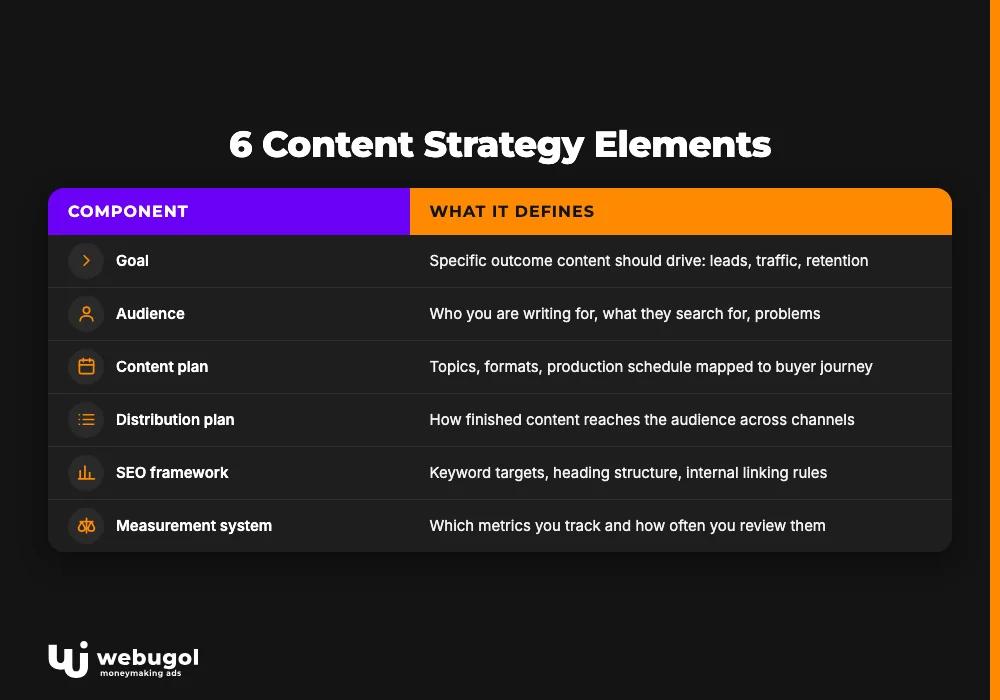
A content marketing strategy should include six core elements: a defined goal, a mapped audience, a content marketing plan, a content distribution plan, an SEO keyword framework, and a measurement system. All six connect to each other, and gaps in any one weaken the rest.
| Component | What it defines |
|---|---|
| Goal | The specific outcome content should drive: leads, traffic, or retention |
| Audience | Who you are writing for, what they search for, what problems they face |
| Content marketing plan | Topics, formats, and production schedule mapped to buyer journey stages |
| Content distribution plan | How finished content reaches the audience across channels |
| SEO framework | Keyword targets, heading structure, and internal linking rules |
| Measurement system | Which metrics you track and how often you review them |
The content distribution plan is the element most teams under-invest in. Publishing is not the same as reaching people. A technically strong article generates little traffic without a plan for getting it in front of the audience that would find it useful. That plan looks different by channel.
Organic search rewards consistent publication over months. Email newsletters deliver to an existing audience immediately. LinkedIn rewards topic focus and regularity. Paid amplification can accelerate reach for a single high-priority piece. A complete content creation strategy specifies which channels you will use and why each fits the goal and the audience.
For teams building content in sectors with specialized audiences, the same six-component framework applies. Campaign planning for specialized industries requires the same structure with tighter audience targeting and more selective channel choices.
How do client case studies support content marketing?
Client case studies support content marketing by providing verifiable proof that a method, product, or service delivers results in a real situation. A case study documents a specific client problem, the approach used to address it, and a measurable outcome. That structure answers the question every B2B buyer asks before committing: has this worked for someone in my situation?
Why case study marketing works at every funnel stage
Case study marketing is effective because it meets buyers where they already are, rather than asking them to trust claims they have no reason to believe yet.
At the awareness stage, a case study published on the blog introduces your approach to people who have not heard of you. The problem description earns their attention by naming a situation they recognize. At the consideration stage, a detailed written case study addresses specific objections and builds confidence. At the decision stage, a case study shared in a proposal or a follow-up email provides the final proof a buyer needs to move forward.
Blog posts that explain best practices are useful. Case studies that show those practices in action convert better because they demonstrate results rather than assert them. That gap in persuasion is where case study marketing delivers its clearest advantage over opinion-based content.
Case studies in a B2B content strategy
In a B2B content strategy, case studies carry particular weight. B2B buying cycles are longer than consumer purchases and involve multiple stakeholders. Sign-off may require approval from finance, operations, and executive leadership, each with different concerns about the same decision.
A well-structured case study addresses all of them at once. The problem section speaks to whoever identified the pain. The process section answers the operations team's questions about implementation. The results section gives the finance team a frame for evaluating return on investment. One piece of content does work that would otherwise require separate collateral for each internal audience.
Structure a case study in three clear sections. The first names the client's situation and the problem they could not resolve on their own. The second describes the approach, the timeline, and the key decisions made along the way. The third presents the outcome in measurable terms where possible, and in behavioral terms where hard numbers are not available. This structure respects the reader's skepticism while answering the questions a buying committee typically raises.
The most effective case studies are specific. They name the industry. They describe the situation in concrete terms. Vague outcomes fail to build confidence. Specificity is what separates case study marketing from a testimonial.
Turning one case study into a content distribution plan
A single case study can generate content across multiple formats without requiring additional client interviews or research sessions. The written version sits on the blog or a dedicated case studies page. Key client quotes become standalone social posts. Data points become slides for a deck or talking points for a sales call. A short video interview with the client becomes an asset for LinkedIn or YouTube.
This is where a content distribution plan earns its value. Without one, a strong case study gets published once and generates a handful of visits before disappearing from view. With one, the same asset generates touchpoints across channels over weeks and feeds the ongoing content creation strategy rather than sitting idle in an archive.
Building your content creation strategy step by step
A working content creation strategy follows a sequence. Research informs planning. Planning drives production. Production feeds distribution. Distribution generates data. Data feeds the next round of research. Break the cycle at any point and the gaps compound over time.
Set one specific goal
Start with a specific, measurable goal. "Publish more content" is an activity target, not a business outcome. A goal connects content work to a business result: qualified leads, increased organic traffic, shorter sales cycles, or stronger customer retention. That goal determines which metrics matter and which content types to prioritize.
A single clear goal also prevents the most common early failure: producing too many content types for too many audiences at once. Focused strategies outperform scattered ones.
Research your audience before writing anything
Audience research identifies who you are creating content for and what they actually care about. Your existing customers are the first source. Sales call recordings, support tickets, and client interviews reveal the language customers use to describe their problems, and that language belongs in your content because it matches what they type into search engines.
Search data adds a second layer. Keyword research shows what questions people ask in your category, at what volume, and with what intent. The intersection of customer language and search volume is where the best content topics live.
Analyze competitors to find what they miss
Competitor analysis shows which topics are well-covered and which are underserved. Read the top-ranking pages for your primary keywords. What questions do they answer thoroughly? What do they skim or leave underdeveloped?
The gaps are your opportunity. A detailed article on an underserved angle with genuine depth will outperform a thinner one on a crowded topic. Competitive analysis in a content creation strategy is not about copying what ranks. It is about finding what the current results are missing and filling it better.
Build a content marketing plan tied to intent
Once you have goals, audience research, and competitive insight, build the content marketing plan. This document lists what you will create, in what format, on what timeline, and for which keyword cluster.
Map each piece to a search intent. Informational queries suit educational content. Comparative queries suit detailed guides. Commercial queries suit service pages and case studies. A content marketing plan that covers all intent types creates a presence at every stage of the buyer journey rather than pulling hard in only one direction.
For a practical look at how search intent shapes content structure and ranking, the ranking-focused content approach at Webugol walks through how this connects to sustainable organic growth.
Build SEO into the writing process
SEO is not a layer you add after writing. It is part of how you write. Each piece needs a primary keyword, a clear heading structure, descriptive image alt text, and internal links to related content on the same site. The introduction should answer the main query directly so both search engines and readers can extract value from the first paragraph.
Internal linking is part of it, not an afterthought. Every new piece of content should link to two or three related pages and receive links from existing content that already holds search authority. That connection distributes ranking signals and helps search engines understand how topics on the site relate to each other.
Measure results and adjust
Measurement closes the strategy loop. Track the metrics that connect to your stated goal. If the goal is lead generation, track conversions alongside traffic because traffic alone tells an incomplete story.
Review performance at a set cadence. Monthly check-ins and quarterly reviews give most teams the right balance of responsiveness and stability. Small week-to-week fluctuations do not require strategy changes. A sustained downward trend in rankings or conversions does.

How often should you update your content strategy?
Review it formally every three to six months and plan a full revision once a year. Search behavior shifts, competitors publish new content, and business goals change. A strategy that was a strong fit 18 months ago may now be directing effort at the wrong topics or channels.
Individual pieces of content need updating on a different timeline. The trigger is data, not a calendar date. When a page that ranked on page one slips to page three, check whether competitors have published stronger content on the same topic. If so, update yours. Add depth, sharpen the structure, refresh examples, and re-optimize for the current keyword landscape.
Periodic content updates are part of it, not a separate maintenance task. Content that declines in rankings without intervention pulls down overall site authority over time. Content that holds or improves its ranking generates sustained returns on the original investment in producing it.
A practical review process: identify any page in your top 20 traffic-driving articles that has not been reviewed in the past 12 months. Compare it against what currently ranks for the same queries. Update whatever falls short of the competitive standard. That process alone can recover meaningful organic traffic without producing anything new.
Agency content strategy versus in-house content development
An agency content strategy spans multiple clients, industries, and goal types simultaneously. That scope requires documented processes, because knowledge must transfer between accounts and team members without relying on any single person to hold the logic in their head.
In-house teams have a different advantage: deeper access to product knowledge, customer relationships, and internal data that outside agencies typically cannot replicate. Most in-house teams also have more raw material for case study content than they realize. Client success emails, product feedback sessions, and account manager notes all contain what a strong case study needs. The gap is usually a structured process for capturing and publishing that information, which is exactly what a formalized content creation strategy provides.
The practical lesson: write the strategy down. Assign ownership of each component. Set review dates. A strategy held informally in someone's head is a single point of failure. When that person leaves, the strategy goes with them.
There is also a meaningful distinction between a content plan and a content creation strategy. A plan lists what to create. A strategy explains why, for whom, through which channels, and how you will know it worked. The plan is an output of the strategy, not the strategy itself. Treating them as the same thing is why many content programs stall after their first few months.

Ready to build a content creation strategy that generates qualified leads?
At Webugol, we build content creation strategies that connect audience research, keyword planning, and client case study marketing into a system designed to generate qualified leads. Whether you need a B2B content strategy, a content distribution plan, or an agency content strategy built around your existing client relationships, we work with you to design and execute it.
To discuss how a structured content creation strategy can support your growth goals, contact us.
FAQ
What is a content creation strategy?
A content creation strategy is a documented plan that guides what content to produce, for whom, in what format, and through which channels. It starts with a clear business goal and a defined audience, and includes a measurement system that shows whether the content achieved its purpose.
How do client case studies support content marketing?
Client case studies provide proof of results by documenting a real problem, the process used to solve it, and a measurable outcome. In a B2B content strategy, they address the concerns of multiple stakeholders at once and convert more reliably than general claims because they show results rather than asserting them.
What should a content marketing strategy include?
A content marketing strategy should include a defined goal, a mapped audience profile, a content marketing plan with topics tied to buyer journey stages, a content distribution plan, an SEO keyword framework, and a measurement system. All six components connect to each other, and gaps in any one weaken the rest.
How often should you update your content strategy?
Conduct a formal review of your content creation strategy every three to six months and a full revision annually. Update individual pieces of content when they lose ranking positions, contain outdated information, or cover topics that have grown more commercially important since they were first published.