



What is bus factor, and why your marketing team's score is probably 1
The bus factor is the minimum number of team members whose departure would halt a critical system. A bus factor of 1 means one person holds the access, the configuration knowledge, and the implementation logic for something your operation depends on. In healthcare marketing, that system is rarely a codebase. It is the GA4 tracking setup, the offline conversion import schedule, the ad account with its special category approvals, or the CRM routing logic nobody ever wrote down. Most practices discover their score only after weeks of wrong-number decisions have already been made.
What is bus factor?
The bus factor meaning is this: count the minimum number of people who would need to leave before a critical system becomes inoperable. One person out and it breaks? That is a score of one. The concept entered software engineering in the mid-1990s as a way to quantify a risk that teams had always felt but rarely measured. Every discipline has an equivalent; the failure pattern is the same.
What does a bus factor of 1 mean?
A bus factor of 1 means one person holds knowledge no one else can replicate, and their absence alone makes the system stop. In a marketing context, that looks like a GA4 event schema that exists only in one analyst's memory, or an offline conversion import job that only one contractor has ever touched. The system does not break loudly when they leave. The signal degrades, bidding algorithms optimize against stale data, and the problem surfaces two to four weeks later when someone finally questions why cost-per-booking is climbing.
Where did the term come from?
The phrase grew out of informal engineering risk discussions in the mid-1990s, capturing the question: how many people would need to be absent before this project stalled? It stuck because it forced teams to quantify something they had been treating as a soft concern. Engineering adopted it as a measurable metric. Marketing has yet to catch up.
Why bus factor goes beyond engineering
Every discipline names the same structural weakness differently. Finance calls it key person risk. Operations calls it continuity exposure. Engineering calls it bus factor. The failure pattern is identical: invisible breakage, late discovery, expensive recovery. As a digital marketing agency that owns the full revenue path from tracking to acquisition, Webugol encounters this pattern consistently in healthcare practices where tracking setups, ad accounts, and funnel documentation carry the same structural fragility as any undocumented codebase.
The marketing version is harder to diagnose. A broken deployment triggers an alert. A broken conversion signal looks like a slow quarter.
What does your marketing stack's bus factor look like?
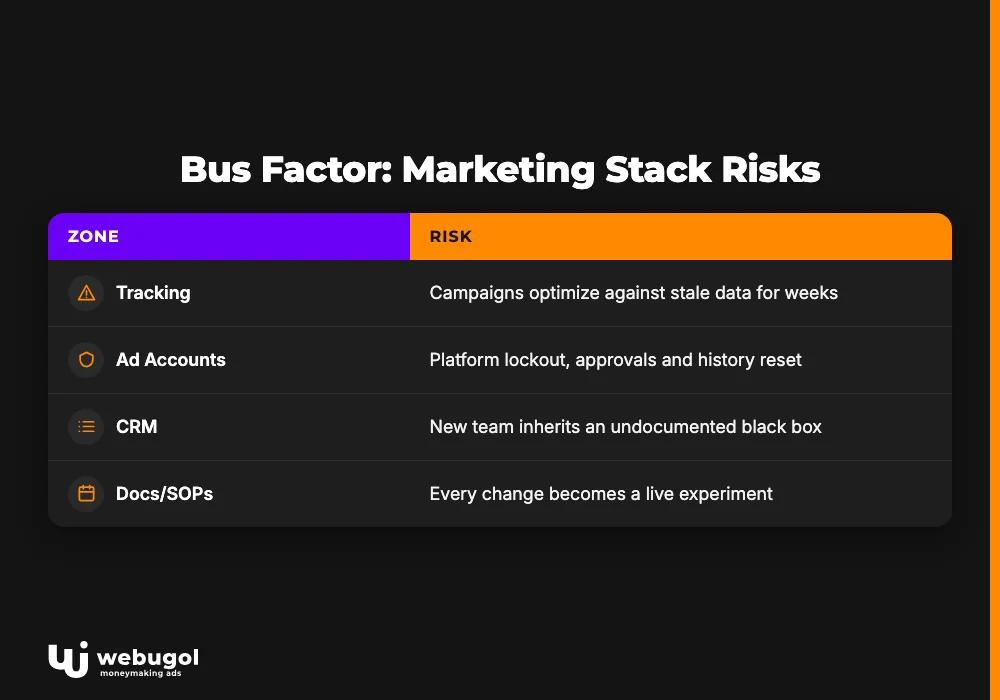
Your stack's score is determined by its weakest zone. In most healthcare marketing practices, that zone is tracking, because broken tracking does not alert anyone. The table below is a self-audit a CEO or CMO can complete in a single meeting.
| Zone | What lives there | BF=1 warning sign | What breaks when that person leaves |
|---|---|---|---|
| Tracking | GA4 events, server-side tags, consent mode, offline conversion schedules | One person owns the full event map | Campaigns optimize against stale data for weeks |
| Ad Accounts | Healthcare special category approvals, billing history, trust scores | One person holds admin access | Platform lockout; approvals and history reset |
| CRM | Stage definitions, routing logic, field mapping | No documented definitions | New team inherits an undocumented black box |
| Docs/SOPs | Funnel logic, UTM naming, confirmation triggers | Processes live in chat history | Every change becomes a live experiment |
Your tracking setup lives in one person's head
Tracking carries the highest revenue consequence weight in healthcare marketing. Custom GA4 events, consent mode toggle states, and conversion event configurations that feed campaign bidding all determine how paid campaigns bid and how cost per acquisition gets measured. When the sole owner of that knowledge leaves, the configuration does not break immediately. The signal drifts. Budget decisions keep running. The problem surfaces only when someone finally asks why CPA is climbing with no obvious cause.
One person controls all ad accounts
Healthcare ad accounts carry special category restrictions, billing history, and platform trust scores that cannot be recreated quickly after an access lockout. Platform access is routinely treated as an administrative task rather than a structural risk. That framing holds until the sole admin leaves and the recovery timeline starts. Restoring access, re-establishing category approvals, and reconciling billing history is measured in weeks, not hours.
No documented SOPs for the funnel
Speed-to-lead routing logic, CRM stage transitions, and appointment confirmation triggers get built once and rarely written down. When no documentation exists, every funnel change is a live experiment with no rollback option. A new team member inheriting an undocumented stack cannot distinguish a broken configuration from an intentional one, so no-show rates and lead quality problems persist until someone reconstructs the full logic from scratch.
How do you calculate bus factor?
Identify every critical system, list who can access and operate each one, then count how many people would need to leave before any system goes dark. That count, by zone, is your score. The calculation takes under 20 minutes applied to one zone.
- List every critical marketing system: ad accounts, tracking container, CRM configuration, UTM taxonomy, and funnel SOPs.
- For each system, identify who can access it, modify it, and explain it to someone new from scratch.
- Score each person's depth: admin-level control, can operate independently, or knows it exists.
- Flag any system where only one person scores at admin or above.
- Count the flags by zone. The zone with the most flags sets your overall exposure and is where you start.
When every zone scores at one, start with tracking. A broken conversion signal corrupts every downstream decision: budget allocation, offer testing, channel mix.
What it costs when that person leaves
The direct cost is rarely the tracking rebuild. An analytics consultant can reconstruct a GTM container in a few days. The real cost is the decisions made during the blind period. In healthcare marketing, two to four weeks of degraded bidding signals produce budget reallocations, GLP-1 program scaling calls, and CPA benchmarks based on counts that were never accurate.
This pattern appears consistently in practices that grow quickly: the undocumented server-side tag configuration the departing analyst built, the offline conversion import that stopped matching two weeks before anyone noticed, the GA4 event renamed during a platform migration and never reconnected. The same late-discovery dynamic appears when organic traffic drops without a clear cause: the root cause is typically weeks old before anyone investigates. The signal breaks quietly. The consequences accrue before the diagnosis.
If your tracking already matches this pattern, the Healthcare Growth System opens month one with a complete tracking foundation and documentation audit before any campaign spend increases.
How to raise your bus factor in 4 steps
- Document every critical system, starting with the components that feed campaign bidding signals.
- Cross-train on non-obvious dependencies beyond the GTM container: offline conversion schedules, consent mode settings, and the naming conventions that bridge ad platform data to CRM records.
- Distribute admin access to at least two team members for every critical platform, with auditable individual grants rather than shared credentials.
- Audit your vendor relationships as an external single-person dependency, not just your internal team.
Document every critical system and process
Start from what the ad platforms are currently receiving and work backward. What conversion events are reported, what source data feeds them, and is the signal current and correct? This forensic approach to re-documentation is faster than starting from a blank spec, because it surfaces what is actually configured rather than what was intended. A thorough re-documentation effort for a healthcare marketing stack covers the conversion event taxonomy, UTM naming conventions, CRM stage mapping, and the offline conversion import schedule.
Cross-train on non-obvious dependencies
The non-obvious dependencies in a healthcare marketing stack include the offline conversion import schedule, consent mode settings that affect Google's bidding eligibility, and the exact naming conventions that allow ad platform data to match CRM records. A bus test surfaces these quickly: for each system, ask what fails if this person is unavailable tomorrow. The answers reveal dependencies that no org chart shows.
Require shared access, not shared logins
Shared login credentials create compliance exposure in HIPAA-adjacent healthcare tools and remove the audit trail that matters when something breaks. Distributed admin grants give the same operational coverage without the risk. Identify every platform where only one person holds admin access, add a second admin before changing anything else, and document both accounts in your operational SOPs.
Audit third-party single points of failure
The agency relationship is itself a dependency. When the only people who understand your tracking stack, ad account history, or CRM configuration work at an external vendor, knowledge concentration transfers outside your organization. What to require in vendor contracts: documentation delivered to the client at project milestones; named contacts with individual admin access to client-owned platforms; and a knowledge transfer session before any transition. The tracking-first growth sprint is structured so documentation and platform access belong to the practice throughout the engagement, not only at contract end.
Is your tracking stack one resignation away from breaking?
If any zone in your stack has only one person who holds admin access or knows how the system was built, yes. That is not a personnel risk. It is a structural one, and it produces the same outcome whether the person leaves, goes on leave, or simply stops answering questions.
The Healthcare Growth System is built so that tracking is documented to client standards, access is distributed from day one, and the diagnostic layer belongs to the practice rather than the vendor. Book a Strategy Call to find out whether your current stack has the structural fragility described above.
FAQ
What is a good bus factor?
A score of 3 or higher is considered healthy: three people would need to leave before a critical system stalls. For most healthcare marketing stacks, a realistic near-term goal is raising any zone at 1 to 2 through documentation and shared access grants before pursuing higher coverage.
Is bus factor the same as key person risk?
They describe the same structural exposure from different disciplines. Key person risk is the financial and continuity term used in operations; bus factor is the metric that quantifies how many people must leave before that exposure activates. Both point to the same fix: document, cross-train, distribute access.
How do you fix a bus factor of 1?
Document what the single person knows, identify who else can operate each system, and distribute admin access to at least one additional person. For a typical healthcare marketing stack, a thorough re-documentation effort takes two to four weeks and should start with the systems that feed campaign bidding signals.
Does bus factor apply to agencies and vendors?
Yes. An agency that holds the only working knowledge of your tracking setup, ad account structure, or CRM configuration is an external single-person dependency. The risk materializes the same way as an internal resignation when the vendor relationship ends or the key contact at the agency changes.

