



Was It a Negative SEO Attack? A Differential Diagnosis for Organic Traffic Collapse
A negative SEO attack is deliberate third-party sabotage of a competitor's search rankings through bulk spam link building, fraudulent removal requests, or coordinated review manipulation. Most organic traffic collapses trace back to something different entirely: an algorithm update, a migration error, or a noindex tag accidentally promoted to production. The evidence chain that separates these three causes lives in Google Search Console artifacts, deploy logs, and backlink timelines. Getting the diagnosis right before you act determines whether you spend hours or months correcting the wrong problem.
What is a negative SEO attack?
A negative SEO attack is a coordinated attempt by a third party to damage a target website's search rankings through tactics that violate Google's guidelines. The critical distinction is between passive link accumulation and active coordinated sabotage. Picking up low-quality links organically over time is not an attack; a campaign that floods a domain with thousands of spam links from unrelated niches within a single week is.
For a clinic owner or telehealth CEO watching organic bookings fall, that distinction is not semantic. The response to algorithm-driven ranking loss looks nothing like the response to a deliberate negative SEO attack, and applying the wrong protocol wastes time and budget that most healthcare practices cannot afford to lose.
Does negative SEO actually work in 2026?
The honest answer depends on your site's resilience baseline. For an established healthcare domain with a diverse backlink profile and documented E-E-A-T signals, link spam alone rarely moves rankings. Google's Penguin algorithm became real-time in 2016, which means most bulk toxic link campaigns are neutralized before they translate into a ranking signal. An established clinic with thousands of legitimate referring domains can absorb a spam link campaign that would damage a newer practice.
Multi-vector attacks are a different calculation. A campaign combining link spam with review bombing on health directories, coordinated fake DMCA removals targeting your strongest backlinks, and a fraudulent complaint to Google Search Central creates compounding damage that even well-established domains absorb poorly without active monitoring. Each vector alone might be survivable; layered together, they erode the trust signals that protect you from each individual component.
Newer telehealth practices with thinner authority profiles face meaningful risk from even single-vector campaigns. Content scraping and review bombing hit hardest here, where the asymmetry between attack cost and recovery cost is sharpest.
The relevant question for a healthcare operator is not "does negative SEO work in theory?" but "what is my current resilience baseline, and which attack vectors would actually move my rankings?" That answer determines which parts of this guide are urgent versus precautionary.
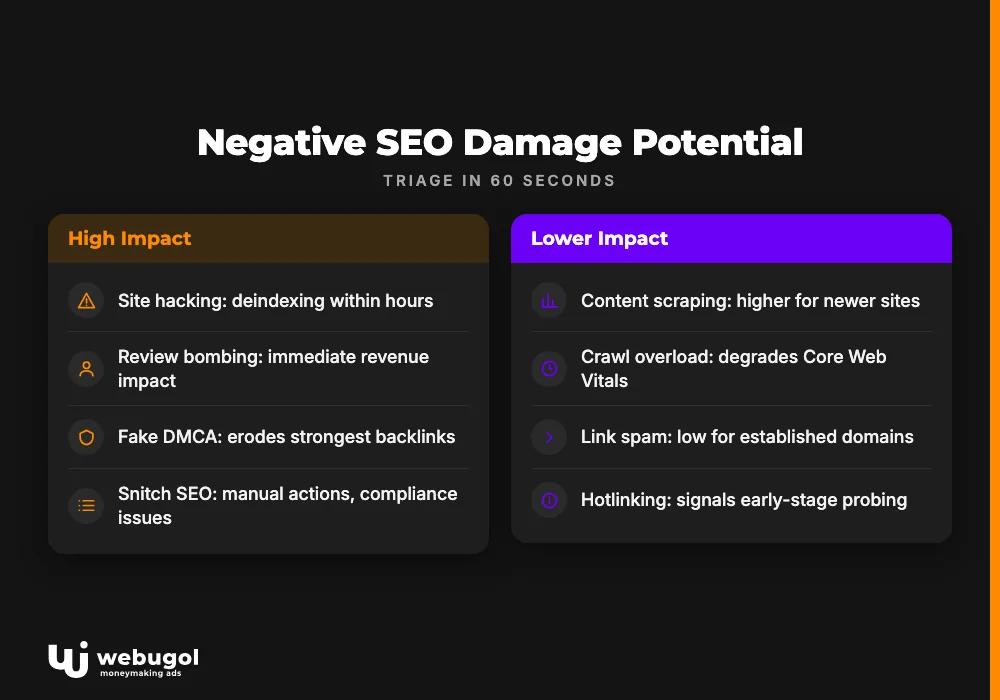
8 types of negative SEO attacks ranked by real damage potential
Competitors enumerate the types. This section rates each by actual damage potential so a healthcare operator can triage in 60 seconds before going deeper. Rankings reflect how quickly each vector compounds without a response.
- Site hacking and malware injection: Critical. A SafeBrowsing flag can trigger deindexing within hours and produce a patient-visible red warning screen.
- Review bombing: High. Immediate revenue impact before any ranking change occurs; appointment inquiries fall before rankings move.
- Fake DMCA and link removal requests: High. Quietly erodes your strongest backlinks with no GSC footprint.
- "Snitch SEO" complaints: Medium-high. Fraudulent policy reports can trigger manual actions with compliance consequences beyond rankings.
- Content scraping at scale: Medium-high for newer sites; lower for established domains with strong brand signals.
- Crawl overload: Medium. Degrades Core Web Vitals scores before any ranking signal shifts.
- Link spam: Low-medium for established domains; medium for sites with thin authority.
- Hotlinking: Low standalone damage; typically signals early-stage probing before a larger campaign.
Link spam
Link spam is the most discussed type and the least likely to damage an established healthcare domain. Since Penguin became real-time, bulk toxic link campaigns are largely neutralized before they process into a ranking signal. What warrants investigation is not raw link count but velocity: a spike of more than 50 new referring domains from unrelated niches within a 7-day window is the threshold worth reviewing.
A site gaining 2,000 backlinks over six months looks entirely different from one gaining 500 new referring domains in a single week from foreign-language link farms with no relationship to healthcare. Watch the rate of the spike, not the accumulated total.
Content scraping
Mass duplication of your pages at scale can confuse search engines about the canonical source. Healthcare compliance content is a preferred scraping target because it is dense, authoritative, and expensive to produce.
For a newer telehealth practice without established brand signals, scraped content can undermine the canonical relationship before you have the authority to override it. Note the timing lag: a scraper may harvest your content today, but Google may not index the duplicates for several weeks. This negative SEO attack type therefore shows up on a delayed timeline relative to when the scraping itself occurred.
Fake DMCA and link removal requests
An attacker sends fraudulent removal requests to webmasters hosting your strongest backlinks, quietly eroding your link equity without any GSC footprint. For healthcare sites, where authoritative backlinks from academic journals, hospital systems, and state health directories represent trust signals built over years, this vector causes disproportionate damage.
The only detection mechanism is monitoring which high-value referring domains disappear from your profile over time. This is the hardest vector to detect and the least covered by competitor articles, which is why maintaining a documented baseline of your most valuable referring domains matters before any attack occurs.
Site hacking and malware injection
A Google SafeBrowsing flag generates a red warning screen visible to every patient visiting your site, triggers deindexing, and appears in GSC's Security Issues report before most internal teams notice the compromise. For a patient-facing healthcare practice, the sequence typically runs: warning screen appears, new inquiries stop, staff notices one to two days later.
The GSC Security Issues report is the fastest confirmation tool and the starting point for the reinstatement process. Damage to patient trust during that window is immediate and not addressable by any SEO fix, which is why GSC security alerts warrant daily monitoring rather than a weekly review cadence.
Review bombing
Coordinated fake negative reviews on Google Business Profile and health directories reduce new patient inquiries before any ranking change occurs. For a healthcare practice, review bombing on Healthgrades, Zocdoc, and WebMD operates differently from a general GBP attack: removal timelines are slower, the impact on appointment conversion is more direct, and a damaged star rating is visible in branded search results before any keyword ranking shifts.
Among all attack types in this ranking, review bombing produces the fastest direct revenue impact. It warrants a dedicated monitoring layer separate from your backlink tracking.
Crawl overload
Bot floods spike server response time and degrade Core Web Vitals scores, which Google measures as a ranking signal. A sustained crawl attack can translate into ranking movement without touching your backlink profile or content at all.
The early warning lives in server access logs: an abnormal crawl rate not correlated with any documented traffic event. When that rate also correlates with a Core Web Vitals regression in GSC Performance data, the causal chain is clear.
"Snitch SEO"
Seobility defines this as filing fraudulent spam or policy reports with Google Search Central to trigger a manual review. No major competitor explains the mechanism in detail. For healthcare operators, the stakes extend past rankings: a complaint about medical claims in your content or ad copy can trigger a manual action affecting your ability to run compliant paid campaigns on the same landing pages, since ad policy review and organic manual review share compliance infrastructure.
The distinguishing signal is a manual action notification appearing in GSC at a time that does not correspond to any changes in your own practices. That mismatch is the diagnostic marker.
Hotlinking
Embedding your hosted media files from external domains drains bandwidth and inflates server costs. Standalone damage potential is low. What makes hotlinking worth monitoring is that it often appears in server logs as early-stage probing before a larger negative SEO attack campaign escalates. Unexpected external requests for your media files at unusual volumes are worth logging and watching for escalation over the following 30 days.

Was it a negative SEO attack, an algorithm update, or your own mistake?
This is the diagnostic question no competitor article addresses directly, and it is exactly what a practice owner or marketing lead is asking after organic traffic drops. The pattern and timing of GSC data, your CMS release history, and your backlink timeline together build the differential diagnosis. Start with the evidence chain, not with assumptions about who might have caused the problem.
Signs it was an algorithm update
Traffic falls broadly across multiple page types on a date that correlates with a documented Google update. Competing sites in your healthcare niche show the same directional shift around the same dates. GSC query data shows ranking drops distributed across a consistent query type: broad core updates affect all page types, while spam updates concentrate losses on link-heavy or thin-content pages.
If two or three direct competitors show the same organic traffic trajectory on the same timeline, algorithm update is the most defensible diagnosis. The correlation across competitors is the signal.
Signs it was your own technical change
The drop is abrupt and maps precisely to a deploy date in your CMS release history or Sanity changelog. Common self-inflicted causes include redirect chains left behind after a domain migration, a noindex tag added to a staging environment and accidentally promoted to production, or a robots.txt change that blocked Googlebot from crawling key page templates.
Running a site-level technical SEO audit against the current state of the site is the fastest way to confirm or rule out self-inflicted causes before pursuing any external explanation. The evidence is in your own systems. It is almost always faster to find than any forensic investigation of external actors.
Signs it was an active attack
A sudden spike in referring domains in GSC's Links report from unrelated or foreign-language sites, not correlated with any of your own outreach or publications, combined with unusual anchor text clusters. Critically, this spike appears before any ranking or traffic change because Google crawls new links before processing their ranking impact.
A pattern of high-value referring domains disappearing from your backlink profile without explanation is a second signal. A manual action notification appearing in GSC with no corresponding change in your own practices is a third. Any one of these alone warrants monitoring over 14 days before drawing conclusions. Two or more appearing together move the diagnosis toward an active negative SEO attack.
How to detect a negative SEO attack early: your monitoring stack
Most prevention advice stops at "monitor your backlinks." That is not a monitoring stack. A working stack specifies what signals to watch, at what threshold a signal becomes worth investigating, and which tool surfaces each signal first. For a healthcare practice, where a day of suppressed bookings has immediate revenue impact, the difference between a vague directive and a concrete threshold is the difference between catching an attack early and discovering it from a revenue report.
Backlink spike detection
GSC's Links report is the free baseline: review weekly for new referring domains you do not recognize. Ahrefs or Semrush new-referring-domain alerts add speed and context. The actionable threshold is a velocity signal: more than 50 new referring domains from unrelated niches within a 7-day window warrants a manual review, not immediate action.
Manual review means checking actual linking domains for topical relevance, examining the anchor text pattern, and verifying whether the spike correlates with any legitimate activity on your side before drawing conclusions.
Content scraping alerts
Set up Copyscape or Siteliner scans on a weekly cadence for your highest-value healthcare pages. Add Google Alerts using exact-match sentences pulled from pages carrying HIPAA language, clinical claims, or compliance disclosures. Those pages are the preferred scraping targets because they carry the densest, most authoritative content on your site.
A Google Alert match does not confirm a negative SEO attack. It confirms a duplicate exists and triggers a canonical check. If the scraped version is indexed and your original is not, that is when a DMCA notice becomes the appropriate next step.
Crawl rate and uptime monitoring
Cloudflare or server-level access logs surface bot traffic spikes that no SEO tool will show. Pair this with Uptime Robot or an equivalent availability monitor. The meaningful signal is a crawl-rate anomaly that correlates with a Core Web Vitals regression in GSC Performance data, not a standalone bot spike.
Bots hit healthcare sites constantly. The pattern worth investigating is a bot flood that simultaneously degrades your LCP scores and correlates with a ranking movement, not routine crawler activity in the logs.
Review and reputation signals
Set Google Business Profile review notifications to real-time. Add monitoring for Healthgrades, Zocdoc, and WebMD using each platform's native alert system. Healthcare operators need directory-specific monitoring because GBP removal disputes and directory-specific appeals follow different processes and timelines.
A pattern of same-day batch postings, reviewer accounts with no prior history, and no local activity signature is the documented evidence needed for a bulk removal request. Without that documented pattern, individual dispute filings rarely succeed on health directories.

What to do during a negative SEO attack: step-by-step response
Every competitor article ends at prevention. This protocol covers the active phase, starting from the moment you have confirmed an attack is underway. The sequence matters: evidence preservation must come before any remediation action that could overwrite forensic data.
- Export and preserve evidence first. Export the GSC Links report, download server access logs with timestamps, and take timestamped screenshots of the backlink spike, the GSC Security Issues report if relevant, and any GBP review patterns. Do this before touching anything else.
- Check for a manual action in GSC. Open the Manual Actions report in Google Search Console. If a manual action is present, note the exact type and issue date. A manual action changes your response path entirely and requires a formal reconsideration request, not just link cleanup.
- Identify the attack vector. Use the damage ranking above to determine whether you are dealing with link spam, a site compromise, review bombing, or a combination. Treating a hacked site as a link spam problem is a costly diagnostic error and the single most common mistake in rushed responses.
- For link spam: run a targeted disavow. Use the Disavow Tool only for confirmed toxic link clusters when a manual action is already present in GSC. Preemptive disavowal of random toxic links without a manual action can remove useful signals. Target specific clusters of low-quality referring domains identified in your monitoring, not your entire backlink profile.
- For site compromise: follow the GSC Security Issues remediation path. Clean the malware using the guidance for each specific issue type, then submit a reinstatement request through GSC. The timeline varies by malware type, but GSC confirms when the SafeBrowsing flag is lifted.
- For review bombing: file through official GBP dispute paths. Document the pattern: batch posting timeline, reviewer account characteristics, no prior review history. For Healthgrades or Zocdoc reviews, each platform has a separate dispute submission process with its own documentation requirements.
- For crawl overload: implement rate limiting at the infrastructure level. Cloudflare or your hosting provider's access controls are more effective than robots.txt for bot floods. Robots.txt guidance is not enforced by malicious bots; infrastructure-level blocking stops the server load.
- For "snitch SEO" manual actions: submit a reconsideration request with documentation. State clearly that you made no changes to your site practices and provide evidence of the complaint's fraudulent basis where possible. A factual, documented submission is more effective than a defensive one.
How to build a resilience baseline that makes attacks less effective
Prevention appears after the response protocol here deliberately. A reader who arrived after a traffic drop needs the active playbook first. The structural argument is this: a strong brand signal makes the majority of negative SEO attack vectors less effective because Google's systems have enough positive signal about your domain to discount the negative. Prevention is maintenance, not insurance.
- Conduct monthly backlink profile reviews to catch new referring-domain anomalies early before they compound into a pattern requiring active response.
- Enable two-factor authentication on all GSC properties, GBP accounts, and any agency access. These accounts are attack surfaces in themselves.
- Add canonical tags to all page templates, not only pages where duplication already exists, to reduce the damage potential of content scraping.
- Build E-E-A-T signals consistently: author credentials, medical reviewer attribution on clinical content, verified NAP data across healthcare directories, and citations from authoritative health publications.
- Document your backlink profile baseline quarterly so that a future spike is detectable against a known normal, not a guessed one.
- Run periodic technical audits to ensure no existing self-inflicted vulnerabilities could be amplified before an external actor finds them.

Healthcare and regulated niches: why the stakes are higher
For a telehealth operator or clinic owner, a negative SEO attack is three problems simultaneously: an SEO disruption, a patient acquisition risk, and a compliance exposure. Each vector hits harder in healthcare than in a general commercial context, and recovery timelines are longer.
Review bombing on health directories operates on a slower removal timeline than Google Business Profile. Healthgrades and Zocdoc removal processes can take weeks, during which a damaged star rating is visible in branded search and suppresses appointment inquiries. The effect on patient retention begins before rankings move, because prospective patients check ratings before they visit your website.
Fake DMCA removals targeting healthcare backlinks are disproportionately effective because authoritative health-domain links are among the hardest to rebuild. A link from a hospital system, a medical journal, or a state health department represents accumulated trust. Losing it to a fraudulent removal request without detection means the damage compounds silently for months before anyone identifies the cause.
"Snitch SEO" complaints about medical claims or ad copy can escalate past rankings into ad account compliance reviews. A complaint that triggers a Google manual review of your healthcare content can simultaneously affect paid campaigns that depend on the same landing pages, because ad policy review and organic manual review share underlying compliance infrastructure.
When security monitoring, reputation management, and organic oversight belong to separate vendors, no one is accountable for reading all three signals together. That fragmentation is the structural gap attack vectors exploit. Webugol owns the cross-signal diagnosis: the audit that surfaces your backlink anomalies is the same audit that identifies infrastructure vulnerabilities and reputation monitoring gaps. For telehealth operators who need one accountable growth system rather than three separate vendor relationships, that integrated view is what stops a negative SEO attack from compounding through the handoffs.
Your traffic dropped and the diagnosis still is not clear
If the evidence chain does not point cleanly to one cause, the most common reason is a combination of factors: an aging migration artifact that a recent algorithm update made visible, or a site security gap that a competitor located before your team did. Combination causes are harder to diagnose independently because each element looks like noise until you see it alongside the other signals.
The Healthcare Growth System opens with a full technical and backlink audit before any acquisition work begins, so the diagnostic baseline is verified before budget moves. If your evidence chain remains inconclusive after working through the diagnostic sections above, that audit is the fastest path to a clear answer. Book a strategy call to work through the evidence together and determine whether you are facing a negative SEO attack, a self-inflicted issue, or an interaction between both.
FAQ
Can Google penalize my site because of someone else's backlinks?
Google's official position is that it ignores most low-quality inbound links and has not issued manual penalties for unnatural inbound links at scale since Penguin became real-time in 2016. If GSC shows a manual action for "unnatural links to your site," that is a confirmed exception and a disavow file targeting those specific link clusters is the correct response. Preemptive disavowal of random toxic links without a manual action in place is not recommended and can remove useful signals.
How quickly does a negative SEO attack affect rankings?
Link-based attacks typically take several weeks to show any ranking impact, if they show any at all, because Google's crawl and re-evaluation cycle is not instantaneous. Review bombing and site hacking can affect patient inquiries within 24 to 72 hours because they trigger immediate user-behavior signals or SafeBrowsing flags rather than waiting for a ranking recalculation. The attack vector determines the timeline far more than the scale of the campaign.
Is negative SEO illegal?
Deliberately building spam links to a competitor's site, filing fraudulent DMCA requests, or coordinating fake reviews likely violates Google's Webmaster Guidelines and may constitute tortious interference or fraud under US law, depending on the method and the scale of provable harm. Law enforcement rarely pursues these cases unless damages are significant, documented, and traceable to a specific actor. The legal risk to the attacker does not typically deter the behavior.
What is the first sign that I am under a negative SEO attack?
The clearest early signal is a sudden spike in referring domains in GSC's Links report from unrelated or foreign-language domains, paired with anchor text that does not reflect your brand or content. A spike without any corresponding traffic or ranking change is not yet actionable: monitor it over 14 days and compare against your deploy changelog before drawing conclusions. The combination of an unexplained link spike and a disappearing high-value referring domain is more diagnostic than either signal alone.
Can a negative SEO attack target my Google Business Profile?
Yes. Review bombing on Google Business Profile is one of the fastest-acting attack vectors for local and healthcare businesses because the star rating is visible in branded search results before any underlying ranking change occurs. A documented pattern of suspicious reviews, same-day batch posting, no prior reviewer history, and no local activity signature strengthens a bulk removal request through the official GBP dispute path. The GBP appeal process is entirely separate from any SEO remediation steps you take simultaneously.

