



Stem cell clinic marketing: strategies that scale revenue
Effective stem cell clinic marketing combines search visibility, compliant paid advertising, and trust-building content into a single patient acquisition system. Budget is rarely the constraint. The clinics that convert most efficiently are the ones whose tracking, funnel, and follow-up work as one connected path from the first ad click to a confirmed appointment.
If your clinic generates leads but show rates are low or cost per booked consultation keeps rising, the ad channel is rarely the cause. The leak is almost always downstream: slow follow-up, a landing page built for clinical depth rather than patient decisions, or attribution data too fragmented to guide budget calls.
How do I market a stem cell therapy clinic?
Start with two foundations before any channel spend: a compliance review of every existing claim and a tracking audit to establish what is actually being measured end to end.
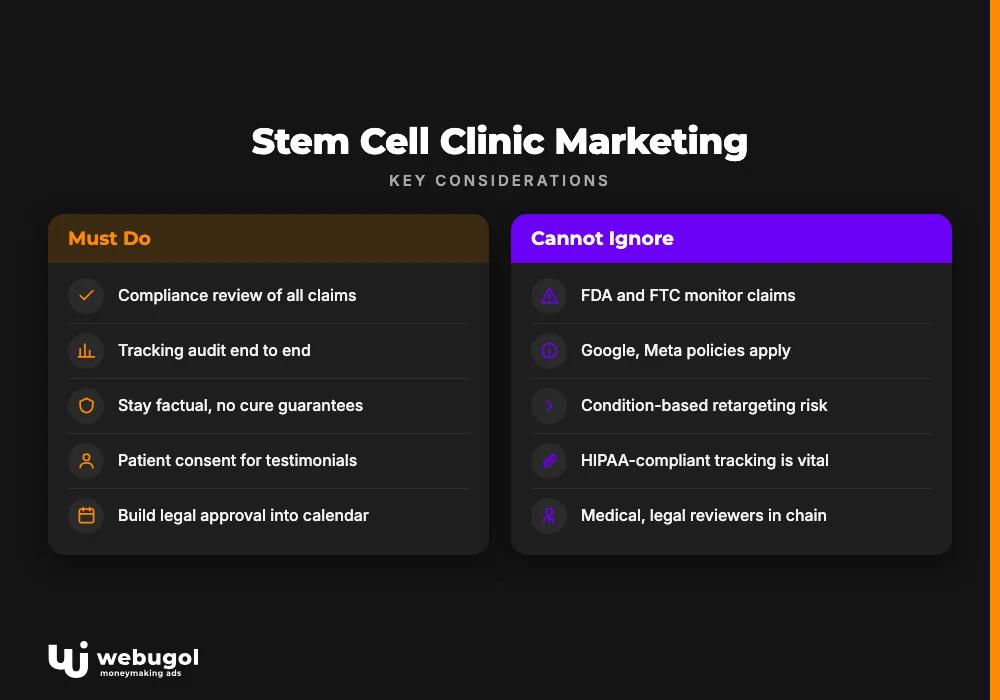
Regulatory constraints define the outer limits of stem cell advertising. The FDA and Federal Trade Commission monitor healthcare advertising for unsubstantiated efficacy claims. Every marketing asset, from landing pages to paid ad copy, must stay factual, grounded in the therapy's current approval status, and free of cure guarantees or unqualified outcome statistics.
Patient testimonials require written consent and framing that discloses when results are not typical.
Advertising rules you cannot ignore
Google and Meta layer their own health and wellness policies on top of FDA and FTC requirements. Condition-based retargeting can trigger a platform policy violation. HIPAA-compliant conversion tracking must be live before any paid acquisition runs. Without it, the data driving your budget decisions is structurally wrong.
In digital marketing for stem cell therapy, your medical and legal reviewers are in the production chain for every creative asset. Build that approval window into your campaign calendar. That is how compliant paid programs actually function.
Core channels for stem cell clinic marketing
The right mix depends on where patients are in their decision process and what your current tracking infrastructure can support.
| Channel | Primary role | Key constraint |
|---|---|---|
| Google Search Ads | High-intent patient acquisition | Condition-based targeting restrictions apply |
| Meta Ads | Awareness and qualified retargeting | Health and wellness policy review required |
| SEO and local search | Long-term organic acquisition | 6 to 12 month payback window |
| Content marketing | Trust-building and authority | All clinical claims require compliance review |
| Email and SMS nurture | Lead-to-consult conversion | HIPAA consent required before sending |
What digital marketing strategies work best for regenerative medicine?
The combination that consistently produces results for regenerative medicine clinics is search-first acquisition, Google Ads plus local SEO, paired with a content layer built for longer consideration windows. Content marketing for stem cell clinics is not a branding exercise. It is the mechanism that converts a skeptical patient who found you on Google into someone who calls.
Regenerative clinic marketing support built around this model reduces CPA and raises show rates because it matches the patient's actual decision process: high-intent search captures the first contact, and educational content moves research-driven patients through weeks of consideration before they book.
SEO and local search visibility
Local SEO is the highest-return entry point for most of these programs. Patients searching "stem cell clinic [city]" or condition-specific queries are close to a booking decision.
The baseline includes a fully optimized Google Business Profile, consistent citation data across directories, and location-targeted content pages. Build on that by structuring pages around the conditions you treat, not just the broad category. Procedure-specific terms carry stronger intent and lower competition than top-level regenerative medicine keywords.
Regenerative medicine marketing strategies that rank and convert share one trait: they answer patient questions with enough clinical context to earn trust and enough clarity to prompt action. Thin content ranks poorly. Content written for crawlers converts poorly. The fix for both is the same: write for a patient who has been researching for three weeks, not a first-time visitor.
Paid media and stem cell advertising on Google and Meta
Google Ads for stem cell therapy work best when structured around specific conditions and geographic modifiers. The conversion path must be fast: a compliant landing page with one clear next step, a form that routes into CRM within seconds, and a routing rule that delivers the lead within minutes of submission.
Speed-to-lead below five minutes is one of the strongest conversion levers available once paid acquisition is running.
Meta Ads fill the top-of-funnel role in lead generation for stem cell therapy. They reach patients who match your profile but are not yet actively searching. Educational video, condition-specific messaging, and lookalike audiences built from consented patient data consistently outperform direct-offer creative in this channel.
How to generate leads for stem cell therapy clinics?
Lead generation for stem cell therapy starts at the tracking layer, not the ad. Clinics that can measure clicks and form submissions but cannot trace those events to booked appointments are making channel decisions on partial information. Build infrastructure first.
The operational sequence:
- HIPAA-compliant conversion tracking across every entry point: paid search, organic, referral, and direct.
- A landing page built for the patient's decision. Move detailed clinical education to the post-conversion nurture sequence.
- CRM routing that fires in real time. Leads sitting uncontacted for more than 30 minutes show lower show rates, regardless of ad quality.
- A nurture sequence built for the full decision window. High-ticket regenerative medicine decisions take days to weeks. Most clinics stop follow-up after two attempts. Patients who book on attempt five were still in consideration.
Clinics that break past the scaling plateau are not the ones that raised their ad budgets. They are the ones that repaired the handoff between marketing and intake. That pattern holds across regenerative specialties: for practices also running neurological protocols, the neuropathy clinic acquisition playbook covers how the same funnel principles apply to a different patient audience.
A marketing agency for stem cells that manages only the ad account leaves the structural gaps in place. Fixing tracking, funnel, and intake operations delivers a higher return than adding budget to a leaking path. That logic underpins how we build full-cycle regenerative clinic growth programs.
Ready to scale your stem cell clinic marketing?
If your clinic is at a growth plateau, the gap is almost always a system problem rather than a creative or channel problem. Webugol builds tracking-first, conversion-led acquisition systems for US healthcare clinics, owning the full path from ad click to recognized revenue: tracking, landing pages, paid acquisition, and intake operations as one coordinated system.
Book a free strategy call to get a diagnosis of where your acquisition path is losing patients before you add more spend.
FAQ
How do I market a stem cell therapy clinic?
Start with a compliance review and a tracking audit before any channel spend. The most effective stem cell clinic marketing combines local SEO and Google Ads for high-intent acquisition with Meta Ads for awareness and a structured nurture sequence to convert leads across the full patient decision window.
What regulations apply to stem cell therapy advertising?
The FDA prohibits marketing unapproved therapies with claims implying established medical efficacy. The FTC requires all advertised outcomes to be substantiated by reliable evidence. Google and Meta enforce additional platform policies restricting condition-based targeting in healthcare. Every campaign asset must clear both the federal regulatory layer and the platform policy layer.
How much does marketing for a stem cell clinic cost?
Budget depends on market competitiveness, channel mix, and whether tracking and funnel infrastructure needs to be built from scratch. The more meaningful metric is cost per booked appointment, not cost per lead. Lead quality and show rate determine actual revenue return, so optimizing cost per lead in isolation often raises total acquisition cost.
Can patient testimonials be used in stem cell clinic marketing?
Yes, with proper written consent and compliant framing. FTC endorsement guidelines require disclosure when results are not typical. Framing testimonials around quality-of-life improvements rather than clinical outcomes carries lower regulatory risk and is less likely to trigger platform policy reviews.

