



Preventive medicine marketing: how to attract and keep the right patients
Preventive medicine marketing works when it matches how patients actually make decisions: slowly, after research, comparing options over days or weeks. A practice that runs SEO, paid ads, content, and email as a coordinated system, each tied to specific programs and trackable outcomes, builds a patient pipeline that compounds over time. This guide covers what that system looks like and where most practices go wrong.

How do you market a preventive medicine practice?
Effective preventive medicine marketing combines four channels: search engine optimization, paid advertising, clinician-informed content, and email retention. The sequence that works most reliably starts with dedicated program pages, one per core screening or service, then adds paid traffic to those pages while organic rankings build, then uses email to keep existing patients returning for annual screenings.
Before running any channel, a practice needs two things in place: a clear definition of the patient it serves best, and conversion tracking that ties clicks to booked appointments. Without both, there is no way to know which spend is producing real results.
How is marketing preventive medicine different from urgent care marketing?
Urgent care marketing targets a patient with a problem today. Preventive medicine marketing targets someone with no symptoms, which changes everything about timing, messaging, and channel mix.
A prospective preventive care patient will search, read, compare, and wait before booking. They may take weeks to decide whether an executive health screening is worth it or how a program differs from a standard annual physical covered by insurance. Marketing that treats this audience like a same-day urgent care lead burns budget chasing a decision that was never going to happen that fast.
The practical difference: urgent care ads convert the day someone sees them. Healthcare practice marketing for preventive programs needs to stay visible across a longer window, which means SEO and content carry more weight relative to short-burst paid campaigns.
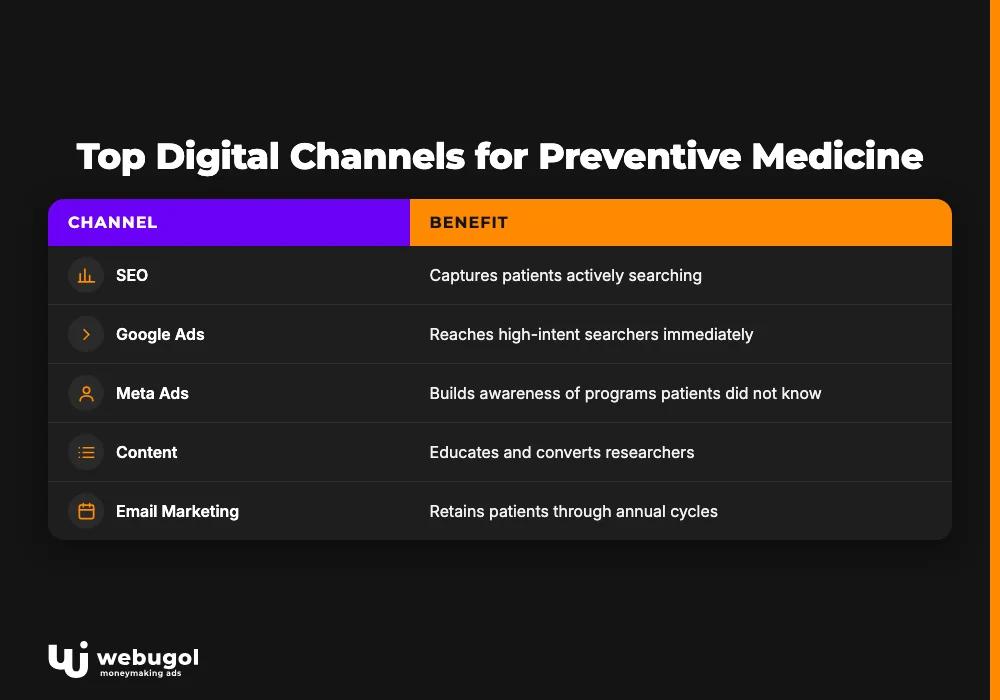
What digital channels work best for preventive medicine patient acquisition?
| Channel | Primary strength | Timeline |
|---|---|---|
| SEO (program pages + local) | Captures patients actively searching | 3-6 months to rank |
| Google Ads | Reaches high-intent searchers immediately | Days to first bookings |
| Meta Ads | Builds awareness of programs patients did not know existed | Weeks to warm audiences |
| Content (clinician-authored) | Educates and converts researchers | Compounds over months |
| Email marketing | Retains patients through annual cycles | Ongoing |
For most independent preventive practices, Google Ads and program-specific SEO produce the strongest early return on patient acquisition because they meet patients at the point of active research. Meta Ads work better for building awareness of proactive health programs a patient has not yet considered.
Local SEO strategies for healthcare websites, specifically an optimized Google Business Profile and location-specific landing pages, help a practice appear above directory listings in map results, which is often where local searches end.
Medical practice marketing strategy: building the full system
Putting channels together into a working plan for preventive health digital marketing follows a clear sequence:
- Define the ideal patient profile: the specific programs, price point, and demographics the practice serves best.
- Audit the current funnel: review the website, booking flow, and any existing ad accounts to find where prospective patients drop off.
- Build dedicated program pages: one page per core screening or protocol, not a single page trying to cover every service.
- Set up conversion tracking: connect calls, form fills, and booking confirmations to real cost-per-patient numbers.
- Layer in paid and organic channels together: use SEO for durable visibility and ads to fill the gap while rankings build.
- Review and reallocate monthly: reinvest in what is producing booked consultations and cut what is not.
Analytics and attribution tie this loop together. A practice cannot improve its marketing for preventive medicine practice without visibility into what is actually converting.
Compliance considerations for preventive health campaigns
Preventive health marketing sits close to regulated medical claims. Campaigns need to avoid guaranteed outcomes, unverified biomarker or screening claims, and language that reads as a diagnosis rather than a described program. A practice that builds compliance into its strategy from the start, rather than fixing it after an ad account gets flagged, moves faster and protects its accounts long-term.
Healthcare SEO content must also meet current health-content quality standards, which reward clinician-authored or clinician-reviewed material over generic promotional copy.
Common mistakes practices make with marketing for preventive medicine
Even well-run practices leave growth on the table. These gaps appear most often when auditing practices that are not growing as fast as their care model deserves:
- One page covering every service: instead of dedicated pages that let each screening or program rank and convert independently.
- Sending ads to a general homepage: rather than a landing page built around the specific program someone searched for.
- Skipping call tracking: many preventive care consultations start with a phone call, so a campaign without call tracking has no visibility into true cost per patient.
- Under-investing in education: assuming patients already understand the value of proactive care rather than explaining what a program includes and what results are realistic.
- Ignoring existing patients: spending most of the budget chasing new leads while annual screenings and follow-up testing remain the easiest revenue to capture.
Fixing two or three of these gaps usually improves booked-patient volume faster than adding a new channel.
How long does it take to see results from preventive medicine marketing?
The timeline depends on the channel. Paid campaigns, Google Ads in particular, can generate booked consultations within a few weeks once targeting and landing pages are set up correctly. SEO and clinician-informed content typically take three to six months to build rankings that produce consistent inbound traffic.
Email retention produces results on whatever cadence the practice uses for outreach. Email marketing for healthcare providers works especially well for preventive practices because the care relationship is ongoing, making annual screening reminders and follow-up sequences a natural fit. The compounding effect of all channels running together is typically visible between months six and twelve.
How Webugol helps preventive medicine practices grow
We have applied this same approach across preventive, integrative, and proactive health practices, including work with Alive Total Wellness, Valhalla Medics, Ways2Well, and Jana Health. Each engagement uses dedicated program pages, compliant messaging, and reporting that connects spend to booked patients.
That framework applies across related specialties, as covered in our guides to marketing for integrative medicine and primary care digital marketing. The underlying principle of health and wellness SEO is the same: match program pages to specific patient searches, track to booked appointments, and build on what converts.
Ready to build a preventive medicine marketing plan?
Webugol builds targeted marketing systems for preventive and proactive health practices. If your current marketing is not producing enough booked consultations, or if you are starting from scratch, talk to our team about a strategy built around your programs, your patients, and your growth goals.
Frequently asked questions
What does preventive medicine marketing actually involve?
It combines SEO, paid advertising, clinician-informed content, and email, all built around specific screenings and programs. The goal is to educate patients on the value of proactive care while making the practice easy to find and easy to book.
Why does preventive medicine marketing require a longer-term approach than other healthcare marketing?
Preventive care decisions are discretionary rather than reactive. Patients research more and take longer to book than urgent care patients do, so healthcare practice marketing for preventive programs has to build trust over time rather than capture a same-day decision.
Which channel produces the fastest results for patient acquisition?
Google Ads targeting specific programs typically generates booked appointments within a few weeks of launch, while SEO builds durable visibility over three to six months.
How much should a preventive medicine practice spend on marketing?
Budgets vary by market and competition. Most independent practices see meaningful results starting around a few thousand dollars per month split across SEO, paid ads, and content, with spend scaling as booked patient volume justifies it.
Does Webugol work specifically with preventive medicine practices?
Yes. Webugol has worked with preventive, integrative, and proactive health practices including Alive Total Wellness, Valhalla Medics, Ways2Well, and Jana Health.