



Corporate wellness marketing: how to reach and convert HR buyers
Corporate wellness marketing is the practice of promoting wellness programs, platforms, and services to employers, HR leaders, and benefits administrators rather than to individual employees. Unlike B2C wellness, which sells personal transformation and lifestyle, B2B wellness marketing must demonstrate measurable ROI, risk reduction, and administrative fit to buyers who answer to finance and legal. That distinction shapes every channel, message, and content format that performs in this space.
What is corporate wellness marketing and how is it different from B2C?

Corporate wellness marketing targets the buyer who funds the program, not the employee who uses it. That buyer is typically an HR director, benefits administrator, or CFO evaluating a line item in next year's budget.
B2C wellness brands sell outcomes people want for themselves: weight loss, stress relief, better sleep. Corporate wellness program providers sell outcomes companies measure in dollars: reduced healthcare claims, lower absenteeism, and improved retention rates. The proof points, messaging, and content formats that move each audience are fundamentally different.
The corporate wellness industry is large and competitive. U.S. employers spend billions annually on wellness programs, driven by rising healthcare costs, tightening labor markets, and growing recognition that burnout and disengagement are expensive. Most of that spend flows to established vendors, which means effective corporate wellness marketing has to earn attention against well-resourced competitors, often before a buyer has defined their requirements.
Who you're actually marketing to
Corporate wellness purchases rarely involve a single decision-maker. HR, finance, legal, and sometimes the C-suite all weigh in. Renewal cycles are typically annual, which means the internal champion who approved the program last year may need to rebuild the business case for a new CFO or a new set of priorities.
This committee-driven process has direct consequences for workplace wellness marketing. A landing page built for one visitor is not enough. Your marketing needs to produce assets that internal champions can use across departments: one-page ROI summaries, benchmark comparisons, compliance documentation, and case studies with verifiable numbers.
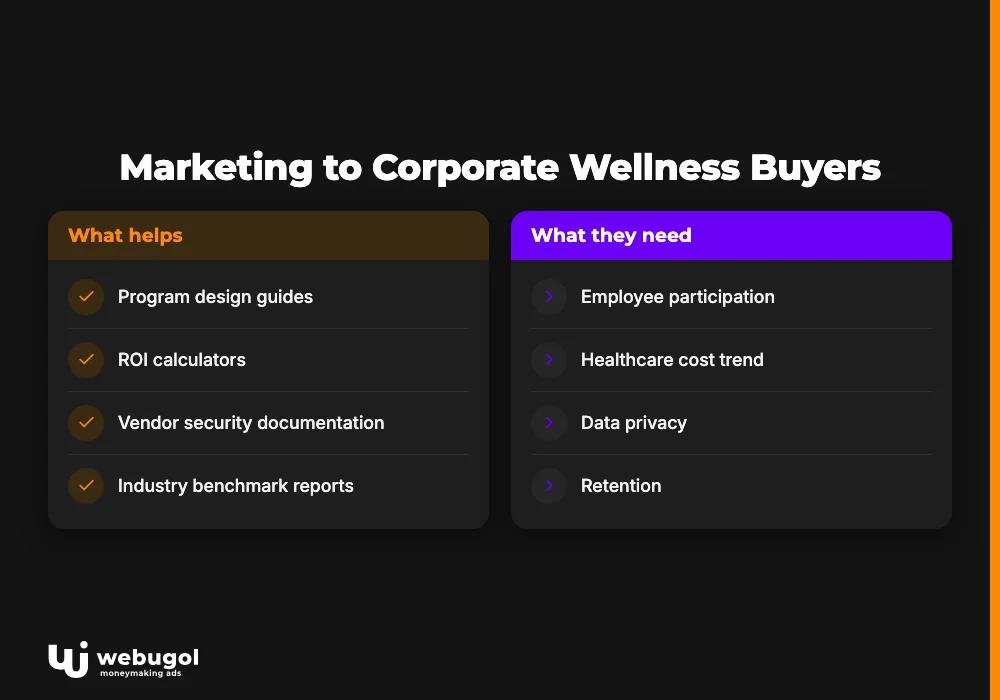
The table below shows how messaging priorities shift by stakeholder:
| Stakeholder | Primary concern | Content that helps |
|---|---|---|
| HR director | Employee participation, admin burden | Program design guides, vendor comparison checklists |
| CFO/Finance | Healthcare cost trend, budget justification | ROI calculators, cost-per-employee benchmarks |
| Legal/Compliance | Data privacy, liability | Vendor security documentation, compliance guides |
| CEO/Executive | Retention, employer brand | Industry benchmark reports, executive summaries |
How do you market wellness programs to HR decision-makers?
The most effective employee wellness program marketing starts by meeting HR leaders at their specific problems, not at a feature list. HR buyers search for solutions to absenteeism, rising claims costs, retention challenges, or compliance requirements. Content that directly addresses those problems builds credibility before any sales conversation begins.
Three formats consistently outperform generic blog posts with this audience:
- Benchmark reports that compare participation rates, claims costs, or program pricing across industries give HR buyers data they can cite internally when justifying spend.
- ROI calculators let buyers model potential savings before they talk to a salesperson, which accelerates the internal approval process.
- Case studies with real numbers give the internal champion something concrete to share. A well-documented case study with participation rates, cost reductions, or retention improvements does more work than a library of feature pages.
Program design templates, compliance guides, and short customer video testimonials focused on measurable outcomes also perform well with this audience. The common thread is content that earns trust before a demo request, then supports the buyer's internal pitch after.
For digital strategy in this space, effective SEO keyword targeting for healthcare follows similar principles: match content to the problems buyers are searching for, not the features you want to promote.
What channels work best for corporate wellness companies?
Channel performance in B2B wellness marketing varies significantly by where a buyer sits in the decision process. Spreading budget evenly across channels regardless of buyer stage is one of the most common ways spend gets wasted.
Awareness stage: HR leaders research "corporate wellness programs," "employee wellness programs," and "workplace wellness" long before they contact a vendor. SEO content and thought-leadership posts on LinkedIn do the heavy lifting here. The buyer is not ready for a sales conversation; they are building a shortlist.
Consideration stage: Once a buyer has two or three vendors under evaluation, comparison content, webinars, and LinkedIn ads targeted at named accounts keep you in the running. Account-based marketing campaigns that target specific company sizes, industries, and existing benefits stacks tend to outperform broad demand generation because the buyer pool for corporate wellness program providers is finite and identifiable.
Decision stage: Case studies, ROI calculators, and sales enablement content matter most here. The internal champion needs material to bring to finance and legal, not a general-purpose product page.
Renewal stage: Often ignored but critical to protecting existing revenue. Satisfaction data, updated benchmark reports, and quarterly business reviews packaged as content keep accounts engaged and create natural upsell opportunities.
Email nurture sequences that deliver benchmark reports, webinar invites, and renewal-season content keep employee benefits marketing present through a sales cycle that can run six to twelve months. The role of social media in healthcare marketing covers how LinkedIn and paid social intersect with these longer B2B timelines.
How to prove ROI of a corporate wellness program to the C-suite?
Every corporate wellness marketing plan should be built around the metrics that move a renewal decision: healthcare cost trend, absenteeism rate, productivity indicators, and employee retention. These are the numbers HR leaders report to finance and executive teams, and connecting your program's outcomes to those figures is what gets budget approved.
Effective employee benefits marketing does not stop at participation rates. It links program engagement to hard cost data: a reduction in claims, a measurable drop in absenteeism, or a retention improvement in a high-turnover role. Programs that can show this link consistently win renewals with less friction than those that rely on engagement numbers alone.
If your marketing materials cannot answer "what is the ROI," your sales team is left answering it cold on every call, often without the data needed to close.
What mistakes do corporate wellness vendors make in marketing?

The most common errors in corporate wellness marketing share a root cause: treating this like a B2C sale.
Marketing to employees instead of the buyer. Feel-good messaging about employee wellbeing has a place, but if your website and ads do not address the HR director's budget constraints and compliance concerns, you attract the wrong audience and generate the wrong kind of traffic.
Leading with features instead of outcomes. A long list of program modules says little without evidence those modules move the metrics HR is measured on. Every feature claim needs a downstream business outcome attached.
Ignoring the renewal-stage buyer. Most wellness company marketing budgets go toward new-logo acquisition. Renewal-stage content, including updated ROI reports and satisfaction data, protects revenue that is already in hand.
Underinvesting in content and SEO. Paid channels are easier to attribute, so they receive disproportionate budget. But organic search compounds over time. In a market with relatively limited content competition, SEO is one of the most efficient channels available to corporate wellness program providers. Why your health and wellness business needs SEO to thrive explains why the long-term return typically outpaces paid at scale.
Ready to build a wellness company marketing strategy that converts?
Corporate wellness marketing requires a different approach than most B2B demand generation, and it is unlike consumer wellness almost entirely. Webugol builds tracking-first, conversion-led growth systems for health and wellness companies, including GA4 and Looker Studio dashboards, cross-channel attribution, and funnel optimization, so you can see exactly which campaigns produce qualified demos, not just clicks.
Our SEO services, Google Ads campaigns, and advanced analytics are built for the full-funnel, ROI-driven marketing this industry demands. Explore our health and wellness industry work, or reach out for a consultation.
Frequently asked questions
What is corporate wellness marketing?
Corporate wellness marketing is the process of promoting wellness programs and services to employers, HR directors, and benefits administrators rather than individual consumers. Messaging focuses on measurable business outcomes: healthcare cost reduction, lower absenteeism, and employee retention, because those are the metrics that drive purchasing and renewal decisions.
How is B2B wellness marketing different from B2C?
B2C wellness sells personal transformation to individuals who make their own buying decisions. B2B wellness marketing must justify program cost to finance stakeholders, prove ROI to executive teams, and satisfy compliance requirements from legal, all before an employee ever engages with the program.
What content works best for reaching HR buyers in employee wellness program marketing?
Benchmark reports, ROI calculators, and case studies with verifiable numbers consistently outperform feature-focused content. These formats give HR buyers data they can use to build an internal business case and get budget approved across multiple stakeholders.
Which channels produce the best results for corporate wellness program providers?
SEO content captures buyers in the research phase, LinkedIn and account-based marketing reach HR and benefits titles directly, and email nurture maintains visibility through sales cycles that typically run six to twelve months.
How do you measure the ROI of a corporate wellness program for the C-suite?
Track healthcare cost trend, absenteeism rate, productivity indicators, and employee retention alongside standard marketing metrics like cost per lead and pipeline generated. Connecting program participation to these business outcomes is what earns renewal decisions and secures ongoing budget approval.