



Semaglutide marketing: legal strategies for clinics and medical spas
Semaglutide marketing covers every paid, organic, and social channel you use to connect patients seeking medical weight loss with the clinic that can provide it. Done right, it generates qualified consultations while meeting FDA, FTC, and HIPAA requirements.
Done wrong, it triggers platform bans and regulatory warnings. This guide gives you a channel-by-channel framework for building a compliant, high-performing semaglutide marketing program.
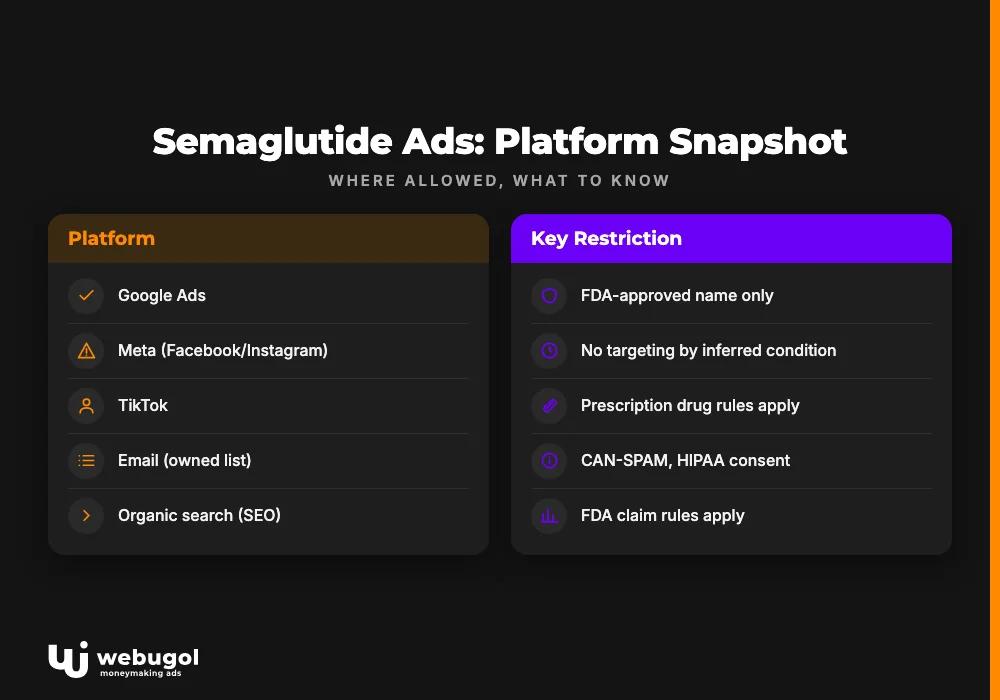
Platform snapshot: where semaglutide ads are allowed
| Platform | Semaglutide ads allowed? | Key restriction |
|---|---|---|
| Google Ads | Yes, with LegitScript certification | FDA-approved drug name only; no off-label claims |
| Meta (Facebook/Instagram) | Limited; health ad authorization required | Cannot target by inferred health condition |
| TikTok | Yes for educational content | Prescription drug promotion rules apply |
| Email (owned list) | Yes | CAN-SPAM and HIPAA consent required |
| Organic search (SEO) | Yes | No platform gate; FDA claim rules still apply |
How to market semaglutide legally in the US?
Marketing semaglutide legally in the US starts with one rule: every claim must be truthful, fairly balanced, and consistent with the FDA-approved label. Start there. Before any ad goes live.
The FDA requires fair balance. Benefits you advertise must be matched by equally clear risk disclosures and side effect information. HIPAA applies the moment a campaign touches patient data, from a remarketing pixel on a consultation page to a segmented email list.
Ethical weight loss clinic promotion also means avoiding language that exploits fear or implies guaranteed outcomes, which would draw FTC scrutiny alongside FDA attention.
Three operational requirements follow. All copy must reference the drug correctly and stay within its approved label. Patient testimonials need signed releases and outcome disclaimers. Any page that collects health information must run on HIPAA-compliant infrastructure.
The classification of obesity as a chronic condition has shifted how patients seek care, with more people turning to medical weight loss programs rather than diet and exercise alone, as reported in health media. GLP-1 agonists have also gained wide awareness thanks to media coverage and high-profile endorsements. That demand already exists. Semaglutide marketing channels it into qualified consultations.
What makes semaglutide advertising FDA-compliant?
FDA-compliant semaglutide advertising has four non-negotiable elements.
Accurate representation: every efficacy claim must match what the FDA-approved label supports. Fair balance: ads of meaningful length must give risk information the same prominence as benefit claims. No misleading omissions: an ad that highlights weight loss results cannot quietly skip contraindications. Clear identification: the ad must be recognizable as a promotion, not editorial content.
The FDA's Office of Prescription Drug Promotion (OPDP) monitors digital advertising, including social media posts. Violations result in warning letters, which are public record.
For medical spa digital ads, the compliance challenge is often organizational. The marketing team and the prescribing provider are frequently different people. Build a documented review checklist: a named approver on record for each creative and a version log for each ad variant. This process adds days to launch but protects the practice from far more costly corrective campaigns later.
What platforms can I use to advertise semaglutide?
Most major platforms allow semaglutide advertising with specific conditions. The table above is your quick reference. Here is what each requires in practice.
How do I run semaglutide ads on Google?
Google's healthcare and medicines policy requires that advertisers promoting prescription drugs in the US obtain LegitScript certification before pharmaceutical ads are approved. LegitScript verifies state licensing requirements and advertising compliance. Without it, the account stays blocked from pharmaceutical ad formats.
Once certified, healthcare Google Ads give you access to search campaigns targeting high-intent queries like "semaglutide weight loss clinic near me." The user is already searching. Your ad appears at peak intent. This makes search advertising efficient for semaglutide patient acquisition compared with channels that reach people who are not actively looking.
To advertise semaglutide online through Google, keep ad copy to approved claims, add site extensions linking to your risk disclosure page, and avoid any wording that implies purchasing medication outside a licensed clinical context.
Meta Ads, social media, and TikTok
Meta requires special ad category status for healthcare campaigns touching sensitive health topics. For semaglutide patient acquisition, behavioral health-condition targeting is off-limits; demographic and geographic targeting replaces it. This matters for reaching your core audience: adults above a specific BMI threshold, people with weight-related health conditions, and those who have not succeeded with other weight loss methods.
Creative carries more weight on Meta than on search. Video content explaining the treatment process builds trust faster than static image ads.
TikTok prohibits direct prescription drug promotion but allows educational content. Short videos explaining how GLP-1 receptor agonists work, or what to expect at a first consultation, build awareness without triggering policy violations. Media coverage and high-profile endorsements have already primed this audience, as health media has widely reported, so educational content meets existing curiosity rather than creating it from scratch.

GLP-1 advertising strategy: content and semaglutide clinic SEO
Paid ads generate leads while the budget runs. Organic search keeps generating leads after it stops. Both matter.
A solid semaglutide clinic SEO strategy starts with landing pages built around high-intent, long-tail queries. Each page should state treatment benefits, the process, and cost structure clearly, with a single prominent call to action. The page is not a brochure. It is the first clinical touchpoint for someone who may have spent weeks researching before clicking.
Blog content fills the funnel above those landing pages. Posts answering specific patient questions, such as the difference between Ozempic and Wegovy or how long results take to appear, attract readers early in the decision process. Internal links from those posts to your consultation page move readers closer to booking.
The market is also growing more competitive: other pharmaceutical companies are entering the space and telemedicine platforms are widening access to GLP-1 therapies, according to the original reporting on this industry. A differentiated content strategy is how an individual clinic stands apart. For a detailed look at how the GLP-1 category is shifting in 2026, the GLP-1 marketing strategies for 2026 overview covers channel economics and in-clinic acquisition models in depth.
Multi-specialty practices can apply the same content architecture to adjacent offerings. The approach used in stem cell therapy marketing follows similar principles and can anchor a broader medical wellness content hub.
Semaglutide patient acquisition through email
Email is the most cost-efficient nurture and retention channel in semaglutide marketing once a lead enters your system.
An email marketing sequence for new leads covers three steps. The first message confirms the inquiry and sets expectations.
The second explains the treatment process in plain language, including how semaglutide works and what a typical schedule looks like. The third addresses the most common concerns about cost, safety, and lifestyle impact, before offering a direct booking link.
For active patients, a monthly newsletter keeps your practice relevant during the maintenance phase. Segment by treatment stage so a patient in week two receives different content than one in month six. Personalization at this level improves both retention and referral rates.
All campaigns must comply with CAN-SPAM and, because they reference health information, with HIPAA consent requirements. Collect explicit opt-in at lead capture, before the first email goes out.

How much does semaglutide marketing cost?
There is no single number. Semaglutide marketing cost depends on channel mix, market size, and how many clinics are competing in your local area.
Search advertising costs more per click in high-competition metro areas, where multiple clinics and telemedicine platforms bid on the same queries. Budget for search, content production, and email automation as separate line items. Mixing them into a single monthly figure makes it impossible to measure return by channel.
The highest-leverage starting point for most practices is a certified Google Ads account paired with a landing page optimized for consultation bookings. That combination captures demand that already exists. Social and content investment builds demand over a longer window. Neither replaces the other. They operate at different stages of the patient decision cycle.
No responsible agency can quote a cost-per-acquisition without auditing your specific market first. The regulatory compliance layer adds creative and legal cost that varies by practice type and geography.
Measuring and optimizing semaglutide marketing performance
A data-driven semaglutide marketing program tracks both leading and lagging indicators. Leading: click-through rate, cost per click, landing page conversion rate. Lagging: consultations booked, patients started, 90-day retention.
Test landing page headlines before testing ad creative. Landing page conversion rate has the largest single impact on cost-per-acquisition, and small improvements compound across the entire ad spend. Test one variable at a time. Let tests run to statistical significance before drawing conclusions.
Google Analytics shows which content drives consultation-intent traffic. Use that signal to guide your content calendar. If posts about insurance coverage outperform posts about mechanism of action, write more of the former.
AI-assisted tools automate bid management and audience segmentation at a scale manual work cannot match. That is where real efficiency gains appear in mature semaglutide patient acquisition programs.
Build a compliant semaglutide marketing program with Webugol
A high-performing semaglutide marketing program requires platform certifications, platform-specific creative, legal review workflows, and analytics infrastructure. Most clinics do not have all four in-house. A digital marketing agency with deep healthcare advertising experience can compress the timeline from initial setup to qualified consultations.
Reach out to Webugol to request a channel audit and a realistic forecast for your market.
FAQ
How do I start semaglutide marketing for my clinic?
Obtain LegitScript certification first if you plan to run Google Ads, then build a HIPAA-compliant landing page and set up CAN-SPAM-compliant email capture before launching any paid campaigns. Compliance infrastructure should be in place before campaigns go live, so build it into your setup timeline.
What is the biggest mistake clinics make in semaglutide advertising?
Publishing efficacy claims without required risk disclosures or using patient testimonials without signed releases and outcome disclaimers. The FDA's Office of Prescription Drug Promotion monitors digital channels, and a resulting warning letter becomes public record.
Can I use patient testimonials in semaglutide ads?
Yes, with conditions. Results must represent typical outcomes or clearly disclose that they are atypical. Each patient must sign a release, and the ad must include a result disclaimer. Without these steps, the testimonial violates both FDA promotional guidelines and FTC endorsement rules.
Does semaglutide marketing work for medical spas?
Yes. Medical spas running compliant semaglutide programs use the same channels as dedicated weight loss clinics: certified search ads, demographics-based social campaigns, and SEO-driven content. Marketing materials must accurately reflect that a licensed prescriber is involved in the clinical workflow.
What is the role of SEO in semaglutide patient acquisition?
SEO captures patients researching treatment options before they are ready to book. A well-optimized landing page and a blog answering common patient questions build a pipeline of informed leads, which shortens the sales cycle and improves consultation conversion rates.