



Best CBD keywords for SEO: research, ranking, and compliance
The best CBD keywords for SEO balance three factors at once: achievable keyword difficulty, meaningful search volume, and compatibility with FDA advertising guidelines. Short-tail terms like "CBD oil" attract enormous traffic. Most CBD brands can't rank for them. Long-tail phrases like "best CBD oil for sleep" convert at higher rates and reach page one faster than broad terms. Picking the right mix is the foundation of any keyword strategy that actually compounds.
What are the best CBD keywords for SEO?
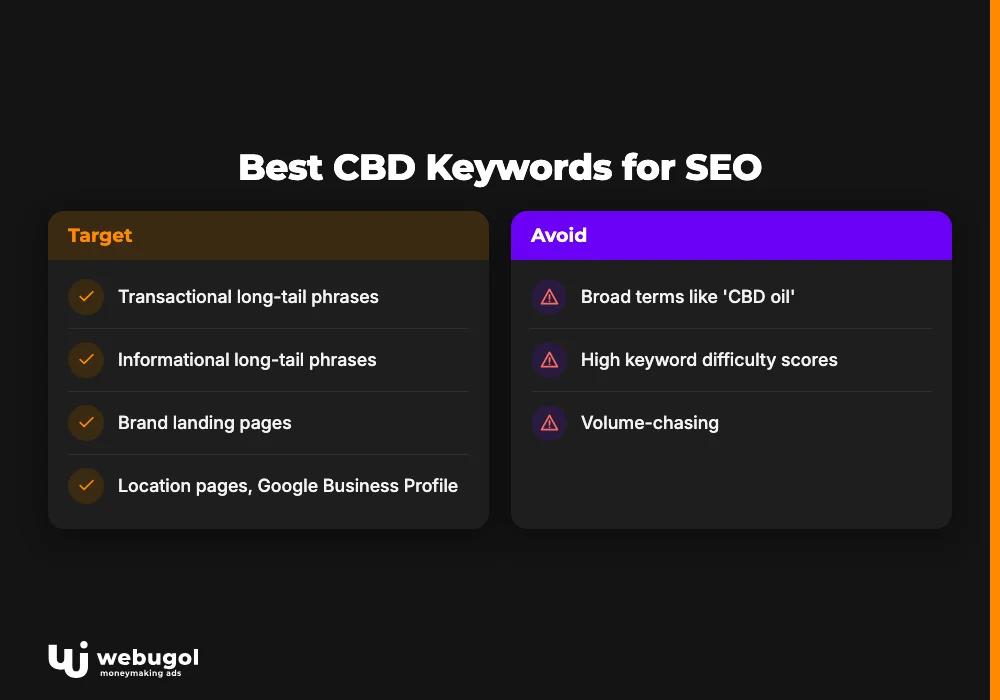
The best CBD keywords fall into four intent categories, each mapped to a different stage of the buying journey and requiring a different content format.
| Intent | Example keywords | Best content format |
|---|---|---|
| Informational | "what is CBD oil," "CBD benefits," "CBD vs THC" | Blog posts, guides |
| Transactional | "buy CBD oil," "best CBD gummies," "CBD tincture sale" | Product pages, comparisons |
| Navigational | "Charlotte's Web CBD," "Medterra official site" | Brand landing pages |
| Local | "CBD shop near me," "CBD oil in Chicago" | Location pages, Google Business Profile |
Broad terms like "CBD oil" or "CBD benefits" carry high keyword difficulty scores. That's a ceiling built for large publishers, not for most growing CBD brands. A practical starting point: target transactional and informational long-tail phrases while building domain authority, then expand toward high-competition terms over 12 to 24 months. Patience and precision beat volume-chasing.
How to do keyword research for a CBD website?
Map the buyer journey first. Before opening any tool, ask who is searching, what they need, and what content format would satisfy that intent. Then run research tools against seed terms drawn from your actual product catalog.
Google Keyword Planner shows volume trends and seasonality for seed terms at no cost. Ahrefs adds difficulty scores, clickstream volume data, and a parent-topic feature that groups semantically related phrases, which prevents two of your pages from competing with each other for the same query. Both tools support structured cbd keyword research that goes beyond a raw list.
Here is the sequence to follow for keywords for cbd oil campaigns:
- Build seed terms from product categories: tinctures, gummies, topicals, capsules, pet products.
- Set a keyword difficulty filter based on your current domain rating (under 30 for new sites, under 50 for sites with 12 months of SEO history).
- Sort remaining terms by intent before assigning them to specific pages.
- Enter each competitor's domain into Ahrefs to surface keywords they rank for that you don't.
- Flag any phrase containing FDA-restricted health claims ("treats," "cures," "prevents") before it reaches a content brief.
Competitor gap analysis gets skipped too often. A rival ranking on page two for a term proves the traffic exists. You just need a better page to take the position.
What CBD keywords have the highest search volume?
Broad cannabis seo keywords top the volume charts. Terms like "CBD oil," "CBD gummies," and "CBD for anxiety" generate the highest raw search numbers but also carry the highest keyword difficulty scores. For most growing brands, these are impractical targets at launch.
The more productive question is: which keywords have enough volume to matter and difficulty low enough to crack? Mid-volume long-tail phrases offer this balance. Terms like "full-spectrum CBD tinctures," "best CBD oil for anxiety," and "CBD gummies for sleep dosage" attract buyers with clear intent at a fraction of the competition that broad terms face.
Seasonality matters too. Demand for pet CBD products has risen as that market segment has grown, creating periodic search spikes. Holiday seasons push gift-adjacent terms into higher-volume windows. Planning content well in advance of these peaks captures the traffic; publishing at peak misses it.
How do I find long-tail CBD keywords?
Long-tail keywords for cbd oil research are phrases of three or more words targeting a specific product, use case, or comparison. "Top-rated CBD oil for anxiety" signals a buyer. "CBD oil" signals curiosity. That distinction separates traffic that converts from traffic that doesn't.
Three reliable sources for long-tail discovery:
- Google's "People also ask" box: Real user questions, pre-sorted by intent. Every question is a potential heading or standalone article.
- Ahrefs Keyword Explorer "Questions" filter: Converts seed terms into question-format phrases that map directly to AEO and FAQ content sections.
- Site search logs: Queries users type into your own site search reveal demand your navigation isn't satisfying.
Long-tail cbd search engine optimization also reduces compliance risk. "CBD oil for relaxation" sidesteps the FDA's prohibition on unapproved disease claims more cleanly than "CBD oil that treats anxiety." Build a compliance check into your evaluation workflow. If a phrase implies a medical claim, reframe it or cut it before it goes live.
For a broader look at how to combine keyword strategy with technical SEO fundamentals, see professional CBD SEO services.

Can CBD companies use Google for keyword targeting?
Yes, for organic search. No, for paid ads. Google and Meta ban paid advertising for CBD products. That removes the fast traffic lever most industries use while organic builds. For CBD brands, every search visit comes from content that earned its ranking through cbd search engine optimization, with no paid backup.
This changes the ROI calculation entirely. Organic search isn't a complement to a paid strategy for CBD companies; it is the strategy. That's why why organic search outperforms paid advertising for CBD wellness brands matters more in this category than almost any other.
The ad ban also tightens keyword selection on the compliance side. Phrases implying medical benefits attract scrutiny from both Google's quality reviewers and FDA enforcement. Use cbd seo tags that attract buyers without making therapeutic claims. "CBD for focus" is workable. "CBD to treat ADHD" is not. For the specific lines Google draws, see our guide to CBD advertising on Google.
Tracking and adjusting your keyword strategy
Rankings shift. Content ages. Competitors publish. A keyword plan needs regular maintenance, not just a strong launch.
Google Search Console is the baseline tracking tool. It shows which queries trigger your pages, average position, impressions, and click-through rate. Pages sitting in positions 8 to 15 for target terms are optimization candidates: they have a relevance signal but need stronger on-page execution. A refreshed heading, a more complete answer section, or additional supporting phrases can move a page from position 12 to position 4 without publishing anything new.
Monthly reviews outperform quarterly ones for CBD brands. The regulatory environment and product landscape shift faster here than in most markets. Pull your top ranking pages each month, verify that the intent behind each target keyword still matches your content format, and identify terms where a competitor has published a more thorough page than yours.
Start building your best CBD keyword strategy
The gap between CBD brands that grow organically and those that stay invisible often traces back to keyword decisions made in the first content sprint. Selecting the right best CBD keywords with a structured process, one that covers intent mapping, difficulty thresholds, competitor gap analysis, and compliance flags, is what separates brands that compound organic traffic year over year from those that plateau early.
Webugol runs full-cycle CBD keyword research and content strategy for brands that need SEO execution and compliance awareness built into the same workflow. Contact us to start with an audit of your current keyword coverage.
FAQ
What are the best CBD keywords for SEO?
The best CBD keywords combine meaningful search volume, achievable keyword difficulty, and clean compliance status. Long-tail phrases like "best CBD oil for anxiety" or "full-spectrum CBD tinctures" consistently outperform broad terms for growing brands because they attract buyers with specific intent and face far less competition.
How do I start CBD keyword research for a new site?
Begin with a seed list drawn from your product categories, then filter by keyword difficulty that matches your current domain rating. Group results by search intent before assigning them to pages, and flag any phrase containing health claims that conflict with FDA guidelines before publishing.
Why can't CBD brands run Google Ads for keyword targeting?
Google prohibits paid advertising for CBD products, removing the fastest route to keyword-driven traffic. This makes organic CBD search engine optimization the primary acquisition channel and raises the stakes on selecting the right long-tail keywords from the outset.
What is keyword stuffing and why does it hurt CBD sites?
Keyword stuffing means repeating a keyword so frequently that the text reads unnaturally. Google's algorithms detect this and may demote the page. For CBD sites, thin or manipulative content can also trigger additional review for quality and compliance concerns.
How often should I update my CBD keyword strategy?
Review rankings and Search Console data monthly. CBD market conditions shift faster than most categories because of regulatory changes and new product launches, so a strategy that performed well six months ago may have significant gaps today.