


What a fractional CMO does in healthcare, and where the revenue path breaks
A fractional CMO for healthcare is a part-time executive who owns brand positioning, channel strategy, budget allocation, and vendor oversight, without the cost of a full-time hire. For clinic owners and telehealth operators in growth mode, the model delivers genuine strategic leadership at a fraction of the fully-loaded executive salary. The core limitation is structural: a fractional CMO healthcare engagement covers the strategy layer, not the revenue path from ad click to booked appointment. That gap determines which model, a fractional strategist or an integrated acquisition system, matches where the business actually is.
What does a fractional CMO do in a healthcare company?
A healthcare fractional CMO owns the full strategic marketing function on a part-time basis. The role steers brand positioning, funnel architecture, and vendor relationships while staying upstream of execution.
Core responsibilities in a healthcare context:
- Brand positioning and offer framing aligned with compliance guardrails, whether the service line is a GLP-1 program, TRT, advanced diagnostics, or regenerative medicine.
- Channel strategy and budget allocation across paid search, paid social, and organic, with a working understanding of which platform policies apply to each service category.
- Compliance coordination: mapping the approval chain so that creative, landing pages, and retargeting configurations pass through the compliance team before launch.
- Vendor oversight: holding the media buyer, developer, CRM specialist, and analytics team accountable to defined revenue outcomes rather than siloed deliverables.
- KPI framing: translating business targets such as cost per booked consult, show rate, and program starts into marketing goals the team can act on.
- Platform policy navigation: understanding Google and Meta health advertising restrictions before a campaign is built, not after a policy rejection notice.
That scope is genuinely valuable. Where it ends matters equally.
Where the fractional CMO healthcare scope typically ends
A fractional CMO for healthcare owns the strategy layer. The revenue path from ad click to recognized revenue sits below that layer, and responsibility for it is rarely written into a fractional contract.
Each vendor in the stack operates correctly within their own scope. The media buyer optimizes the campaign. The developer ships the page. The CRM specialist configures the workflow.
No individual vendor is paid to look at the white space between their scope and the next person's. That white space is where revenue leaks.
The handoff problem: from click to revenue, who owns what?
The pattern most fractional CMO healthcare operators describe before moving to an integrated model looks like this: ad CPLs are strong, leads enter the CRM, and booked appointments are flat. The gap is almost never in the ad account. It lives in the handoffs.
Comparing how specialized and integrated models distribute accountability shows the difference is not strategy quality. It is ownership of the space between vendors.
| Dimension | Fractional CMO | Full patient acquisition system |
|---|---|---|
| Scope of ownership | Strategy: positioning, channels, budget | End-to-end: ad account to booked appointment |
| Compliance implementation | Strategy and risk flags; execution sits with vendors | Compliance built into tracking, consent mode, and platform approvals |
| Handoff accountability | Outside fractional scope | Single team owns every handoff |
| Exit and continuity risk | Institutional knowledge embedded in one person | Systems documented; continuity built into the team structure |
| Timeline to first results | 60-90 days for decision-ready data | Tracking foundation in two weeks; lead quality trends by day 30-45 |
Can a fractional CMO manage HIPAA-compliant marketing?
A fractional CMO can set the compliance strategy and flag risks before a campaign launches. The implementation, including consent mode configuration, HIPAA-compatible tracking, and platform-level policy submissions, requires hands-on execution that sits outside a typical fractional engagement.
Healthcare advertising compliance is not a one-time checklist. Google and Meta require separate policy approvals for different health-related campaign types, and those approvals can be revoked.
Retargeting on medical conditions is restricted at the platform level, not just under HIPAA. Every creative asset and landing page must pass through the compliance approver before it goes live, and that approval chain needs to be built into the campaign workflow from day one.
A fractional CMO healthcare engagement can architect that approval chain and oversee it at the strategic level. The hands-on configuration still needs an execution team. Understanding how HIPAA-compliant scheduling and intake tools fit into the broader compliance infrastructure is part of the same picture.
How long before a healthcare fractional CMO shows results?
Meaningful, decision-ready performance data typically emerges at 60-90 days, not 30. The first month is almost entirely diagnostic and foundational: market analysis, offer framing, funnel audit, and tracking review. That work is necessary, but it produces plans and recommendations, not campaign metrics.
This is the honest fractional CMO healthcare timeline. It is not a flaw in the model; it is the structural arc of any engagement that starts from the strategy layer. For clinic owners and telehealth operators working against a specific growth window, the question is whether that ramp time matches the business situation.
Month-by-month breakdown: what actually happens in the first quarter
Month 1 covers the strategic foundation: market intelligence, competitor positioning, offer framing, and a full funnel audit from tracking to intake. The output is a documented strategy and channel plan. Live campaigns have not launched yet.
Month 2 covers asset development and campaign launch, including tracking foundation, landing pages, and initial campaign structure. Early data starts flowing. Sample sizes are too small for confident optimization decisions.
Month 3 is the first period where daily performance optimization is grounded in sufficient data. Cost-per-acquisition trends become clear enough to make scaling decisions. For clinic owners and telehealth operators making that commitment, understanding what a realistic first-quarter patient growth trajectory looks like matters before selecting the engagement model.
If the 90-day window is the pressure you are working against, the Healthcare Growth System combines strategy, tracking implementation, and execution accountability from week one. The clock on measurable results starts on day one rather than after a month of planning.
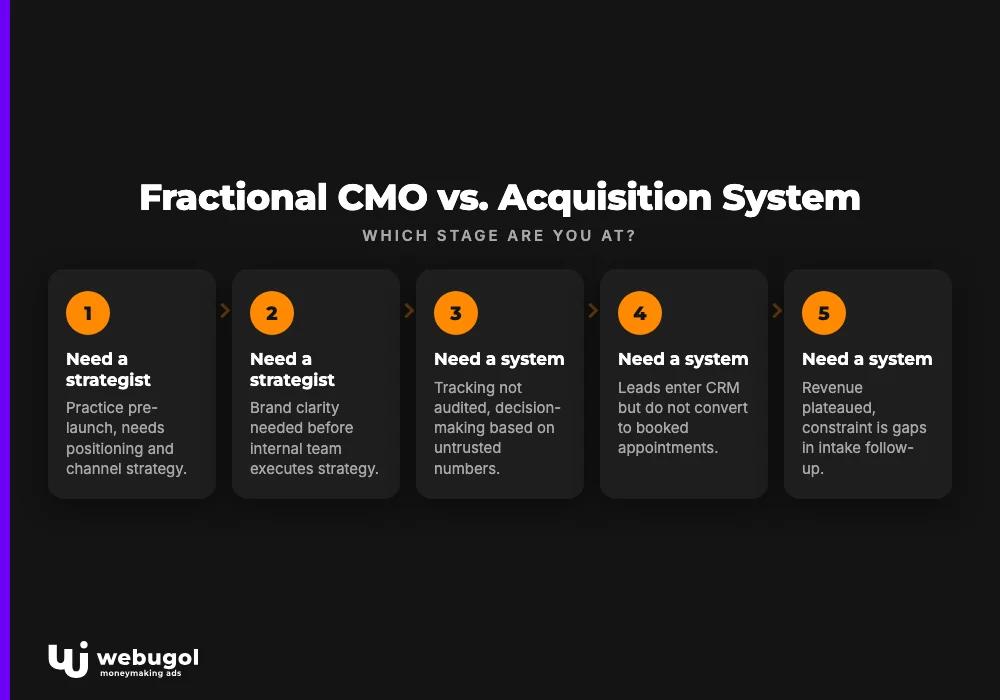
Fractional CMO vs. full patient acquisition system: which stage are you at?
A fractional CMO for healthcare is the right model at a specific stage of marketing maturity. An integrated acquisition system is the right model at another. The decision is diagnostic, not adversarial.
Webugol builds tracking-first, conversion-led acquisition systems for US healthcare providers, owning the full revenue path from ad click to booked appointment. The core observation is that failures in healthcare marketing rarely live in a single vendor's work. They live in the handoffs between vendors, and no individual vendor is paid to own those handoffs.
Signs you need a strategist vs. signs you need a system
Signs the fractional CMO model fits:
- The practice is pre-launch and needs positioning and channel strategy before any paid spend begins.
- Brand clarity and offer framing are needed before the internal team can execute a defined strategy.
- A capable internal team exists and can run a clearly documented plan.
- The existing marketing structure needs better direction, not a structural rebuild.
Signs you need a full acquisition system:
- Tracking has not been audited end-to-end in over a year, and decision-making is based on numbers nobody fully trusts.
- Leads enter the CRM but do not convert to booked appointments, and no single vendor can isolate why.
- A previous CMO or agency exited and performance collapsed within weeks, signaling that institutional knowledge lived in one person rather than in documented systems.
- Revenue has plateaued and the constraint is not strategy quality but gaps in intake follow-up, lead routing, or the offer itself.
The pattern Webugol sees in telehealth practices that move from "spend and hope" to a measurable acquisition system points to the same root cause: the revenue path had no single owner, and the handoffs were unmanaged.
What happens when the fractional CMO exits
Without documented systems, the institutional knowledge built during a fractional CMO healthcare engagement leaves with the person. This is a structural reality to plan for, not a reason to avoid the model entirely.
The risk in a fractional CMO healthcare arrangement shows up in three places. Undocumented tracking setups are the most common first loss: if the CMO was the only person who understood how offline conversions mapped to pipeline stages, that knowledge is gone on their last day.
Compliance context is the second exposure. The reasoning behind ad copy approvals, the platform policy submissions in progress, and the retargeting restrictions applied for regulatory reasons are all embedded in one person's memory.
Vendor relationships without a handoff plan are the third. The media buyer and developer knew the CMO's preferences, not the business's documented requirements. Planning for continuity before the engagement ends is part of what a well-structured fractional arrangement includes.
Is a patient acquisition sprint right for your practice?
If the gap between strategy and execution ownership is the constraint you are managing, the Healthcare Growth System closes it in 90 days. The program combines strategy, tracking implementation, funnel development, and daily performance management as a single system owned by one accountable team. Book a Strategy Call to find out whether your current structure has the foundation to scale, or whether the revenue path needs a rebuild before you increase spend.
FAQ
What does a fractional CMO do in a healthcare company?
A fractional CMO in a healthcare company owns brand positioning, channel strategy, budget allocation, and vendor oversight on a part-time basis. The role includes compliance coordination, platform policy navigation, and performance KPI framing specific to healthcare marketing. Execution of campaigns, tracking implementation, and CRM configuration typically sit with separate vendors.
How much does a fractional CMO cost for a medical practice or telehealth company?
Fractional CMO engagements are typically priced on a monthly retainer, with rates varying by scope, seniority, and the degree of execution oversight included. Most healthcare practices at meaningful marketing scale budget a significant monthly investment for executive-level strategic leadership. Exact pricing is engagement-specific and quoted after a scope discovery call.
What's the difference between a fractional CMO and a healthcare marketing agency?
A fractional CMO provides strategic leadership as an embedded part-time executive rather than an external vendor. A healthcare marketing agency typically executes within a defined channel or service scope and reports into the strategic layer. The accountability structure differs: the CMO sits in the leadership layer while the agency is accountable to it for execution.
Can a fractional CMO manage HIPAA-compliant marketing?
A fractional CMO can design the compliance strategy, map the approval chain, and oversee compliance risk at the strategic level. Hands-on implementation of consent mode configuration, HIPAA-compatible tracking, and platform policy submissions requires execution resources outside a typical fractional engagement. Both strategy and execution must be in place for a healthcare marketing program to run legally.
How long before a fractional CMO shows results in a clinic?
Decision-ready performance data typically emerges at 60 to 90 days. Month one covers strategy and auditing; month two covers asset builds and campaign launch; month three is the first period with enough data to make confident scaling decisions. Month one rarely produces revenue metrics.