



Facebook Ads for Healthcare Providers: What Actually Works in 2026
Facebook ads for healthcare practices generate consistent patient appointments, but the rules governing healthcare social media marketing changed substantially in 2024 and 2025. Meta now restricts pixel-based conversion tracking for health and wellness advertisers, limits detailed health-related audience segments, and applies category-level content review to health campaigns. Practices that updated their compliance and measurement foundation continue booking patients through Facebook at scale. Those still running older playbooks burn ad spend with no visibility into why conversions stall.
This guide covers what targeting remains available, what HIPAA demands in practice, which formats work for medical practice advertising, and what the cost structure looks like for healthcare advertisers in 2026.
If you are building your first healthcare Facebook marketing campaign, the compliance requirements here apply from day one. If you already manage $20,000 or more per month in ad spend and have plateaued, the structural gaps below are almost always the cause. The beginner's problem and the established clinic's plateau are the same underlying problem at different scale: without a proper compliance and measurement foundation, you optimize the wrong signals and scale a broken system.
Are Facebook ads allowed for healthcare providers?
Yes, with category-specific restrictions. Facebook ads for healthcare providers are permitted under Meta's advertising policies. Health and wellness advertisers face rules, however, that do not apply to other industries.
Meta restricts detailed health-related targeting. Audience segments built from chronic illness interests, medication behavior signals, or diagnosis-adjacent keywords are not available for healthcare digital advertising. The platform also restricts certain conversion tracking events for health and wellness landing pages. Standard lead or purchase events may not pass back to Ads Manager correctly for health-related content.
What remains: location targeting, demographic signals, interest categories like fitness and wellness, lookalike audiences built from anonymized patient contact lists, and engagement-based audiences from video viewers or page followers. These options are sufficient to reach relevant local populations at scale when campaigns are structured correctly.
Meta ads for clinics carry real constraints. They have not made the channel unworkable for patient acquisition.
What targeting options does Facebook offer for healthcare marketing?
Meta's available targeting for healthcare social media marketing falls into four categories that remained intact after the 2024 policy changes.
Geographic targeting is the foundation of local patient acquisition on Facebook. Radius targeting around a clinic location, city-level targeting, and ZIP code exclusions all remain available. A practice with a defined service area can reach nearby residents without relying on condition-based signals. For practices also building organic local visibility, working with a specialized local search partner ensures paid and organic discovery reinforce the same patient conversion path.
Demographic targeting covers age, gender, and life-stage signals. For many healthcare verticals, demographics alone narrow the audience substantially. A men's health or testosterone replacement clinic can target men aged 35 to 65 without flagging any health condition. A maternal health practice uses parental or life-stage signals that do not carry diagnosis associations.
Interest targeting now covers a narrower range than it did before 2024. Wellness, fitness, nutrition, and general health lifestyle interests remain available. Condition-specific interests, medication-related behavioral signals, and chronic illness categories were restricted across Meta platforms to reduce health data exposure to third parties.
Custom and lookalike audiences are the highest-leverage targeting option for established practices. Upload a HIPAA-compliant hashed contact list, names and emails only, never health data, and Meta builds a matched audience from existing users. From that match, the platform constructs a lookalike of users with similar profiles. This is how clinics managing large ad budgets find high-quality cold audiences at efficient cost.
Practices just starting with facebook healthcare marketing can rely on geographic and demographic targeting to build initial volume. Practices spending at scale, with validated audiences and results to build from, see the strongest efficiency gains through custom and lookalike targeting.
For an overview of how social media channels compare for healthcare patient engagement, including organic versus paid benchmarks, see social media trends in healthcare marketing.
What types of Facebook ads work best for clinics?
Format choice depends on where the prospective patient sits in the decision process.
| Ad Format | Primary Use | Why It Works for Healthcare |
|---|---|---|
| Video ads | Provider introductions, condition education | Builds credibility; higher average engagement than static |
| Image ads | Service promotions, local awareness | Fast to test; low production cost |
| Carousel ads | Multiple service lines or program steps | Patients self-select the panel that applies to them |
| Lead ads | Direct appointment or consultation requests | Submits without leaving Facebook; reduces drop-off |
| Slideshow ads | Multi-step program explanations | Loads fast on low bandwidth; accessible across device types |
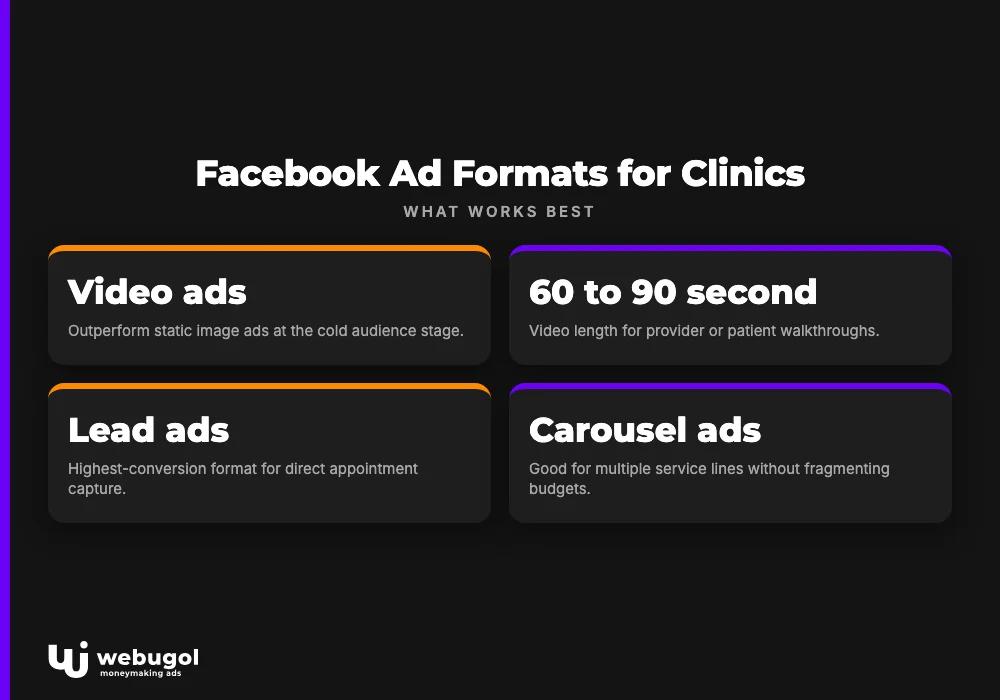
Video ads outperform static image ads consistently at the cold audience stage. A 60 to 90 second video featuring a provider or patient walkthrough addresses the credibility question before asking for a conversion. This matters more in healthcare than in most categories. Prospective patients evaluating a new clinic are assessing trust first.
Lead ads are the highest-conversion format for direct appointment capture. The user clicks, Meta auto-fills contact information from their Facebook profile, and the form submits without leaving the app. For programs with direct consultation offers, such as weight loss assessments or men's health evaluations, lead ads reduce the friction between interest and submission substantially. They also generate faster response-cycle opportunities because the submission is instant.
Carousel ads work when a practice covers multiple service lines and does not want to fragment budgets across separate single-service campaigns. A user scrolling through panels self-selects what applies to them. Simple segmentation with no audience split required.
Image ads remain the fastest format to test and iterate. For retargeting campaigns, where the audience already knows the practice, a direct image ad with an appointment offer outperforms educational video. Retargeting audiences do not need more information. They need a reason to book now.
Slideshow ads are underused in facebook ads for healthcare. They explain complex procedures or multi-step programs in a simple, accessible format and load quickly on low-bandwidth mobile connections.
How much do Facebook ads cost for medical practices?
Healthcare is among the more expensive categories on Meta. CPMs and CPLs vary by vertical, location, audience size, and campaign objective. No single benchmark applies across all practice types.
The variable that matters most is patient economics. Medical practice advertising on Facebook runs at higher CPLs than most consumer categories because the lifetime value of a healthcare patient justifies higher acquisition costs. Budget planning for facebook ads for healthcare should work backwards from patient economics, not forwards from an arbitrary monthly spend target.
Start with your target cost-per-acquisition. Divide by your historical close rate to get the maximum cost-per-lead you can sustain. That ceiling tells you how much you can spend per submitted lead and still hit revenue targets. Without this calculation, monthly budgets are guesses.
Healthcare practices running validated acquisition programs typically operate in the $10,000 to $100,000 per month range in Meta ad spend, the range consistent with the clinic and telehealth profile that has moved past early testing. Starting spend should be large enough to generate statistically meaningful data across target audience segments.
Concentrating budget works better than distributing it. A focused allocation across two well-defined campaigns consistently outperforms the same budget spread across eight fragmented ad sets. For specific guidance on pacing budgets across campaign types for health programs, see Facebook ad budget strategy for health programs.

How Do Facebook Ads for Healthcare Comply With HIPAA?
HIPAA compliance in facebook healthcare marketing is not optional. It is a hard legal requirement and a practical prerequisite for running campaigns without risk of ad account suspension or regulatory exposure.
The core rule: never send protected health information (PHI) to Meta. PHI includes diagnoses, treatment details, prescription data, and any information that connects a specific individual to a health condition. Standard pixel implementations capture PHI unintentionally, often without the advertiser knowing. A URL containing a condition name, a form field that records a symptom, or a booking confirmation URL with a service identifier can trigger a pixel event that sends health-related data to Meta's servers.
Four compliance steps matter in practice.
Audit your pixel implementation. Review whether any URL parameters or page slugs contain condition names or treatment identifiers. If a user visits a URL that includes a health-related term, the pixel event associated with that page view may attach health-context to data sent to Meta.
Configure Conversion API (CAPI) through a server-side integration. CAPI gives you direct control over which events fire and which parameters they include. This removes the risk of automatic PHI capture that browser-only pixels carry. For any healthcare advertiser running more than basic awareness campaigns, CAPI is required, not optional.
Understand the Business Associate Agreement situation. Meta does not sign BAAs. PHI cannot go to Meta under any circumstances. Aggregate conversion signals and anonymized event data, yes. Individual health records, appointment condition data, or diagnosis-linked identifiers, never. There is no gray area here.
Use hashed contact lists for custom audiences. Hash email addresses locally before uploading. Never upload lists that connect contact information to health conditions, appointment types, or treatment categories.
For practices building a patient content strategy for medical practices alongside paid campaigns, these data-handling rules apply equally to collected engagement data.
The common exposure pattern: a practice launches campaigns quickly, installs standard pixel event tracking, and routes form submissions through a booking tool that was never reviewed for pixel compatibility. The pixel captures form field values that include PHI and sends them to Meta. This is discovered during an internal audit or after a platform policy flag, sometimes months later. The result is a pause on active campaigns, a compliance review, and lost acquisition momentum during a window that cannot be recovered.
From ad campaigns to a patient acquisition system
Individual campaigns can generate appointments at a predictable cost. A properly configured lead generation campaign for a specific program, running to a qualified audience, works. The gap between a working campaign and a scalable acquisition system is where most established clinics plateau.
The plateau is almost never a Facebook problem.
The ad delivers a click. What happens next determines whether that click becomes revenue.
Speed-to-lead is the most consistent drop-off point in healthcare advertising. A prospective patient submits a lead ad form on Facebook. If the practice responds within five minutes, contact rates are substantially higher than if the follow-up comes hours later. Lead ads generate instant submissions that often sit unrouted in a CRM while the practice team processes them. That is not a campaign failure. It is a handoff failure between the ad platform and the intake workflow.
Show rate is the second common leak. A clinic can generate strong monthly booking volume through Meta ads for clinics and still lose 25 to 30 percent of those appointments to no-shows. The confirmation sequence, reminder timing, and nurture messaging between booking and appointment are marketing functions that determine whether Facebook ad spend produces actual patient revenue. Show rate belongs to marketing, not only to scheduling.
Tracking completeness is the structural problem beneath both of the above. Without end-to-end visibility from ad click to closed patient, campaign optimization is built on incomplete data. Healthcare advertisers running significant monthly spend who cannot connect Facebook cost to downstream revenue cannot identify which campaigns generate patients, which generate unqualified leads, and which are being optimized toward a metric that does not reflect business outcome.
These problems do not belong to new advertisers alone. They appear routinely in practices with experienced operators, real budgets, and multiple marketing vendors. The campaigns may be performing. The creative may be converting. But if lead routing is slow, nurture is absent, and tracking is broken, you are losing revenue that the ad spend already paid to acquire.
Webugol's approach to facebook ads for healthcare practices starts with closing these structural gaps before scaling spend. The diagnostic question is always the same: where in the acquisition path does the system break? The client outcomes in Webugol's healthcare portfolio, including the Valhalla Vitality and Ways2Well cases, start with a tracking and funnel audit, not a new campaign launch. The results come from fixing the handoffs between click and patient, not from running more ads against a system that already leaks.

Stop losing revenue your ads already paid for
If your Facebook campaigns generate leads but those leads do not convert to booked, attended appointments, the problem is almost never the ads. It is the acquisition path between the click and the patient.
Webugol's Healthcare Growth System is a 90-day sprint built for healthcare practices and telehealth companies that want to turn ad spend into a predictable, measurable patient acquisition system. It starts with a full tracking and funnel diagnostic, covers campaign build across Meta advertising for healthcare and Google, and includes the nurture sequencing and intake operations that make cost-per-patient consistent and scalable. Weekly growth calls, daily optimization, and monthly executive reporting give you the visibility to make decisions based on what is actually happening.
Book a Strategy Call to find out where your current acquisition system is leaking and what fixing it is worth to your practice.
FAQ
Are Facebook ads effective for healthcare providers?
Yes. Healthcare providers across telehealth, weight loss, men's health, and multi-location clinic verticals generate consistent appointment bookings through Facebook. Effectiveness depends on compliance configuration, audience structure, and whether the intake process handles leads fast enough to convert the volume that campaigns deliver.
What is HIPAA compliance for Facebook advertising?
HIPAA compliance in Facebook advertising means never sending protected health information to Meta. In practice, this requires auditing your pixel for PHI capture, configuring server-side Conversion API, and uploading only hashed contact data for custom audiences, never condition-linked or appointment-linked records.
How much should a medical practice budget for Facebook ads?
Budget planning should work backwards from your target cost-per-acquisition and patient lifetime value. The right monthly spend depends on audience size, campaign objective, and how much statistical data each campaign needs to optimize effectively. Healthcare practices running validated acquisition programs typically operate with Meta ad spend in the $10,000 to $100,000 per month range.
What Facebook targeting is still available for healthcare advertisers?
Geographic targeting, demographic signals, interest categories like fitness and wellness, custom audiences from hashed contact lists, and lookalike audiences built from those matches remain available. Condition-specific, medication-related, and chronic illness targeting segments were restricted under Meta's 2024 healthcare advertising policy updates.
What types of Facebook ads work best for clinic patient acquisition?
Video ads perform best at the cold audience stage because they build provider credibility before requesting a conversion. Lead ads reduce submission friction by keeping users on Facebook instead of routing them to an external landing page. Carousel ads work well when a clinic offers multiple service lines and wants prospective patients to self-select the relevant one.

