



AI appointment scheduling for healthcare clinics: cut no-shows and fill after-hours slots
AI appointment scheduling automates patient booking across phone, chat, and web around the clock, without front-desk staff. The category covers software that uses artificial intelligence to handle booking requests through voice, chat, and web interfaces, returning a confirmed appointment without a human in the loop. For US clinics and telehealth providers running paid media, the revenue consequence is direct: every hour the booking path is closed, acquisition spend generates leads that convert for a competitor instead. Closing the after-hours gap is one lever; connecting the scheduler to the full acquisition funnel is what turns it from a booking tool into a revenue asset.
What is AI appointment scheduling for healthcare clinics?
AI appointment scheduling is software that uses artificial intelligence to handle patient booking requests through voice, chat, and web interfaces without requiring a human to manage each interaction. The difference from general-purpose schedulers like Calendly or Motion is not feature depth. It is the clinical-grade infrastructure those tools were never built to provide.
Generic B2B productivity schedulers were designed for professionals coordinating internal meetings. They lack the architecture a clinical environment requires. Before evaluating any healthcare scheduling software for your practice, confirm it does not fail on these five criteria:
- No Business Associate Agreement available. A scheduler that cannot sign a BAA cannot legally process patient information, regardless of how capable its booking logic is. This is a disqualifying constraint, not a configuration issue.
- It treats all appointment types as equal. A 15-minute follow-up and a 90-minute GLP-1 consultation are not interchangeable slots. Tools without procedure-specific duration logic create calendar conflicts and require manual correction.
- No EHR integration. A scheduler that books in isolation from your clinical record system guarantees double-booking risk and forces front-desk staff to duplicate data entry between systems.
- Fixed-interval reminders with no self-rescheduling. Effective patient no-show reduction requires behavior-timed sequences. A single 24-hour reminder applied uniformly across all appointment types is not a strategy.
- Web-only booking with no inbound phone capability. A significant share of patients, particularly in older demographics and high-volume GLP-1 or weight loss practices, default to calling. Without an AI voice layer, the after-hours phone gap stays open regardless of how well your web booking form converts.
The decision between clinical healthcare scheduling software and AI-layered clinic booking automation shapes every integration and compliance decision that follows. It belongs at the start of the evaluation process, not after a demo.
This applies whether you are launching your first practice or running a clinic that has already plateaued: the structural weakness that causes a new operator to miss after-hours bookings is the same gap that caps CPA efficiency at scale.
How does AI scheduling reduce patient no-shows?
The system reduces no-shows by delivering automated, multi-channel reminders timed to patient behavior and by enabling self-rescheduling before an empty slot becomes lost revenue. The mechanics matter more than the promise. A confirmation sequence running across SMS, email, and voice, staged at defined intervals, gives patients multiple paths to confirm or move their appointment without any staff involvement.
The pattern in telehealth practices: reminder timing outperforms reminder frequency. A 72-hour confirmation, a 24-hour re-confirmation, and a same-day access link converts a meaningful share of potential no-shows into attended appointments. Adding a self-rescheduling link to the 72-hour message turns cancellations into reschedules rather than lost slots.
The compounding cost extends beyond the single missed visit. When a slot goes unfilled, your cost per acquired patient increases for every patient who did show. The math runs against you. A practice running $20,000 per month in paid media with a high no-show rate is subsidizing cancellations with acquisition spend. Strategies that reduce patient no-shows most consistently address both the reminder sequence and the self-rescheduling window at the same time.
No-show cost calculator:
| Variable | Example value |
|---|---|
| Provider slots per week | 80 |
| Average visit value | $200 |
| Weekly revenue at full capacity | $16,000 |
| No-show rate | 15% |
| Weekly revenue lost to no-shows | $2,400 |
| Monthly revenue at risk | $9,600 |
Example values are illustrative round numbers. Run this arithmetic on your own slot count, average visit value, and current no-show rate.
Show rate belongs to the scheduling layer. If no-show attribution currently routes to the media buyer, you are auditing the wrong system.
Key features to demand from AI scheduling tools in healthcare
Not every AI appointment scheduling product marketed to clinics is production-ready for a clinical environment. Both the CMO making the procurement case and the compliance approver reviewing the contract should clear the same list before any vendor conversation moves to a demo.
Healthcare AI scheduling feature checklist:
- Signed BAA executed before any PHI enters the system. Not optional. Not retroactive.
- HIPAA-compliant data storage with documented residency. Confirm the cloud region and certification level before signing.
- Two-way EHR sync. Read and write, not read-only.
- Multi-channel reminder sequences configurable by appointment type. SMS, email, and voice.
- Self-rescheduling capability. Patients who can reschedule do not cancel.
- AI voice agent for inbound and outbound calls. This is the mechanism that closes the after-hours phone gap.
- Procedure-specific slot logic. Different appointment types require different durations and intake requirements.
- Audit logs and role-based access controls. Required for ongoing HIPAA compliance review.
- Real-time availability sync across all providers. Multi-provider practices cannot prevent double-booking without this.
Is AI appointment scheduling HIPAA compliant?
Not all AI schedulers are HIPAA compliant. Compliance requires a signed Business Associate Agreement before any patient data is processed, encrypted PHI handling at rest and in transit, and data residency on HIPAA-certified infrastructure.
The gap in practice: many AI appointment scheduling products carry a BAA addendum without a structural audit of how PHI actually flows through their system. Before contracting any HIPAA scheduling tool, request the vendor's most recent HIPAA risk assessment, confirm the specific cloud region where patient data is stored, and verify that reminder and voice channels are in scope for that assessment. A tool that processes bookings through a HIPAA-certified layer but delivers reminders through an uncertified SMS provider has created a PHI exposure vector that neither party has formally reviewed. For a full pre-contract compliance checklist, the scheduling software HIPAA verification guide covers every question your compliance approver needs answered before sign-off.
AI voice agents vs. chatbots: which fits your patient journey?
Voice agents handle inbound phone calls and outbound confirmation reminders autonomously. Chatbots handle web and SMS interactions. The right modality depends on how patients in your specific specialty prefer to reach the clinic. That is a data question, not a default assumption.
A voice agent outperforms a chatbot in three specific scenarios: after-hours inbound calls from patients who default to phone regardless of web booking availability; outbound reminder calls to older patient demographics with lower SMS engagement rates; and high-volume inbound surges from GLP-1 or weight loss campaigns where call volume spikes within 48 hours of a launch.
Chatbots consistently outperform voice in web intake forms, pre-appointment questionnaires, and SMS self-rescheduling flows where the patient is already in a text-based channel. Telehealth practices serving distributed, younger patient populations typically find that a chatbot-led scheduling flow with voice escalation handles the bulk of their volume. Dental practices and specialty clinics with established older patient bases often invert this: voice-first, with web as the secondary channel.
AI appointment scheduling by specialty
Clinic booking automation fails when applied without modification to workflows built around specialty-specific slot durations, intake requirements, or compliance structures that general tools were not designed to support. Three specialties illustrate where general AI appointment scheduling tools break down and what a purpose-built system handles differently.
Telehealth and virtual clinics
Telehealth scheduling requires timezone-aware booking, video platform integration, and instant consent capture that in-clinic tools do not support natively. A patient booking a video consult from a different timezone than the clinic's billing state receives the wrong appointment time without explicit timezone logic in the booking flow. For distributed patient populations, this is not a rare edge case.
The AI appointment scheduling flow for virtual-first operations needs to deliver intake documents and digital consent forms before the visit, not as a post-booking step someone on staff chases. Platforms that auto-generate video links for Zoom, Doxy.me, or Microsoft Teams directly in the confirmation message and include them again in the medical appointment reminders treat this as a baseline requirement. For practices booking dozens of virtual visits daily, a tool that confirms a time without generating the access link creates a manual step that does not scale.
Dental and specialty practices
Dental AI scheduling must handle procedure-specific slot durations, multi-provider calendar management, and hygiene recall automation in a single connected system. A standard scheduling tool has no concept of the difference between a new patient exam, a prophylaxis, a crown prep, and an emergency extraction. Without procedure-aware slot logic, the booking flow over-schedules high-value provider time or leaves capacity gaps that could have been filled.
Hygiene recall is where most general schedulers leave a retention gap unaddressed. A patient who completes a prophylaxis and receives an automated re-booking prompt at the clinically appropriate interval returns at a higher rate than one who receives a generic recall notice months later. Dental practices that automate recall within their scheduling workflow protect retention revenue that would otherwise require active outreach from front-desk staff.
Weight loss and GLP-1 clinics
High-volume GLP-1 consultation flows require both speed-to-lead and built-in intake qualification. A paid campaign generating 200 consultation requests in a single week creates a staffing problem if every request books an unqualified slot before eligibility is confirmed.
Embedding a qualification step directly in the booking flow reduces downstream no-shows by ensuring the patient arriving for a consult is already aligned on program requirements. A brief eligibility screener covering BMI threshold and prior GLP-1 experience is sufficient to filter the flow. The AI appointment scheduling workflow for weight loss programs should route qualified leads to immediate booking and flag off-protocol cases for staff review before a slot is confirmed. This protects provider time and paid media efficiency by preventing low-intent consultations from occupying slots a qualifying patient would have converted.

7 AI scheduling tools for healthcare compared
The table below applies a healthcare-only filter to the leading AI appointment scheduling tools. Each entry reflects the clinical-grade criteria above, not general scheduling capability.
| Tool | HIPAA compliant | Voice agent | EHR integration | Starting price |
|---|---|---|---|---|
| Hyro | Yes | Yes | Epic, Salesforce | Custom |
| Luma Health | Yes | No | Epic, Cerner, 50+ | Custom |
| NexHealth | Yes | No | 50+ EHR systems | Custom |
| Klara | Yes | No | Multiple EHRs | Custom |
| Smith.ai | BAA available | Yes (hybrid) | Via Zapier/CRM | Per-call; quote-based |
| Doctible | Yes | Yes | 100+ integrations | Custom |
| Calendly (HIPAA plan) | BAA required | No | Limited | Custom (Enterprise) |
Which AI scheduling tool is best for small clinics?
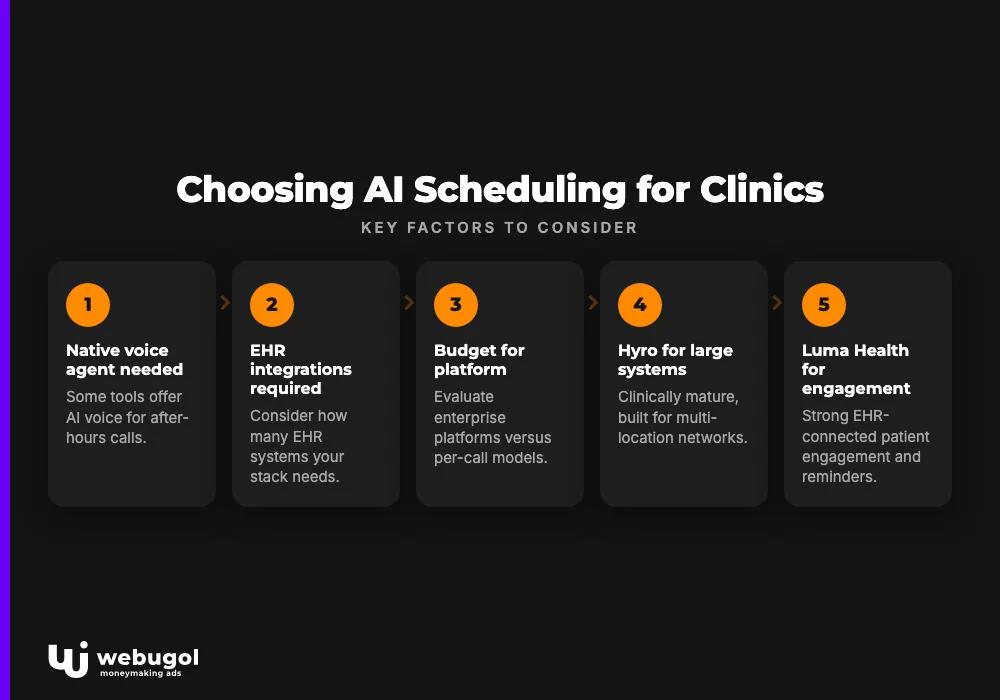
The best AI appointment scheduling tool for a small clinic depends on three factors: whether you need a native voice agent for after-hours calls, how many EHR integrations your stack requires, and your budget for an enterprise platform versus a per-call hybrid model.
Hyro is designed specifically for healthcare, with native Epic sync and an AI voice agent that handles booking, rescheduling, and cancellation without staff involvement. It is among the most clinically mature AI appointment scheduling solutions available, built for large health systems and multi-location networks.
Luma Health delivers strong EHR-connected patient engagement and configurable multi-channel medical appointment reminders. It does not offer a native voice agent, so after-hours phone volume requires a separate solution alongside it.
NexHealth covers scheduling, two-way messaging, and a broad EHR integration library. It is well-suited for multi-location practices managing heterogeneous clinical systems that need a single scheduling interface across different EHR environments.
Klara is a patient communication platform with scheduling built in, suited for practices that prioritize messaging-first engagement. Its scheduling logic is solid; its specialty-specific automation is limited relative to purpose-built platforms.
Smith.ai uses a hybrid model where AI manages routing and initial response while live agents handle complex or sensitive intake calls. For a small clinic that needs a human fallback before committing to full automation, Smith.ai offers an accessible entry point into this category. It is not fully autonomous, but it reduces after-hours abandonment while a practice builds confidence in the AI layer.
Doctible covers dental AI scheduling comprehensively, with recall automation, multi-provider calendar management, and review generation in one platform. It is well-positioned for dental and multi-specialty practices where recall retention is a primary KPI.
Calendly with a HIPAA-compliant enterprise plan and a signed BAA can satisfy compliance requirements for practices with simple scheduling needs. Its intake logic, reminder sequencing, and specialty-slot configuration are limited relative to purpose-built clinical tools, placing it at the entry level of this list.
How much does AI appointment scheduling software cost?
Purpose-built healthcare platforms including Hyro, Luma Health, NexHealth, and Doctible use custom enterprise pricing. Calendly reaches HIPAA compliance only on its custom-priced enterprise tier. A small clinic with moderate call volume may find a hybrid per-call model like Smith.ai more cost-effective than a full enterprise voice platform. Confirm current pricing directly with each vendor before committing to any contract.
Implementation checklist: launch AI appointment scheduling without breaking compliance
A CMO bringing an AI appointment scheduling platform to a compliance approver needs more than a feature comparison. The following checklist frames each step as an auditable action with a clear owner and a defined completion criterion.
- Execute the BAA before any data flows. Obtain a countersigned Business Associate Agreement before the vendor receives or processes any patient information. Owner: legal or compliance lead. Completion: countersigned BAA on file.
- Confirm data residency in writing. Document the specific cloud region and certification level where patient data will be stored. Owner: IT or compliance. Completion: written vendor confirmation attached to the contract.
- Audit the PHI flow end to end. Map every point where patient data enters, moves through, or exits the scheduling system, including reminder channels, voice recordings, and intake form storage. Owner: compliance plus IT. Completion: documented data flow diagram signed off by legal.
- Run a sandbox EHR integration test. Test two-way sync with your EHR in a staging environment before any live patient data touches the system. Owner: IT and clinical operations. Completion: confirmed read and write operations in staging with documented results.
- Configure reminder sequences by appointment type. Build and test distinct sequences for each appointment category your practice uses, covering SMS, email, and voice, with self-rescheduling links at the appropriate intervals. Owner: marketing or operations. Completion: each sequence tested end to end with a test booking record.
- Define the AI-to-staff handoff protocol. Specify which booking scenarios the AI handles autonomously and which trigger staff escalation. After-hours calls involving complex clinical questions, crisis-related inquiries, and insurance verification should route to a human. Owner: clinic operations. Completion: protocol documented and distributed to front-desk staff.
- Set a no-show rate baseline. Measure the current no-show rate by appointment type before launch so post-launch performance has a meaningful comparison point. Owner: analytics or operations. Completion: baseline rate documented and stored for the 30-day post-launch review.
- Run a soft launch with daily monitoring. Operate the system for two weeks with a defined monitoring cadence before full cutover, tracking booking completion rate, no-show rate, and escalation volume against baseline. Owner: operations or marketing. Completion: two-week monitoring period completed with no compliance events.
- Review all reminder and voice scripts for compliance. Every SMS, email, and voice script must pass compliance review for PHI exposure risk, platform policy adherence, and any clinical language requiring medical-legal sign-off. Owner: compliance plus marketing. Completion: approved script library on file before the soft launch begins.
- Test and document the after-hours escalation path. Define and test what happens when the AI voice agent cannot resolve a patient inquiry late at night. The path must be reliable before the system operates unsupervised. Owner: operations. Completion: escalation path tested, documented, and included in staff training materials.

The revenue math: CPA, speed-to-lead, and the no-show multiplier
AI appointment scheduling is a revenue math problem before it is a technology decision. The after-hours booking gap does not only lose leads. It inflates the effective CPA for every patient who does book, because fixed acquisition spend is divided across fewer confirmed and attended appointments.
Speed-to-lead decay is a consistent pattern across patient acquisition data. The gap between a patient's initial inquiry and their first booking confirmation is the window in which conversion either happens or disappears. A patient who submits a contact form at 9 p.m. and receives no booking path until the following morning faces a gap in which a competitor with 24/7 after-hours patient booking captures the appointment. Speed-to-lead in healthcare is not about urgency. It is about competing in the window the patient is actually deciding.
Running paid media to a clinic that cannot capture after-hours bookings creates a structural acquisition leak, not a campaign performance issue. The monthly revenue-at-risk figure from the no-show calculator above makes this concrete: a practice spending $15,000 per month in paid media while absorbing $9,600 per month in no-show revenue loss is paying for every patient who did not show up in its cost per attending patient. Reducing no-shows through automated, behavior-timed reminders is a direct reduction in effective CPA.
For practices that connect scheduling data back into their attribution model, the picture becomes clearer still. Connecting your scheduling data to your CRM attribution model is what separates a clinic that knows which channels produce patients who show up from one that optimizes for clicks alone.
Stop paying for after-hours leads that never land
Every hour the clinic is unreachable is an hour acquisition spend generates leads with nowhere to go. The tools covered above are most effective when they connect to the full acquisition system: from the ad click through the confirmed booking, into the post-visit communication sequence, and back into the attribution model that shows which channels produce patients who actually show up.
Webugol builds patient acquisition systems for US clinics and telehealth providers. The M3 automation phase of the Healthcare Growth System integrates AI appointment scheduling into the full patient acquisition funnel, from ad click to confirmed booking to post-visit retention sequence, so no phase of that funnel operates in isolation from the others.
Book a strategy call to audit your current booking flow and identify the specific gaps your CPA is paying for.
FAQ
What is AI appointment scheduling for healthcare clinics?
AI appointment scheduling is software that uses artificial intelligence to handle patient booking requests through voice, chat, and web interfaces without requiring a human to manage each interaction. For clinics, the category includes HIPAA-compliant tools with EHR integration, multi-channel reminders, and procedure-specific slot logic that general-purpose schedulers do not provide natively.
How does AI scheduling reduce patient no-shows?
AI scheduling reduces no-shows by delivering automated, multi-channel reminders timed to patient behavior and by enabling self-rescheduling before an empty slot becomes lost revenue. A confirmation sequence across SMS, email, and voice, staged at defined intervals with a self-rescheduling link, turns potential cancellations into attended or rescheduled appointments.
Is AI appointment scheduling HIPAA compliant?
Not all AI scheduling tools are HIPAA compliant by default. Compliance requires a signed Business Associate Agreement before PHI is processed, encrypted data handling at rest and in transit, and storage on certified infrastructure. Request the vendor's HIPAA risk assessment and confirm that all reminder channels, including voice and SMS, are in scope.
Which AI scheduling tool is best for small clinics?
For small clinics, the right choice depends on whether you need a native voice agent for after-hours calls, your EHR integration requirements, and your budget. Smith.ai offers a cost-effective hybrid per-call model for practices that want a human fallback. NexHealth and Luma Health cover multi-EHR environments well. All require a signed BAA before any patient data is processed.
How much does AI appointment scheduling software cost?
Purpose-built healthcare platforms like Hyro, Luma Health, and NexHealth use custom enterprise pricing, as does Calendly's HIPAA-compliant enterprise tier. A hybrid per-call model like Smith.ai may be more accessible for smaller clinics. Contact each vendor directly for current pricing, as this category changes frequently.