



What Is Direct-to-Consumer Healthcare, and Why Your Acquisition Model Is the Real Variable
Direct to consumer healthcare is the model where clinic and telehealth operators acquire patients through owned paid-media channels, conversion funnels, and lifecycle programs rather than through referral networks or insurance-driven routing. The model removes the referral intermediary. That gives operators direct control over CPL, show rate, and CPA as a connected system they can optimize with real data. The practices scaling fastest are not the largest; they are the ones that built measurable, compliance-safe acquisition systems before scaling spend.
What is direct to consumer healthcare?
In the clinic and telehealth context, direct to consumer healthcare means marketing and converting patients through paid search, social media, landing pages, and CRM sequences. This is structurally different from the pharma and genomics definitions that dominate most published writing on the topic, where DTC refers to national brand campaigns and prescription intent. For a $500k-per-month practice, the definition that matters is operational: you own the funnel and every data point in it.
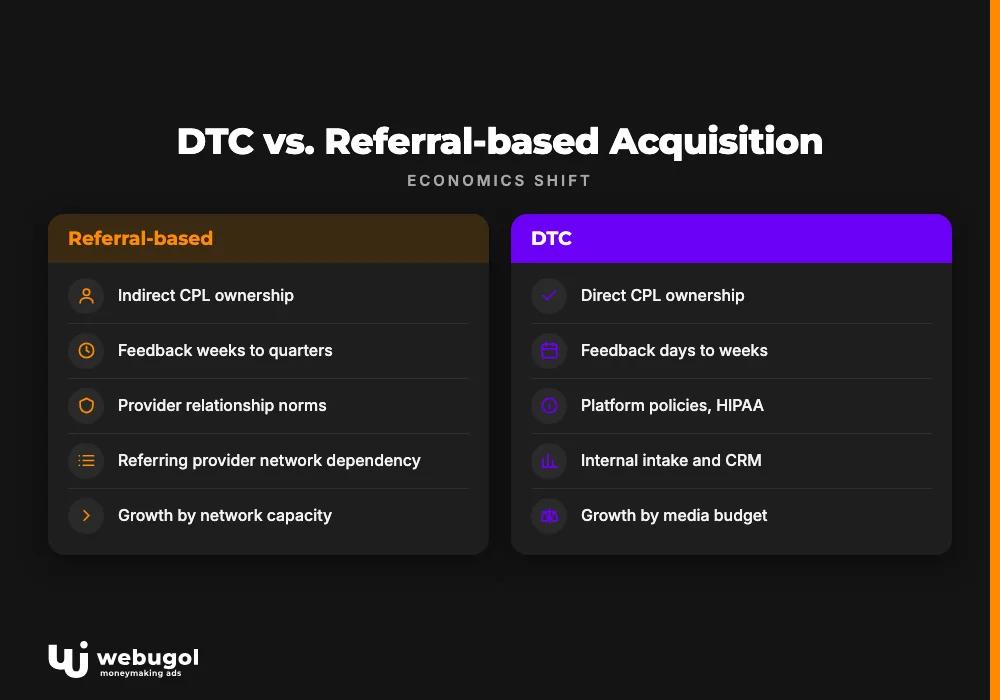
DTC vs. referral-based acquisition: the economics shift
Referral models trade optimization leverage for relationship stability. DTC trades that dependency for cost visibility, feedback loop speed, and direct attribution surface. The comparison clinic owners want before committing to a model change:
| Variable | Referral-based | DTC |
|---|---|---|
| CPL ownership | Indirect; relationship-dependent | Direct; media account |
| Feedback speed | Weeks to quarters | Days to weeks |
| Compliance surface | Provider relationship norms | Platform policies, HIPAA |
| Ops dependency | Referring provider network | Internal intake and CRM |
| Growth ceiling | Network capacity | Media budget + system throughput |
Neither model is wrong in absolute terms. The economics question is which one you can measure, debug, and scale within your compliance constraints.
Why 94% of health leaders are expanding DTC programs
Ninety-four percent of pharma and health leaders currently run or plan to run DTC programs within the next year, according to an ixLayer and PharmExec survey. The headline reads as pharma news. The underlying dynamic is not. Patient attention has shifted toward search, social, and digital intake, and operators positioned to capture that attention built their direct to consumer marketing in healthcare infrastructure before the shift, not as a reaction to it.
What this means for clinic and telehealth operators
The survey data matters for one reason: it confirms where patient attention is moving. At the clinic level, the operators benefiting from this shift built scalable patient acquisition infrastructure that produces measurable cost-per-booked-appointment data, lets them iterate within the compliance review cycle, and holds performance when ad spend increases. Build the system first. Scale the spend second.
The 3 layers a DTC healthcare program actually needs
A functioning DTC program for clinic and telehealth operators runs on three layers that must work as one system: demand generation under platform guardrails, conversion infrastructure built for accurate tracking and speed, and a patient lifecycle layer that holds acquisition economics past month one. Treat these as three separate vendor scopes and the failures concentrate in the handoffs between them.
How do healthcare companies advertise directly to patients?
Healthcare providers reach patients through Google Search, Meta, and programmatic channels. Each platform applies health-specific restrictions governing claims, audiences, and retargeting setups. Running compliant paid media for health services is possible. It requires setup choices that standard ad configurations do not make by default.
Key platform guardrails for health advertisers:
- No retargeting on diagnosed conditions. Meta and Google prohibit using health condition data as an audience signal; audiences built from condition or symptom pages create compliance exposure at the account level.
- Consent mode is required. Google Consent Mode v2 is mandatory for EU advertising and increasingly standard in US healthcare setups; a missing implementation corrupts attribution data across every campaign.
- Standard pixels are not HIPAA-safe. Meta Pixel and standard Google Tag Manager configurations can transmit protected health information to ad platforms; server-side or Conversions API setups are required for compliant tracking.
- Restricted claim language. "Cure," "treat," and outcome guarantees violate platform policies; copy needs compliance review before launch, not after the account receives a policy flag.
- Landing page content requirements. Platforms review destination pages against health advertising policies; a non-compliant landing page creates account-level risk, not just ad-level.
For a breakdown of channel-specific compliance requirements for health advertisers, including tracking architecture and platform policy details, that guide covers the execution layer.
Conversion infrastructure: funnel, tracking, and speed-to-lead
The ad buy delivers traffic. The conversion layer determines whether that traffic becomes a booked consult. HIPAA-compatible tracking is not a compliance checkbox; it is the data foundation every optimization decision rests on. A misconfigured pixel or missing offline conversion feed means bid strategy and budget decisions run on noise.
Speed-to-lead is the most underpriced variable in DTC healthcare. Response time measured in hours rather than minutes can effectively double CPA with no change to ad spend or creative. This metric typically belongs to operations, which means marketing owns the cost but not the lever. No one is paid to look at that gap. Mapping and closing it before scaling spend is the structural move most operators skip.
Patient lifecycle after the first appointment
Acquisition cost is highest at the first appointment. What happens in the 90 days after determines whether DTC economics hold. Post-appointment nurture sequences, membership and program conversion flows, and reactivation campaigns form the retention layer that turns a fragile spend model into a durable revenue system. Without that layer, you raise ad spend each quarter to replace revenue you already earned once. A structured patient retention program converts acquisition math from a recurring cost into a compounding one.
If your current setup cannot show you CPL, show rate, and CPA in one place, the system layer is the gap. Audit your acquisition system before scaling spend into it.
Where DTC healthcare programs break down most often
DTC programs rarely fail because the media strategy was wrong. They fail because structural problems go undiagnosed while spend increases. Across telehealth practices that scaled spend before the system was ready, the failure modes are consistent:
- Attribution gap. The ad platform, GA4, and CRM disagree on conversion counts, often by 30 to 40%; every optimization decision downstream runs on corrupted data.
- Speed-to-lead measured in hours. Every hour of delay after a lead submits reduces the booking probability; in healthcare, that window is short and does not extend.
- No-show rate owned by nobody in marketing. Show rate directly affects effective CPA, but it lives in operations and is invisible to the team managing spend.
- Intake logic that disqualifies qualified patients. Overly restrictive intake flows drop patients who would have converted; the drop is invisible without end-to-end funnel tracking.
- Compliance hold blocking creative iteration. A two-week review cycle means campaigns run on stale creative; spend efficiency decays while the approval sits in queue.
The attribution problem that kills DTC ROI
When the ad platform, GA4, and CRM disagree by 30 to 40%, every optimization decision runs on corrupted data. The symptom looks like campaigns performing well in the dashboard while revenue stays flat. The cause is almost always a pixel misconfiguration, a missing offline conversion feed, or a GA4 goal set up once and never audited. The cost compounds daily; every bid adjustment and budget reallocation made on that data pushes the account further from reality.
Speed-to-lead and no-show rate: the hidden CPA driver
A lead reached in under five minutes converts at a meaningfully higher rate than one that waits hours. That gap can effectively double CPA with no change to ad spend or creative. Valhalla Vitality's 287% monthly revenue growth and 45% CAC reduction came from addressing system-layer issues, not media-layer ones, which illustrates where the real leverage sits. Show rate is the downstream signal of the same structural problem: consults book, patients do not show, and the ad account gets blamed for what operations owns.
What does running a DTC healthcare program actually cost?
The DTC program cost structure has two layers. Setup costs for tracking, landing pages, and CRM configuration typically run $5,000 to $15,000. Ongoing media spend for a functioning program starts at $10,000 per month for most healthcare verticals, with management and optimization adding to those figures. Economics improve as attribution matures and CPA stabilizes over 60 to 90 days. Operators who pull budget before the attribution system is stable tend to exit the model at exactly the moment it would have worked.
Is direct-to-consumer healthcare the right model for your practice?
Direct-to-consumer healthcare is the right model for operators who can close patients at speed, complete compliance review within the creative cycle, and sustain media spend while the attribution system matures. Before committing budget, use this readiness checklist:
- HIPAA-compatible tracking installed and verified end-to-end
- Speed-to-lead target under five minutes defined and monitored
- Offer converts without unverified clinical claims
- Compliance approver engaged in the creative review cycle, not downstream of launch
- Landing pages updatable without a developer sprint
- Show-rate baseline established and owned by someone in marketing
- CRM pipeline stages mapped to funnel events
If more than two items are missing, fix the infrastructure gap first. Scaling media budget before the system is ready does not accelerate results; it accelerates the cost of the problem.
Ready to scale your direct-to-consumer patient acquisition system?
Webugol builds tracking-first, conversion-led DTC acquisition systems for US telehealth and clinic operators, owning the full revenue path from ad click to recognized revenue as one accountable program rather than a vendor stack. The Healthcare Growth System covers funnel architecture, compliance-safe creative, and daily performance management, replacing the coordination cost that typically falls on the owner or marketing lead. If your program is stalling at the infrastructure or attribution layer, a strategy call identifies the exact gap before you scale spend into it.
FAQ
What is direct to consumer healthcare?
It is a model in which providers market and convert patients through owned channels: paid search, social media, landing pages, and CRM sequences. It removes the referral intermediary and gives clinic and telehealth operators direct control over their patient pipeline, acquisition cost, and optimization speed.
Is direct-to-consumer healthcare marketing HIPAA-compliant?
It can be, but it requires deliberate infrastructure choices rather than standard ad setups. HIPAA-compatible tracking, consent mode, and platform-approved claim language are required; retargeting on medical conditions and standard pixels that pass health data to ad platforms are not compliant without additional controls.
What is the difference between DTC pharma advertising and DTC clinic marketing?
Pharma DTC targets brand awareness and prescription intent at national scale with large creative budgets and FDA-governed claim standards. Clinic and telehealth DTC targets direct patient conversion within a regional market, with a compliance approver in the creative loop and success measured in booked appointments, not brand lift.
How much does a direct-to-consumer healthcare program cost to run?
Setup costs for tracking, landing pages, and CRM configuration typically run $5,000 to $15,000; ongoing media spend for a functioning DTC program starts at $10,000 per month for most healthcare verticals. Management and optimization add to those figures, and economics improve as attribution matures and CPA stabilizes over 60 to 90 days.
Why do DTC healthcare programs fail?
The most common failure modes are attribution gaps that corrupt optimization data, speed-to-lead measured in hours rather than minutes, and no-show rates that belong to nobody in marketing. These are infrastructure and operations problems, not media problems, and they rarely surface until spend has already scaled past what the system can support.

