



Google Ads for Medical Practices: Stop Losing High-Intent Patients
Google Ads for medical practices put your clinic in front of patients actively searching for care right now. A well-structured campaign captures high-intent demand, controls cost per acquisition, and generates data you can act on. Without the right setup, ad spend accumulates while patient volume stays flat.
If this is your first campaign, the steps below apply from day one. If your practice is already spending significant budget on paid search and hitting a growth ceiling, the structural gaps driving that plateau are the same ones: broken conversion tracking, unfocused keyword lists, and landing pages that do not convert. The fix starts in the same place.
Before scaling any patient acquisition campaign, verify these four metrics are visible end to end:
| Metric | What it measures | Where it typically breaks |
|---|---|---|
| Cost per acquisition | Ad spend ÷ booked patients | Tracked as clicks, not consults |
| ROAS | Revenue ÷ total ad spend | Ad platform and CRM disagree |
| Show rate | Patients who attend booked visits | Owned by intake, blamed on ads |
| Speed-to-lead | Form submit to first contact | Ignored until CPA spikes |
More budget through a broken funnel raises CPA faster than it raises patients.
How to set up Google Ads for a medical practice?
Start with a clear conversion goal: appointment bookings, inbound calls, or consult form submissions. Everything in the account builds from that decision.
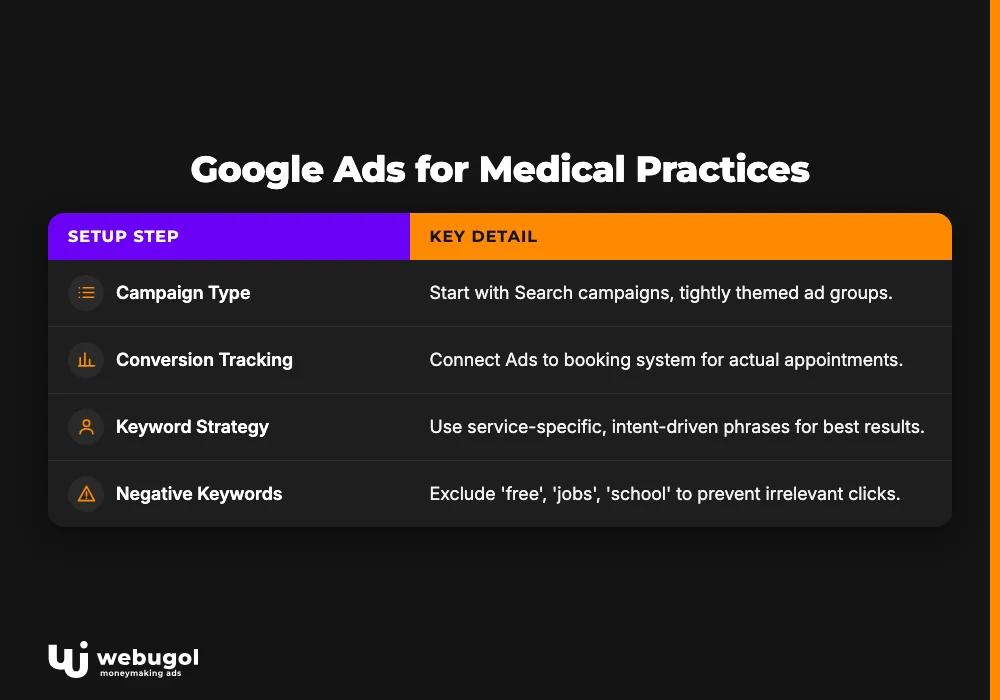
For most medical clinic advertising, a Search campaign with tightly themed ad groups outperforms broad or Performance Max campaigns in the first few months. Each ad group should cover one service line, target three to five closely related keywords, and send traffic to a dedicated landing page. A "pediatric urgent care near me" search should not land on a general homepage.
Conversion tracking is the foundation. Connect Google Ads to your booking or intake system so you measure actual appointments, not just form fills. Every automated bidding strategy in Google Ads learns from the conversion signals you feed it. Feed it the wrong signals and it optimizes for the wrong outcome.
Which keywords perform best for healthcare advertising?
Service-specific, intent-driven phrases outperform broad health terms in both conversion rate and cost efficiency. Strong patterns for doctor advertising online:
- "[specialty] near me", urgent care, TRT clinic, weight loss clinic
- "[condition] treatment [city]", targets active need, local supply
- "[service] appointment", weight loss consultation, blood work appointment
- "best [specialty] doctor [city]", captures comparison-stage searches
Negative keywords matter equally. Excluding "free", "jobs", "school", and unrelated brand terms prevents irrelevant clicks from inflating spend. Review terms that trigger Google ad disapprovals before your campaign goes live.
For building out campaign architecture within a healthcare PPC management plan, match type selection and ad group structure are covered in depth.
What budget should a medical practice spend on Google Ads?
There is no fixed number. Budget depends on your service area, specialty competition, and the CPA your practice economics can sustain.
The more useful question is: what cost per patient acquisition can your model support given average revenue per visit and payback window? If campaigns are delivering double your target CPA, adding budget amplifies the problem. The issue is tracking, keyword selection, or the conversion flow, not spend volume.
Start with enough daily budget to accumulate conversion data within two to three weeks. Scale once CPA trends are stable. Spending before that evidence exists is allocating capital to guesswork.
How do HIPAA rules affect Google Ads for medical practices?
HIPAA does not ban advertising. It governs how patient health information is handled, and several standard ad practices cross that line without the advertiser realizing it.
Key guardrails for healthcare digital marketing under HIPAA:
- Do not pass patient health information through tracking pixels or URL parameters, including diagnostic codes or medication names in query strings
- Remarketing lists based on specific health conditions violate Google's own health audiences policy alongside HIPAA
- Forms collecting intake data must route through a HIPAA-compliant handler, not a standard third-party contact form tool
- US practices operating under state privacy laws such as CCPA should apply equivalent consent frameworks to their ad tracking configuration
The Google Ads healthcare compliance guide covers ad copy restrictions and account-level certifications in detail. Every medical ppc strategy should pass through your compliance approver before launch. Build that review into the campaign timeline from the start.

How to measure Google Ads ROI for a clinic?
ROI measurement for google ads for medical practices breaks most often not in the ad account, but at the handoff between click and intake.
Three things to get right:
Connect conversions to revenue events. Clicks and form fills are proxies. The real signal is a booked, attended, completed patient visit. Push these events from your CRM back to Google Ads as offline conversions so your bidding algorithm optimizes for actual revenue, not form submissions.
Reconcile your data sources. The ad platform, Google Analytics 4, and your CRM will report different numbers. When the gap is large enough to affect budget decisions, that is a tracking break, not normal variance. Identify it before making bidding calls.
Match the measurement window to the business model. A 30-day ROAS figure for a membership program with a 90-day payback looks poor and leads to premature budget cuts. Define the window your model supports, then hold to it consistently.

Build a patient acquisition system that actually scales
Healthcare digital marketing on Google requires the full stack to work together: tracking, landing pages, bidding signals, CRM, and intake operations. Most practices treat these as separate problems. They are one problem with multiple symptoms, and the cost shows up in CPA figures nobody can explain.
Webugol builds tracking-first, conversion-led acquisition systems for US healthcare providers. If your campaigns are spending without converting, or you are launching and want to build the foundation correctly, book a Strategy Call.
FAQ
How long does it take to see results from Google Ads for a medical practice?
Early performance signals typically appear within two to four weeks of a well-structured launch. Statistically stable data for making bidding decisions takes six to eight weeks. Broader funnel improvements such as landing page updates and intake flow changes run in parallel and compound returns over 60 to 90 days.
Does a medical practice need a separate landing page for each service?
Yes. Sending all ad traffic to a homepage or general services page reduces conversion rates significantly. Each ad group should connect to a page that matches the specific search intent, service, and call to action relevant to that group.
What is the difference between Google Ads and SEO for medical practices?
Google Ads delivers immediate visibility to patients searching today; results stop when spend stops. SEO builds organic ranking over months and produces compounding traffic without per-click cost. Most practices benefit from running both, with paid search covering demand while organic rankings develop.
How does HIPAA affect conversion tracking in medical Google Ads accounts?
Standard tracking setups can inadvertently pass protected health information through URL parameters or form submission events. Healthcare practices should audit their full tracking configuration and verify that intake forms do not send sensitive data to third-party ad platforms before any campaign goes live.

