



Weight loss marketing: top strategies to attract clients
Weight loss marketing is the practice of positioning health and wellness programs so the right prospects find, trust, and choose them over competing options. Done well, it combines search visibility, targeted content, and conversion-focused campaigns across the channels where clients already spend time. The result is steady wellness client acquisition at a predictable cost. This guide covers every layer of an effective health marketing strategy, from channel selection to budget benchmarks.
How to market a weight loss business online?
Effective weight loss marketing starts with education. Buyers research heavily before committing. Brands that teach win the sale before competitors enter the picture.
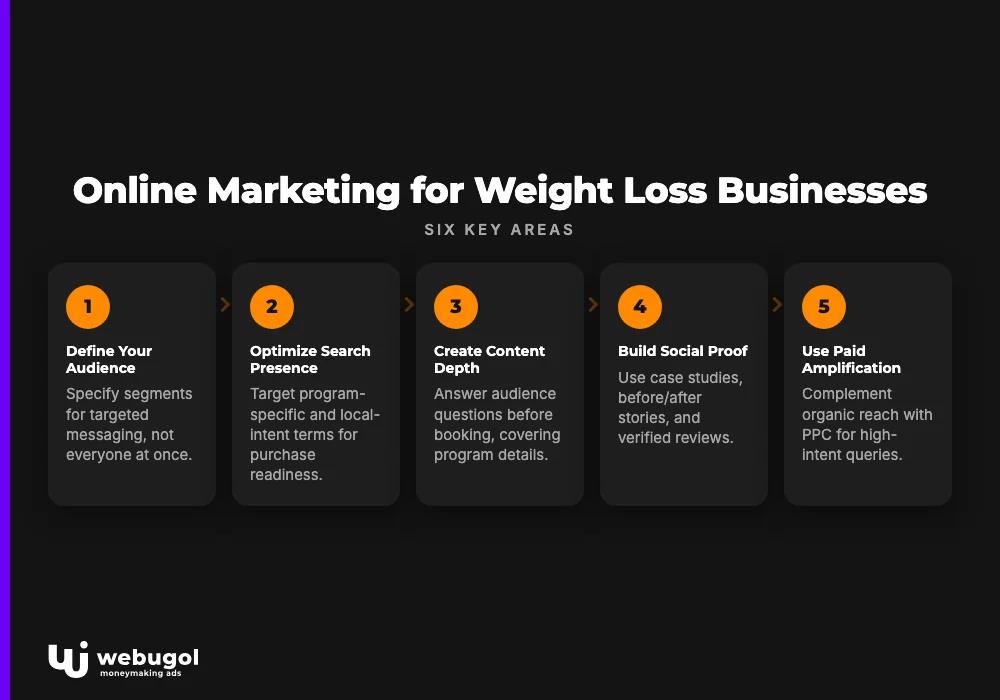
A practical framework covers six areas:
- Audience definition: specify the segment (lifestyle changers, pre-event clients, or medically-driven candidates) so messaging speaks to someone specific, not everyone at once.
- Search presence: optimize for program-specific and local-intent terms that signal purchase readiness, such as "weight loss clinic [city]" or "supervised program near me".
- Content depth: publish answers to the questions your audience asks before booking, covering diet comparisons, program structures, and realistic outcome timelines.
- Social proof: case studies, before/after stories with consent, and verified reviews all reduce perceived risk before a prospect books a call.
- Paid amplification: use PPC to complement organic reach for high-intent queries once landing pages show consistent conversion rates.
- Email sequences: automated nurture flows convert researchers into consultations days or weeks after their first site visit.
Build the organic and trust layers first. Add paid spend only after you have baseline conversion data on your landing pages.
What marketing channels work best for weight loss companies?
No single channel wins alone in weight loss marketing. The strongest health wellness digital marketing approach stacks channels so each one reinforces the next.
SEO is the foundation. Organic search brings visitors who are already researching, meaning they are partway through the buying decision before they arrive. A weight loss business optimized for program-specific and local-intent terms earns consistent traffic without recurring ad spend.
PPC accelerates early traction. Google Ads placed against high-intent queries like "supervised weight loss program" or "medical weight loss near me" generate leads quickly. Cost per click is ongoing, so PPC performs best alongside a landing page that converts at a tested rate.
Social media builds credibility over time. Consistent posting, real client stories, and interactive Q&A sessions build the community that referral-driven fitness brand promotion depends on. Influencer partnerships in the health space extend reach to audiences that already trust health-focused creators.
Email handles retention and re-engagement. Regular newsletters, personalized program suggestions, and targeted offers keep existing contacts active and drive repeat bookings.
Video converts the skeptical. Cooking demonstrations, fitness tutorials, and patient success interviews answer the "does this actually work?" question that text alone cannot address.
What is the best strategy for health and wellness marketing?
The best health marketing strategy matches the channel to the buyer's stage. Early-stage prospects respond to educational content: blog posts, comparison guides, and social media that answers real questions. Mid-stage prospects need proof. Testimonials, practitioner credentials, and free consultations close the trust gap. Late-stage prospects want a specific path to start, not general messaging.
Two principles hold across every stage. Specificity beats generality: "our 12-week metabolic program" outperforms "weight loss solutions" in both ad copy and organic search. Data closes the loop: tracking acquisition cost by channel, not just total spend, shows exactly where to reallocate budget for better returns.
Trust signals are non-negotiable in online wellness promotion. Certifications, practitioner bios, and transparent program details all reduce drop-off before conversion.
Medical weight loss marketing: compliance and credibility
Medical weight loss advertising carries compliance requirements that general fitness promotion does not. Claims must be accurate and substantiated, without implying guaranteed outcomes. Within those requirements, licensed medical providers hold a credibility advantage that consumer diet brands cannot match.
A credibility-focused content strategy for medical practices highlights four elements: physician and dietitian credentials, the clinical basis of each program protocol, realistic outcome ranges drawn from documented cases, and patient education materials that build informed consent before the first consultation. This kind of diet program promotion attracts self-selected clients who are serious about treatment, which reduces churn and increases referrals over time.
For a deeper look at the digital toolkit available to health providers, see our complete guide to medical practice promotion.

How to attract clients to a weight loss program?
Start with the channel where your audience searches when they are ready to act. For most weight loss businesses, that channel is Google.
Sustainable wellness client acquisition depends on three mechanics running together:
- A search-optimized website that ranks for program-specific queries in your market.
- A low-friction conversion path (a free consultation or short assessment) that captures interest before the full purchase decision.
- A follow-up sequence that educates unconverted leads over days or weeks until they are ready to commit.
Personalization sharpens all three. Segmenting email lists by goal type (medical, lifestyle, event-driven) and sending relevant content to each group raises open rates and conversion rates across the board. The same logic applies to paid ads: tailored creative for each audience segment outperforms generic campaign copy.
A/B testing matters more in this category than in most. Headline variants, CTA wording, and landing page layouts all affect conversion rates measurably. Running controlled tests and acting on the data separates growing programs from those that stall.
How much does it cost to market a weight loss service?
Cost depends on channel mix, geography, and existing brand recognition. A practical starting point is to budget by acquisition: determine what a new client is worth over their full program lifecycle, then set a cost-per-acquisition ceiling you can sustain.
Typical channel cost structures in the health and wellness space:
- SEO: involves setup fees or an ongoing retainer; results compound over 6 to 12 months and deliver lower cost-per-lead than paid channels once rankings are established.
- PPC (Google Ads): cost-per-click in weight loss categories varies by market and competition level, with major metros running significantly higher.
- Social ads: run at a lower CPM than search and work better for awareness and retargeting than direct conversions.
- [Email marketing](https://webugol.com/services/email-marketing/): carries the lowest ongoing cost per contact and delivers strong ROI when lists are segmented and sequences are actively maintained.
The most common mistake is concentrating the entire budget in paid ads without building organic and email channels in parallel. When ad spend pauses, all traction stops. A diversified mix protects against channel volatility and reduces average acquisition cost over time.

Start building your weight loss marketing plan
Webugol is a digital marketing agency with a focused practice in health and wellness. We build search, paid media, and content campaigns that drive consistent wellness client acquisition for weight loss clinics, coaching programs, and medical practices. Contact our team today to discuss your goals and build a weight loss marketing strategy matched to your growth targets.
FAQ
How to market a weight loss business online?
Lead with educational content that answers your audience's questions before they book, combine that with SEO and PPC for search visibility, and follow up with email nurture sequences. Build trust through transparent credentials and documented outcomes before asking for a sale.
What marketing channels work best for weight loss companies?
SEO and PPC together cover search intent at every stage of the buyer's journey. Social media and influencer partnerships build brand credibility over time. Email marketing retains and re-engages existing contacts. Most successful weight loss programs run all four channels together.
How much does it cost to market a weight loss service?
Cost depends on channel mix, market competition, and program scale. Email marketing carries the lowest ongoing cost per contact. PPC produces fast results but requires continuous spend. SEO takes longer to build but generates compounding returns as rankings improve.
What is the best strategy for health and wellness marketing?
Match the channel to the buyer's stage: educational content for early researchers, proof and credentials for mid-stage prospects, and specific offers for those ready to act. Track acquisition cost by channel and reallocate budget to what converts, not what generates clicks.
How to attract clients to a weight loss program?
Rank for program-specific queries in your market, offer a low-commitment first step like a free consultation, and follow up with a segmented email sequence. Tailor messaging by client goal type to improve conversion rates across the full acquisition funnel.

