



Medical doctor marketing: proven digital strategies for 2026
Medical doctor marketing covers every strategy physicians use to attract new patients, retain existing ones, and build a practice's reputation in local search. Done right, it replaces referral dependency with a measurable acquisition system. Results vary by specialty and market. The most consistent performers in 2026 combine local SEO, condition-specific content, and retention workflows built around how patients actually search for care.
Why digital marketing for doctors requires a different approach
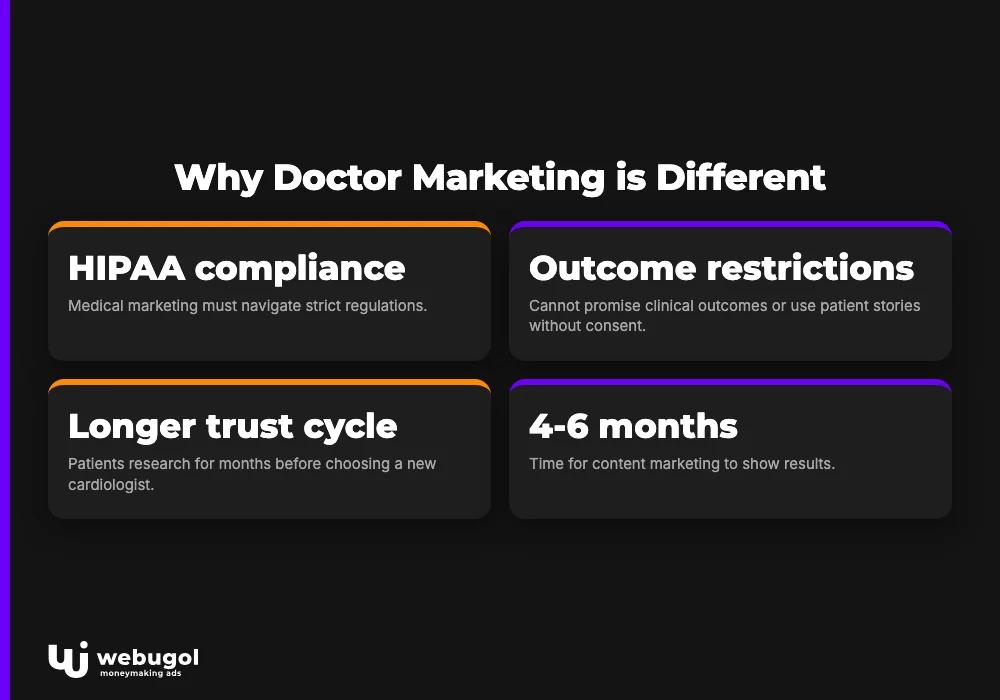
Generic business promotion focuses on brand awareness and conversion. Medical doctor marketing must also navigate HIPAA compliance, outcome restrictions, and a longer patient trust cycle than almost any other service category. A patient switching accountants decides in a week. A patient choosing a new cardiologist may research for months.
That constraint shapes every decision in a healthcare marketing strategy. You cannot promise clinical outcomes or use patient stories without consent. Trust must come before bookings.
The channel map below shows where each tactic fits and what trade-offs to expect.
| Channel | Primary purpose | Key watch-out |
|---|---|---|
| Local SEO | Capture high-intent "near me" searches | Requires active review management |
| Google Ads | Immediate visibility for competitive terms | Costs rise without a strong landing page |
| Social media | Build familiarity and name recognition | HIPAA limits patient story use |
| Content marketing | Build clinical authority over time | Results take 4-6 months |
| CRM and email | Retain and reactivate existing patients | Needs consent and list hygiene |
Mapping channels this way, before committing budget, is one of the most practical physician marketing tips in this guide. It prevents spending on tactics that do not match your current goals.
How do doctors market their practice online?
Doctors market their practice online by combining a mobile-optimized website, a verified Google Business Profile, condition-specific content, and a structured review acquisition process. Paid search fills gaps while organic rankings build. The goal is capturing patients at every stage, from "is this symptom serious?" to "book an appointment now."
Here is the sequence that works for most practices:
Step 1: Claim and populate your Google Business Profile. List services, add team photos, enable messaging, and respond to every review. This single step moves the needle on local SEO for doctors faster than most other tactics and costs nothing.
Step 2: Build a patient-first website. Pages must load in under 2.5 seconds, render well on mobile, and give a clear path to booking. The medical website design decisions your site makes are as important as its content.
Step 3: Publish condition-specific pages and blog posts. Match queries patients actually type: "when to see a doctor for back pain" or "what causes recurring headaches." These pages build organic traffic and clinical authority.
Step 4: Run paid search for competitive services. Google Ads produce immediate visibility for high-value specialties, but only when the landing page matches the ad keyword and makes booking easy.
Step 5: Collect reviews systematically. A text or email sent immediately after a positive visit, with a direct link to your Google review page, is one of the lowest-cost patient acquisition tactics with consistent results.
What digital marketing strategies work for medical practices?
The strategies that consistently produce results for medical practices are local SEO, condition-specific content, paid search for high-intent queries, and CRM-driven patient retention. No channel works in isolation. A practice that ranks well locally but runs a slow website loses patients to a competitor with a weaker ranking and a faster booking flow.
Search engine optimization for a medical practice
SEO splits into two tracks. Local SEO captures "near me" and city-name searches, the highest-intent queries. Informational SEO captures condition, symptom, and treatment queries from patients earlier in their decision process.
Both tracks need consistent NAP data (name, address, phone number across every directory), dedicated service pages for each major offering, and technical basics like HTTPS and fast load speeds. MedicalOrganization and Physician schema markup helps search engines surface your practice in rich results with no additional content effort.
For local SEO for doctors, the most consistent ranking factors are Google Business Profile completeness, review recency and volume, and citation accuracy across Healthgrades, Zocdoc, Vitals, and WebMD's provider directory. Accuracy matters more than raw quantity.
Content marketing and clinical authority
Educational content does two jobs simultaneously. It ranks for long-tail searches. It also gives answer engines like Google's AI Overviews something to quote when patients ask health questions. Write at a 7th-grade reading level, answer the main question in the first sentence, and add supporting detail after. That structure serves both AEO optimization and what patients actually want.
Patient testimonials, video introductions of your team, and procedure walkthroughs build trust that converts a first-time visitor into a confirmed booking. Treat this content as a conversion asset, not a cosmetic addition.
Paid advertising for new patient acquisition
Google Ads work when cost per new-patient acquisition stays below that patient's lifetime value. For high-value specialties (orthopedics, dermatology, elective procedures), this math usually holds. For general practitioners in competitive urban markets, it requires careful bid management and a purpose-built landing page.
Meta ads (Facebook and Instagram) work well for weight loss marketing strategies and other elective services, reaching patients who are not actively searching but respond to interest and demographic targeting. Targeted social advertising campaigns within a defined geographic radius let a practice control spend while testing which messages produce bookings.
CRM and patient retention
Patient retention costs less than new-patient acquisition. Full stop. CRM platforms automate appointment reminders, post-visit follow-ups, and annual recall messages for checkups. Practices with the strongest practice growth online numbers are often not the heaviest ad spenders. They lose the fewest existing patients because their follow-up runs on a consistent, structured system.
How to attract new patients through online marketing?
Attracting new patients through online marketing requires covering all three stages of the patient journey: awareness, consideration, and booking. Most practices invest only in the booking stage and get less volume than they expect.
Awareness stage: Blog posts and social content reach patients who are researching symptoms or conditions. They are not ready to book. They want accurate information. Consistent, helpful content builds the name recognition that moves them toward a provider decision.
Consideration stage: Review pages, provider bios, and detailed service pages help patients compare their options. This is where your Google Business Profile and your website's About section do the real work. Patients here are reading credentials, scanning reviews, and looking for a reason to choose you over the next name in the list.
Booking stage: A frictionless booking flow converts consideration into a confirmed appointment. Online scheduling, visible phone numbers, and a callback option each reduce drop-off. Every extra step in the booking process loses a percentage of patients who were ready to commit.
These patient acquisition tactics compound when they run together. An awareness blog post brings a new visitor; a persuasive bio page moves them to consideration; a clean booking flow closes the appointment.

Which social media platforms are best for physician marketing?
For most physician practices, Facebook and Instagram reach the widest patient-facing audience. LinkedIn supports professional referral relationships. YouTube and TikTok work for practices willing to invest in video content explaining conditions and procedures.
Facebook carries the broadest reach in the 35-65 age group, which covers most specialty patient bases. Community group participation and local event promotion work consistently here.
Instagram suits practices with strong visual content: dermatology, orthopedics, elective and cosmetic procedures. Reels increase organic reach without additional paid budget.
LinkedIn is not a patient acquisition channel for most practices. Its value in physician marketing is building referral relationships with other providers and supporting recruitment efforts.
YouTube procedure walkthroughs and "what to expect" videos rank in both YouTube and Google search. Production takes more effort, but the content has a long shelf life and continues earning views months after publishing.
Pick two platforms and do them consistently. Spreading effort across five produces thin output on all of them. Social media builds familiarity and trust; direct bookings rarely come from a first-time follower.
How to improve local SEO for a medical practice?
Improving local SEO for a medical practice starts with treating your Google Business Profile as an active channel, not a one-time setup task. From there, the levers are review acquisition, citation accuracy, and location-specific content.
Google Business Profile: Complete every field. Add photos monthly. Post updates when services or hours change. Enable messaging and respond within one business day. Practices that actively maintain their GBP consistently outrank inactive competitors in the local map pack, even when the inactive practice has a technically stronger website.
Review strategy: Ask satisfied patients the same day, via a text message with a direct link to your review page. Respond to every review, positive or negative. Volume and recency both influence local rankings. A practice collecting 10 new reviews per month will outrank one that collected 50 reviews two years ago and stopped asking.
Citation consistency: Get listed accurately on Healthgrades, Zocdoc, Vitals, WebMD's provider directory, and your state medical association. Each consistent citation strengthens Google's confidence in your location and specialty data.
Location-specific content: Practices with multiple locations need a separate optimized page for each one. Single-location practices build local relevance through blog content that references the local community and neighborhood health topics.
For the technical side of citation management and map pack optimization, the guidance for local SEO for healthcare providers covers this in more detail. For specialty practices, the physician specialty growth framework maps these tactics across most practice types.

Telemedicine marketing tips for extending your reach
Telemedicine has moved from a temporary accommodation to a standing patient expectation. Marketing it well requires clarity on three fronts: what conditions qualify for a virtual visit, how patients access the platform, and whether their insurance covers telehealth.
Dedicated telehealth page: List qualifying conditions. Explain the technology clearly (smartphone or laptop, no app download needed). Add a booking link labeled "Book a Virtual Visit," not "Learn More." Burying telehealth under a general services page reduces bookings significantly.
Paid ads: Telehealth campaigns work well for patients in underserved areas or with mobility limitations. Geographic targeting extends a practice's effective reach to patients who have no local specialist access.
Google Business Profile: List telehealth as a service and mark that virtual appointments are available. Patients now filter for this in Google Maps, and practices that list it appear when others do not.
Video walkthrough: A 90-second video showing a full virtual visit, from login to prescription, removes the uncertainty that prevents first-time telehealth patients from booking. These telemedicine marketing tips work because they lower friction, not because they increase pressure.
Medical doctor marketing for telemedicine works best when the service has its own landing page, dedicated ads, and separate performance metrics, not when it is folded into general practice promotion.
Measuring your medical doctor marketing results
Medical doctor marketing strategies only improve when you measure them. The core analytics stack for a physician practice does not need to be complex.
Google Analytics 4: Set conversion events for appointment bookings and contact form submissions. Monitor which traffic sources (organic, paid, social, direct) produce conversions, not just visits. Traffic without conversion is noise.
Google Search Console: Shows which queries bring patients to your site and where you rank for them. Look for queries where you appear on page 2. Those pages are closest to producing more organic traffic with targeted SEO performance improvements.
CRM reporting: Track lead-to-patient conversion rate by channel. This tells you whether paid campaigns produce bookings or only clicks.
Review monitoring: Watch your average rating on Google, Healthgrades, and Zocdoc each month. A declining rating needs a response strategy before it starts suppressing booking volume.
Review these numbers monthly. Change one variable at a time. Measure results over 4-6 weeks before adding another variable. This discipline is what separates practices that improve their digital marketing for doctors consistently from those that cycle through new tactics without measurable gains.
Build the system, then let it compound
Medical doctor marketing delivers its best results when local SEO, content, paid acquisition, and patient retention run together as a coordinated system, not as separate campaigns. If you are building this from scratch or reassessing what you already have, the Webugol healthcare growth system is designed for physician practices that want a trackable, channel-by-channel path to consistent new patient growth.
Contact Webugol for a practice marketing audit and a prioritized list of the highest-impact moves for your specialty and market.
FAQ
What is medical doctor marketing?
Medical doctor marketing covers the strategies physicians use to attract new patients, retain existing ones, and build their practice's online reputation. It spans digital marketing for doctors including local SEO, paid search, content marketing, social media, and CRM-based patient retention.
How long does it take to see results from digital marketing for doctors?
Google Business Profile and local SEO changes typically show measurable results within 60-90 days. Content marketing takes 4-6 months to build organic traffic. Paid search can generate new patient inquiries within days of launch, though optimizing cost per acquisition requires several weeks of campaign data.
Which patient acquisition tactics deliver the highest return for a medical practice?
Review acquisition (asking satisfied patients directly via a text message with a direct link) and Google Business Profile optimization consistently produce the highest return at the lowest cost. Paid search delivers strong ROI for high-value specialties where patient lifetime value exceeds cost per acquisition.
How do telemedicine marketing tips differ from standard practice marketing?
Telemedicine marketing focuses on extending geographic reach and must make insurance coverage and platform access immediately clear to patients. A dedicated telehealth page with a direct booking link and a short video walkthrough of a virtual visit are the two most effective moves for converting first-time telehealth patients.
Can a small medical practice compete with large health systems in digital marketing?
Yes. Local SEO levels the playing field because proximity and review quality influence local map rankings more than marketing budget. A small practice with 20 recent reviews and an actively maintained Google Business Profile often outranks a large health system that set up its profile years ago and never updated it.