



Orthopedic marketing: strategies that grow your practice
Orthopedic marketing is the coordinated set of digital and outreach tactics that help bone and joint practices attract new patients, retain existing ones, and build durable local authority. It connects patients searching for orthopedic care with the right practice at the right moment, across Google search, social media, email, and paid advertising. Practices that run systematic orthopedic marketing programs consistently outperform those relying on physician referrals alone, based on documented results from clinics that rebuilt their digital presence. This guide covers the channels, tools, and verified outcomes that drive real growth.
Why orthopedic marketing needs its own strategy
Bone and joint patients are not a generic healthcare audience. They arrive online already in pain, comparing multiple surgeons quickly, and making decisions in days. That urgency shapes every element of medical practice marketing for orthopedics.
Most orthopedic surgeons also face a split reality. Consumer-facing channels like Google and Instagram reach patients directly. Physician-to-physician referrals still drive a large share of consults for many practices. A healthcare digital marketing strategy that ignores either side leaves growth untouched.
Geography adds another constraint. Orthopedic care is intensely local, more so than most specialties. A patient needing total knee replacement rarely drives three hours for a surgeon, so ranking for local search queries is not optional. It is the foundation of orthopedic practice growth.
For practices building their digital foundation, physician marketing tips and frameworks remain the starting point before layering on specialty-specific approaches.
How do orthopedic practices attract new patients online?
Orthopedic practices attract new patients online through local SEO, paid search, and educational content that targets patients while they are still researching symptoms or comparing surgeons. Each channel operates at a different stage of the patient journey.
The most effective patient acquisition strategies for orthopedic practices:
- Optimize your Google Business Profile for local searches like "orthopedic surgeon near me." A rural practice that focused on geo-specific keywords and local health directories saw a 50% increase in local web traffic and a 30% jump in appointment bookings within one year, according to documented case data.
- Publish condition-specific educational content that answers what patients search when they first notice symptoms. An urban mid-sized clinic that restructured its blog around patient-focused topics saw a 25% rise in new patient consultations and a 40% increase in organic traffic within six months.
- Run targeted PPC campaigns for high-intent procedure keywords. An orthopedic facility that launched paid search ads for a minimally invasive surgical procedure saw a 35% increase in procedure inquiries during the campaign period.
- Build social media presence through patient recovery stories, live physician Q&A sessions, and educational posts. One clinic that adopted a structured approach saw a 50% increase in followers and a 30% rise in referral rates.
- Partner with local fitness and sports communities to reach active patients before injuries escalate. A suburban practice that collaborated with local fitness coaches on sports-injury content saw a 40% increase in consultations from that demographic in six months.

What digital marketing channels work best for orthopedic surgeons?
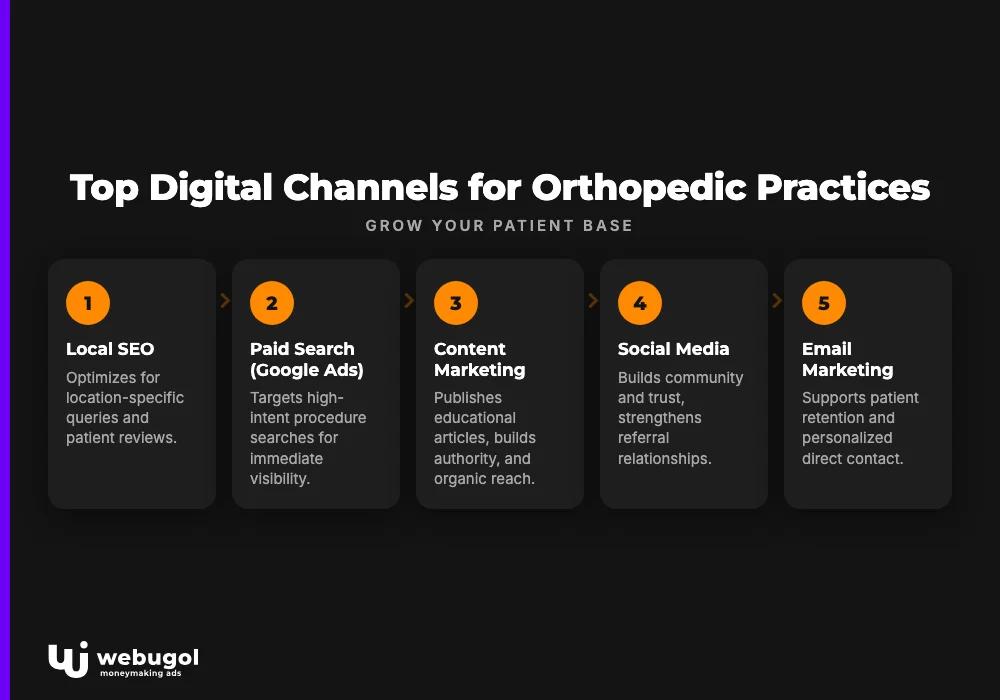
Local SEO, paid search, and content marketing deliver the strongest results. Social media and email marketing play important supporting roles in patient retention and referral generation.
| Channel | Primary function | Key advantage |
|---|---|---|
| Local SEO | Organic patient discovery | Long-term, compounding returns |
| Google Ads (PPC) | Immediate search visibility | Targets high-intent procedure searches |
| Content marketing | Authority and organic reach | Answers questions patients already have |
| Social media | Community and trust | Strengthens referral relationships |
| Email marketing | Retention and follow-up | Personalized, direct patient contact |
Local SEO for orthopedic practices
Local SEO is the core of any orthopedic SEO program. It means optimizing your site for location-specific queries, keeping your Google Business Profile accurate and active, and building a consistent stream of patient reviews. For most practices, this is where orthopedic marketing delivers its most reliable long-term return on investment.
Paid search advertising
Google Ads place your practice at the top of results for searches like "knee replacement specialist" or "sports medicine orthopedist [city]." PPC is particularly valuable when launching a new service line or entering a market where organic rankings take time to build.
Healthcare content marketing
Healthcare content marketing for orthopedics means publishing educational articles, condition explainers, and procedure guides that answer what patients are already searching. This approach builds organic rankings over time and steadily reduces cost-per-acquisition compared to paid channels alone. It also positions the practice as a credible authority, which matters in a specialty where trust drives the final decision.
What is the ROI of SEO for orthopedic practices?
SEO delivers strong ROI for orthopedic practices but takes time to build. Documented case results show organic traffic increases of 25–50% and new consultation growth of 25–35% within six to twelve months of a focused orthopedic SEO effort.
The compounding nature is what separates it from paid channels. A mid-sized urban clinic that combined an updated orthopedic SEO strategy with educational content saw a 40% organic traffic increase and a 25% rise in new patient consultations within six months. A rural practice that prioritized local search saw 50% more local web traffic and 30% more bookings within a year. Once rankings are established, those results continue without the ongoing per-click costs that paid campaigns require.
The practical implication: PPC and SEO work best together. Paid search provides volume immediately. SEO builds the durable asset. For orthopedic practice growth, the two strategies are more effective in combination than either one alone.
How to improve patient retention for orthopedic clinics
Patient retention in orthopedics starts after the appointment, not during it. Most practices underinvest here, and the gap shows up in both revenue and satisfaction scores.
Email marketing is the most cost-effective retention tool available. Segmented campaigns that match content to each patient's procedure and recovery stage consistently outperform generic newsletters. One orthopedic clinic that implemented a structured post-treatment email program, including procedure-specific recovery tips, appointment reminders, and satisfaction surveys, saw patient retention improve by 20% and satisfaction scores rise by 45%.
Personalization drives the result. When messages reflect where a patient actually is in recovery, compliance with treatment plans improves and referrals increase. Data analytics tools now make this segmentation practical even for smaller practices.
Social media community-building also contributes to retention. Patients who follow their clinic between visits stay connected, which makes them more likely to return and more likely to refer others. It is a low-cost way to extend the patient relationship beyond the clinical encounter.
Technology shaping orthopedic practice growth
Three technology shifts are changing how orthopedic practices compete for and keep patients right now.
AI analytics and chatbots. AI tools support orthopedic marketing at two levels: audience targeting and patient communication. Predictive analytics help practices identify which patient segments to prioritize in campaigns. Automated chatbots handle routine inquiries around the clock. A large orthopedic hospital that deployed an AI-powered chatbot on its website and social platforms found it resolved more than 50% of basic patient queries, reducing staff workload and cutting response times, according to implementation case data.
Wearable device integration. Fitness trackers and smartwatches provide continuous data on patient activity and recovery progress. Orthopedic practices that incorporate this data can tailor rehabilitation protocols to actual patient behavior rather than estimated timelines. The ongoing data connection strengthens the patient-provider relationship throughout recovery, increasing long-term engagement.
Augmented reality for patient education. AR technology allows surgeons to walk patients through visual simulations of procedures and conditions during consultations. Mark Rogers, a medical device technology developer cited in industry research on orthopedic digital marketing, predicts that AR will shift how patients understand diagnoses and treatment plans, leading to more informed decisions and higher consultation-to-treatment conversion rates.
Early adopters in healthcare digital marketing are already using these technologies to differentiate their patient experience in competitive local markets.
Build your orthopedic marketing system with Webugol
Growing an orthopedic practice today requires more than a good website. It requires coordinated SEO, targeted content, paid media, and patient communications working as one system. Webugol designs and runs integrated healthcare growth programs built specifically for medical practices with measurable goals. To move from scattered tactics to an orthopedic marketing strategy that compounds over time, reach out to Webugol and let us show you what the right system looks like for your practice.
FAQ
How much should an orthopedic practice spend on marketing?
Orthopedic marketing budgets vary by market size, practice type, and growth targets. Because orthopedic patients have high lifetime value, the ROI ceiling for marketing investment is considerably higher than in primary care, which supports larger budgets. At minimum, the budget should cover consistent local SEO and content production.
What is the ROI of SEO for orthopedic practices?
Documented case data from orthopedic practices shows organic traffic gains of 25–50% and new consultation increases of 25–30% within six to twelve months of a focused SEO program. These gains compound over time, unlike paid ads, which stop generating traffic when the budget pauses.
How do orthopedic practices use social media effectively?
The most effective approach treats social media as a community and trust channel rather than direct advertising. Sharing recovery stories, hosting physician Q&A sessions, and engaging with patient questions builds referral relationships. One clinic using this model saw a 50% follower increase and a 30% rise in referral rates.
Does local SEO work for smaller or rural orthopedic practices?
Yes. Local SEO is especially effective outside major metro areas because competition for geo-specific keywords is typically lower. A rural orthopedic practice that focused on local search optimization and relevant directories saw 50% more local web traffic and 30% more appointment bookings within one year.
What is the best first step for an orthopedic practice starting digital marketing?
Claiming and fully optimizing your Google Business Profile, then auditing your website for mobile performance and basic on-page SEO, is the highest-impact starting move. These two actions close the most common visibility gaps in orthopedic online presence and cost far less than most other marketing investments.