



Medical tourism marketing: a complete strategy guide for clinics
Medical tourism marketing is the practice of positioning a clinic, hospital, or health travel agency to attract patients from other countries seeking care abroad. Done right, it combines digital marketing for clinics with precise audience targeting, multilingual communication, and trust-building content calibrated to each source market. Most clinics underperform because they run tactics without a plan. This guide covers every component of a complete medical tourism marketing plan: audience research, SEO, paid advertising, email nurturing, and analytics.
What should a medical tourism marketing plan include?
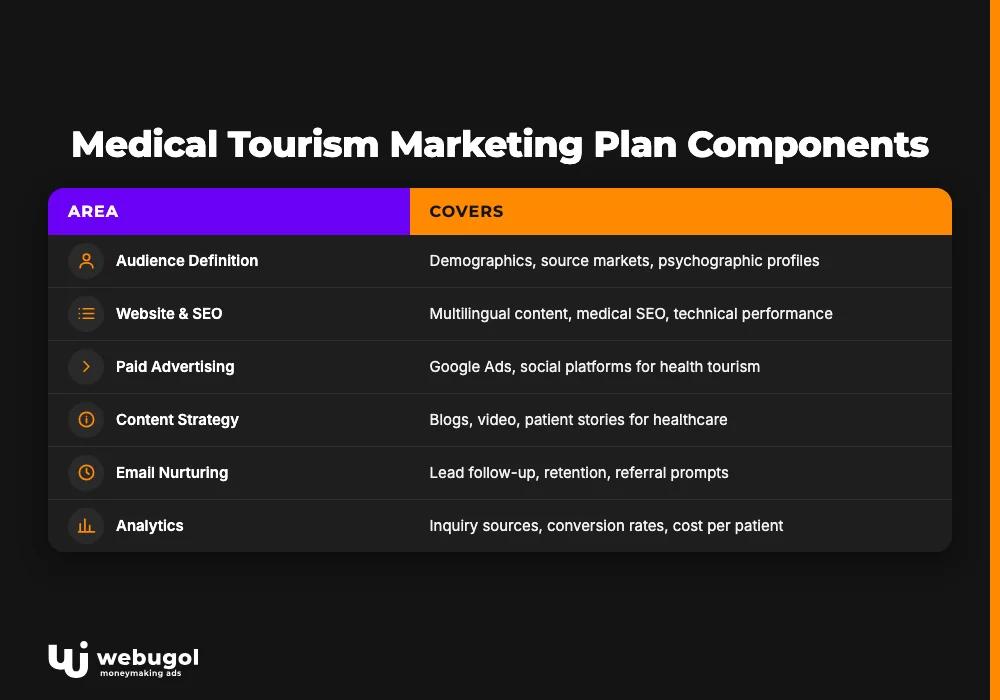
A complete medical tourism marketing plan covers six core areas. Each one closes a specific gap between your clinic's services and an international patient's decision to travel.
| Component | What it covers |
|---|---|
| Audience definition | Demographics, source markets, psychographic profiles |
| Website and SEO | Multilingual content, medical clinic SEO, technical performance |
| Paid advertising | Health tourism advertising via Google Ads and social platforms |
| Content strategy | Healthcare content strategy: blogs, video, patient stories |
| Email nurturing | Lead follow-up, retention campaigns, referral prompts |
| Analytics | Inquiry sources, conversion rates, cost per booked patient |
Clinics that address all six areas consistently outperform those relying on a single channel. International patients rarely convert on their first touchpoint.
How do I attract international patients to my clinic?
Start with data. Collect inquiry records, website analytics, and patient intake forms to identify which countries generate the most interest. Examine each source market: income distribution, healthcare gaps, and geographic distance from your location. That analysis shapes every downstream decision.
Identify by demographics and psychographics. Age, gender, and income level tell you who is searching. Psychographic profiling, covering values, health attitudes, and emotional decision triggers, tells you how to reach them. A patient seeking elective cosmetic care responds to entirely different messaging than someone researching oncology options abroad.
Create multilingual content. Translating your website, patient forms, and marketing materials into target market languages removes friction at the most critical point in the patient journey. Pair that with multilingual customer support so no inquiry drops because of a language barrier.
Offer comprehensive care packages. In travel medicine clinic marketing, logistics are consistently the top hesitation point for patients evaluating overseas care. Packages that combine accommodation, airport transfers, and post-treatment follow-up reduce that friction directly. Lead with these packages in campaign messaging directed at first-time international patients.
Build international partnerships. Relationships with overseas travel agencies, diaspora organizations, and local health insurers extend your reach without proportional ad spend. Referral agreements with these partners can produce a consistent, low-acquisition-cost pipeline over time.
What digital marketing strategies work best for medical tourism?
The most effective digital marketing for clinics combines organic search, paid advertising, social media, and content into a coordinated system where each channel reinforces the others. No single channel sustains growth. Coordination is what separates clinics that scale from those that stall.
SEO and medical clinic SEO fundamentals
Search is where most international patients begin their research. Optimizing for medical clinic SEO means targeting the specific procedures, specialties, and destination queries your patients actually type. Place primary keywords in page titles, meta descriptions, headings, and body copy. Maintain mobile-responsive design and fast loading speeds, since a large share of health tourism searches happen on phones in source markets.
Internal linking between procedure pages and informational blog content improves both rankings and session depth. Why organic search delivers compounding returns for health clinics explains this dynamic in detail, and the same principles apply directly to travel medicine clinic marketing and international patient acquisition.
Display accreditation credentials on every page where patients assess trust. Certifications such as JCI or ISO reduce bounce rates because patients read them as evidence of safety standards. Lower bounce rates improve search performance over time.
Health tourism advertising with paid search
PPC campaigns reach high-intent patients quickly. Bid on procedure-specific keywords, filter by geography to focus on source markets with strong conversion history, and set budget caps while campaigns find their footing. Monitor cost-per-inquiry weekly. Cut ad groups that generate clicks but never inquiries.
Social media health tourism advertising adds demographic precision that search alone cannot deliver. Platforms like Facebook and Instagram let you filter by age, interest category, health topic, and region simultaneously. How social media shapes healthcare decisions is worth understanding before you split budget across platforms.
Healthcare content strategy: blogs, video, and testimonials
Content builds trust before a patient ever contacts you. A regularly updated blog covering procedures, recovery timelines, travel logistics, and patient stories positions your clinic as a credible source. Video adds a concrete layer: facility walkthroughs, procedure explanations, and recorded patient testimonials give prospective patients a real picture of what to expect before they book.
Patient testimonials are among the most persuasive assets in medical tourism marketing. They address the specific concerns a prospective traveler carries: safety, communication, and post-treatment support. Feature them on your website, in email campaigns, and as social proof in paid ads.
Influencer collaborations with health and wellness creators expand organic reach. A genuine account from an influencer reads as peer recommendation rather than advertising. Select collaborators whose audience demographics match your target source markets.
Online booking and patient experience
Remove friction at the conversion point. An online booking system that works on mobile, protects patient data, and sends automated reminders converts more inquiries than a contact-form-only process. Post-treatment follow-up through email improves satisfaction and generates the reviews and referrals that reduce your cost per new patient over time.
How to use SEO for a medical tourism agency?
Agencies operate differently from single clinics. Instead of promoting procedures at one location, they match patients to providers across multiple destinations. SEO for agencies targets comparison and decision-stage queries: "best country for knee replacement," "most affordable IVF abroad," or "medical tourism agency reviews."
Build dedicated landing pages for each destination you cover. Optimize each page for the procedures most popular in that specific market. Add structured schema markup for MedicalOrganization, FAQ, and BreadcrumbList so search engines can parse the content cleanly. Content depth matters more than content volume. One authoritative guide on cardiac care in a given destination outperforms ten thin blog posts covering the same topic.
Combining that depth with a local SEO approach calibrated for competitive healthcare markets produces rankings that compound month over month and are difficult for newer competitors to displace.
Display certifications prominently. Accreditation functions as both a patient trust signal and a search engagement indicator. Patients who see recognized credentials stay longer on the page, which feeds back into rankings.
How does email marketing work for health tourism?
Email is a high-ROI channel in health tourism because the patient decision cycle is long. A person researching treatment abroad may spend weeks comparing clinics before submitting an inquiry. Email keeps your clinic present throughout that process without additional ad spend.
Segment your list by source market, procedure interest, and funnel stage. A lead from this week needs different content than a past patient you want to re-engage. Building email campaigns that convert health tourism inquiries covers segmentation frameworks that work across multi-specialty clinics and reduce drop-off between first contact and booking.
Regular newsletters work best when they mix practical information, new treatment availability, and patient stories rather than promotion alone. Personalized follow-up after an initial inquiry increases reply rates. Automated sequences triggered by form submissions ensure no lead cools while your team handles other priorities.
Patient retention emails are a distinct function from acquisition. Post-treatment check-ins, annual health reminders, and loyalty offers give satisfied patients reasons to return and refer their network. Systematic email turns word-of-mouth, the oldest form of health tourism advertising, into a repeatable process.
Monitoring your medical tourism marketing results
No medical tourism marketing plan survives first contact with real data unchanged. Track website traffic by channel, inquiry volume by source, and conversion rate from inquiry to booked patient. Review these numbers monthly, not quarterly.
Attribution is harder in health tourism than in e-commerce. The decision cycle spans many touchpoints: a patient might discover you through organic search, follow your social accounts for two weeks, open several email newsletters, and then call. Even a basic first-touch and last-touch comparison reveals which channels start conversations versus which ones close them.
Cut what underperforms consistently. Reinvest in what converts reliably. That cycle is what separates clinics that grow from those that plateau.
Build your medical tourism marketing strategy with Webugol
A complete medical tourism marketing strategy compounds over time. Search rankings, email lists, and patient referral networks grow with every year of consistent effort. To accelerate that timeline, Webugol specializes in digital growth for healthcare providers. Our structured patient acquisition programs cover SEO, paid advertising, multilingual content, and conversion optimization for clinics looking to attract international patients from multiple source markets.
Request a free strategy review to identify gaps in your current plan and determine what would move your patient numbers fastest.
FAQ
What digital marketing strategies work best for medical tourism?
SEO, paid search, social media, and content marketing each contribute, but they work best when coordinated into a single system. Clinics that align organic content with paid campaigns and email follow-up convert more inquiries than those running each channel independently.
How do I attract international patients to my clinic?
Analyze your inquiry data to identify high-value source markets, then build multilingual content and targeted advertising for those regions. Comprehensive care packages that handle travel logistics alongside treatment reduce the hesitation that prevents patients from committing to care abroad.
How to use SEO for a medical tourism agency?
Focus on destination and procedure comparison keywords that match how patients research overseas care. Build authoritative landing pages for each destination, implement structured schema markup, and display accreditation credentials prominently to reduce bounce rates and improve search rankings.
What should a medical tourism marketing plan include?
A complete plan covers audience research, website SEO, paid advertising, a healthcare content strategy, email nurturing, and analytics. Addressing all six areas consistently outperforms relying on a single channel because international patients rarely convert on their first touchpoint.
How does email marketing work for health tourism?
Email keeps your clinic visible during the long research phase that precedes international medical travel. Segment by procedure interest and funnel stage, automate follow-up sequences for new inquiries, and send retention emails to past patients to generate referrals and repeat visits.