



Facebook ads for ecommerce: strategy, common mistakes, and what drives results
Facebook ads for ecommerce give online stores direct access to buyers at every stage of the purchase funnel. When audience targeting, creative quality, and campaign structure align, they produce measurable revenue at a predictable cost per acquisition. When they don't, even a well-funded facebook campaign budget disappears without meaningful returns. This guide covers the structural mistakes behind most underperforming ecommerce campaigns, the creative and retargeting decisions that drive consistent conversions, and the tracking setup that keeps every dollar accountable.
Seven mistakes that break most ecommerce Facebook campaigns
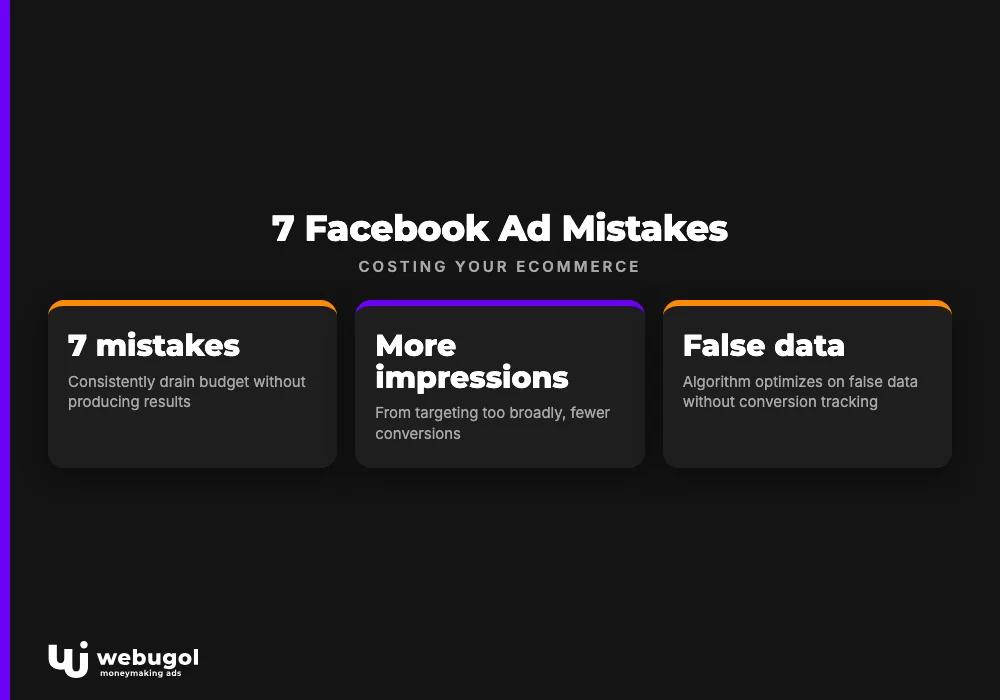
Before going deeper into each problem area, here is a quick view of the errors that consistently drain budget without producing results.
| Mistake | What it costs you | The fix |
|---|---|---|
| Targeting too broadly | More impressions, fewer conversions | Layer interests, behaviors, and lookalike audiences |
| Missing conversion tracking meta setup | Algorithm optimizes on false data | Install Pixel plus Conversions API; verify in Events Manager |
| No retargeting campaigns for ecommerce | Warm audiences get no follow-up | Build custom audiences from visitors, add-to-carts, and initiators |
| Weak or absent CTAs | Clicks land but don't convert | Match CTA language to funnel stage |
| Underestimating facebook campaign budget | Learning phase stalls, data too thin | Concentrate budget into fewer ad sets rather than spreading it thin |
| No a/b testing ads | Dying creative runs unchecked | Test one variable at a time: image, headline, then CTA |
| Inaccurate reporting | Decisions built on wrong metrics | Cross-check Ads Manager against backend order counts |
What are the most common mistakes in Facebook ads for ecommerce?
The most common mistakes are overly broad targeting, misconfigured conversion tracking, absent retargeting, weak calls-to-action, and running campaigns without a/b testing ads. Any one of these can prevent a campaign from being profitable; together, they make it nearly impossible to generate consistent returns from facebook ads for ecommerce.
Targeting too broadly and diluting ad spend
Casting a wide demographic net is one of the most common and expensive errors in ecommerce facebook ad targeting. The reasoning seems sound: a larger audience means more potential buyers. In practice, impression counts rise but conversion rates fall, because a large portion of the expanded audience has no interest in the product.
Effective facebook ad targeting layers multiple conditions: demographic filters such as age, gender, and location, combined with interest and behavior signals, and lookalike audiences built from existing customer lists. Each added layer narrows the audience but raises the probability that any given person in it will take action. Lookalike audiences tell the algorithm to find users who resemble your best customers, which is one of the most reliable ways to find buyers without exhaustive manual interest selection.
The practical diagnostic: if cost per purchase is rising and conversion rate is falling, narrow the audience before changing creative. Overly broad targeting is often the quietest budget leak in an ecommerce account, because impression and click numbers stay high enough to look healthy while cost per result climbs in the background.
Neglecting a/b testing ads and running one creative until it fails
Without a/b testing ads, a campaign runs a single creative variation until performance decays, and there is no data to explain what would have worked better. This pattern repeats across most underperforming ecommerce accounts.
Structured ad creative testing changes one variable at a time. Testing a new headline alongside a new image simultaneously produces results that cannot be cleanly interpreted. A workable sequence: test two image formats or visual treatments first, identify the winner, then test headline variations against that winning image, then test CTA wording. Each test builds on the previous one.
A/b testing also uncovers audience behavior. Different ad variations often reveal which customer segments respond to product-focused messaging versus lifestyle-focused messaging. That insight carries over to the entire account, not just the campaign being tested.
Skipping or misconfiguring conversion tracking meta
Inaccurate tracking is one of the most damaging invisible problems in facebook ads for ecommerce. When conversion events fire incorrectly, the campaign optimization algorithm makes decisions based on false data. It may over-optimize toward low-value micro-conversions or under-count actual purchases, steering targeting in the wrong direction in either case.
The first check: confirm that the Meta Pixel fires on all relevant pages, including product pages, cart, checkout, and order confirmation. Standard events (ViewContent, AddToCart, InitiateCheckout, Purchase) must fire with the correct parameters, especially the value and currency fields on purchase events.
Inaccurate conversion tracking meta data also distorts customer lifetime value calculations and ROAS figures. A campaign that appears to run at a healthy return may actually be losing money if purchase events are inflated by duplicate firing. As a baseline practice, cross-reference your Ads Manager figures against Facebook API data and investigate any discrepancies rather than dismissing them.
Using CTAs that don't match the funnel stage
A call-to-action that doesn't match where the buyer sits in the decision process wastes the reach the ad generates. Cold audiences encountering the brand for the first time respond differently from someone who already viewed a product page twice and left without buying.
For cold audiences, lower-friction CTAs such as "See the collection" or "Learn more" reduce the barrier to clicking. For warm retargeting audiences, CTAs like "Get 10% off today" or "Complete your order" address the specific hesitation that caused the person to leave. Matching CTA language to funnel stage is one of the highest-leverage adjustments in any meta ads strategy, and it costs nothing to change.
The landing page must also match the CTA's promise. An ad that reads "Shop the sale" should direct users to the sale page. Sending paid traffic to the homepage forces the buyer to do extra navigation, and most will not bother.
How much budget do ecommerce businesses need for Facebook ads?
There is no universal figure, but there is a structural principle: the facebook campaign budget must support enough weekly conversion events for the algorithm to optimize reliably. Below a sufficient volume of conversions per ad set per week, performance stays erratic and the account may never exit the learning phase in a way that produces clean, actionable data.
To estimate the minimum useful budget, identify your expected cost per purchase and calculate what it would take to generate a meaningful volume of weekly conversions at that rate. If the math requires daily spend that exceeds your available budget, you have a real choice to make: increase total budget, reduce the number of active ad sets so existing budget concentrates per set, or accept that results will remain inconsistent.
Several factors push required budgets higher. Ad targeting complexity raises cost per thousand impressions in competitive niches. Frequency capping limits delivery and increases cost when audiences are small relative to daily budget. Creative optimization across multiple simultaneous variations requires additional spend to generate reliable data for each variant. Running separate prospecting, retargeting, and retention campaigns, which is the correct structure for most accounts, each requires its own allocation to function without starving the others.
The most common budget mistake is starting too low and expecting consistent output. A campaign running on minimal daily spend against a high-cost product will rarely generate the conversion volume the algorithm needs to make useful targeting decisions. When budget is genuinely constrained, concentrating it into fewer, larger ad sets is almost always more effective than spreading a small total across many audiences that each receive insufficient data.
For a closer look at how to divide spend across campaign objectives, see our breakdown of facebook campaign budget structures for ecommerce.
Key factors that affect how much budget ecommerce campaigns require:
- Ad targeting complexity increases cost per thousand impressions in competitive product categories.
- Frequency capping limits delivery and raises effective costs when audiences are small.
- Creative testing across multiple simultaneous variants requires additional spend to generate reliable comparative data.
- Running prospecting, retargeting, and retention as separate campaigns means each layer needs its own allocation to exit the learning phase.
How do you set up retargeting on Facebook for an online store?
Retargeting campaigns for ecommerce consistently produce higher returns than cold prospecting because they reach people who already expressed purchase intent. Setting up retargeting on Facebook for an ecommerce store requires three elements: the Meta Pixel installed and reporting correctly, custom audiences built from Pixel data, and ad creative that addresses why the specific person left without completing a purchase.
Building the custom audiences that power retargeting
The most productive retargeting audiences for facebook ads for ecommerce are built from specific behavioral signals:
- Website visitors from the past 7 to 30 days who viewed product pages, with existing purchasers excluded from the audience to avoid wasted spend on people who already converted.
- Add-to-cart events with no corresponding purchase. These are typically the highest-intent segment in any ecommerce account because the product selection decision is already made and only the final step remains.
- Initiate checkout events without a completed purchase. These are the narrowest and most valuable audience: people who got within one or two steps of completing a transaction before leaving.
- Past customers targeted with upsell, cross-sell, or replenishment campaigns, particularly effective for consumable products with predictable reorder timing.
Excluding existing purchasers from non-purchase retargeting is not optional. Including them wastes budget on people who already converted and creates a poor experience for customers who receive ads for something they already own.
Choosing retargeting creative that brings buyers back
Retargeting creative works best when it acknowledges the context. Someone who viewed a product multiple times and left needs something different from a cold audience seeing the brand for the first time.
Dynamic product ads automatically populate with the exact items each visitor viewed, pulled from your product catalog. They are the most operationally efficient format for retargeting campaigns for ecommerce because they match creative to viewer at scale without manual creative work per segment. Where price sensitivity is the main purchase barrier, an ad featuring a limited-time discount or free shipping offer can outperform generic product imagery. Where trust is the barrier, ads featuring customer reviews or ratings for the specific viewed product give buyers the social proof they need to move forward.
Retargeting campaigns for ecommerce also work for content marketing purposes. Ads containing educational material about a product category help people still in the research phase move toward a decision. Timing shapes what creative is appropriate: short-window retargeting after a cart abandonment supports urgency-based offers, while longer-window retargeting supports brand-reinforcing content and review-based creative.

What makes a good creative strategy for ecommerce Facebook ads?
A creative strategy for facebook ads for ecommerce starts with understanding who the buyer is and what prevents them from purchasing. Every element of the ad, the image or video, the headline, the body copy, and the CTA, should address a specific friction point or desire of the target customer.
The research phase comes before production. Before building any ad, identify which product benefits the target audience values most, what objections they raise before purchasing, and what content formats they engage with on Facebook. This shapes the message, not just the visual treatment.
Choosing formats for ecommerce ads
Format selection should follow creative intent:
- Single image ads work well for direct-response campaigns targeting warm or retargeting audiences. They communicate quickly, load efficiently, and perform strongly with a clear product shot and a focused headline.
- Video ads suit top-of-funnel prospecting. Video demonstrates the product in use, communicates benefits that static images cannot, and builds brand familiarity with people who have never heard of the product.
- Carousel ads display multiple products, different use cases of a single product, or a sequential story. They suit stores with broad catalogs or campaigns that walk the viewer through a comparison or decision process.
- Dynamic ads automatically populate from the product catalog and are the standard format for retargeting campaigns because they show each viewer the specific product they viewed without requiring manual creative work per audience segment.
Running ad creative testing that produces actionable data
The process for systematic ad creative testing is straightforward: isolate one variable per test, collect enough data for a clear winner to emerge, and move to the next variable. Most accounts test too many elements simultaneously, which makes it impossible to attribute performance differences to any single change.
The recommended testing sequence: start with the hero visual, either two different image treatments or image versus video. The visual is the primary scroll-stopper and has the largest effect on whether an ad gets clicked at all. After identifying the winning visual, test headline variations. Then test CTA wording. Finally, test audience segments or placements.
Track the right metrics at each stage. Click-through rate shows whether the creative captures attention. Cost per purchase shows whether it drives conversions. An ad with a high CTR and a high cost per purchase usually points to a landing page problem, not a creative problem. For specific benchmarks on what click-through rates to expect from ecommerce Facebook campaigns and how to improve them, see our guide on click-through rate optimization for ecommerce Facebook ads.
How to track Facebook ad conversions for ecommerce?
Conversion tracking for ecommerce on Meta runs through the Meta Pixel and, for greater accuracy, the Conversions API. The Pixel fires from the browser; the Conversions API fires from the server. Using both covers situations where browser-side tracking is blocked by ad blockers or privacy settings, which have meaningfully reduced Pixel-only reporting accuracy in recent years.
The standard setup for an ecommerce store:
- Install the Meta Pixel across all store pages, not just the product pages or homepage.
- Configure standard events on the relevant pages: ViewContent on product pages, AddToCart on cart add actions, InitiateCheckout on the checkout start page, and Purchase on the order confirmation page.
- Set up the Conversions API through your ecommerce platform's native integration or a third-party partner connector. This captures server-side purchase data that the browser Pixel misses.
- Enable event deduplication so that when both the Pixel and the Conversions API fire for the same purchase, Ads Manager records one conversion rather than two.
- Verify the full setup using the Events Manager in Meta Business Suite. Confirm that each event fires with the correct parameters and that the values your Ads Manager reports align with what your backend systems record.
After setup, compare your Ads Manager purchase count against actual backend order counts for the same date range. A meaningful gap indicates a tracking problem that needs investigation before campaign optimization can work reliably.
Inaccurate conversion tracking meta data has a compounding effect: the algorithm uses reported conversions to determine whom to show ads to, so if the data is wrong, targeting drifts wrong alongside it. Performance decline under these conditions becomes very hard to diagnose from inside the account.

Structuring a meta ads strategy that compounds over time
Running facebook ads for ecommerce profitably over months requires a campaign structure that separates different funnel stages rather than blending them into one campaign with a shared budget.
A working structure for most ecommerce accounts divides campaigns into three layers:
- Prospecting campaigns target cold audiences through interest targeting, lookalike audiences, or broad targeting with Advantage+ audience enabled. The goal is filling the top of the funnel with people who don't know the brand yet.
- Retargeting campaigns for ecommerce target warm custom audiences (site visitors, add-to-carts, checkout initiators) with a conversion objective. These close people already in the funnel.
- Retention campaigns target past purchasers with upsell offers, cross-sells, or replenishment reminders. These extend customer lifetime value without requiring new acquisition spend.
Each layer operates at a different expected ROAS. Prospecting runs at lower ROAS but generates the warm audiences that make retargeting possible. Evaluating each layer's performance separately, rather than looking at a blended account-level average, shows where the account is actually profitable and where it needs adjustment.
The meta ads strategy that consistently fails is a single campaign trying to accomplish everything at once: reach new people, retarget warm visitors, and serve existing customers from one shared budget. The algorithm receives conflicting signals, costs rise, and a blended ROAS number hides whether any individual layer is working or not.
Consistent creative rotation also prevents audience fatigue. When the same ad runs against the same audience for long enough, frequency rises and performance falls. A sustainable creative schedule introduces new variations before performance decays, rather than reacting after frequency has already peaked and engagement has dropped.
The Webugol Meta Ads service builds this campaign structure from scratch, covering tracking verification, audience segmentation, ongoing ad creative testing, and performance reporting. If your campaigns are spending without scaling, the issue is almost always structural rather than a simple budget shortfall.
Get your facebook ads for ecommerce working properly
If your facebook ads for ecommerce are burning budget without consistent returns, the cause is usually one of three things: the audience definition is too broad, conversion tracking meta is reporting incorrect data, or the campaign structure combines objectives that conflict with each other. Each of these is diagnosable with a methodical account audit.
Start with tracking. Confirm that the Events Manager shows clean purchase events with correct values that align with your backend. Then audit your facebook ad targeting to confirm there is no excessive audience overlap or demographic overbreadth that is diluting your spend. Finally, verify that prospecting and retargeting campaigns run as separate campaigns with their own budgets and objectives, not as ad sets competing within a single campaign.
The Webugol team works with ecommerce brands on the full Meta Ads cycle: account audit, audience build, creative testing, and performance reporting. Contact us to get a detailed consultation on structuring your facebook ads for ecommerce in a way that produces consistent, compounding returns.
FAQ
What are the most common mistakes ecommerce stores make with Facebook ads?
The most common mistakes are targeting audiences too broadly, skipping accurate conversion tracking meta setup, neglecting retargeting campaigns for ecommerce, and running ads without a/b testing. Most underperforming accounts have two or more of these problems running simultaneously, which makes diagnosing root cause harder than it needs to be.
How much budget does an ecommerce store need for Facebook ads?
Budget requirements depend on your product's cost per purchase and how many weekly conversion events the algorithm needs to optimize reliably. Factors including targeting complexity, frequency capping, and the number of active ad sets all push the required minimum higher. When budget is limited, concentrating it into fewer ad sets produces better optimization data than spreading a small total across many audiences.
How do you set up Facebook retargeting for an ecommerce store?
Install the Meta Pixel, verify that it fires correctly on all key pages, and build custom audiences from add-to-cart and checkout-initiator events. Exclude past purchasers from non-purchase retargeting audiences to avoid wasted spend. Dynamic product ads are the most efficient creative format because they automatically match the shown product to what each visitor viewed.
Why is conversion tracking so important for ecommerce Facebook ads?
The campaign optimization algorithm uses reported conversion data to decide who to show ads to. If the conversion tracking meta setup reports incorrect numbers, the algorithm targets the wrong people and performance degrades in ways that are difficult to diagnose. Inaccurate tracking also distorts customer lifetime value calculations and ROAS measurement, making it impossible to judge whether a campaign is profitable.
Is a/b testing ads worth running for smaller ecommerce budgets?
A/b testing ads is worth running at any budget level, but the approach changes with available spend. Smaller budgets should test one variable at a time and allow more time for a meaningful difference to emerge, rather than running many simultaneous tests that each receive too little spend to produce reliable data.