



Facebook ads strategy: cold, retargeting, lookalike, and dynamic campaigns
A Facebook ads strategy is the structured plan that defines who sees your ads, which campaign type runs at each funnel stage, and what objective Meta uses to optimize your spend. The most effective approach layers four campaign types: cold audience targeting to reach new people, retargeting campaign setup to re-engage site visitors, lookalike audience ads to scale proven buyers, and dynamic product ads to recover abandoned carts. Getting the sequence right matters because running the wrong campaign type at the wrong funnel stage is the most common reason ad budgets return nothing.
This guide covers each layer of the meta ads funnel in the order you should build it, ending with how to choose the right facebook campaign objectives for each stage.
Campaign types in a Facebook ads strategy
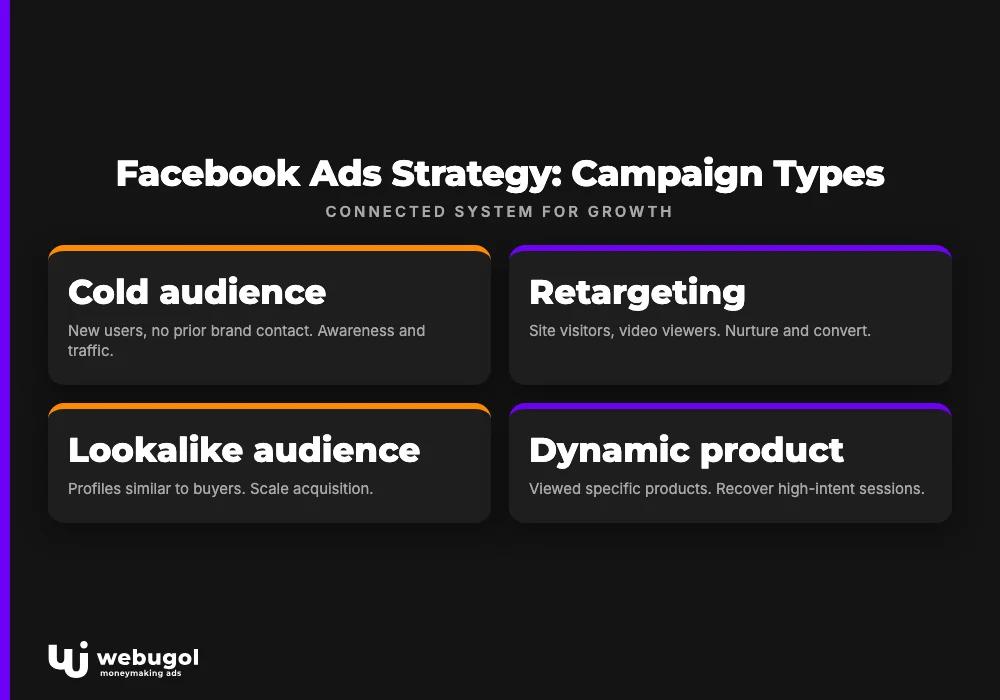
The four campaign types form a connected system. Understanding how they relate helps you allocate budget and sequence them correctly.
| Campaign type | Audience | Goal | Main metric |
|---|---|---|---|
| Cold audience targeting | New users, no prior brand contact | Awareness and traffic | CPM, CTR |
| Retargeting | Site visitors, video viewers | Nurture and convert | CVR, CPA |
| Lookalike audience ads | Profiles similar to your buyers | Scale acquisition | ROAS, CPA |
| Dynamic product ads | Visitors who viewed specific products | Recover high-intent sessions | ROAS |
Cold campaigns fill the top of the funnel with new traffic. That traffic creates the custom audience pools retargeting and dynamic product ads draw from. The conversion signals those campaigns generate give the algorithm the data it needs to build accurate lookalike audience ads. Remove any layer and the whole system loses efficiency.
What is a cold audience in Facebook ads?
A cold audience in Facebook ads is a group of users with no prior relationship with your brand. They have not visited your site, watched your videos, or interacted with your page or any previous ads. Cold audience targeting works by using interest categories, demographic filters, and behavioral signals inside Meta Ads Manager to reach these people.
Cold audience targeting is where most facebook ads strategies begin, and where most budgets are also lost. Two failure points come up repeatedly: audiences that are too broad to carry meaningful signal, and ads that fail to earn attention in the first three seconds.
To build effective cold targeting:
- Set demographic boundaries: age, location, and language. Keep them as tight as your product's real market justifies.
- Layer interest and behavior signals relevant to your category. Test narrower sub-interests in separate ad sets so you can see which clusters drive qualified clicks rather than guessing.
- Write creative that introduces the problem your product solves. Cold audiences have no brand context, so the ad carries that full responsibility.
- Use CPM and CTR as your primary success metrics at this stage. You are testing which messages resonate, not yet optimizing for purchases.
- Review Facebook Insights regularly to identify which interest clusters perform, cut the underperformers, and reinvest budget in what works.
Cold campaigns typically need two to three weeks of data before performance becomes readable. The first week often shows elevated CPMs as Meta's delivery system tests the audience. CTR and engagement rates stabilize in week two. Cut consistently underperforming ad sets at that point and reallocate budget before scaling.
What is the difference between cold and warm audience targeting?
A cold audience has had no contact with your brand. A warm audience has already interacted in some form: they watched 50% of a video ad, clicked through to a product page, or engaged with a previous campaign without converting.
The functional difference is purchase intent. Warm audiences are closer to a buying decision, so they respond better to direct offers, specific product creative, and social proof. Cold audiences need context and problem framing first.
Running a purchase-conversion campaign against a cold audience before any warming typically produces high CPAs. The algorithm cannot find enough ready buyers inside a group that has never encountered the brand.
A well-built facebook ads strategy keeps cold and warm audiences in separate campaigns with separate budgets, separate creatives, and separate objectives. That separation keeps performance data clean and makes optimization decisions straightforward.
How does Meta ads retargeting work?
Meta ads retargeting works by using the Meta Pixel, a snippet of JavaScript installed on your website, to record what users do: page views, product views, add-to-cart events, and completed purchases. You then build custom audiences from that behavioral data and show those users ads designed to bring them back.
Retargeting campaign setup: core steps
Setting up a retargeting campaign in Meta Ads Manager follows a clear sequence:
- Install and verify the Meta Pixel. Confirm that standard events, ViewContent, AddToCart, and Purchase, fire correctly in Meta's Events Manager. Inaccurate event data produces unreliable custom audiences before you have built anything.
- Build segmented custom audiences. Separate by behavior: all site visitors in the last 30 days, product page viewers who did not purchase, cart abandoners, and past buyers for upsell campaigns.
- Match creative to each segment's intent. Cart abandoners respond to direct reminders or time-limited offers. Product page viewers respond to social proof or comparison content. Past buyers respond to complementary product suggestions.
- Set purchase exclusions. Exclude recent buyers from acquisition-focused retargeting ad sets to avoid spending budget on people who already converted.
- Track CVR and CPA on a weekly basis. Retargeting typically produces lower CPAs than cold campaigns because the audience already knows the brand. Rising CPA combined with rising ad frequency means the creative needs refreshing, not the audience.
A facebook ads strategy that commits to proper retargeting setup, including Pixel verification, audience segmentation, and exclusion lists, will outperform one that skips these steps even with stronger cold-audience creative.
Watch click-through rate alongside frequency to catch ad fatigue before it drags performance. For a practical reference on what strong retargeting looks like, your Facebook ad CTR and how to raise it covers the key benchmarks.
How to set up a lookalike audience in Meta ads?
To create a lookalike audience in Meta Ads Manager, navigate to Audiences, click "Create Audience," and select "Lookalike Audience." Meta prompts you to choose a source audience, a target country or region, and an audience size from 1% to 10% of the target population.
The source audience is the most important input. Meta models the lookalike on the traits of the people in that source: their demographics, interests, and online behavior. A strong source produces an accurate lookalike. A noisy or low-quality source produces a lookalike that does not reflect your actual customers.
Choosing the right source for lookalike audience ads
The source you choose determines the quality of the targeting that follows:
- Customer list (best option): upload a CSV of actual buyers with email addresses, phone numbers, or both. Meta matches these to Facebook profiles and models from your real customers. Purchase-based lookalike audience ads consistently outperform engagement-based ones in acquisition campaigns.
- Pixel purchase events: if your Pixel has recorded at least 100 purchase events (Meta recommends 1,000 or more for best accuracy), you can build a lookalike directly from that event data without uploading a list manually.
- Engaged custom audiences: video viewers past 25%, page engagers, or lead form completers can work as source audiences when purchase data is too thin. These produce lower accuracy but are a better starting point than interest-only cold targeting.
Meta's 1% lookalike is the tightest match and delivers the highest relevance at a smaller reach. A 5-10% lookalike offers more volume at lower precision, which helps when scaling a campaign that has already proved its ROAS at the 1-2% level.
Always run lookalike audience ads in a separate campaign from interest-based cold targeting. Mixing audience types in the same ad set makes optimization data unreadable. Compare CPAs from both over at least two weeks before deciding which to scale.

Dynamic product ads: retargeting at the product level
Dynamic product ads, usually called DPAs, are a retargeting format that automatically assembles ad creative from your product catalog based on what each user viewed on your site. Instead of a generic brand reminder, the user sees the exact product they were considering, with current pricing and imagery pulled in real time.
DPAs occupy the retargeting layer of any facebook ads strategy but operate at higher precision than standard retargeting creative. A single DPA campaign can cover an entire product catalog because the ad template references dynamic catalog fields rather than fixed creative assets.
Running DPAs requires three things in place:
- A product catalog in Meta Commerce Manager with accurate titles, images, prices, and inventory data.
- The Meta Pixel firing ViewContent, AddToCart, and Purchase events reliably on your site.
- An ad template in Meta Ads Manager that uses dynamic tokens to pull the product name, image, price, and destination URL from the catalog.
DPAs are most valuable for e-commerce accounts with large product ranges where creating separate retargeting creative for every item would be impractical. For businesses with fewer than 20 products, standard retargeting with manually crafted creative typically performs just as well and gives more control over the message.
Service businesses without a product catalog cannot use DPAs at all; standard retargeting is the only option in that case.
For accounts that qualify, DPAs also work as upsell and cross-sell tools targeting past buyers. Exclude converters from the standard retargeting campaign and build a separate DPA set showing past buyers catalog items they have not purchased yet. This separation keeps acquisition retargeting and upsell retargeting distinct, which makes ROAS reporting cleaner. For guidance on splitting budget across these campaign types, structuring Facebook campaign budgets across ad types covers that decision in detail.
What campaign objectives should I use on Facebook?
The objectives that matter most in a structured facebook ads strategy are Traffic, Conversions, Leads, and Catalog Sales. Each tells Meta's algorithm which user action to optimize your budget toward.
This choice is made at the campaign level and cannot be changed after launch. Using the wrong objective is a structural error: Meta will optimize for exactly what you select, regardless of your actual business goal.
The main facebook campaign objectives and when each applies:
Traffic is the right choice for cold campaigns where the goal is driving qualified visitors to a landing page or product page. Use it when your Pixel does not yet have enough conversion history, specifically fewer than 50 purchase events per week, per Meta's own guidance. Traffic campaigns maximize link clicks, not purchases.
Engagement maximizes your ad's visibility to users who have interacted with your content before. It works as a supporting layer for brand presence alongside traffic or conversion campaigns, not as a standalone acquisition tool. Running engagement campaigns alone will not generate purchases, but keeping the brand visible between purchase cycles can lower retargeting CPAs over time by maintaining awareness.
App installs is the correct objective if your product is a mobile application. Meta identifies users statistically likely to download and open apps.
Leads uses Facebook's native lead form to collect contact details without sending users to an external site. This works well for service businesses that want inquiries without the friction of a landing page redirect.
Conversions (purchases or on-site leads) is the core objective for most e-commerce facebook ads strategies. Meta optimizes toward users most likely to complete the conversion event you specify. To run this effectively, Meta recommends at least 50 conversion events per ad set per week. Without that volume of signal, the algorithm cannot identify who converts, and performance will fluctuate.
A logical facebook ads strategy sequences these objectives rather than defaulting to conversions on day one. A new account with no Pixel history starts with Traffic to accumulate event data. Once conversion signal is strong enough, the account shifts to Conversions. Retargeting and DPA campaigns layer in as custom audience pools grow large enough to sustain their own ad sets.

Ready to sharpen your Facebook ads strategy?
A facebook ads strategy that produces consistent returns runs in layers: cold audience targeting fills the top of the meta ads funnel, retargeting campaign setup converts the middle, and lookalike audience ads extend proven acquisition to new users. Dynamic product ads recover high-intent visitors. The right facebook campaign objectives point the algorithm toward the action that matters at each stage.
If you want a team to audit your account structure and build this funnel for your business, Webugol's paid social team works across all four campaign types and can identify where your current spend is underperforming. Reach out to start with a focused account review.
FAQ
What is a cold audience in Facebook ads?
A cold audience in Facebook ads is a group of users who have never interacted with your brand: no site visits, no ad clicks, no video views. Cold audience targeting on Facebook reaches these people through interest categories, demographic filters, and behavioral signals inside Meta Ads Manager.
How does Meta ads retargeting work?
The Meta Pixel records user behavior on your website, including page views, product views, and add-to-cart events. You build custom audiences from that data and serve those users ads designed to bring them back to complete the action they left unfinished.
What campaign objectives should I use on Facebook?
The right objective depends on your Pixel data and funnel stage. Use Traffic when you have fewer than 50 weekly purchase events; switch to Conversions once you meet Meta's recommended threshold of at least 50 events per ad set per week; use Leads for service businesses without a landing page; use Catalog Sales for dynamic product ads.
What is the difference between cold and warm audience targeting?
Cold audiences have no prior brand contact; warm audiences have already engaged through an ad click, site visit, or video view. Warm audiences convert at higher rates because they already know the brand, so they respond better to direct offers than to introductory context-setting creative.
How to set up a lookalike audience in Meta ads?
Go to Audiences in Meta Ads Manager, click "Create Audience," and select "Lookalike Audience." Choose a source audience of actual customers or Pixel purchase events, select your target country, and set the size between 1% and 10%. A 1% lookalike is the most accurate; wider percentages give more reach at lower precision.