



Medical Tourism Marketing: Strategies That Win International Patients
Medical tourism marketing is the practice of attracting patients from other countries or regions to seek medical, dental, or surgical care at your facility. Done well, it builds a predictable pipeline of international patients through targeted digital channels, credibility signals, and strategic partnerships. Done poorly, it burns budget on campaigns that reach the wrong audience entirely.
This guide covers channel selection, website conversion, trust-building, and ROI measurement for providers competing for international patients.
How do you market a medical tourism business?
Effective medical tourism marketing starts with two questions: who exactly are you trying to reach, and why would they choose your facility over a domestic option or a competing destination? Answering both shapes every other decision in the strategy.
Once the audience is defined, the channel mix follows. Most providers need three layers working together: organic search to capture active demand, paid search to accelerate patient lead generation in healthcare, and social proof to convert interest into real inquiries. Referral partnerships with travel agencies and international facilitators add a fourth layer that paid media alone cannot replicate.
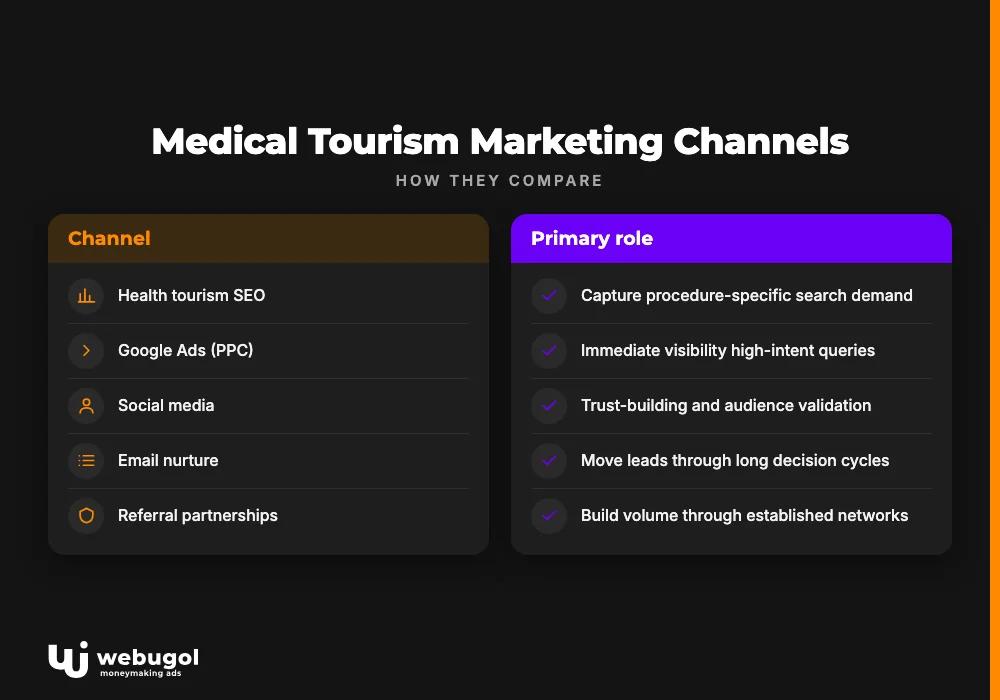
Here is how the primary medical tourism marketing channels compare:
| Channel | Primary role | Key strength |
|---|---|---|
| Health tourism SEO | Capture procedure-specific search demand | Long-term, compounding traffic |
| Google Ads (PPC) | Immediate visibility for high-intent queries | Speed and geographic precision |
| Social media | Trust-building and audience validation | Patient testimonials, facility credibility |
| Email nurture | Move leads through long decision cycles | Follow-up sequences and retention |
| Referral partnerships | Build volume through established networks | Low cost per patient at scale |
What digital channels work best for attracting international patients?
Search and paid advertising together form the core of medical travel digital marketing. Both reach patients at the moment of highest intent: when someone is actively researching a procedure abroad.
Health tourism SEO
Search engine optimization places your facility in front of patients who are already looking. For medical tourism, this means targeting procedure-specific terms alongside destination queries simultaneously. Long-tail keywords with lower competition typically convert better because the searcher is further into the decision process.
Health tourism SEO compounds. A page ranking for 50 procedure queries keeps generating inquiries without ongoing spend. That sustained return distinguishes it from paid channels. For a deeper look at how organic search builds durable visibility for healthcare providers, our guide to organic search strategy for healthcare practices covers the foundational mechanics.
Google Ads for patient lead generation
Google Ads operates on a pay-per-click model: you bid on keywords and ads appear when patients search those terms. For medical tourism agency services, this delivers immediate visibility that organic search takes months to achieve.
Effective campaigns require four elements. First, keyword research targeting procedure names, destination queries, and cost-comparison searches. Second, ad copy addressing the patient's primary concern upfront: accreditation, language support, or price transparency. Third, landing pages that match the ad exactly and remove obstacles to inquiry. Fourth, regular review of click-through rates, conversion rates, and cost per acquisition to shift budget toward what performs.
Ad extensions add measurable value. Phone numbers, specific service links, and location details increase click-through rates and give patients more contact options before they reach the landing page.
Social media for international patient acquisition
Social media works differently from search. Patients rarely begin a medical tourism decision on Instagram. They use it to validate a provider they found elsewhere. After discovering your facility through search, they look for patient stories, real facility photos, and evidence that others made the same choice without regret.
Facebook and Instagram work well for reaching patients in source markets by age, income, location, and relevant health interests. LinkedIn matters more for corporate wellness partnerships and B2B referral relationships. Platform behavior varies considerably, and connecting with international patients through social media requires audience-specific approaches for each channel.
Healthcare tourism advertising on social should lead with patient testimonials, procedure explainers, and transparent facility content rather than promotional messaging.
What makes a medical tourism website convert visitors into patients?
Most medical tourism marketing efforts generate traffic but fail at conversion. The gap is almost always trust, not volume of information.
A converting website answers the unspoken questions before the patient asks them. What international accreditations do you hold? What languages does your care team speak? What happens if a complication arises after the patient returns home? Who is the dedicated point of contact throughout the process? These are the actual decision criteria for anyone evaluating cross-border care.
Specific elements that lift conversion:
- Display accreditation badges on procedure pages and the homepage, not only on an "about" page.
- Patient testimonials must include country of origin, procedure name, and real narrative detail; generic five-star ratings without context carry little weight with international prospects.
- Use authentic facility photographs of operating rooms and recovery areas rather than stock images.
- Publish a response time commitment visibly on the inquiry form.
- Ensure full mobile optimization throughout, since a large share of international health searches happen on mobile.
Landing pages tied to paid campaigns need further discipline. They should match the ad copy precisely, remove navigation that pulls visitors away from the inquiry path, and present one clear action. A general-purpose page does not convert as a paid landing page.
How to build trust with international medical tourists online?
Trust is the single largest barrier in international patient acquisition. Patients are evaluating cross-border care with real health stakes, significant logistical unknowns, and no existing relationship with the facility.
International accreditation from recognized bodies is the fastest trust signal. It tells patients that an independent organization has audited and verified your standards. This is the credential that most directly separates credible providers from those patients cannot properly evaluate.
Patient testimonials work when they are specific. Country of origin, procedure name, and genuine narrative details convert skeptical prospects. Vague positive reviews without context contribute very little to the evaluation process.
Educational content builds credibility over time. Articles explaining procedures in plain language, honest destination guides, and transparent descriptions of the medical tourism process establish your facility as a knowledgeable resource before the patient ever contacts you. This content layer is where medical travel digital marketing and organic authority reinforce each other.
Third-party partnerships add external validation. Established collaborations with travel agencies, airlines, and hotels signal that recognized businesses have evaluated your operation and found it credible. Relationships with local embassies and consulates extend that credibility into specific source markets.
How do you measure ROI in medical tourism marketing?
Two metrics anchor measurement: return on investment and patient acquisition cost.
Return on investment compares revenue from patients acquired through marketing against the spend required to acquire them. A campaign costing $5,000 that brings patients with a combined treatment value of $50,000 is working. One costing $5,000 that generates $3,000 in revenue is not, regardless of traffic volume. Traffic data alone tells you nothing.
Patient acquisition cost (PAC) measures spend per new patient by channel. The PAC from organic search typically differs from PAC through paid social or partnership referrals. Knowing which channel delivers the lowest PAC for your highest-value procedures tells you where to concentrate future budget.
Track these alongside:
- Track inquiry-to-consultation conversion rate: what share of website inquiries become scheduled consultations.
- Track consultation-to-procedure conversion rate: what share of consultations result in a confirmed booking.
- Monitor source market breakdown to see which countries generate the most inquiries and highest-value cases.
- Calculate average treatment value by channel, since different channels attract different procedure types and patient profiles.
Google Ads surfaces this data in near real-time. SEO performance takes longer to read but shows in organic inquiry volume and keyword ranking trends over time. Social media attribution is harder to isolate; UTM parameters on every outbound link are the minimum required to track social's contribution to medical tourism marketing ROI accurately.
Partnerships and referral networks in medical tourism
Digital channels address inbound search demand. Partnerships build a parallel referral layer that often delivers lower patient acquisition cost than paid advertising at scale.
Travel agencies and medical facilitators maintain ongoing relationships with clients who ask about overseas healthcare options. When they recommend your facility, they pass along established trust. Structuring these relationships with clear commission terms, fast response protocols, and co-branded materials makes them consistently productive for both parties.
Airlines and hotels participate in bundled medical travel packages for providers with established patient volume. These arrangements reduce the logistical friction that deters many potential patients and give partners a concrete incentive to promote your services actively.
Diaspora communities in source markets are a consistently underused channel in healthcare tourism advertising. Former patients who had a positive experience become referral sources when the process makes sharing easy. A structured patient referral program formalizes this and makes it scalable over time.
Ready to grow your international patient base?
Medical tourism marketing involves more moving parts than most providers can manage in-house. Health tourism SEO requires ongoing technical and content work. PPC campaigns need frequent optimization. Healthcare tourism advertising must comply with regulations across multiple jurisdictions. Patient communications need to function in multiple languages.
The Webugol team brings years of experience in medical travel digital marketing, from health tourism SEO through paid search and content strategy. Our healthcare growth system is designed for providers who want to grow their international patient base systematically without building a full internal marketing team.
Get in touch to discuss your facility's goals and target source markets.
FAQ
How do you market a medical tourism business?
Identify your highest-demand procedures and the source markets where those procedures are most searched. Build search visibility through health tourism SEO and Google Ads, add credibility through patient testimonials and accreditation signals, and layer in referral partnerships with travel agencies and facilitators as a parallel acquisition channel.
What digital channels work best for attracting international patients?
Organic search and Google Ads capture patients already researching procedures abroad and deliver the highest conversion intent. Social media supports trust-building and validation after initial discovery. Email marketing nurtures long decision cycles through follow-up sequences once a prospect has expressed interest.
How do you measure ROI in medical tourism marketing?
Compare revenue from patients acquired through each channel against the marketing spend for that channel. Patient acquisition cost and consultation-to-procedure conversion rate are the secondary metrics that most clearly show where budget is working and where it needs adjustment.
What makes a medical tourism website convert visitors into patients?
Prominently displayed accreditation badges, specific patient testimonials with country of origin and procedure type, authentic facility photography, and a single clear call to action per page. Landing pages tied to paid campaigns should eliminate navigation options and match the ad copy precisely.
How do you build trust with international medical tourists online?
International accreditation from recognized bodies is the most direct trust signal available. Specific patient testimonials, educational procedure content, and documented partnerships with travel agencies and hotels build credibility incrementally. Publishing a response time commitment on inquiry forms closes the gap between initial interest and a booked consultation.