



Cannabis Dispensary Marketing: A Complete Strategy Guide
Cannabis dispensary marketing is the full set of tactics a dispensary uses to attract, educate, and retain patients through legal channels. It covers SEO, content, email, social media, and local outreach. Strict federal and state rules constrain every option available to you. Done well, it positions your business as a trusted medical provider rather than just another retail operation. This guide focuses on what actually works under those constraints.
What are the legal restrictions on cannabis advertising in the US?
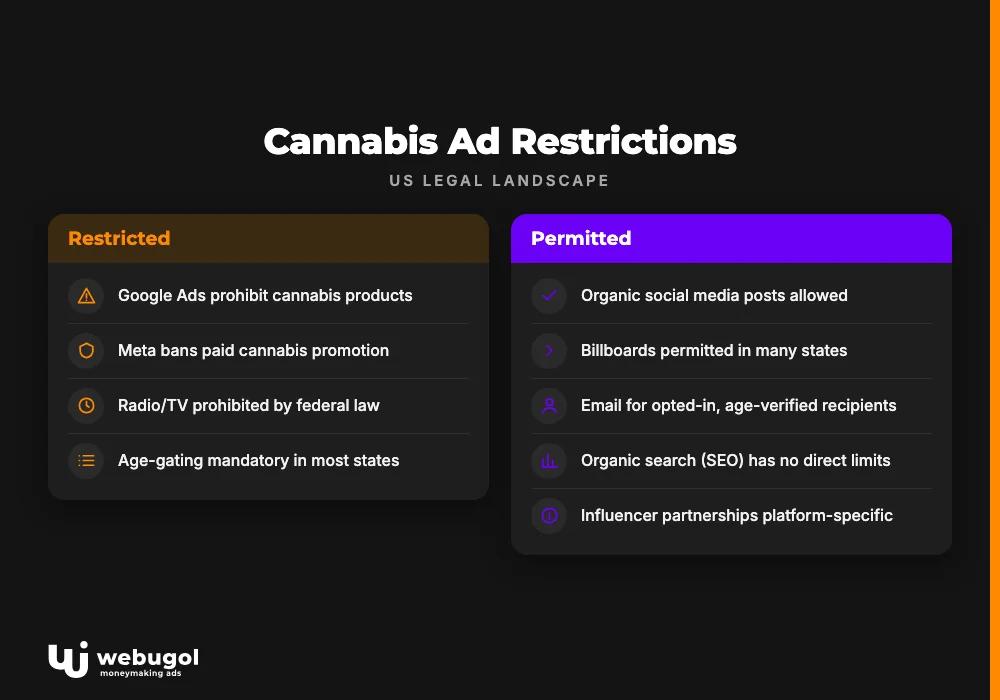
Cannabis advertising restrictions are the defining constraint on dispensary growth. Federal law classifies cannabis as a Schedule I substance. That classification blocks access to most major ad platforms, federally licensed broadcast media, and standard banking services. State regulations add a second layer: permitted ad language, required disclaimers, distance minimums from schools and parks, and limits on outdoor advertising all vary by state.
The table below shows how common channels are typically affected:
| Channel | Typical Status |
|---|---|
| Google Ads | Cannabis products prohibited under ad policies |
| Meta (Facebook/Instagram) | Paid promotion banned; organic posts generally allowed |
| Radio/TV (federal licensees) | Prohibited under federal law |
| Billboards | Permitted in many legal states; local zoning rules apply |
| Legal for opted-in, age-verified recipients | |
| Organic search (SEO) | No direct advertising restrictions |
| Influencer partnerships | Platform-specific; FTC disclosure rules apply |
Age-gating is mandatory in most states. Any advertising that could reach minors violates state licensing rules and risks license suspension. Claims about therapeutic effects require careful wording: language that implies cannabis "treats" or "cures" a specific condition crosses into FDA medical claim territory.
The practical result: cannabis dispensary marketing concentrates in owned and earned channels far more than other retail sectors.
How to market a medical marijuana dispensary online?
Medical marijuana marketing online works through four channels that regulators and platforms still permit: organic search, content, email, and local business listings. Paid search is largely closed. Social ads are blocked. That narrows the options, but every competitor faces the same restrictions.
Start with your Google Business Profile. Patients searching "medical dispensary near me" or "cannabis [city]" see the local map pack first. A complete GBP with accurate hours, photos, services, and patient reviews directly determines whether your dispensary appears there. It costs nothing. Results arrive faster than any paid campaign.
From there, strategy expands outward. Your website content answers patient questions and builds search visibility over time. Your email list creates direct patient relationships that no algorithm can interrupt. Social media, within platform limits, builds community. Each channel reinforces the others when they share consistent messaging and a clear brand voice.
Building a brand that earns patient trust
A dispensary brand is the consistent answer to one question: why should a patient choose you? For medical cannabis, the answer centers on product quality, staff expertise, and patient experience.
Patients seeking cannabis for chronic pain, arthritis, epilepsy, anxiety, or PTSD are making healthcare decisions, not impulse purchases. They research options. They read reviews. A dispensary that communicates clearly about product sourcing, potency testing, and staff training earns trust that paid advertising cannot shortcut.
Visual identity reinforces that positioning. Green and blue tones are common in medical cannabis branding because they connect the product to health rather than recreation. That choice affects how regulators review your materials and how patients evaluate your credibility before they ever visit.
What digital channels work best for cannabis dispensary marketing?
Dispensary digital marketing is most effective when it concentrates on channels with the fewest restrictions and the highest long-term returns. Four categories consistently outperform the rest.
Marijuana dispensary SEO
Marijuana dispensary SEO generates the most durable patient traffic of any digital channel. When a patient searches for a product, a condition, or a local dispensary, your ranking determines whether they reach you or a competitor.
Location-based keywords drive local results. Phrases like "medical cannabis dispensary [city]" capture patients with high purchase intent. Condition-specific content, articles on cannabis and chronic pain or anxiety relief, attracts patients earlier in their research. Both audiences matter for sustained acquisition.
Technical site health matters just as much as content. A site that loads slowly on mobile, has crawl errors, or lacks local business structured data underperforms regardless of content quality. Fast page load, valid HTTPS, clean URL structures, and correct schema markup are prerequisites for competitive rankings, not optional upgrades.
For health businesses in regulated markets, the compounding effect of SEO is especially high. The dynamics described in why health businesses in regulated niches need long-term SEO investment apply directly to dispensaries: organic authority grows over time, while paid reach disappears the moment a budget stops.
Cannabis content marketing
Cannabis content marketing builds site authority while educating the patients most likely to become loyal visitors. This audience is larger than most dispensary operators realize.
Many prospective patients are still researching, not yet searching for a specific product. Real patient questions drive the best content: which conditions qualify for medical cannabis in my state, what is the difference between CBD and THC, how does cannabis interact with existing medications. These are long-tail queries with genuine intent. No paid channel can reach them.
Answering those questions thoroughly and on a consistent publishing schedule positions your dispensary as the authoritative local source on medical cannabis. That library of content accumulates search rankings over months and years, without any recurring ad spend.
Video extends reach further. YouTube is more permissive on cannabis education than Meta platforms. Educational videos on product types, usage methods, and staff expertise can rank in both YouTube and Google search, driving qualified patient traffic to your site without touching the ad systems that prohibit cannabis content.
Dispensary social media strategy
A dispensary social media strategy works within tight constraints. Paid promotion of cannabis on Facebook and Instagram is prohibited. Organic posts are generally allowed, but platform policies change and accounts get reviewed for violations without warning.
The approach that stays within those limits: post education, not sales. Share harm reduction information. Feature staff knowledge. Document community involvement. Highlight patient stories, with permission. This type of content builds a following among prospective patients without triggering platform review. It also generates content that can rank in search.
Platforms with more room for cannabis content include LinkedIn for industry positioning and B2B networking, YouTube for educational video, and podcast platforms. Influencer partnerships, properly disclosed under FTC guidelines, function similarly to referrals and bypass most ad restrictions without requiring paid placement.
Email marketing for dispensaries
Email bypasses platform ad bans entirely. Messages go directly to opted-in, age-verified patients. No algorithm filters the content. No platform can revoke your access to the list.
A structured email program for a dispensary includes a welcome sequence for new patients, regular product education, promotions where state law permits, and re-engagement messages for patients who have not visited in 60 or 90 days. Segmenting by condition, purchase history, or visit frequency makes each message more relevant and reduces unsubscribe rates significantly.
How to drive organic traffic to a dispensary website without paid ads?
Organic traffic for a dispensary comes from three sources: search rankings, referrals from other websites, and direct visits from returning patients. Paid search is largely unavailable for cannabis businesses. That puts SEO and link building at the center of patient acquisition.
Local SEO produces the fastest results. A complete Google Business Profile, consistent Name/Address/Phone data across directories, and a steady stream of patient reviews directly affect local map pack visibility. Most dispensary-related searches resolve in the map pack, not the organic blue-link results below it.
Link building compounds results over time. When local news outlets, cannabis publications, health organizations, or community groups link to your site, domain authority rises and rankings improve across all keywords. Cultivating media coverage and community relationships creates the conditions for those links to form naturally.
The specific GBP and citation signals that most affect local rankings for health-adjacent businesses are covered in the local search ranking guide for dispensaries and health businesses, including the map pack factors that most sites overlook.

What is the best SEO strategy for a cannabis dispensary?
The best SEO strategy for a cannabis dispensary combines local optimization, content depth, and technical site health. These three components reinforce each other and compound over time.
Local optimization starts with a complete Google Business Profile. Fill every field. Add photos. Respond to every review. Maintain consistent citations across every directory where the dispensary appears. Inconsistent name or address data suppresses map pack rankings directly.
Content depth means the site has a page or post that directly answers every question a prospective patient might have at every stage of research. Thin pages with minimal content do not rank in competitive local markets. Comprehensive, specific content organized around real patient search intent earns both rankings and patient trust.
Technical health means pages load in under three seconds on mobile, the site has no crawl errors, HTTPS is valid, and local business structured data is implemented correctly. Search engines cannot reliably rank content they cannot reliably index.
Cannabis dispensary marketing built on these three foundations generates patient traffic that no ad platform policy change can remove. Each component strengthens the others over time, rather than requiring constant budget to maintain.
Collaborating with healthcare professionals
Dispensaries that build relationships with physicians, nurses, and pharmacists gain a referral channel that operates entirely outside platform restrictions. Healthcare providers in legal states are increasingly aware of cannabis as an option for specific qualifying conditions.
A dispensary known for patient education, product quality documentation, and knowledgeable staff is one a provider will mention to appropriate patients. Building those relationships takes consistency: attending local health events, providing clear educational materials, and maintaining clinical seriousness in all patient-facing communications.
The patient demographics in the US medical cannabis market are genuinely broad: young adults through seniors, with qualifying conditions including chronic pain, arthritis, epilepsy, anxiety, and PTSD. Marketing materials and provider outreach should reflect that range rather than assuming a single patient profile.

What not to do in cannabis dispensary marketing
Most cannabis dispensary marketing failures are compliance failures, not creative ones.
Marketing to minors is the most serious error. Any advertising that could plausibly reach an underage audience violates state licensing rules and platform policies. Age-gating websites, email lists, and social accounts is mandatory, not a best practice.
Unapproved medical claims create regulatory risk. Stating that cannabis "treats" or "cures" specific conditions falls under FDA oversight. Use careful language: "patients report using it for" or "may support relief from" are safer framings. Always verify your state's specific ad guidelines before publishing any health-related claims.
Posting uniform content across all platforms results in account suspensions. Instagram's cannabis policies differ from YouTube's. Facebook's rules differ from LinkedIn's. Adapt content for each platform rather than reposting the same material uniformly.
Overlooking traditional channels leaves patient traffic on the table. Billboards drive real foot traffic to dispensaries in legal states. Community event sponsorships build neighborhood relationships. Print advertising in appropriate publications reaches demographic groups that rely less heavily on digital platforms.
Tracking cannabis dispensary marketing performance
Cannabis dispensary marketing without measurement is guesswork. The metrics that matter: organic search traffic by page and keyword, Google Business Profile views and direction requests, email open and click rates, website-to-visit conversion rates, and average purchase value by patient segment.
These numbers reveal which channels bring the right patients, not just traffic volume. A blog post with 500 monthly readers and no patient conversions is worth less than a local citation that sends 30 patients per month who become regulars.
Patient feedback sharpens the picture further. Which products are patients asking about that the dispensary does not stock? What are first-time visitors confused about before their appointment? Those gaps define the next content and merchandising priorities.
Reviewing these signals quarterly and adjusting strategy accordingly keeps cannabis dispensary marketing responsive to real patient behavior, not just dashboard numbers.
Ready to build a dispensary marketing program that works?
Cannabis dispensary marketing is more constrained than most industries. That constraint is also a competitive advantage for dispensaries that build strong organic channels. When paid platforms are unavailable to everyone, the dispensary with the best SEO, content, and email program wins.
Webugol's healthcare growth system for regulated businesses is built for exactly this environment. If you want patient acquisition that does not depend on ad platforms that can close access overnight, contact Webugol to start the conversation.
FAQ
How to market a medical marijuana dispensary online?
Medical marijuana marketing online relies on organic search, content, email, and local business listings because most paid ad platforms prohibit cannabis promotion. A complete Google Business Profile, a content calendar built around patient questions, and a segmented email list are the three highest-return starting points. Add social media and influencer outreach after these foundations are established.
What are the legal restrictions on cannabis advertising in the US?
Cannabis advertising restrictions include bans on most paid digital ads (Google, Meta), prohibitions on federally licensed broadcast advertising, mandatory age-gating, and state-specific rules on ad language and required disclaimers. Federal Schedule I classification blocks platform access that other health businesses take for granted. Always verify your state's current rules before launching any campaign.
What is the best SEO strategy for a cannabis dispensary?
The best marijuana dispensary SEO strategy combines a fully optimized Google Business Profile for local map pack visibility, content that answers patient questions at every research stage, and clean technical site health including mobile speed, HTTPS, and structured data. These three components compound over time and produce patient traffic that ad platform policy changes cannot remove.
How do dispensaries use social media without violating platform rules?
A dispensary social media strategy that stays within platform rules focuses on education and community rather than direct sales. Posting patient stories, staff expertise, product information, and harm reduction content builds a following without triggering platform review. Organic educational posts are generally allowed on Facebook and Instagram; paid promotion of cannabis products is not.
Does email marketing work for cannabis dispensaries?
Yes. Email bypasses platform ad bans entirely because messages go to opted-in recipients without any intermediary platform review. A well-segmented program with a welcome sequence, product education, and re-engagement campaigns builds patient retention and drives repeat visits without depending on paid channels or social algorithms.