



Medical Practice SEO: How to Rank Higher and Attract More Patients
Medical practice SEO is how clinics earn top positions in Google search results so that patients find them before they find competitors. A practice ranking in the top three organic positions receives a reliable stream of appointment-ready visitors every month, at no cost per click. Paid ads stop working the moment the budget runs out. Organic rankings compound.
The gap between page one and page two comes down to keyword targeting, site performance, local signals, and earned authority. This guide covers each layer in concrete terms.
What is SEO for medical practices?
Medical practice SEO is the work of making a clinic's website visible in unpaid search results when patients look for healthcare services. It combines on-page content, technical optimization, local presence, and link authority into a system that signals to Google: this site is trustworthy and relevant to this patient's search.
Google applies stricter quality standards to healthcare content under its "Your Money or Your Life" (YMYL) framework. Thin or poorly sourced content does not just fail to rank: it can actively suppress a site's visibility. Your practice website must demonstrate Expertise, Authoritativeness, and Trustworthiness (E-E-A-T) across every page, from physician credentials on the About page to citations in blog posts.
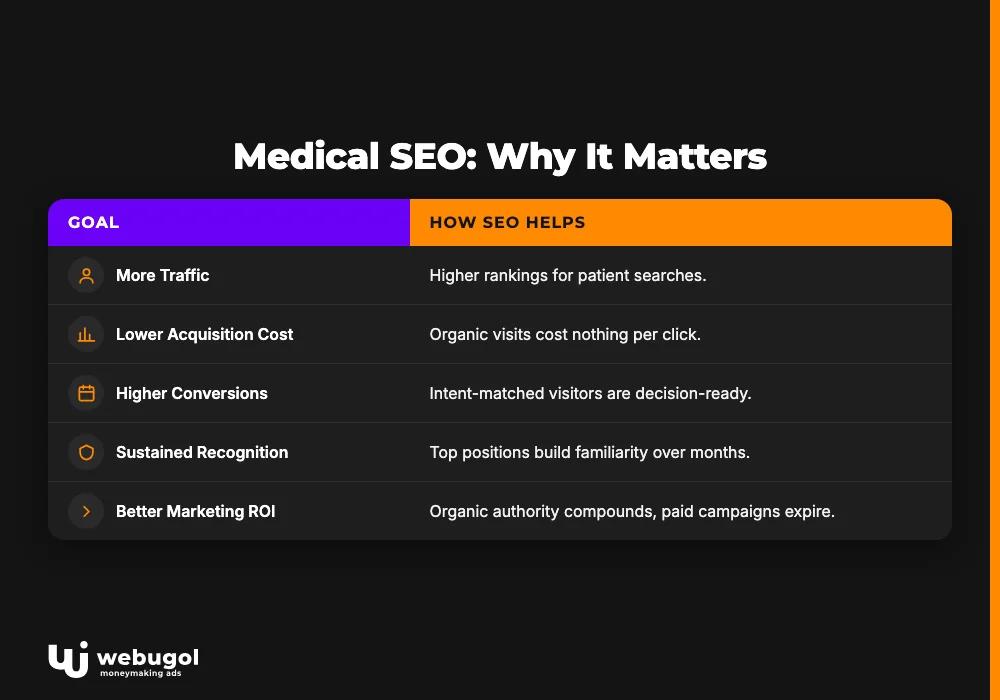
Effective medical practice SEO delivers across multiple dimensions at once:
| Business goal | How SEO addresses it |
|---|---|
| More qualified website traffic | Higher rankings for searches patients actually run |
| Lower patient acquisition cost | Organic visits cost nothing per click |
| Higher appointment conversion rates | Intent-matched visitors are already decision-ready |
| Sustained brand recognition | Top positions build familiarity over months |
| Better marketing ROI | Organic authority compounds; paid campaigns expire |
How to rank a medical practice website on Google?
Ranking a medical practice website requires coordinated improvements across keyword strategy, content quality, technical health, and local signals. Google weighs roughly 200 factors, so gains compound when multiple areas improve together. There is no single tactic. There is a system.
Keyword targeting aligned with patient search behavior
Doctor website ranking starts with understanding what your patients actually type into Google. That is rarely the clinical name of a specialty.
Short, high-competition terms like "oncologist" attract 74,000 monthly searches according to keyword research data, but they are nearly impossible for an independent practice to win against large health systems. Long-tail keywords for healthcare are the smarter entry point. "Surgical oncologist NJ" pulls only 170 monthly searches, but those searchers are further along in their decision: they know the specialist they need and where they want it. Conversion rates rise as specificity increases.
Question-based terms work for the same reason. "Can chiropractors relieve a pinched nerve" receives 1,600 monthly searches and faces a competition level most independent practices can realistically rank for. Patients use Google the way they ask a question in the exam room: they want a direct answer to a specific problem. Content structured around those questions gets found.
Start keyword research by entering a seed term ("cardiologist," "physical therapist") into Google Keyword Planner or Ahrefs. Sort results by difficulty first, then by intent. Look at Google's "People Also Ask" box for question keywords patients use every day.
On-page elements that signal relevance
Each page on your site should target a specific keyword cluster. The meta title and meta description are your first contact with a potential patient in search results: they determine whether someone clicks. Include the primary keyword in the title, keep it under 60 characters, and write the description as a sentence that makes clicking feel natural.
H1, H2, and H3 headings organize content for both readers and crawlers. Use the primary keyword in your H1 and naturally in one or two H2 headings. Body content should repeat the phrase throughout, but always in sentences that read naturally. If a sentence sounds forced, the keyword belongs somewhere else.
Internal linking distributes authority across the site. Link blog posts to service pages, link service pages to each other, and always use descriptive anchor text that describes what the destination page covers.
Site performance: speed, security, and mobile readiness
Google evaluates roughly 200 site signals, including load speed, HTTPS encryption, and mobile performance. A slow site loses patients before they read a single word.
Target a load time under half a second. Google's PageSpeed Insights identifies the biggest bottlenecks. Common fixes include compressing image and video files, cutting unused plugins, enabling browser caching, deploying a content delivery network (CDN), and reducing JavaScript and CSS file sizes. Upgrading to a faster host, such as WPX or SiteGround, often delivers an immediate improvement.
An SSL certificate encrypts data between your site and the patient's browser. If your URL begins with "http://" instead of "https://", you don't have one. Google lowers rankings for unencrypted sites. For practices collecting patient information, it is also a basic security requirement beyond ranking considerations.
More than half of all searches happen on smartphones. Google's Mobile-Friendly Test tool checks your site in under a minute. A responsive design adapts to any screen size automatically. If a full responsive rebuild is not immediately feasible, a separate mobile site built with a mobile-detect script is a workable alternative while a redesign is planned.
What are the best keywords for a medical practice website?
The best keywords for a medical practice website match what patients type before they pick up the phone, not the clinical terminology providers use internally.
Three categories consistently produce results:
Location-based keywords combine your specialty with a city or neighborhood: "gynecologist Brooklyn," "emergency care New Jersey," "internist near me." These phrases attract patients who are geographically qualified and ready to book. Local SEO for doctors depends on location keywords more than any other type.
Long-tail keywords for healthcare go deeper than specialty names. "Best treatment for lower back pain" or "how to manage Type 2 diabetes without medication" mirror how patients research before choosing a provider. These phrases have lower search volume than broad terms but higher conversion intent and less competition, which makes them the most realistic path to page-one rankings for most practices.
Question-based keywords reflect how patients think. "What is the best treatment for back pain," "how do I know if I need a referral to a specialist", these represent patients in active decision mode. Structuring content around these questions positions your practice as an authoritative source and can earn featured-snippet placement above standard organic results.
For research, enter a seed term into Google Keyword Planner or Ahrefs and review the expanded list. Sort by difficulty before volume. Pull question keywords from Google's "People Also Ask" box, which surfaces exactly what your patients are already asking.
Local SEO for doctors: winning nearby patient searches
Local SEO for doctors, including SEO for sleep clinics, is the highest-leverage area of medical practice SEO. Most patients choose a provider within a reasonable driving distance. Google's map pack, the cluster of three local results that appears above organic listings, is the most visible real estate in local healthcare searches.
Appearing in the map pack requires consistent local signals: a complete Google Business Profile, matching business information across directories, and locally relevant website content.
Is Google My Business important for doctors?
Yes. A complete, active Google Business Profile is one of the most direct ways to appear when patients search "internist near me" or "pediatrician open now." Map pack results are driven by Business Profile data, and they appear above organic listings for most local searches.
Fill out every field: practice name, address, phone number (NAP), website URL, hours, accepted insurance, services, and a practice description. Upload photos of your facility, staff, and daily operations. Keep hours updated, especially during holidays or temporary schedule changes.
Reviews on the profile influence both ranking and patient decisions. Healthcare consumer research makes the stakes concrete: 71% of patients consult online reviews when choosing a new physician, 94% use reviews to evaluate providers, and 84% trust those reviews as much as a personal recommendation. A provider with consistently positive reviews attracts 43% of patients even when that provider falls outside their insurance network.
Responding to reviews, both positive and negative, signals to Google and to patients that your practice pays attention. Active Business Profiles consistently outperform neglected ones in local rankings for exactly this reason.
For a deeper look at local optimization across healthcare settings, our complete local SEO guide for healthcare websites and business profiles covers the full approach.
Location-specific content for patient acquisition
Beyond the Business Profile, your website needs location signals. If you practice in New Jersey, content optimized for "doctor NJ," "gynecologist near me," and "emergency medical services in New Jersey" positions your site for searches your local patients run daily.
Location content is more than keywords. Write about local health concerns, community resources, and area-specific information your patients care about. That specificity reads as authentic to Google's quality evaluators and to patients comparing options.

Healthcare website optimization: content that earns rankings
Content is the engine of medical practice SEO. Without substantive, accurate pages, there is nothing for Google to rank and nothing for patients to trust.
Building a content strategy around patient questions
Core pages come first: home, about, services, contact, and individual specialty pages. Each must target a specific keyword cluster and answer the question a patient brings to the search. A services page that lists specialties without context misses searches like "what does a gastroenterologist treat" or "do I need a referral for a dermatologist."
A healthcare blog extends reach into long-tail territory. Publishing once or twice a week builds topical authority and signals to Google that the site is actively maintained. Healthcare SEO tips for blog content include:
- Answering questions patients commonly ask during appointments
- Explaining procedures in plain language, without clinical jargon
- Publishing physician spotlights that display credentials and build trust
- Covering healthcare news with context about what it means for patients
- Sharing condition-specific health tips organized by specialty or season
Healthcare content falls under Google's YMYL category, meaning quality standards are higher than for general content. Posts should reflect real clinical expertise, cite sources where relevant, and be reviewed by a licensed practitioner before publishing. Understanding HIPAA requirements is a prerequisite for any healthcare content program; violations carry consequences well beyond search penalties.
Optimizing images and video for medical practice SEO
Images and video support healthcare website optimization in two ways: they increase time-on-site, which signals engagement to search engines, and they make complex medical information easier for patients to process.
Adding a relevant video to a landing page can increase conversions by more than 130%, according to the data behind this optimization approach. Effective video formats for medical practices include facility tours, condition explainers, physician interviews, health tips, and patient testimonials.
Write descriptive alt text for every image. Alt text assists patients using screen readers and tells search crawlers what the image depicts. Include a keyword where it fits naturally. Skip it where it doesn't.
Backlinks, reviews, and clean URLs
Building link authority for your practice
Backlinks, links from other websites pointing to yours, tell Google your site is credible. A link from a medical association, a local news outlet covering your practice, or a respected patient directory each carries real weight. Authority accumulates over time and is difficult for competitors to replicate quickly.
Start with the easiest wins: Healthgrades, Zocdoc, WebMD, and other healthcare directories. If your practice is affiliated with a hospital or medical group, get listed on their site. Local business associations and referral relationships with complementary providers, such as physical therapists or nutritionists, generate legitimate inbound links that also send direct traffic.
Online reviews as a local ranking signal
Reviews don't just persuade patients. They feed local ranking algorithms. A consistent volume of recent, positive reviews improves visibility in the map pack. After positive appointments, share a direct link to your Google Business Profile review form. Lower friction means more reviews.
URL structure and site architecture
Short, descriptive URLs are a part of healthcare website optimization that practices frequently overlook. /services/cardiology communicates the page topic to both patients and crawlers instantly. /page?id=1247 communicates nothing.
Keep URLs lowercase, hyphen-separated, and free of stop words. Match each URL to the primary keyword the page targets. Clear URLs also improve click-through rates from search results: patients read the path and confirm it matches what they searched for before they click.

How long does SEO take for a medical clinic?
Results from medical practice SEO typically appear within three to six months for local and long-tail terms. Competitive city-wide searches, such as "cardiologist Chicago," take longer: nine to twelve months or more, depending on domain age and the strength of competing sites.
That timeline is not a reason to delay. Every month without optimization is a month competitors build a lead that takes progressively longer to close. Practices that start earlier and sustain the effort hold positions that newcomers must work years to approach.
Measure from the beginning. Google Search Console shows which queries generate impressions and clicks, and how average position shifts week over week. Google Analytics reveals what patients do after they arrive: which pages hold attention, which drive contact form submissions. Those behavioral signals feed back into rankings, because a site that answers visitor questions tends to rank higher over time.
A broader view of how medical practice SEO fits alongside paid campaigns, social, and email is covered in our guide to digital marketing for medical practices. Practices managing multiple specialties or locations may benefit from a more structured approach through our healthcare growth system, designed specifically for independent practices navigating the full channel mix.
Start building your medical practice SEO today
Your practice's search presence is a fixable technical and content problem, not an unsolvable competitive one. Medical practice SEO rewards consistent effort: patient acquisition online shifts from unpredictable referral pipelines to a measurable system you can track and improve. The practices that rank well in two years are the ones that start the work now.
Webugol works with independent healthcare practices on exactly this: building the technical foundation, content strategy, and local presence needed to rank and sustain that ranking. If you want to understand where your practice stands today and what a realistic path to page one looks like, reach out for an initial review.
FAQ
What is SEO for medical practices?
Medical practice SEO is the process of optimizing a clinic's website so patients find it in organic search results when searching for healthcare services. It combines keyword research, on-page content, technical performance, local optimization, and link-building. The goal is consistent patient acquisition online without paying for each individual click.
How long does SEO take for a medical clinic?
Most practices see measurable improvements in local and long-tail rankings within three to six months. Competitive city-wide terms typically take nine to twelve months or longer. SEO compounds over time, so earlier investment accelerates the point at which rankings produce a steady patient flow.
Is Google My Business important for doctors?
Yes. A complete, active Google Business Profile is one of the most direct ways to appear in local map pack results when nearby patients search for a provider. Healthcare consumer research shows 94% of patients use online reviews to evaluate providers, and the Business Profile is where most of those reviews are collected and displayed.
What are the best keywords for a medical practice website?
The most effective keywords combine specialty with location ("cardiologist Brooklyn"), address specific patient questions ("can a chiropractor fix a pinched nerve"), or describe a condition and its treatment. Long-tail keywords for healthcare convert better than broad terms because they match searches from patients who already know what they need.
How do I get more patients through my website?
Focus on local SEO for doctors first: complete your Google Business Profile, collect reviews consistently, and create location-specific content on your site. Pair that with a fast, mobile-ready site and a blog that answers the questions patients search before booking. Patient acquisition online accelerates once technical health and content quality both meet Google's YMYL standards.