



SEO for Sleep Clinics: Rank Higher and Get More Patients
SEO for sleep clinics is how your practice gets found by patients searching for sleep disorder help online. A strategy combining local search optimization, keyword-targeted content, and technical fixes turns your website into a steady source of new appointments. Results compound. Unlike paid ads, organic rankings do not stop when a budget runs out, and every improvement made today keeps working for months or years.
How does SEO help sleep clinics attract more patients?
SEO connects your clinic with patients who are already looking for sleep disorder treatment. When someone types "sleep apnea diagnosis near me" or "sleep specialist in [city]," Google returns a ranked list ordered by relevance, distance, and authority. Clinics at the top get the appointment. Clinics on page two rarely do.
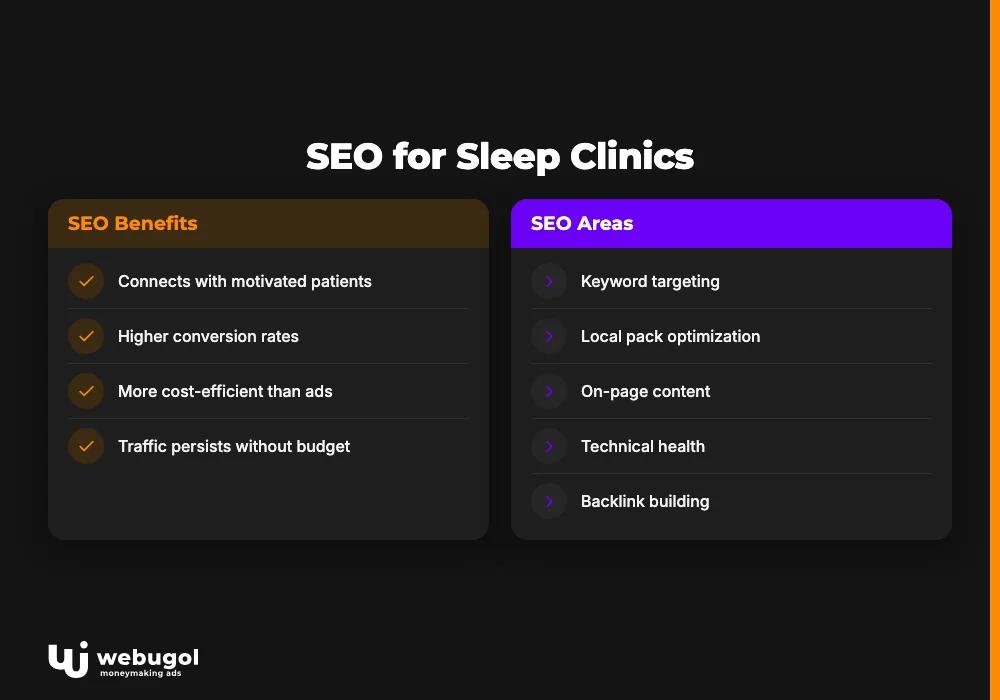
Here is what each component contributes to your practice:
| SEO area | What it does for your clinic |
|---|---|
| Keyword targeting | Matches your pages to the exact searches patients type |
| Local pack optimization | Places your clinic in Google's map results |
| On-page content | Answers patient questions and signals topic expertise |
| Technical health | Allows Google to crawl, index, and rank your pages reliably |
| Backlink building | Transfers authority from trusted sources to yours |
Sleep clinic digital marketing built around organic search is more cost-efficient than running paid ads continuously. Traffic does not disappear when a budget is paused. Because patients searching for sleep disorder treatment are already motivated, conversion rates tend to run higher than those for broad display advertising.
What keywords should a sleep clinic target?
Target three levels: condition terms that capture awareness-stage searches, service terms that reach patients actively researching their options, and location-based phrases that bring in people ready to book. Broad terms like "sleep clinic" carry high search volume but face steep competition from large health directories and national providers. More specific long-tail phrases convert better.
Four keyword categories to build into your plan:
- Condition terms cover diagnoses patients search by name: sleep apnea, chronic insomnia, restless leg syndrome, hypersomnia.
- Service terms target patients researching specific procedures, such as home sleep tests, CPAP consultations, and overnight polysomnography.
- Local phrases add city or neighborhood modifiers to reach people searching for nearby clinics.
- Question queries capture informational searches and build patient trust before the first appointment.
Long-tail keywords with location modifiers drive the highest-quality leads in sleep specialist patient acquisition because they match searches from patients ready to book rather than just browse. Our full guide to healthcare keyword targeting walks through the complete research process for medical practices.
Is local SEO important for sleep medicine practices?
Yes, and substantially so. Local SEO for healthcare is the highest-priority tactic for most sleep clinics because patients almost always search for nearby options. Google surfaces a "local pack" of three results above the regular organic listings. Miss that pack and you are invisible to the majority of local searchers. Healthcare local search ranking depends on three core pillars.
Google Business Profile. Claim and fully complete your listing with clinic name, address, phone number, hours, service categories, and photos. Encourage satisfied patients to leave reviews after their visit. A complete, actively maintained profile is the strongest signal for local pack placement that any practice can control directly.
NAP consistency. Your clinic's name, address, and phone number must be identical across every directory where you appear: Yelp, Healthgrades, Vitals, and any local health listings. A mismatch between your website and a directory entry suppresses local rankings. Audit citations at least once a year.
Location-based content. Pages or dedicated sections targeting phrases like "sleep disorder specialist in [your city]" confirm geographic relevance for Google. Each community you serve is worth a dedicated content block at minimum.
Getting this right takes careful setup and regular maintenance. Our guide to healthcare Google Business Profile optimization covers every field that affects your local ranking.
On-page and technical SEO for sleep clinics
Effective on-page SEO for sleep clinics means placing target keywords where search engines look first. The page title, H1 heading, meta description, first paragraph, and at least one subheading should each include your primary phrase. Supporting terms like "medical practice online visibility" and "sleep apnea website traffic" belong in body paragraphs where they fit the meaning of the sentence naturally.
On-page optimization also includes internal linking. Connecting related pages across your site helps Google understand the breadth of your expertise and distributes ranking authority across your content.
Technical SEO removes obstacles that prevent Google from crawling and ranking your pages. Four areas matter most:
- Page speed affects both rankings and patient experience; a slow site sends visitors to a competitor. Google's PageSpeed Insights shows exactly what to fix.
- Mobile usability is non-negotiable because the majority of health searches happen on phones. Your site must function fully on a small screen.
- HTTPS security encrypts patient data between their browser and your server and is a confirmed Google ranking signal.
- Schema markup tells search engines your clinic's location, hours, services, and patient reviews. Properly implemented, it can trigger rich results that improve click-through rates before a visitor reaches your page.
Strong on-page signals combined with a clean technical foundation are the infrastructure everything else depends on.
Content that builds sleep apnea website traffic
Content is where SEO for sleep clinics creates long-term growth. A blog lets you address the exact questions patients type into Google: what causes sleep apnea, what to expect at a sleep study, how long treatment takes. Each well-answered question becomes a potential ranking page and a trust signal before the first appointment.
Two formats perform especially well for sleep practices.
Patient testimonials. Written or video reviews add social proof. When tagged with review schema markup, they can appear directly in search results and improve click-through rates before a visitor even reaches your page.
Explainer videos. Short videos about sleep disorders or treatments increase time-on-page, which signals genuine engagement. Host them on YouTube and embed them on your site to extend reach across both platforms.
Keep content current. Outdated guidance on treatment options or diagnostic standards weakens credibility with both patients and search engines. Regular updates also create opportunities for fresh internal links between related posts, which strengthens topical authority over time.
How long does SEO take to work for a sleep clinic?
SEO is not an immediate channel. Search engines need time to crawl updates, assess new content, and reassign rankings among competing pages.
Most clinics see early movement in local and long-tail results within the first several months of consistent effort. Competitive broad terms take longer to shift. Because SEO results compound, a practice that starts optimizing today builds an asset that grows in value over years. Some clinics add Google Ads for sleep clinic keywords while organic rankings develop, since paid search captures high-intent patients immediately but stops the moment the budget is paused. Organic SEO, by contrast, continues working once the investment is made.
The two approaches work well together in the short term. Long-term, organic search is the more durable channel.
Work with a specialist who understands healthcare search
A complete SEO for sleep clinics strategy requires more than generic optimization. Healthcare search carries stricter quality signals, local competition is intense, and patient trust must be earned before anyone calls to schedule an appointment.
At Webugol, a digital marketing agency focused on growing medical practices, we build SEO strategies tailored to sleep specialists and other healthcare providers. We cover technical audits, keyword research, content creation, local citation management, and ongoing performance reporting. Our website SEO services are designed for the specific demands of healthcare search, not generic traffic.
Contact us today for a free SEO audit to see exactly where your clinic stands and what it would take to move your rankings.
FAQ
How does SEO help sleep clinics attract more patients?
SEO places your clinic in front of patients actively searching for sleep disorder treatment. Higher rankings generate more clicks, more booked consultations, and a steady flow of new patients without continuous ad spending.
What keywords should a sleep clinic target?
Focus on condition-specific terms, service terms like "home sleep test" and "CPAP consultation," and location-modified phrases such as "sleep clinic in [city]." Long-tail local keywords convert at higher rates because they target patients ready to book rather than just researching.
How long does SEO take to work for a sleep clinic?
Local and long-tail rankings often show early movement within the first several months of consistent effort. Competitive broad terms take longer. SEO results compound, so early investment pays growing returns for years.
Is local SEO important for sleep medicine practices?
Local SEO is critical for sleep clinics. Nearly every patient search includes a location signal, and Google's local pack appears above the organic results. A complete Google Business Profile, consistent directory data, and location-specific content are the three core requirements.
How much does SEO cost for a sleep clinic?
Cost depends on your market's competition, the scope of work needed, and whether you work in-house or with an agency. A full-service approach covers technical audits, content creation, citation management, and ongoing reporting, with pricing varying significantly by market and practice size.