



Medical device marketing: the complete inbound guide
Medical device marketing connects manufacturers with the hospital administrators, physicians, and procurement committees that evaluate clinical products. Inbound strategies earn that attention by publishing useful content and optimizing for search, so qualified buyers find you before a competitor does. Done consistently, this approach generates qualified leads without relying on cold calls alone. This guide covers the channels, content formats, and pipeline mechanics that convert visitors into sales conversations.
Who actually buys medical devices?
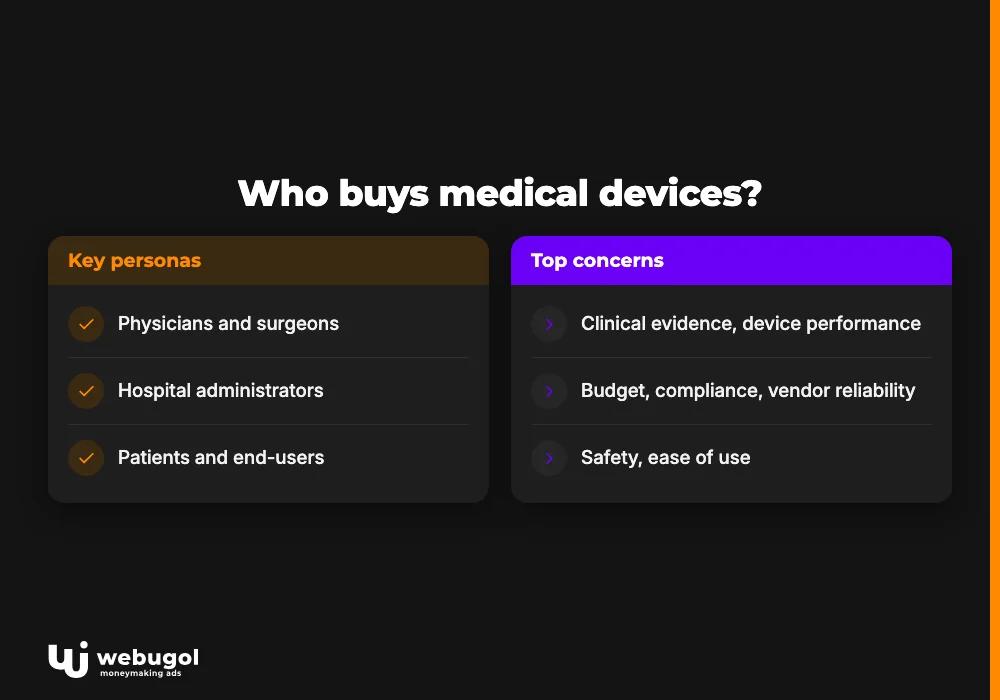
Effective B2B medical marketing strategy begins with knowing who controls the budget and who shapes the clinical decision. Purchasing decisions rarely rest with one person. Three personas drive most outcomes.
| Buyer persona | Primary concern | Highest-value content |
|---|---|---|
| Physicians and surgeons | Clinical evidence, device performance | Outcome summaries, peer-reviewed case studies |
| Hospital administrators | Budget, compliance, vendor reliability | ROI whitepapers, total cost of ownership models |
| Patients and end-users | Safety, ease of use at home or in clinic | Plain-language guides, instructional video |
Mapping content to each persona prevents a common failure: publishing material that educates everyone in general and converts no one in particular. When a procurement manager downloads a total cost of ownership model and forwards it to the CFO, that content is doing exactly what medical device marketing requires.
How does inbound marketing work for medical device companies?
Inbound marketing builds a system where qualified buyers come to you. A hospital administrator searching for a clinical workflow improvement finds your whitepaper. She enters an email sequence, attends a product demonstration, and eventually converts. No cold call started that relationship.
Three stages define the system. Attraction brings decision-makers to your site through search, educational content, and social presence. Conversion turns anonymous visitors into identifiable leads via gated resources, optimized landing pages, and clear calls-to-action. Closing moves high-intent prospects toward a purchase through personalized sequences and sales-aligned follow-up.
Healthcare raises the stakes at every stage. Clinical buyers scrutinize accuracy. Procurement teams need sourced evidence. Regulatory references must be current. Every content asset reflects on your vendor credibility, which is one reason inbound medical device marketing outperforms interruption-based tactics in regulated markets: it lets you demonstrate expertise before any sales conversation begins.
What digital marketing strategies work best for medical devices?
No single channel dominates. Effective healthcare digital marketing layers search visibility, educational content, and relationship-building tools so buyers encounter your brand repeatedly across the channels they already use.
Medical device SEO
Search optimization places your content in front of procurement managers and clinicians when they search for a solution. Begin with keyword research using tools such as Ahrefs, SEMrush, or Google Keyword Planner. Identify the exact queries your buyers type, then map those terms to title tags, H1 headings, meta descriptions, and body copy site-wide.
Off-page authority matters alongside on-page factors. Backlinks from clinical associations, healthcare publications, and industry directories signal domain credibility to search engines. Search visibility compounds over time in a way that paid advertising cannot, which makes medical device SEO the highest long-term return channel in most inbound programs.
Healthcare content marketing
Content attracts buyers, establishes credibility, and gives prospects a reason to return before they are ready to purchase. Formats with the strongest track record in the medical device sector include:
- Blog posts explain clinical use cases, regulatory developments, and device comparisons in language both clinicians and procurement teams can use when building an internal business case.
- Whitepapers and e-books provide detailed technical or operational analysis that buyers can circulate across departments to build consensus before committing to a purchase.
- Case studies document measurable outcomes from real clinical settings, showing directly how a device improved patient care or reduced operational cost.
Blog posts attract early-stage researchers. Case studies close late-stage evaluators who need hard evidence before recommending a vendor.
Email nurturing for healthcare leads
A structured email program keeps leads engaged between sales touchpoints. Segmentation is the key variable. A surgeon evaluating a new device needs clinical outcome data. A hospital administrator reviewing a contract renewal needs cost and compliance evidence. One campaign cannot serve both audiences effectively.
Behavioral triggers improve timing. When a lead downloads a whitepaper or visits a pricing page, an automated sequence can deliver the next logical piece of content within hours rather than waiting for manual follow-up. Consistent, well-timed emails build the familiarity that makes a sales call feel like a natural continuation.
What content should medical device companies publish?
Publish content that addresses what buyers are actively researching. For medical device marketing, three priority areas cover most of the decision-making cycle.
Clinical audiences need to know whether a product works under real conditions. Outcome summaries, data from published studies, and head-to-head comparisons with clinical alternatives serve this group. Administrative buyers need procurement risk addressed directly. Whitepapers modeling multi-year ROI, compliance checklists, and vendor evaluation frameworks give them the evidence to take to a budget committee.
Regulatory content is the gap most competitors overlook. Clear explanations of FDA clearance pathways, CE marking requirements, and post-market surveillance obligations attract procurement teams that must confirm compliance before approving a purchase. This category also ranks well organically because few vendors invest in it.
An editorial calendar makes production sustainable. Audit existing topics, identify gaps between what you publish and what buyers search, assign ownership, and hold a cadence your team can maintain for at least six months. Irregular publishing undermines the compounding effect that healthcare content marketing depends on.
How to generate leads for medical device sales?
Medical device lead generation requires specific conversion mechanics, not just more traffic. High-intent buyers will exchange contact details for resources that solve a real problem: a regulatory readiness checklist, a clinical comparison guide, or a product ROI calculator built for their facility type.
Landing pages need a single focused offer, a short form, and no competing navigation. Test headline variants, form length, and button copy iteratively. Small conversion rate improvements multiply across the traffic earned through search.
Lead scoring and prioritization
Lead scoring assigns numeric values based on job title, company type, pages visited, and content downloaded. A hospital procurement director who attended a webinar and read three whitepapers scores far higher than someone who downloaded one brochure.
Set thresholds that route contacts appropriately. Lower-score leads stay in automated nurture sequences. High-score leads receive direct outreach from a sales representative within a defined response window. Without scoring, sales teams waste time on low-intent contacts while missing high-intent ones in the same queue.
Building the medical device sales funnel
The medical device sales funnel maps the buyer journey from first awareness to signed contract. At the top, SEO-driven blog content and social posts bring qualified visitors to the site. In the middle, gated resources and webinars capture and qualify those visitors. At the bottom, personalized demonstrations and direct sales conversations close the deal.
Gaps appear when investment concentrates in one stage. Generating traffic without conversion mechanics wastes the audience earned through search. Nurturing leads without bottom-of-funnel content stalls the pipeline indefinitely. Effective medical device marketing requires all three stages functioning in parallel.
How long does inbound marketing take to work in healthcare?
Longer than most teams expect. SEO typically requires three to six months before pages rank competitively for meaningful queries. Lead volume then grows as more content earns authority and more gated offers accumulate contacts.
Healthcare procurement timelines extend the picture further. Hospital buying decisions often take months to clear committee review, legal sign-off, and budget approval. A qualified lead captured in month two may not close until month eight or later. Inbound shortens the early research phase of that cycle by keeping your brand present across multiple touchpoints, but it does not bypass the institutional processes that govern large clinical purchases.
The practical implication is clear. Teams that commit to inbound for at least six months see materially different results than those who evaluate after sixty days and reallocate budget. Domain authority and content library value compound continuously. Stopping and restarting from zero costs far more than maintaining momentum through a slow period.

Measuring what your medical device marketing delivers
Track metrics that connect to revenue. Website traffic measures reach. Lead volume measures conversion efficiency. Sales-qualified lead rate reveals whether marketing and sales agree on what a ready prospect looks like.
Core performance indicators for medical device marketing include:
- Organic sessions by landing page reveal which content drives the most qualified traffic from search.
- Lead-to-SQL conversion rate surfaces gaps in content targeting, form design, or lead-scoring thresholds.
- Cost per lead by channel guides budget allocation toward sources that consistently outperform.
- Time on page and scroll depth on educational assets indicates whether visitors find the content substantive enough to read fully.
Review these numbers monthly. Double down on content that generates high-quality leads. Update or retire pages that attract traffic without producing qualified contacts. LinkedIn and other social platforms drive referral traffic and brand recognition among healthcare decision-makers, so track social referrals alongside organic search in every monthly review.
Build your medical device marketing engine
A medical device marketing system that combines inbound content, search optimization, email nurturing, and structured lead generation compounds in value over time. If you want a structured path from strategy to a full pipeline, our Healthcare Growth System is designed for companies operating in regulated health markets.
Talk to the Webugol team to identify where your current pipeline has gaps and how inbound can close them.
FAQ
What is medical device marketing?
Medical device marketing covers the strategies manufacturers and distributors use to reach clinical buyers, hospital procurement teams, and end-users. It includes content creation, SEO, email nurturing, and lead generation mechanics designed for regulated healthcare buying environments.
How does medical device SEO differ from standard SEO?
Medical device SEO operates under stricter accuracy requirements because buyers include clinicians who evaluate technical claims directly. Keyword strategy must target professional search behavior, and all published claims must be sourced and consistent with applicable regulatory guidelines.
What is inbound marketing for healthcare?
Inbound marketing for healthcare is a strategy that attracts buyers by publishing content answering their clinical and operational questions. Rather than interrupting prospects with advertising, inbound builds a content library that draws qualified leads organically over time.
How long does healthcare content marketing take to deliver results?
Most programs see meaningful organic traffic growth within three to six months of consistent publishing. A visible pipeline impact typically takes six to twelve months, depending on market competition and the number of buyer personas addressed.
Which content formats drive the most leads in B2B medical marketing?
Case studies and clinical whitepapers consistently attract buyers in active evaluation mode and generate the highest-quality leads. Blog posts build top-of-funnel awareness; gated guides and calculators convert that awareness into identifiable contacts.