



Medical marketing NYC: how to grow your practice in a competitive market
Medical marketing NYC covers the digital strategies NYC doctors use to attract new patients and retain existing ones. It works best as a coordinated system: local SEO, Google Business Profile management, online reputation, and patient communication running together. New York City patients can choose from hundreds of providers per specialty. Consistent digital execution is what separates growing practices from ones that stagnate.
What makes medical marketing NYC different?
Competition is dense in every borough, across every specialty. A patient searching for a cardiologist or a pediatrician in Manhattan or Brooklyn sees dozens of results. Practices without strong digital visibility lose those patients to competitors before a phone call is ever made.
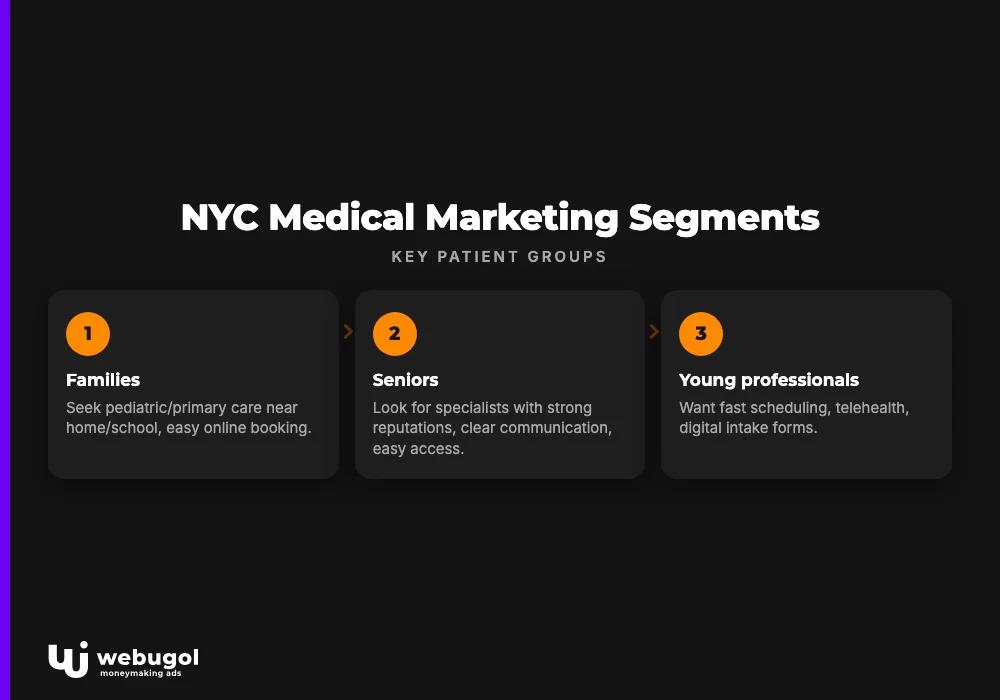
Three patient segments drive appointment volume for most NYC practices:
- Families want a pediatric or primary care provider near home or school, with straightforward online booking.
- Seniors look for specialists with strong reputations, clear communication, and easy appointment access.
- Young professionals want fast scheduling, telehealth options, and digital intake forms.
Knowing which segment your practice serves most shapes every channel decision, from the content you publish to the platforms where you invest budget.
| Channel | Primary goal | Works best for |
|---|---|---|
| Local SEO | Appear in "near me" searches | High-intent, ready-to-book patients |
| Google My Business | Map pack visibility and calls | First impressions at the moment of search |
| Online reviews | Trust and conversion | Turning searchers into appointments |
| Social media | Awareness and engagement | Long-term patient relationship-building |
| Email marketing | Retention | Reactivating current and lapsed patients |
| Paid advertising | Immediate reach | Launching new services or locations |
How can NYC doctors attract more patients online?
Most patients search before they book, and they choose from the first results they see. NYC doctors build a reliable patient pipeline by combining healthcare SEO services with a strong Google Business Profile and a steady flow of positive reviews. Each element reinforces the others.
Build a website that converts
Your website is the first decision point for most prospective patients. Fast mobile loading, service pages organized by condition or specialty, a visible phone number and booking link, and patient testimonials are the baseline requirements. A single generic "services" page does not rank for specific conditions. Each core offering needs its own dedicated page with targeted, condition-specific content.
What is local SEO for medical practices?
Local SEO healthcare is the process of making your practice appear in geographically relevant searches, such as "internist Midtown" or "family doctor Queens." The complete local SEO playbook for medical practices covers ranking factors in depth, but the core elements are your Google Business Profile, location-specific keywords across your site, and consistent name-address-phone data in directories such as Healthgrades and Zocdoc. Each office location needs its own dedicated page that includes the neighborhood, borough, and nearby cross-streets where they read naturally.
Google My Business for doctors
A complete, active Google Business Profile is one of the highest-return actions in medical marketing NYC. For Google My Business, doctors should set their primary category with precision, upload current office photos, list every service they offer, and post updates at least twice a month. Respond to every review. Prospective patients read how practices handle feedback before booking, and a calm, professional reply to a complaint shows future patients that the practice takes concerns seriously.
Healthcare SEO services that drive organic traffic
Organic search compounds over time in a way paid advertising does not replicate. Healthcare SEO services cover technical site health, condition-focused content that answers patient questions, and the authority signals that help your pages rank for competitive terms. A consistent publishing schedule matters more than occasional long articles. Writing about the conditions you treat builds topical relevance across your specialty and attracts patients who are searching for specific answers before they book.
How do doctors get more patient reviews on Google?
Ask right after the appointment. That is the moment when the experience is freshest and the ask feels most natural. Give patients a QR code or a short URL that goes directly to your Google review form. Friction at any step reduces follow-through. A text or email within 24 hours reinforces the ask without being intrusive.
Online reviews medical practice growth depends on a consistent pace, not a sudden burst of volume. Reviews arriving steadily over months look more credible than a large cluster in a single week.
Respond to every review, positive and negative, within 24 hours. For negative reviews: acknowledge the concern, keep the reply brief, share no patient details, and offer to resolve the issue offline. Prospective patients read these exchanges closely before making a decision.
What digital marketing strategies work best for medical practices?
The strategies that produce consistent results combine local search visibility, reputation management, and patient communication. They build on each other: stronger rankings bring more patients, more patients generate more reviews, stronger reviews improve rankings further.
Social media for doctors
Social media for doctors is primarily an awareness channel, not a direct booking channel. Instagram and Facebook reach most patient demographics in NYC. LinkedIn supports specialist-to-referral networking. Effective content combines health education posts, practice updates, and condition-specific tips. For a breakdown of how patients engage with healthcare content across platforms, see the guide on social media's role in patient engagement.
Paid social extends your reach beyond current followers. Targeting by zip code, age range, and health interest makes it practical for promoting a new service or a second location.
Email marketing healthcare campaigns
Email is the most underused channel in medical marketing NYC. Most practices focus on new patient acquisition and ignore retention, even though returning patients cost far less to keep than new ones to win. Effective email marketing healthcare campaigns start with list segmentation by visit type or condition.
That segmentation lets you send appointment reminders, seasonal health prompts, and reactivation messages for patients overdue for a visit. For a framework to build these programs from the ground up, see how to build effective patient email campaigns.
Track open rates and click-through rates monthly. If unsubscribes climb after a campaign, adjust the content or frequency before the list shrinks further.
Paid advertising and patient acquisition strategies
Google Ads deliver immediate visibility for patients actively searching right now. Tight keyword targeting using specific service terms and location qualifiers keeps cost-per-click manageable. Broad campaigns drain budget quickly. Facebook and Instagram ads work well for condition awareness and new service launches. Traditional channels like local radio and print still reach patients over 60, and they can extend the overall reach of your patient acquisition strategies alongside digital campaigns.
Patient referral programs
Word-of-mouth is one of the strongest drivers of new patients in healthcare. A formal referral program gives existing patients a clear path to recommend your practice. Small incentives, such as service credits or wellness perks, lower the barrier to making an introduction. Promote the program through your email list and social channels, and provide a simple referral card or short form so the process is immediate.
Track referral conversions separately from other channels. That data shows whether the program justifies its incentives and where word-of-mouth is already strongest among your patients.
Medical marketing NYC: work with a dedicated growth team
Medical marketing NYC delivers the best results as an integrated system, not as a set of disconnected tasks managed in isolation. Webugol builds and manages digital marketing programs for medical practices in New York City, covering the full acquisition and retention cycle. If you want a structured program that combines local SEO, reputation management, paid search, and patient communication, explore our healthcare growth system or contact us to discuss a strategy matched to your specialty and goals.
FAQ
How can NYC doctors attract more patients online?
Start with your Google Business Profile and local SEO, since most patients search before booking. A mobile-friendly website, a fully optimized profile, and consistent online reviews are the three levers that produce the fastest measurable results.
What digital marketing strategies work best for medical practices?
Local SEO, Google My Business optimization, online reviews, and email retention campaigns consistently outperform single-channel approaches. Paid search advertising adds immediate visibility when launching new services or opening a new location.
How much does medical marketing cost for a doctor?
Costs vary based on specialty, competitive market, and the channels you prioritize. Contact a healthcare marketing agency for a quote tied to your specific practice goals, since there is no fixed budget that applies across medical marketing NYC.
How do doctors get more patient reviews on Google?
Ask patients directly at the close of their appointment and provide a short, direct link to your Google review form. A follow-up text or email within 24 hours significantly increases the number of reviews submitted.
What is local SEO for medical practices?
Local SEO healthcare is the process of optimizing your website, Google Business Profile, and directory listings so your practice appears when patients search for nearby providers. It targets high-intent searches from people who are ready to book an appointment.