



Medical marketing for doctors: proven strategies to grow your practice
Medical marketing for doctors is the systematic use of digital and offline channels to attract new patients, retain existing ones, and build measurable local visibility. It spans SEO, reputation management, social media, paid advertising, and email. Most physician practices that struggle with patient volume are not short on clinical quality; they are simply invisible online. Fix that visibility, and the schedule fills.
What is medical marketing for doctors?
Medical marketing for doctors covers every touchpoint between a prospective patient and your practice: how easily they find you in search, what they see when they look you up, how quickly your site answers their questions, and whether they trust you enough to book.
It differs from general marketing in two ways. HIPAA imposes strict limits on how patient data can be used in communications. And the trust threshold is higher: patients are making healthcare decisions, not selecting a product they can return.
Physician practice promotion has moved online. Google reports that 5% of all searches on its platform are health-related, meaning millions of patients research care before calling any provider. Your digital presence is your front door. For most new patients, it is the first one they open.
What digital marketing channels work best for doctors?
No single channel dominates for every practice. The right combination depends on specialty, location, competition, and patient demographics. Search is where most patient journeys begin, which makes SEO and local search the non-negotiable foundation for online marketing for clinics.
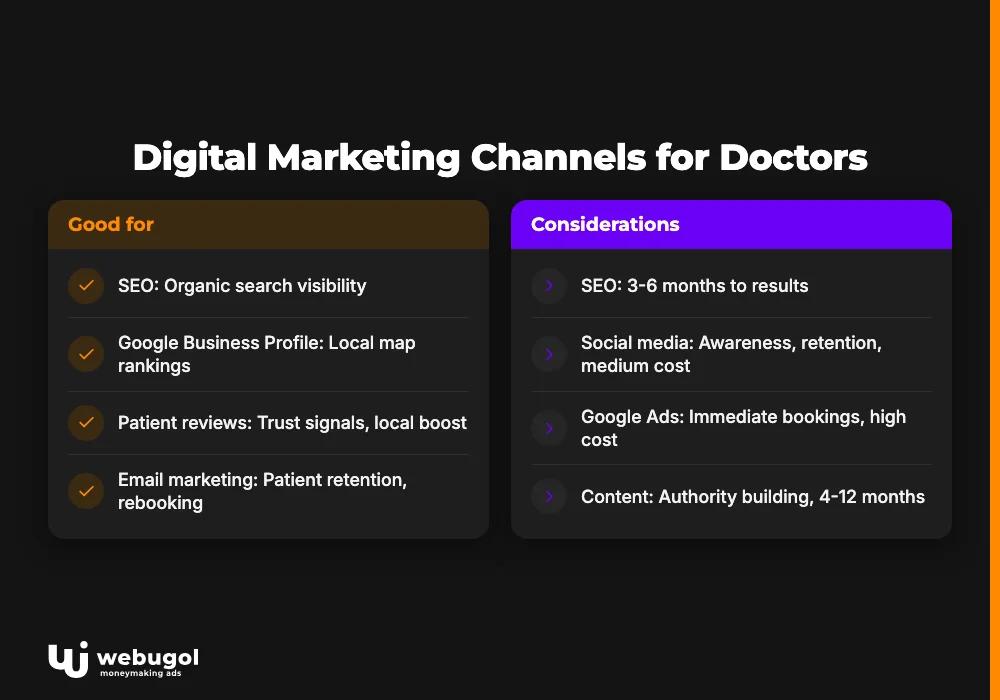
The table below maps each major channel against the variables practices care about most.
| Channel | Primary outcome | Time to results | Cost level |
|---|---|---|---|
| Medical practice SEO | Organic search visibility | 3–6 months | Low (ongoing) |
| Google Business Profile | Local map pack rankings | 4–8 weeks | Free |
| Patient review strategy | Trust signals, local ranking boost | Ongoing | Low |
| Healthcare social media marketing | Awareness and retention | 1–3 months | Medium |
| Google Ads / PPC | Immediate appointment bookings | 1–2 weeks | High |
| Email marketing | Patient retention and rebooking | Immediate | Low |
| Content / blog | Long-tail search, authority building | 4–12 months | Medium |
Healthcare digital marketing produces compounding results when these channels work together. Strong reviews lift local rankings. Better rankings bring more traffic. Better content converts that traffic into bookings. More satisfied patients generate more reviews. Each element reinforces the next.
How do doctors attract more patients online?
Doctors attract more patients online by combining a fast, mobile-optimized website with targeted SEO and a clear booking path. The website converts visitors. SEO brings them to the site. Local search captures the patients who are ready to book today.
Building a website that converts
Your website is the foundation of doctor patient acquisition. It has two jobs: rank in search results and convert visitors into booked appointments. Neither is optional.
Mobile performance is a prerequisite. Google's ranking algorithm prioritizes mobile page speed, and most patients search on phones. A site loading in under two seconds converts at significantly higher rates than one that takes four or five.
Clear navigation, plain-language service descriptions, and a visible "Book an appointment" button on every service page remove friction for patients already ready to commit. Downloadable intake forms shorten the front-desk process and increase follow-through from patients who book online. Patient testimonials placed near booking calls to action address the hesitation most new patients feel at the moment of decision.
Content on service pages should answer the specific questions patients type into Google. A dermatologist explaining what to expect during mole removal provides more targeted value than a generic post about skin health. Answering patient questions in patient language converts better than clinical terminology.
Medical practice SEO: ranking where patients search
Medical practice SEO is the technical and content work that gets your pages onto page one for queries your prospective patients already type: "cardiologist near me," "sports medicine doctor in [city]," "back pain specialist in [neighborhood]."
The technical foundation: HTTPS encryption (a confirmed Google ranking signal and a trust indicator for patients), fast page load speed, and structured data markup that identifies your business type, location, hours, and specialty to Google. Without these basics, content and link-building work hits a lower ceiling.
On-page SEO means building service and condition pages around specific patient queries, not broad category names. Long-tail keywords convert better because they match a precise patient need. "ACL reconstruction specialist in [city]" targets a patient with specific intent; "orthopedics" does not.
For a deeper look at how search authority compounds for health practices over time, how organic search builds long-term patient growth for health practices covers the mechanics worth understanding before you set your SEO budget.
Does local SEO work for medical practices?
Yes. For most physician practices, local SEO delivers the highest return of any marketing activity. Patients almost always choose providers within a short geographic radius. Local SEO captures exactly that decision moment, placing your practice in Google's map pack for searches like "dermatologist near me" or "pediatrician in [city]."
Google Business Profile: the local anchor
Your Google Business Profile (GBP) appears above organic results in local searches and inside Google Maps. It is often the first thing a new patient encounters. An incomplete or outdated profile loses patients before they ever reach your website.
Fill every available field: specialty categories, accepted insurance, current hours, and office photos. Practices that upload more photos receive more direction requests and website clicks, according to Google's GBP product data. Google treats profile engagement, including photo views and call clicks, as local ranking inputs.
Your practice name, address, and phone number must match exactly across your website, GBP, and every directory where you appear: Healthgrades, Zocdoc, WebMD, Yelp, and local business directories. Inconsistencies send conflicting signals to Google's local algorithm and suppress rankings. Post brief updates to your GBP regularly; Google treats profile activity as a freshness signal.
For the full breakdown of how to rank in local search for medical specialties, the local search ranking guide for medical practices covers every ranking variable in detail.
Location-specific content and citations
Writing location-specific content strengthens the geographic relevance signals that local SEO rewards. A post about health concerns common in your county, or a guide to accessing specialist care in your region, builds local authority that directory listings alone cannot provide.
Online marketing for clinics serving specific neighborhoods benefits from dedicated location landing pages with unique content on each. Duplicate content across location pages suppresses local rankings. Participating in community health events and earning mentions from local organizations generates citations and backlinks that reinforce geographic relevance to search engines.

What is the best marketing strategy for physicians?
The best marketing strategy for physicians combines owned media (website, content, email list) with local search authority and a patient review strategy that builds consistent social proof. Paid advertising accelerates results but is not a substitute for the foundation. Build the foundation first, then use paid channels to amplify what already works.
Content marketing that earns authority
Educational content attracts organic traffic from patients researching symptoms, conditions, and treatments. More importantly, it positions you as the credible choice to book with once they are ready to act.
Blog posts covering specific conditions, treatment comparisons, and procedure FAQs address the research phase of the patient journey. Writing in patient language and answering the questions people actually bring to appointments outperforms generic health content by a wide margin. Specificity drives search relevance: a neurologist explaining "what causes chronic migraines" matches a patient with that exact concern.
Video works particularly well in healthcare. A short walkthrough of a procedure, a facility tour, or a brief explanation of a diagnosis process reduces patient anxiety and raises the probability that a visitor books rather than postpones. Keep videos under three minutes. Publish them on both your website and YouTube with transcripts for search benefit.
Healthcare social media marketing
Social media is primarily a trust-building and retention channel for physician practices, not a cold acquisition channel. Patients who already know your practice follow you on social. Their engagement makes your content visible to their networks, generating referral awareness organically.
Platform selection should follow patient demographics. Facebook reaches older adult patients and family healthcare decision-makers. Instagram fits aesthetics, dermatology, and wellness practices. LinkedIn builds referral relationships with other providers. Consistent presence on two relevant platforms outperforms scattered activity across five.
Two to three posts per week, maintained consistently over months, builds more trust than a burst of daily posts followed by silence. Content that works: educational tips tied to your specialty, brief staff profiles, patient success stories with documented written consent, and answers to common appointment questions.
For platform-specific data on how different channels influence patient decisions, how social media shapes patient engagement in healthcare breaks down the patterns worth knowing before you allocate social budget.
Email for patient retention
Email is the most underused channel in physician practice promotion. It reaches patients who already chose you, costs little to maintain, and produces measurable rebooking and referral activity when run systematically.
A practical email program includes appointment reminders, seasonal health content tied to your specialty, post-visit follow-ups, and annual wellness reminders for patients due for routine screenings. Segment your list: patients managing chronic conditions should receive condition-specific updates, not the same general newsletter as everyone else.
Using a patient's name and referencing their care history creates relevance that mass emails cannot match. Tracking open rates and click-through rates by topic reveals what your patients actually read, directly informing better content planning.
For a systematic approach to building patient retention through email, see email campaigns that strengthen patient retention in healthcare practices.
How to get patient reviews for a medical practice?
The most effective patient review strategy is a consistent, systematic ask delivered within 24 hours of a positive encounter. Patients who had a good experience will write a review if you make it easy and ask promptly. They rarely act without prompting.
Building a systematic review process
Send a review request by text or email within 24 hours of each appointment. Keep the message short: acknowledge the visit, express appreciation, and include a direct link to your Google Business Profile review page. Three sentences is enough. More text reduces completion rates.
Volume and recency both affect how your review score influences local rankings and patient decisions. A consistent stream of new reviews arriving each month signals an active, growing practice to both Google and prospective patients. A one-time push of many reviews followed by extended inactivity produces diminishing returns.
Automated follow-up tools built into most practice management platforms remove the manual work. Configure the request to send automatically after each appointment and track completion rates monthly to verify the system is running correctly.
Never offer discounts, gifts, or any compensation for reviews. It violates Federal Trade Commission guidelines and Google's review policies, and can result in removal of your entire review profile.
Responding to every review
Responding to both positive and critical reviews signals attentiveness to prospective patients reading your profile. A brief acknowledgment of a positive review takes thirty seconds. A professional response to a critical review matters more to future patients than the review itself.
For critical reviews: acknowledge the concern without confirming any clinical details (HIPAA prohibits clinical discussion in public channels), thank the patient for the feedback, and invite them to contact your office privately. Prospective patients read how you handle criticism to predict how you will treat them. Defensiveness is a conversion killer.

Compliance in healthcare digital marketing
HIPAA governs every digital channel where patient information intersects with your marketing system.
Email marketing requires documented patient consent before sending health-related communications. Any email or CRM platform storing patient data must sign a Business Associate Agreement (BAA) with your practice. Most major platforms offer HIPAA-compliant configurations, but these require active setup, not just account creation.
Website contact forms that collect health information need HTTPS encryption. Your Google Analytics 4 setup must avoid passing personally identifiable information through tracking parameters. Review any retargeting pixel configuration to confirm protected health information is not being captured inadvertently.
Social media rule: never respond to a patient's clinical question or complaint in a public comment thread. Direct them to a private channel. Never share patient images or case details, even without names, without documented written consent.
Annual HIPAA training for all staff covering digital channels is not optional. A single employee posting the wrong content on a practice account can trigger a breach notification requirement. Training costs far less than a violation.
Ethical marketing in healthcare also requires factual accuracy. Credentials displayed, procedures described, and outcome language in ads must all be verifiable and not misleading. State medical board advertising rules vary by jurisdiction; confirm what claims are permissible before running any outcome-based copy.
Measuring healthcare digital marketing results
Set up goal tracking in Google Analytics 4 for appointment form submissions and click-to-call events before running any campaign. These conversion actions tell you which channels produce patients. Website traffic is a secondary metric; booked appointments are the primary signal.
For local SEO, monitor GBP insights monthly. Profile views, direction requests, and call clicks are leading indicators of local performance before changes appear in your actual booking volume.
Email metrics worth tracking: open rate by segment, click-through rate, and rebooking rate among patients who received specific communications. Social media: reach among your target demographic and appointment-link clicks. Overall engagement rate is a secondary signal, not a patient acquisition metric.
Establish baselines before spending on any new channel. Monthly new patients, current Google ranking positions for target queries, and your current average review score give you the before-and-after comparison needed to attribute growth and justify continued investment.
A/B testing applies throughout medical marketing for doctors. Test two email subject lines. Test two appointment page layouts. Test two review request messages. Systematic small tests compound into meaningful improvements over a six-to-twelve-month horizon.
Build a medical marketing system that fills your practice
Medical marketing for doctors produces compounding returns when each channel reinforces the others. Local SEO captures patients searching now. A review program builds the trust signals that lift local rankings. Content attracts patients earlier in their decision process. Email retains the patients you have already earned. Together, these form a system that isolated tactics cannot replicate.
If you are ready to move from scattered tactics to a tracked growth system, Webugol's healthcare growth program is designed specifically for physician practices that need consistent, measurable patient acquisition without managing multiple vendors. Start with a practice growth review to identify your largest patient acquisition gaps and the fastest path to closing them.
Visit Webugol to schedule your free review.
FAQ
What does effective medical marketing for doctors require?
Medical marketing for doctors requires a mobile-optimized website, local SEO that places your practice in Google's map pack, a systematic patient review program, and consistent content that builds trust over time. These channels compound when run together; no single tactic produces lasting results alone.
How long does it take for digital marketing to produce new patients?
Paid search can generate new appointment requests within one to two weeks. Local SEO typically shows measurable ranking improvements within four to eight weeks, with meaningful new patient volume building over three to six months. Content marketing takes the longest, with significant organic traffic developing over four to twelve months.
Does local SEO work for small or single-physician practices?
Yes, local SEO often performs better for smaller practices than for large health systems because geographic and specialty competition is finite. A complete Google Business Profile, consistent directory listings, and a steady review program can move a single-physician practice to the top of the local map pack within a few months.
What is the best way to get more patient reviews?
Send a review request by text or email within 24 hours of each appointment, with a direct link to your Google Business Profile. Keep the message short and the action simple. Respond to every review received, both positive and critical, to show prospective patients that your practice is attentive.
How should a medical practice measure digital marketing success?
Track appointment form submissions and click-to-call events in Google Analytics 4, not just website traffic. Monitor Google Business Profile insights monthly for direction requests and call clicks. Establish baseline metrics for new patients, ranking positions, and average review score before spending on any new channel.