



Orthopedic reputation management: a guide for practices
Orthopedic reputation management is the ongoing process of monitoring, generating, and responding to patient reviews and online content that shapes how prospective patients evaluate your clinic. Before booking, most patients search for orthopedic surgeons on Google, Healthgrades, or Zocdoc and read reviews as part of their decision. That search happens before the first call.
A structured approach to healthcare online reputation management builds patient trust, drives new appointments, and strengthens your clinic's position in local search. Practices that build this consistently gain a meaningful advantage in the local market.
Why is online reputation important for orthopedic surgeons?
Your online reputation directly influences whether a prospective patient calls your clinic or books with a competitor. This matters especially in orthopedics, where patients face significant decisions about surgery, rehabilitation, or long-term pain management. They want evidence before they commit.
Orthopedic practice marketing that treats online reviews as secondary loses ground to practices that manage their digital presence actively. Your ratings on Google and healthcare-specific directories affect both patient decisions and local search rankings. Those two effects reinforce each other.
A consistent pattern of positive feedback gives prospective patients confidence that your care quality matches what your website promises.
Strong orthopedic reputation management also protects your clinic when critical reviews appear. Practices with a high volume of recent positive reviews absorb the occasional negative comment far better than those with sparse review histories.
Which platforms matter most for orthopedic online reputation?
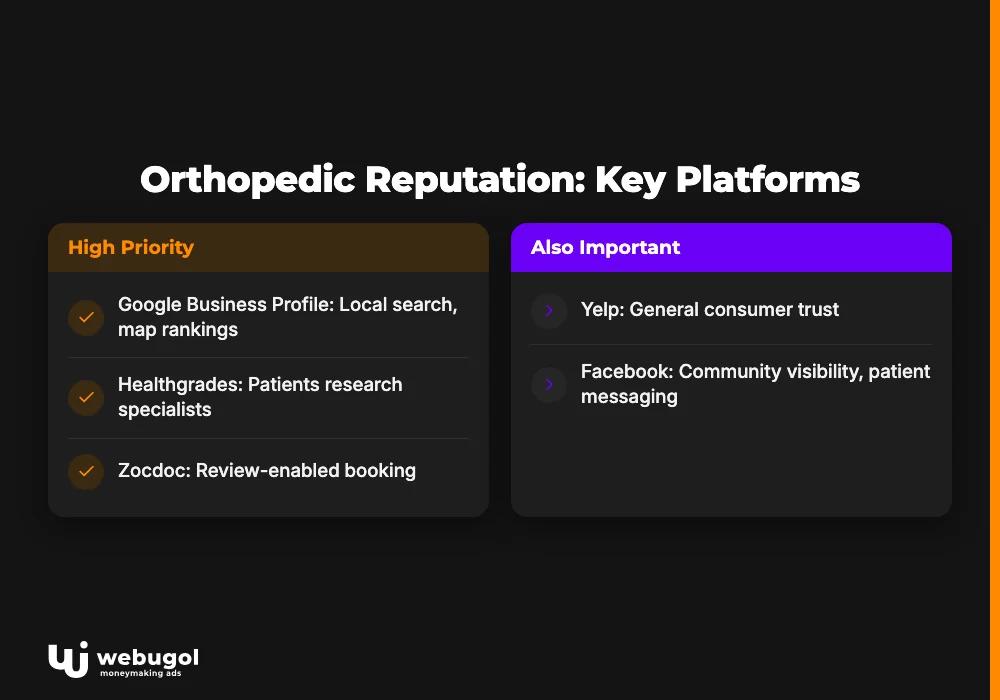
Google Business Profile is the highest-priority platform for most orthopedic clinics, followed by healthcare-specific directories. Here is a breakdown of the platforms that carry the most weight for online reviews for orthopedic surgeons:
| Platform | Why it matters | Primary audience |
|---|---|---|
| Google Business Profile | Drives local map pack rankings; reviews appear in search | All patients |
| Healthgrades | Widely used by patients researching specialists | Patients evaluating orthopedic surgeons |
| Zocdoc | Review-enabled booking platform | Patients scheduling online |
| Yelp | High domain authority; general consumer trust | Patients without provider referrals |
| Community visibility; supports patient messaging | Existing patients and referrals |
Claiming and completing your profile on each of these platforms is the foundation of orthopedic practice marketing. An incomplete profile reduces trust and can suppress your visibility in search results. Start with Google, then build outward.
How do orthopedic practices manage online reviews?
Effective medical reputation management for orthopedic practices combines three activities: generating new reviews consistently, monitoring all major platforms for incoming feedback, and responding to every review in a professional manner. No single activity works in isolation.
The core workflow looks like this:
- Generate: Ask satisfied patients for feedback at the point of care or through a structured follow-up sequence.
- Monitor: Set up alerts or use a dedicated reputation management tool to catch new reviews as they are posted.
- Respond: Reply to all reviews, positive and negative, promptly and without delay.
Consistent execution across all three separates practices with strong online reputations from those that manage reviews reactively.
How to get more patient reviews for an orthopedic clinic?
The most reliable approach is a direct, personal request right after a positive visit. A care team member asking face to face is more effective than an automated email sent days later. Proximity matters.
For higher-volume practices, follow-up communications reinforce in-person requests. A short text or email sent soon after the appointment, linking directly to your Google Business Profile review form, reduces friction. The shorter the path from request to review, the higher the completion rate.
Two principles guide this process. First, ask consistently across all appropriate post-visit contacts rather than selectively targeting patients who seem pleased. A systematic approach produces a more representative and credible review profile. Second, keep all follow-up communications HIPAA-compliant by avoiding any reference to specific conditions, procedures, or clinical details in the message body.
Orthopedic practice marketing that treats review generation as a repeatable process builds steady review volume that compounds over time.
How to respond to negative patient reviews as an orthopedic practice?
A negative review is not a crisis. It is a visible demonstration of how your practice handles problems. Respond promptly, acknowledge the concern, and move the resolution offline.
A practical response framework:
- Thank the reviewer for the feedback.
- Acknowledge that their experience did not meet expectations.
- Provide a direct contact, such as a phone number or email, and invite the patient to reach out, keeping all case-specific details out of the public reply.
Never argue publicly with a reviewer. That approach damages your reputation with every future reader. Your goal is not to win the exchange. It is to show prospective patients that your practice listens and responds appropriately.
Every public response also carries a HIPAA dimension. Do not reference the patient's condition, visit details, or treatment in your reply, even when the review contains inaccuracies about those facts. Confirming clinical details in a public thread can create a compliance violation, regardless of intent.
Orthopedic reputation management and your digital marketing strategy
Orthopedic reputation management connects directly to how Google evaluates your clinic for local search rankings. Your review count and average rating feed into the local map pack algorithm, meaning review-building work has direct SEO value.
For that reason, building your clinic's local search presence and managing your online reputation are two sides of the same effort. A well-maintained Google Business Profile with strong ratings earns more prominence in local results, which drives more impressions, which creates more review opportunities. The cycle reinforces itself.
Social content supports this loop too. Patient education and stories shared on Facebook or Instagram build familiarity that makes prospective patients more receptive to your reviews. Practices that connect reputation, content, and search build a more durable patient acquisition channel than those relying on any single tactic.
Staying HIPAA-compliant across all digital activities is part of this orthopedic digital marketing strategy as well. That discipline extends to review responses, follow-up messages, and all patient-facing digital communications. For context on how these channels are shaping the specialty, see our orthopedic digital marketing trends overview.
Take control of your practice's online reputation
Orthopedic reputation management requires consistent effort across review generation, monitoring, and response. The practices that build this discipline see compounding returns: more reviews strengthen local rankings, better rankings drive more patient visibility, and greater visibility produces more review volume.
To build a structured orthopedic reputation management plan as part of a complete medical reputation management program, explore our growth program for orthopedic and specialty clinics or reach out to the Webugol team to discuss your practice's goals.
FAQ
Why do patients trust online reviews when choosing orthopedic surgeons?
Orthopedic patients face high-stakes decisions, often involving surgery or prolonged rehabilitation. Online reviews let them assess a surgeon's communication, responsiveness, and care quality when those factors are difficult to evaluate from a website alone.
What makes healthcare online reputation management different from general reputation management?
Orthopedic practices must follow HIPAA requirements when responding to reviews, meaning they cannot confirm or discuss specific patient cases or treatments in public replies. This requires a more carefully worded response approach than most consumer businesses need.
How often should orthopedic practices ask for reviews?
Review requests work best as a consistent part of the post-visit workflow rather than an occasional campaign. Asking after each appropriate visit keeps review volume current and your average rating reflective of recent patient experience.
Should an orthopedic practice respond to positive reviews as well as negative ones?
Yes. Responding to positive reviews reinforces patient loyalty and signals to prospective patients that the practice is attentive and engaged. Consistent responses across all reviews carry more weight than replying only to complaints.
Can an orthopedic practice remove a negative Google review?
Practices cannot remove reviews simply because the content is unflattering. Google allows flagging reviews that violate platform policies, such as spam or fake reviews, but factual feedback from real patients typically remains. A professional public response is the most effective tool available.