



Healthcare email marketing: strategies for medical practices
Healthcare email marketing is the practice of sending targeted, HIPAA-compliant messages to patients to build relationships, reduce no-shows, and grow a medical practice. Patient email campaigns cost less per contact than most other channels. They keep communication personal enough to feel clinical rather than commercial. Medical practices use email to deliver appointment reminders, educational newsletters, and condition-specific content at scale.
What a complete healthcare email program covers
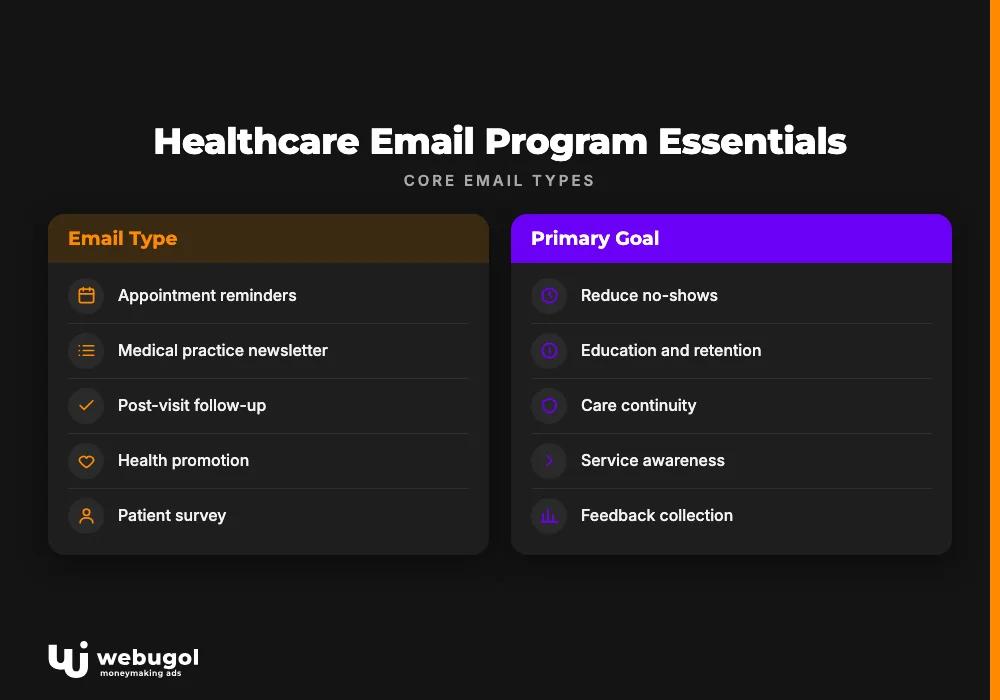
Before getting into tactics, it helps to map the core email types most practices run. Each one addresses a distinct moment in the patient relationship.
| Email type | Primary goal | Typical timing |
|---|---|---|
| Appointment reminders | Reduce no-shows | 48-72 hours before visit |
| Medical practice newsletter | Education and retention | Monthly |
| Post-visit follow-up | Care continuity | Within 48 hours |
| Health promotion | Service awareness | Quarterly |
| Patient survey | Feedback collection | After appointments |
| Automated education series | Condition management | Triggered by diagnosis |
A strong clinic email strategy coordinates all of these so patients feel guided through their care rather than marketed to. That distinction matters.
What are the best email marketing strategies for medical practices?
The most effective healthcare email marketing strategies combine segmentation, automation, and compliance from the start. Sending one generic newsletter to every patient on the list leaves most of the channel's potential untapped. Here is what separates programs that work from ones that don't.
Segment before writing anything. Dividing a patient list into meaningful groups is the highest-leverage action in email. Age-appropriate cohorts, chronic condition groups, and patients due for preventive screenings all respond to different messages. Sending pediatric care resources to retirees, or cancer management content to healthy annual-visit patients, trains those patients to ignore future sends.
Automate what's predictable. Appointment reminders, post-visit check-ins, and new-patient welcome sequences are consistent touchpoints. Email automation for medical practices handles all of them reliably, cuts administrative work at the front desk, and prevents patients from falling through the cracks after a visit.
Personalize past the first name. Patient engagement emails that reference the patient's last visit, specific health condition, or next recommended screening outperform generic sends significantly. Achieving this level of relevance requires an email platform that syncs with your Electronic Health Records (EHR) system or pulls data from your practice management software.
Lead with education, promote second. Articles on common conditions, preventive care guidelines, and seasonal health tips build genuine trust over time. Health promotion emails introducing new services land far better once that trust exists.
The mechanics of building each of these layers are covered in this step-by-step patient email framework.
How do HIPAA regulations affect email marketing in healthcare?
HIPAA compliance is not optional in healthcare email marketing. Any message that contains or references Protected Health Information (PHI) must travel through a HIPAA compliant email platform that encrypts data in transit and at rest. This is a hard legal requirement, not a recommendation.
Standard free email accounts and unencrypted plan tiers on general platforms are not appropriate for clinical communications. The platform must sign a Business Associate Agreement (BAA) with the practice before any patient data is imported. A BAA is a legal commitment that the vendor handles PHI according to HIPAA requirements. No BAA means no protection, regardless of what the email contains.
Consent adds a second layer. Practices must obtain explicit written consent before sending marketing emails to patients. Transactional messages like appointment reminders generally fall under treatment communication and operate under different consent rules than promotional content. An email promoting a new wellness service requires a separate opt-in from the appointment reminder list.
Practical steps to stay compliant:
- Sign a BAA with the email platform before importing patient data
- Use encryption in transit and at rest on every platform handling PHI
- Keep PHI out of subject lines entirely
- Maintain audit logs for all email communications involving patient data
- Provide a clearly labeled, one-click opt-out on every marketing send
- Review data retention and deletion policies at least annually
Email compliance is one piece of a broader picture. A full digital marketing plan for your practice should have HIPAA-safe defaults built into every channel, not just email.
How can medical practices increase patient engagement with email?
Low open rates are the most common complaint with patient email campaigns. The fix is rarely sending more email. Better targeting and timing solve it.
Subject lines carry the first decision. "Your appointment is coming up" consistently outperforms "Monthly newsletter from [Practice Name]" because it signals immediate relevance. Personalizing with the patient's name or appointment date lifts opens further.
Reduce friction with interactivity. Adding appointment scheduling links, health questionnaires, or brief quizzes directly into the email body lets patients act without leaving their inbox. Modern medical email templates support these interactive elements on most major platforms. Fewer steps between email and action means higher completion rates.
Match sends to patient journey moments. A follow-up email arriving within 48 hours of a visit gets read. Three promotional emails in a single week get deleted. Mapping email triggers to real lifecycle moments, such as post-visit, pre-screening, or annual recall, consistently produces better engagement than filling a marketing calendar.
Use AI-driven personalization where the platform supports it. Platforms with machine learning capabilities analyze each patient's open and click history to forecast which content format and send time gets the best response. This kind of email automation for medical practices learns individual preferences over time. Less guesswork, better results.
For context on what engagement rates to expect, email performance metrics across industries provides useful comparison data.
What email marketing tools are HIPAA-compliant for healthcare?
No single platform dominates healthcare email marketing across all practice sizes. The right tool depends on list size, automation requirements, EHR integration needs, and the technical resources available on staff.
General platforms with BAA support: Mailchimp and Constant Contact both offer plans that include a Business Associate Agreement. They work well for practices that want design flexibility and customizable medical email templates without building a complex stack. Neither is built specifically for healthcare. HIPAA compliance configuration requires close attention during setup and ongoing monitoring.
Purpose-built patient communication tools: Some platforms are designed from the ground up for patient communication and integrate directly with common EHR systems. These typically include automated recall campaigns, two-way messaging, and no-show follow-up sequences alongside standard email functionality. The tradeoff is reduced template flexibility compared to general-purpose platforms.
Analytics layer: Google Analytics, connected through UTM parameters added to email links, shows what patients do on the practice website after clicking through. Appointment bookings, form completions, and page depth all become measurable. Standard email dashboards show clicks. They miss everything that happens afterward.
Minimum criteria for any platform in a healthcare email marketing program:
- Signed BAA before patient data is imported
- Encryption in transit and at rest
- Audit logs available for compliance review
- Segmentation and automation capabilities
- Template builder for consistent, professional-looking sends

How often should a medical practice send emails to patients?
Frequency should match patient expectations, not the marketing calendar. Sending too often drives unsubscribes. A shrinking active list quietly reduces deliverability for appointment reminders that matter far more than any promotional send.
A practical cadence for most practices:
- Monthly: Medical practice newsletter covering health education and practice updates
- Per appointment: Reminder 48 to 72 hours ahead, plus a same-day confirmation
- Within 48 hours post-visit: Brief follow-up checking on the patient
- Seasonally: Health promotion tied to flu season, open enrollment, or specific screening campaigns
- Triggered: Welcome sequence for new patients; education series after a specific diagnosis or procedure
More than one marketing-focused email per month typically pushes unsubscribes higher. Quality of targeting beats frequency every time.
Measuring what actually matters
Open rates and click-through rates give a baseline. The outcomes that justify a healthcare email marketing investment are further downstream: appointments booked, no-shows reduced, recall visits completed.
Track these at minimum:
- Open rate by email type (appointment reminders and newsletters will differ significantly)
- Click-through rate on every call-to-action link
- Conversion rate for emails with a specific intended action (scheduling, survey completion)
- Unsubscribe rate per campaign (a spike signals a frequency or targeting problem)
Most email platforms surface these natively. Adding Google Analytics UTM parameters to email links provides a complete picture of post-click behavior, not just that a click occurred. Small practices with no dedicated marketing resource can start with monthly reviews of opens and unsubscribes, then layer in subject-line A/B testing once send volume supports statistical confidence.
Building and maintaining a clean patient list
Growing a list of genuinely engaged patients is ongoing work. The two highest-converting capture moments are the first appointment, when the patient relationship begins, and the practice website, where people are actively searching for care.
Capturing email addresses at intake is standard. Opt-in forms on appointment booking pages, contact forms, and high-traffic educational content extend list growth beyond the office visit. Every new subscriber should receive a short welcome sequence setting clear expectations about what they will receive and how often.
Purchased email lists have no place in a healthcare email marketing program. They violate HIPAA's consent requirements, produce low engagement, and damage sender reputation with email providers over time. A smaller list of genuinely opted-in patients consistently outperforms a large cold one.

The segmentation gap most practices leave open
Treating every patient as the same audience is the most common structural failure in clinic email strategy. Segmenting by age, health condition, visit frequency, or care stage makes every other element of healthcare email marketing work harder.
Age-based segmentation lets a practice send pediatric care resources to parents and geriatric screening reminders to older patients. Condition-based segmentation means patients managing a chronic illness receive content relevant to their specific situation rather than generic tips. Specific segments make for shorter, more actionable emails. That's a win on both sides.
The payoff grows when personalization goes deeper. Automated education series triggered by a specific diagnosis, recall campaigns timed to each patient's screening schedule, and post-visit sequences tailored to treatment plans are where healthcare email marketing delivers its strongest results. The setup takes more time upfront. Engagement and retention data consistently shows it's worth it.
Ready to build a patient email program that converts?
Healthcare email marketing works when it's built on the right tools, segmented properly, and sent with HIPAA compliance as a default rather than an afterthought. If your practice sends the same newsletter to every patient once a month and wonders why engagement is flat, the structure is the problem, not the content.
Webugol's Healthcare Growth System is built for medical practices that want a complete, HIPAA-compliant patient communication infrastructure. Ready to build a system that brings patients back consistently? Reach out to Webugol today.
FAQ
What is healthcare email marketing?
Healthcare email marketing is the use of targeted, HIPAA-compliant email campaigns to communicate with patients, reduce no-shows, and build long-term practice relationships. It includes appointment reminders, medical practice newsletters, post-visit follow-ups, and automated education sequences. Done consistently, it keeps the patient-practice connection active between office visits.
How do I make sure my medical practice emails are HIPAA compliant?
Use an email platform that provides a signed Business Associate Agreement and encrypts data in transit and at rest. Never include Protected Health Information in subject lines or unencrypted attachments. Get explicit written consent from patients before sending any marketing email, separate from transactional appointment communication.
What should a medical practice newsletter include?
A well-built medical practice newsletter covers health education relevant to your patient population, practice news such as new providers or changed hours, and seasonal health tips. Keep each issue focused on one or two topics rather than loading it with multiple updates. Monthly delivery is a practical default for most practices.
How do I grow a medical practice email list without buying contacts?
Capture email addresses at every patient intake and add opt-in forms to high-traffic pages on the practice website. New subscribers should receive a welcome sequence explaining what content they will receive and how often. Purchasing or renting contact lists violates HIPAA's consent requirements and should never be done in a clinical context.
Which metrics matter most for patient email campaigns?
Track open rate, click-through rate, and conversion rate (appointments booked, surveys completed) as the core three. Monitor unsubscribe rate per campaign to catch frequency or targeting problems early. Use UTM parameters on email links to track what patients do on your website after clicking through, since post-click behavior reveals where real conversion happens.