



Plastic surgery website design: what actually converts visitors into patients
Plastic surgery website design determines whether a potential patient books a consultation or finds a competitor. A site that builds credibility quickly, presents your work clearly, and removes friction from the booking path becomes your most reliable patient acquisition asset. For a cosmetic surgery practice, the website is not a brochure. It is the front end of your revenue operation.
This holds whether you are launching a new practice or running one that has plateaued at current acquisition costs. The structural gaps that frustrate a surgeon building their first online presence are the same gaps that quietly drain a high-revenue clinic: unclear conversion paths, poor mobile performance, and SEO that peaked years ago without active investment.
Why plastic surgery website design determines patient acquisition
Patients make high-value decisions based on what they find online before they ever call your office. What they encounter in the first seconds on your site decides whether they stay or leave.
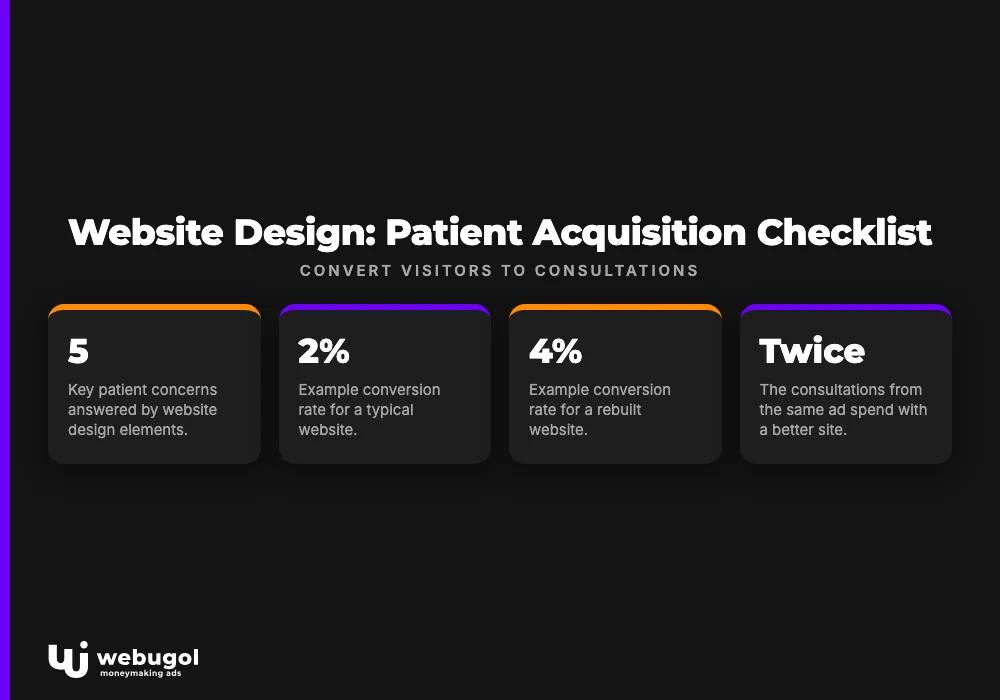
A prospective patient is not reading when they land on your page. They are scanning for enough confidence to stay. The table below maps their mental checklist to the design elements that answer each concern:
| Patient concern | Design element that answers it |
|---|---|
| Is this surgeon qualified? | Board certifications, credentials, affiliations visible without scrolling |
| Are the results real? | High-resolution before-and-after galleries sorted by procedure |
| Do others trust them? | Testimonials, video reviews, and star ratings |
| Can I reach them quickly? | Prominent click-to-call, online booking, stated response time |
| Is this practice worth contacting? | Educational content and a clear consultation process |
A site that answers all five clearly keeps visitors moving toward a consultation. Miss any one of them and you lose patients to whoever ranks below you in search results.
For a practice already running paid traffic, this matters in direct revenue terms. If your site converts 2% of visitors and a rebuilt site converts 4%, the same ad spend produces twice the consultations. That multiplier is why plastic surgery website design is a revenue decision. It is not an aesthetic preference.
What features should a cosmetic surgery website have?
A well-converting surgery clinic website needs several core elements working together as an integrated system, not as a checklist of independent additions.
Mobile-first architecture and load speed. A large share of visitors arrives on a smartphone. Responsive layout is the baseline. Load speed matters just as much: a slow page pushes visitors back to search results before they read a single word about your work. Image optimization, clean code, and reliable hosting are non-negotiable in a competitive cosmetic surgeon web development project.
Trust signals visible without scrolling. Board certifications, professional affiliations, and accreditation badges should appear above the fold. This is the first question every patient has, and they should not have to search for the answer.
Before-and-after galleries organized by procedure. Visual proof drives booking intent more than any other content element on a plastic surgery site. Organized, high-resolution galleries let potential patients assess your results directly. This is where visitor interest turns into action.
A clear booking path on every page. A buried contact form is a lost patient. Click-to-call, online scheduling, and a stated response time expectation reduce drop-off at the moment someone is ready to book. The goal is zero friction between intent and submission.
A content management system the team can operate. Practices change: new surgeons join, procedures update, blog content needs publishing. A CMS that the marketing or admin team can use without developer support keeps content current and reduces the operational dependency on outside technical resources. This applies equally to a solo-surgeon practice and a multi-location group.
Educational content that earns trust and rankings. Patients researching elective procedures read extensively before they decide. Detailed procedure guides, answered FAQ pages, and blog posts that address real patient concerns position your practice as a credible resource. This content drives organic search visibility over time and reduces the cost per acquired patient through paid channels.
The challenge is that these elements need to function as a system. A beautiful gallery on a slow page loses to a faster competitor with a mediocre gallery. Strong trust signals above the fold cannot compensate for a confusing booking flow two clicks later. Understanding how design choices drive patient retention from the first visit forward starts with the same structural foundations that bring patients in.
How does website design affect patient acquisition?
Patient trust web design directly controls the percentage of visitors who convert to consultations. This is where most practices lose the most patients without knowing it.
A poorly structured page creates friction at the wrong moment. Visitors arrive with genuine interest, then encounter a confusing layout, contradictory information, or a contact form that takes too long to fill out on a phone. Each friction point is a drop-off point. A site that removes friction throughout the decision process consistently outperforms one with stronger visuals but weaker conversion architecture.
Speed compounds this. Slow pages do not just frustrate visitors. They lower organic search rankings, which reduces how many relevant visitors arrive in the first place. Healthcare website SEO and conversion design solve different problems but create the same outcome when both are neglected: fewer patients, at higher cost per acquisition.
Cosmetic practice online presence is a revenue metric, not a vanity one. When a practice reaches a growth ceiling despite increasing ad spend, the diagnostic often leads back to the website. Conversion rate, page speed, and mobile experience together determine how efficiently that spend produces appointments. Fixing those issues is a revenue optimization project.
What SEO strategies work for cosmetic surgery websites?
Healthcare website SEO for plastic surgery requires local search optimization as the foundation, with technical and content work layered on top.
Local visibility. Most patients search for a surgeon in their city or metro area. A verified Google Business Profile, consistent name-address-phone data across directories, and location-specific procedure pages give your practice the strongest signal for local intent searches.
Procedure-specific keyword targeting. Broad terms like "plastic surgeon" compete nationally. Phrases that combine a procedure with a location, or a procedure with a specific patient concern, target the visitors most likely to book in your market. Every procedure page should be optimized for the terms that specific patient population actually uses.
Technical site health. Page speed, clean URL structure, proper heading hierarchy, and medical practice schema markup all affect how search engines index and rank your pages. These factors also determine how your practice appears in AI-generated search summaries, which increasingly surface single answers at the top of the page before a visitor clicks to your site.
Authority-building content. Blog posts that answer the specific questions patients search before booking, comparison guides, and educational procedure content build topical authority over time. This content attracts organic links from health journalism and patient communities, which strengthens domain authority across the entire site.
A strong cosmetic practice online presence in search results requires ongoing maintenance. Algorithms update. Competitors invest in their own visibility. What ranked well two years ago may require active work to hold that position now. For a view of the patient experience shifts changing medical web design expectations, the pressures on how practices present online are only increasing.

Does a plastic surgery practice need custom web development?
For most practices competing seriously in mid-to-large markets, yes.
Template-based websites have a performance ceiling. They constrain page architecture, limit custom integrations, and often include excess code that slows load times. For a new practice with limited budget, a template may be a reasonable starting point. For a practice competing in a market where other clinics have invested in their infrastructure, the technical compromises of a template accumulate into measurable performance gaps.
Custom cosmetic surgeon web development gives full control over page structure, schema implementation, booking integrations, and load performance. It also allows for the kind of ongoing optimization that improves conversion rates over time: testing call-to-action placement, rebuilding sections without template constraints, and integrating with the specific CRM and scheduling systems the practice already uses.
The SEO consequences matter too. Search engines reward pages that load fast, have clean code, and are structured clearly. A custom-built site makes fewer structural compromises than a retrofitted template. That difference compounds over time in competitive search environments where your site competes against practices that have invested in their technical foundation.
How much does a plastic surgery website cost?
The range is wide, and the sticker price is the wrong number to optimize.
A template-based build from a freelancer can be completed for a few thousand dollars. A fully custom site with integrated booking, before-and-after gallery management, blog infrastructure, SEO optimization, and performance engineering from a specialist team reaches five figures or higher. Neither number means much without understanding what the site produces in return.
The useful metric is cost per acquired patient. A site that converts 3% of visitors instead of 1.5% effectively halves your acquisition cost for the same ad spend. Medical website design tips that focus only on aesthetics miss this point entirely. The design, the technical foundation, and the conversion architecture together determine where on that range your site performs.
A better way to frame the investment: the cost of a website is not what you pay to build it. It is what you stop losing every month when it works correctly.

Stop losing patients to a site that cannot close
Your plastic surgery website design is the front end of your patient acquisition system. If it is not building trust quickly, handling mobile traffic efficiently, and routing visitors to a consultation with minimal friction, your ad spend is funding drop-off rather than growth.
Webugol builds patient acquisition systems for cosmetic and healthcare practices that need measurable outcomes. The Healthcare Growth System covers the full path from site architecture and tracking to booked appointments, designed as one integrated build rather than a collection of disconnected deliverables. Book a strategy call to understand where your current site is losing patients and what a rebuilt system would produce.
FAQ
How long does it take to build a plastic surgery website?
A custom plastic surgery website typically takes 8 to 16 weeks from discovery to launch, depending on the number of procedure pages, gallery size, and integration requirements. Template-based builds can move faster, but that speed comes with long-term performance trade-offs in competitive search environments.
What makes a plastic surgery website convert well on mobile?
Mobile conversion depends on fast load times, single-column layouts that surface the booking path without scrolling, and thumb-accessible call-to-action buttons. Before-and-after galleries also need to render at full quality on small screens, since gallery browsing is often the deciding moment for a mobile visitor.
How important are before-and-after galleries for patient conversion?
Before-and-after galleries are among the highest-converting elements on any cosmetic surgery site. They let prospective patients evaluate real results rather than relying on descriptions alone. The quality of the photography, organization by procedure, and the ability to view clearly on mobile all affect how effectively a gallery builds booking intent.
How often should a plastic surgery website be updated?
Procedure pages and gallery content should be updated whenever the practice adds new work or refines its offer. Blog content benefits from regular additions to maintain search relevance. Technical SEO, page speed, and schema markup should be reviewed at least annually as platform and algorithm standards change.
Can a plastic surgery website rank without paid ads?
Yes. Organic rankings driven by targeted procedure pages, local SEO, and educational content can produce consistent patient inquiries independent of paid traffic. Paid and organic channels work better together, but a well-structured site with strong SEO fundamentals builds visibility that continues working regardless of ad spend levels.