



Plastic surgery SEO: how to attract high-intent patients through search
Plastic surgery SEO is the process of optimizing a practice's online presence so it ranks prominently when potential patients search for specific cosmetic procedures. Done well, it places your practice in front of people who have already decided to pursue a procedure and are comparing local surgeons. The result is a steady pipeline of qualified consult requests, without paying for each individual click.
The structural gaps that make a new practice invisible in search are often the same ones holding an established clinic back from its next growth tier: thin procedure pages, inconsistent local citations, and an unconverted Google Business Profile. That gap has a revenue cost.
What is plastic surgery SEO and how does it work?
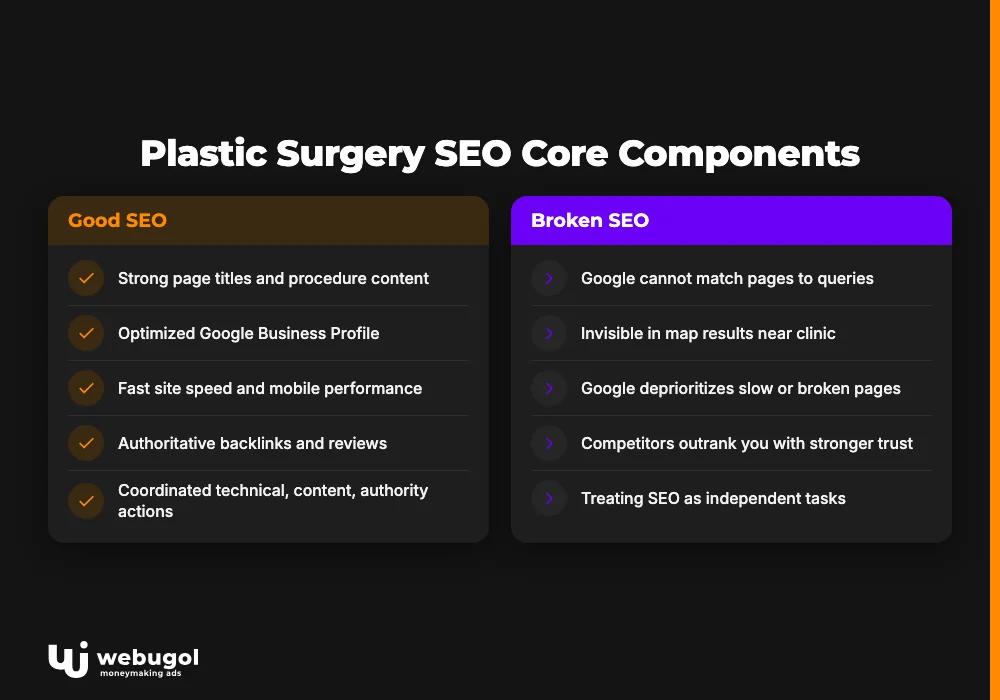
Plastic surgery SEO is a coordinated set of technical, content, and authority-building actions that signal to Google that your practice is the most relevant and trustworthy result for a given procedure search. These are the core components plastic surgery SEO works across simultaneously.
| Layer | What it covers | What breaks without it |
|---|---|---|
| On-page optimization | Page titles, procedure content, structured data | Google cannot match your pages to specific procedure queries |
| Local SEO | Google Business Profile, citations, local content | Your practice is invisible in map results when patients search near your clinic |
| Technical SEO | Site speed, mobile performance, crawlability | Google deprioritizes slow or broken pages regardless of content quality |
| Authority building | Backlinks, reviews, E-E-A-T signals | Competitors with stronger trust signals outrank you even with weaker content |
Each layer depends on the others. Strong on-page content with no local signals will not win the map pack. A fast site with no authoritative backlinks loses to a slower competitor with stronger domain trust. For plastic surgery digital marketing, treating SEO as a checklist of independent tasks rather than a system is where most execution falls apart.
What keywords should a plastic surgery clinic target?
A plastic surgery clinic should focus on two keyword types: procedure-specific terms and location-qualified terms. The highest-converting searches combine both. "Rhinoplasty surgeon [city]" or "breast augmentation clinic near me" indicate a patient who has decided on a procedure and is evaluating local providers.
Keyword categories worth building around:
- Procedure pages: rhinoplasty, breast augmentation, tummy tuck, liposuction, blepharoplasty, mommy makeover. Each major procedure should have its own dedicated landing page optimized for that procedure's specific queries.
- Location modifiers: city name, neighborhood, "near me," metro area. Google uses geolocation context, so matching the language local patients use matters.
- Decision-stage queries: "how much does [procedure] cost," "recovery time after [procedure]," "what to expect from [procedure]." These signal active research and drive blog content.
- Comparison queries: "[procedure] vs [procedure]," "best [procedure] surgeon [city]." Patients comparing options are closer to booking than those browsing passively.
Generic keywords like "plastic surgery" or "cosmetic surgery" attract high search volume but low conversion rates. The keyword strategy for a practice focused on cosmetic clinic leads should weight procedure-specific, location-qualified terms heavily, even when individual search counts look modest. Someone searching a generic term may be a journalism student or a curious browser. Someone searching "facelift surgeon Manhattan" is a qualified prospect. Intent beats volume.
The same logic applies to paid advertising: keywords that appear generic often attract audiences who are not ready to book, running up cost per acquisition without improving consult volume.
Local SEO for surgeons: ranking where patients search
Most patients choose a plastic surgeon within driving distance of their home or work. Local SEO for surgeons is therefore not supplementary to cosmetic surgery marketing. For most practices, it is the primary channel.
Google Business Profile. A complete, actively managed GBP listing is the single most visible asset in local search. When someone searches "plastic surgeon [city]" or uses a maps-based search, the local pack results appear above organic listings. Practices with comprehensive profiles, accurate hours, populated service categories, and recent photos consistently outperform those with thin or outdated listings. For a step-by-step approach to maintaining a high-performing listing, the guide on Google Business Profile management for medical practices covers the full setup and maintenance process.
NAP consistency. Your practice name, address, and phone number must be identical across every directory where your practice appears: Google, Yelp, Healthgrades, RealSelf, Zocdoc, and local business directories. Inconsistent data creates ranking friction and confuses patients calling to book.
Patient reviews. Reviews affect local search ranking and directly influence whether a patient contacts your practice. Encouraging satisfied patients to leave honest reviews, and responding professionally to all feedback, is both a local SEO task and a reputation management task. Practices with higher review counts and consistent ratings see higher click-through rates from local search results.
One important distinction for established practices: local SEO is not a one-time setup. GBP requires active maintenance. The citation profile needs periodic auditing. Review velocity matters for local ranking. A practice that set up its GBP two years ago and has not touched it since is losing ground to competitors who maintain theirs consistently.
Building a plastic surgeon website that earns rankings and consultations
A plastic surgeon website that ranks well is not automatically one that converts well. Both matter. Rankings bring the click; the site earns the consult request.
Procedure-specific landing pages. Each significant procedure you offer needs a dedicated page optimized for that procedure's specific search terms. A single "services" page trying to rank for a dozen procedures will consistently lose to practices with deep, specific pages for rhinoplasty, body contouring, or eyelid surgery. These pages should cover what the surgery involves, realistic recovery expectations, what affects outcomes, and a clear path to booking a consultation.
Before-and-after galleries. When published with patient consent, galleries serve two purposes: they give prospective patients evidence of your clinical work, and they add SEO value through descriptive image alt text and procedure-specific categorization. Organized galleries (by procedure type, not just a general grid) are more useful to patients researching specific procedures and more accessible to search engine indexing.
FAQ content and procedure guides. Patients researching cosmetic surgery ask specific clinical questions before they are ready to contact a surgeon. FAQ pages targeting those questions, what recovery from a facelift looks like, how long rhinoplasty swelling lasts, draw in patients at the research stage and establish clinical credibility before the first consultation. Well-crafted procedure FAQs also capture featured snippet placements in search results, putting your practice at the top of the page even outside the standard organic listings.
For the content to perform in search, every page and post needs to meet technical and stylistic standards that go beyond basic writing. Medical SEO content production for plastic surgery practices covers the specific approach to content that satisfies both accuracy requirements and search performance goals.
Backlink strategy for cosmetic surgery marketing
Search engines use backlinks as a signal of expertise and trustworthiness. For cosmetic surgery marketing, the highest-value links come from medical and healthcare-adjacent sources: medical associations, healthcare publications, local news coverage, and complementary providers such as dermatology practices, medical spas, and wellness centers.
Backlinks from local organizations carry particular weight in local search. A mention in a regional magazine's healthcare coverage, a contribution to a hospital's patient resources page, or a guest post on a related healthcare blog all build local authority that feeds back into GBP rankings and local pack visibility.
The approach should focus on earning relevant, authoritative links rather than accumulating volume. A link from a prominent plastic surgery journal or a local hospital system will move surgeon Google rankings more than a dozen links from low-relevance directories. For a detailed approach to building the kind of link profile that moves rankings in a competitive market, earning backlinks for plastic surgery and cosmetic clinics covers the acquisition approaches that work in this space.
What to avoid. Paid link schemes, link exchanges with irrelevant sites, and thin guest posts on content farms have drawn Google penalties. Healthcare is a "Your Money or Your Life" (YMYL) content category, meaning Google applies stricter quality assessment to medical content and the sites that link to it.

Technical SEO: mobile performance and site speed
Mobile optimization. Most patients research cosmetic procedures on mobile devices, often privately and outside of work hours. A plastic surgeon website that is not fully responsive, that requires pinching to read text, or that has buttons too small to tap, loses patients before they see your clinical work. Google uses mobile performance as a ranking signal.
Site speed. A slow website increases bounce rates and reduces the time patients spend evaluating your practice. Optimizing page load speed involves compressing images, minimizing unnecessary code, and using reliable hosting infrastructure. The relationship between site speed and both user experience and search engine rankings is direct: Google's Core Web Vitals are partly speed-based metrics that factor into ranking decisions.
Structured data markup. Adding schema markup to procedure pages, your business listing, FAQ sections, and physician profiles helps search engines understand what your pages contain. It also creates the conditions for rich snippets, enhanced visual displays in search results that increase click-through rates relative to plain listings.
How long does it take to rank a plastic surgery website on Google?
For most practices, local pack rankings for primary procedures in a medium-competition market begin to move within three to six months of consistent plastic surgery SEO work. First-page organic rankings for competitive procedure terms typically take six to twelve months. Highly competitive markets such as New York, Los Angeles, and Miami can take longer.
Several variables determine timeline. A new domain with no history starts from a lower trust baseline than an established practice website. A site with significant technical problems needs those resolved before content work starts to pay off. Local search responds faster than national organic rankings. And a practice that has never invested in SEO is starting with a foundation gap relative to competitors who have been building for years.
The practical implication for a practice at a growth plateau: waiting another six months before starting is not a neutral decision. Every month of delay is a month of compounding positioning advantage for competitors already investing in medical SEO services.
How do I get more patients from Google search?
Getting more patients from search requires two things to work in combination: ranking well for the right queries, and converting the traffic those rankings deliver. Many practices invest in plastic surgery SEO, see ranking improvement, and find that consult bookings have not followed proportionally. The gap is usually in the conversion layer, not the SEO layer.
Conversion-focused consultation pages. A first-page ranking for "rhinoplasty surgeon [city]" is only as valuable as the page patients land on. If that page is thin, hard to navigate on mobile, or buries the consultation booking path, you are losing patients who already found you.
Call tracking and attribution. Understanding which pages, searches, and keywords drive actual consultation bookings, not just site visits, tells you where to focus. Without that data, you are optimizing for ranking metrics that may not be correlated with revenue.
Speed to response. A patient who fills out a consultation request form and does not hear back within a few hours will often contact a competitor. Response time is a sales operations decision, but it directly determines whether plastic surgery SEO investment converts to revenue. The leak between ranking and revenue, search position to click to form submission to no follow-up, is one of the most common patterns in practices with good traffic and flat consult numbers.
For a practice investing meaningfully in marketing, the integration between SEO-driven traffic and the downstream booking and intake process matters as much as the rankings themselves.

How much does plastic surgery SEO cost?
Plastic surgery SEO pricing varies based on market competition, the starting state of your website, your target procedures, and the scope of work required. A practice in a small market with a well-structured site and an existing review base needs different investment than one in a highly competitive market starting from scratch.
What holds across situations: effective plastic surgery SEO is an ongoing engagement, not a one-time project. Local SEO requires active maintenance. Content requires regular additions and updates. Backlink acquisition is a continuous process. Practices that have tried one-time SEO "fixes" consistently report that rankings decline within months without continued work.
The right frame is not "what does SEO cost" but "what does the absence of a functioning organic acquisition channel cost per month in deferred consultations." A practice that could be generating additional consult bookings from search, but is not, carries a real revenue cost for every month that gap remains open. No gap stays cost-free.
Start building a patient acquisition system around organic search
Plastic surgery SEO, run as a system rather than a checklist, is one of the most durable acquisition channels a practice can build. The same infrastructure that generates consult requests this month keeps working next month, without paying for each individual click.
For practices already running paid search and social, SEO is not a replacement. It is the foundation that reduces cost per acquisition over time, that provides coverage when ad accounts face policy issues, and that captures patients specifically looking for a surgeon they can trust before they encounter an ad. Rankings compound.
Webugol builds patient acquisition systems for healthcare practices, connecting tracking infrastructure, funnel, content, and paid channels into one measurable path from search to booked consultation. Book a strategy call through the Healthcare Growth System to assess where your practice's search presence currently stands and what a realistic growth path looks like.
FAQ
What is plastic surgery SEO and how does it work?
Plastic surgery SEO optimizes a practice's website and online presence to rank prominently when patients search for specific cosmetic procedures. It works through four coordinated layers: on-page content, local search signals, technical site performance, and authority building through backlinks and reviews.
How long does it take to rank a plastic surgery website on Google?
Local pack rankings for primary procedures typically start improving within three to six months of consistent work. First-page organic rankings for competitive procedure terms usually take six to twelve months, depending on market competition, domain history, and the starting state of the site.
How much does plastic surgery SEO cost?
Pricing varies by market, competition level, and scope of work. What stays consistent is that effective SEO requires ongoing investment, not a one-time setup. The more useful question for most practices is what monthly revenue is being deferred by the absence of a functioning organic acquisition channel.
What keywords should a plastic surgery clinic target?
Clinics should prioritize procedure-specific, location-qualified terms like "rhinoplasty surgeon [city]" or "breast augmentation near me." These high-intent terms indicate a patient who has decided on a procedure and is comparing local providers, which produces materially higher conversion rates than generic searches.
How do I get more patients from Google search?
Ranking well is necessary but not sufficient. Conversion-focused procedure pages, fast follow-up on consultation requests, and attribution tracking that connects specific keywords to actual bookings are what turn search rankings into patient revenue.

