



Healthcare geofencing campaigns: how clinics stop losing patients to geography
Healthcare geofencing campaigns use GPS, Wi-Fi, or radio signals to place a virtual boundary around a physical location and deliver ads to every mobile device inside it. When a prospective patient walks past your clinic, sits in a competitor's waiting room, or enters a specific ZIP code, they become reachable with a timely, relevant message. That precision matters. For clinic owners running $10,000 or more in monthly ad spend, it is the difference between burning budget on broad demographics and spending on people who are physically in your market right now.
Whether your practice is setting up geofencing for the first time or auditing why a long-running campaign has stalled, the structural issue is the same: targeting without location precision keeps budget broad and attribution broken, regardless of how polished the rest of your funnel is.
What is geofencing in healthcare marketing?
Geofencing in healthcare marketing is a location-based advertising technique that triggers ads or push notifications when a mobile device enters, remains in, or exits a defined geographic zone. That zone can surround your practice, a hospital campus, a competitor's clinic, or any area where your target patients are likely to be.
The technology runs on GPS coordinates, Wi-Fi triangulation, Bluetooth beacons, or RFID signals. When a device crosses the boundary, the system fires a pre-configured action: a display ad, a push notification, or a promotional offer. The complexity is not technical. It is strategic: choosing the right boundaries, the right message, and the right compliance guardrails for a healthcare setting.
For a standalone clinic or a multi-location telehealth network, that strategic layer is where budget is won or lost.
What is the difference between geotargeting and geofencing in healthcare?
Geotargeting serves ads to users based on their registered location, typically a city, region, or ZIP code pulled from their IP address or account settings. Geofencing responds to real-time physical movement: the ad fires because the device entered a specific zone right now, not because the profile says the user lives nearby.
In a healthcare advertising strategy, the practical difference matters. Geotargeting suits broad metro awareness. Geofencing captures high-intent moments: someone who just walked into a competing urgent care clinic, or who is sitting in a waiting room and actively deciding where to book next. Location-based healthcare marketing that conflates the two ends up with the cost of geofencing and the precision of neither.
Use geotargeting for regional awareness. Use healthcare geofencing campaigns for real-time, high-intent moments.
How does geofencing help hospitals attract more patients?
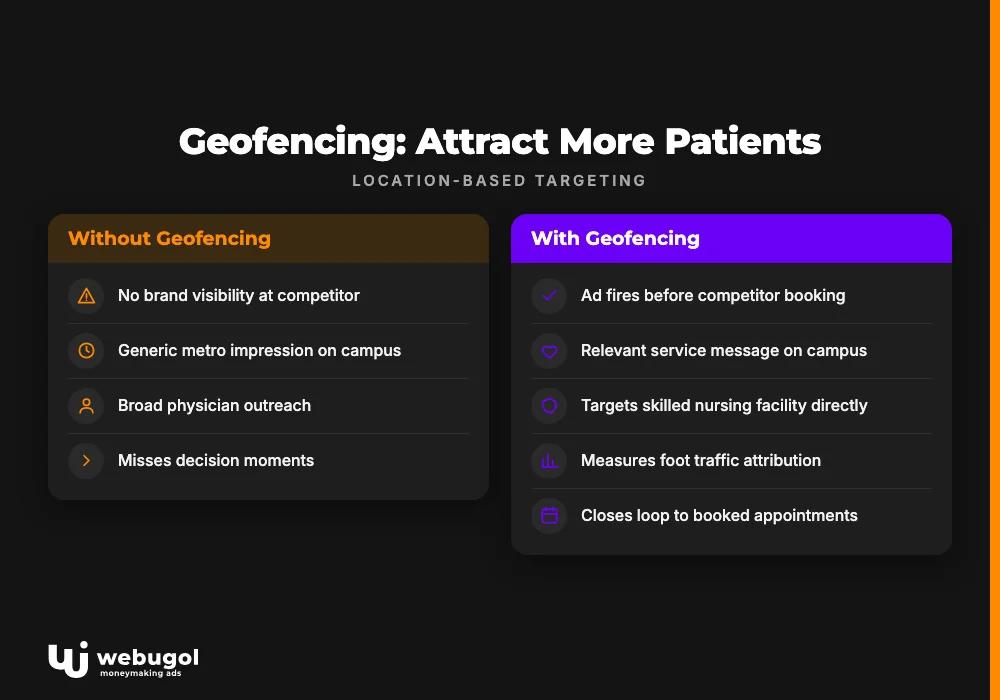
Hospital geofencing advertising works by reaching people when they are physically present and already in decision mode: near competitor facilities, inside major campuses, or within the service radius of your practice. Hospitals that rely only on regional display or social spend miss those moments entirely.
Three situations where location-based targeting changes the outcome:
| Situation | Without geofencing | With geofencing |
|---|---|---|
| Patient visits a competitor's urgent care | No brand visibility in that moment | Ad fires with your differentiator before they book |
| Visitor on a hospital campus | Generic metro impression | Relevant service line message tied to that building |
| Skilled nursing facility referral path | Broad physician outreach | Skilled nursing geofencing targets the facility directly |
For a practice at scale, the more valuable question is attribution. Foot traffic attribution, available through most major geofencing platforms, measures how many people who saw the ad came through the door. That closes the loop between ad spend and booked appointments, which is the measurement gap most multi-vendor setups never address.
What are the benefits of geofencing for healthcare providers?
The benefits of geofencing for healthcare providers come down to four outcomes that matter directly to a clinic owner or head of growth:
- Higher ad efficiency: Budget goes only to devices inside defined zones, cutting waste on audiences who cannot realistically book with your practice.
- Real appointment attribution: Foot traffic data connects ad exposure to physical visits, instead of relying on clicks that disappear into a reporting gap.
- Service line precision: Skilled nursing geofencing, for example, targets referral-generating facilities separately from consumer-facing campaigns.
- Competitive interception: Geofences around competitor locations reach patients who are actively shopping for the service you offer.
Healthcare geofencing campaigns make geography a conversion signal, not just a targeting parameter. That shift is consequential. Practices that plateau on paid performance typically optimize creative and landing pages while leaving the targeting footprint unchanged for months. The geofence was set at launch, the market shifted, and no one reviewed it. A quarterly radius audit is a cheap diagnostic relative to the CPL it recovers.
How to set up healthcare geofencing campaigns that convert
Start with compliance, not creative
The most critical constraint in location-based healthcare marketing is HIPAA. You cannot geofence specific hospital departments that imply a medical condition: a cancer treatment center, a behavioral health unit, or an addiction clinic is off-limits as a targeting signal. The fence belongs around the general campus, a competitor's full facility, or a broad ZIP code.
Every creative asset follows the same logic. No copy that implies knowledge of the patient's health status. No retargeting based on diagnosed conditions. Work only with platforms and partners who can document HIPAA-compliant data handling processes. Healthcare geofencing campaigns built on compliance shortcuts create liability, not leads.
Pair geofencing with organic local visibility
Geofencing campaigns perform best when the local search layer is already strong. If a patient sees your geofenced ad, grows curious, and searches your practice name, you need to own that result. Pairing your campaigns with a solid local SEO foundation for medical practices ensures the campaign does not leak warm traffic to competitors at the organic search step.
Practices that run geofencing without a local search presence often see higher CPLs than expected. Working with a digital marketing agency that connects both channels eliminates that leak.
Track foot traffic, not just clicks
Conversion tracking for healthcare geofencing should go beyond click-through rate. Set up conversion events for calls, appointment form submissions, and, where the platform supports it, foot traffic attribution. This tells you which fence zones drove patients through the door and which generated clicks without converting.
Test different radii. Too small and you capture too little traffic. Too large and you dilute targeting with irrelevant impressions. A starting radius of 0.5 to 1 mile around a specific facility is a reasonable baseline for most urban practices, adjusted after two to four weeks of data.
Common mistakes that drain geofencing budgets
Teams that specialize in search and paid media for healthcare practices see the same errors repeatedly. Knowing them in advance cuts the cost of learning them through wasted spend.
- No conversion tracking from day one: Without appointment calls or form fills tracked, you cannot tell whether the campaign works or just spends.
- Generic creative sent to geofenced audiences: Someone near a competitor's urgent care needs a different message than someone in your general ZIP code.
- Fences never reviewed after launch: Patient movement patterns shift seasonally and with practice expansions. Monthly radius reviews are a minimum viable discipline.
- No HIPAA audit of ad copy: Creative written under active compliance review drifts when that attention lapses. Quarterly copy audits prevent long-running ads from accumulating regulatory risk.
Ready to stop losing patients to location blind spots
For practices spending $10,000 or more per month on ads, healthcare geofencing campaigns represent one of the highest-leverage adjustments available: geographic precision layered on existing media spend, with attribution that closes the loop between impressions and booked appointments.
The Healthcare Growth System connects geofencing setup with tracking infrastructure, funnel diagnosis, and ongoing campaign management in one accountable engagement. If your current campaigns cannot tell you which location-level activity drives booked patients, that is the gap to close first.
Book a Strategy Call, Healthcare Growth System
FAQ
What is geofencing in healthcare marketing?
Geofencing in healthcare marketing delivers ads to mobile devices when they enter a defined geographic zone, such as the area around your clinic or a competitor's facility. The system uses GPS, Wi-Fi, or RFID signals to detect device location in real time. Campaigns fire based on physical presence, not demographic profiles or browsing history.
How does geofencing help hospitals attract more patients?
Hospital geofencing advertising reaches prospective patients at high-intent moments, when they are physically near a facility or visiting a competitor. Foot traffic attribution connects ad exposure to actual visits, which standard digital campaigns rarely measure. This makes it possible to identify which campaign zones drive appointments, not just impressions.
What are the benefits of geofencing for healthcare providers?
Geofencing improves ad efficiency by restricting spend to devices inside defined, high-intent zones. Foot traffic attribution connects impressions to physical appointments rather than relying on click data alone. Competitive interception, placing geofences around rival facilities, is a benefit specific to location-based targeting that no other channel replicates directly.
What is the difference between geotargeting and geofencing in healthcare?
Geotargeting uses a user's registered or reported location to serve ads by city or ZIP code. Geofencing triggers ads based on real-time physical movement: the device crossed a specific boundary right now. In a healthcare advertising strategy, geofencing captures higher-intent moments because it responds to where the person actually is, not where they said they live.
Can healthcare geofencing campaigns run without violating HIPAA?
Yes, when geofences target general locations: a full hospital campus, a competitor's broad facility, or a ZIP code. Targeting specific departments that imply a diagnosis, such as oncology or addiction treatment units, is prohibited. All ad copy must avoid language that implies any knowledge of the patient's health status or medical history.

