



SEO for Chiropractors: How to Rank and Get More Patients
SEO for chiropractors is the process of making your clinic discoverable when local patients search for care online. A practice ranking on Google's first page for local chiropractic terms captures patients who are actively looking. One that does not sends those patients, and every future visit they represent, to a competitor who invested in showing up. Done consistently, SEO for chiropractors converts search intent into scheduled appointments without the ongoing cost of paid advertising, and the rankings built today keep generating new patient inquiries months from now.
If your schedule has plateaued despite a steady referral program, the structural gap is usually the same one stalling any local business at a growth ceiling: no reliable system converting online search intent into appointment calls. That is what a structured chiropractic SEO program closes.
This guide covers the complete strategy: chiropractic local SEO, keyword research, Google Business Profile optimization, on-page fundamentals, content, backlinks, and what realistic results look like on an honest timeline.
How does SEO help chiropractors attract more patients?
SEO for chiropractors places your practice in front of patients at the precise moment they express intent. When a prospective patient types "back pain chiropractor near me" or "chiropractic adjustment [city]," they are not passively browsing. They are ready to act. Appearing at that moment, in the right position, converts search traffic into booked visits.
Google returns two formats for local chiropractic searches: the map pack, three results with ratings, addresses, and call buttons, and organic listings below. Practices in the map pack receive the dominant share of clicks for local intent queries. Those outside it are effectively invisible to most of that search demand.
Patients now discover healthcare providers through search the way they once found them through word of mouth. A prospective patient scans the top results, reads a few reviews, and calls or books online, often without scrolling further. The practice appearing at the top of those results, with strong ratings and a visible path to booking, wins the appointment.
SEO compounds in a way paid ads do not. A well-optimized service page built today still attracts patients a year from now without additional spend. Content that ranks for informational queries, like "how often should I see a chiropractor," introduces your practice to patients before they have even decided to book. You become the trusted resource first. The clinic they call second.
Three signals determine where Google places your practice in local results: relevance, how well your content matches the search; proximity, how close Google estimates you are to the searcher; and prominence, how authoritative your practice appears based on reviews, backlinks, and citations. Every element of a structured SEO program improves at least one of these signals.
For practice owners who have scaled past their immediate referral network, a strong chiropractor online presence is the acquisition channel that operates while you are treating patients. Referrals are warm but finite. Organic search scales. Practices that build both run a patient acquisition engine that grows more efficient with each additional month of consistent work.
What keywords should chiropractors target on their website?
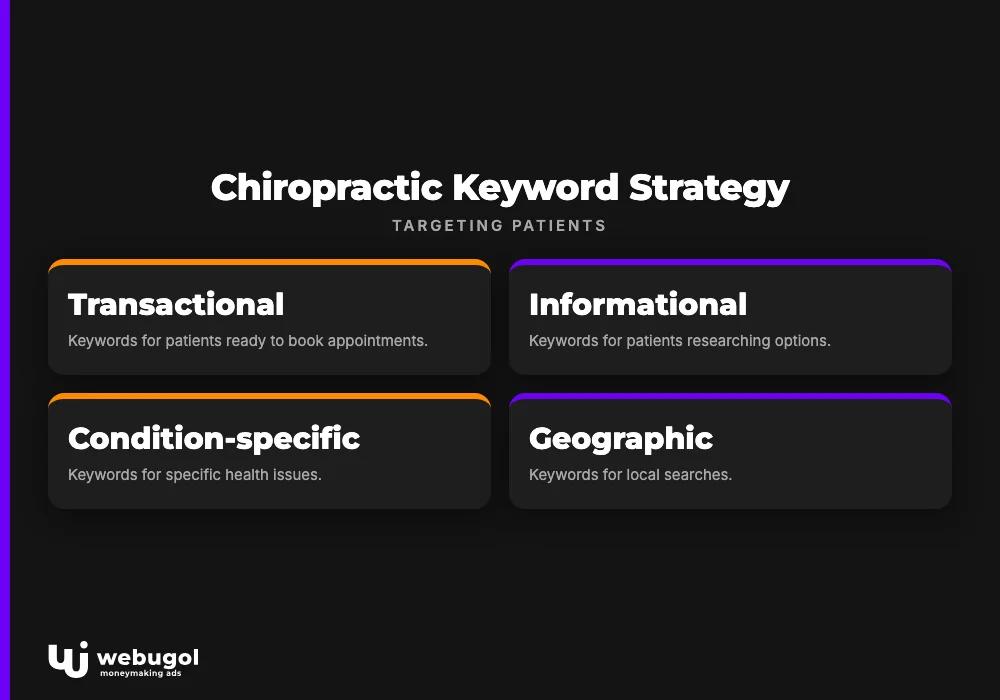
Chiropractic keyword research begins with a distinction that drives the entire content strategy: transactional intent versus informational intent.
Transactional keywords signal a patient ready to book. "Chiropractor [city]," "chiropractic clinic near me," and "sports chiropractor [neighborhood]" all belong here. These terms go on your homepage and service pages, where their job is to convert visitors into appointment inquiries.
Informational keywords reach patients earlier. "Is chiropractic safe during pregnancy," "what to expect at a first chiropractic visit," and "chiropractic versus physical therapy for back pain" come from patients who are researching options, not yet booking. Ranking for these terms means your practice shapes the decision before they have evaluated any competitor.
An effective SEO for chiropractors strategy uses both types. The table below maps each keyword category to the right page:
| Keyword type | Example phrases | Target page |
|---|---|---|
| Transactional | "chiropractor [city]", "chiropractic near me" | Homepage, service pages |
| Informational | "how often to see a chiropractor", "chiropractic for sciatica" | Blog posts, FAQ pages |
| Condition-specific | "neck pain chiropractor", "herniated disc chiropractic" | Condition landing pages |
| Geographic | "[neighborhood] chiropractor", "[city] back pain relief" | Location pages, GBP |
The core keyword cluster for most practices:
Local chiropractor marketing builds from a concentrated foundation. Most single-location practices should anchor their keyword map around:
- "[City] chiropractor" and nearby neighborhood variations
- Condition modifiers: sciatica, herniated disc, neck pain, sports injury, car accident recovery
- Procedure modifiers: spinal adjustment, chiropractic decompression, dry needling
- Outcome phrases: "back pain relief [city]," "neck stiffness treatment near me"
Where keyword strategies break down:
Generic terms like "best chiropractor" are dominated by national directories a single-location practice cannot outrank. Highly clinical terminology often goes unsearched because patients describe symptoms in plain language, not diagnostic codes. The productive middle is terms specific enough to match real patient searches with sufficient local monthly volume to actually generate appointments.
Use Google Keyword Planner to verify search volume before committing content resources to any term. A phrase with 10 monthly local searches will not move the needle regardless of how well you rank for it. Prioritize terms with 50 to 500 monthly local searches and achievable competition scores.
Keyword mapping is the deliverable of this research: a document assigning specific target terms to specific pages so your site covers the full range of patient searches without individual pages competing against each other internally.
Chiropractic local SEO: getting found in your neighborhood
Most chiropractic practices compete for patients within a 5- to 15-mile radius. That narrow geography makes this a local SEO competition, not a national one. Chiropractic local SEO focuses specifically on the signals Google uses to rank practices within that radius, and the map pack is where most of the competition concentrates.
SEO for chiropractors in local markets responds to three primary inputs: Google Business Profile completeness and activity, NAP consistency across the web, and review volume combined with quality.
NAP consistency
NAP is name, address, and phone number. These three data points must appear identically on your website, your Google Business Profile, Yelp, Healthgrades, Zocdoc, and every other directory listing your practice. Even small inconsistencies, "St." versus "Street" or a suite number present on some listings but absent on others, erode the trust signals Google uses to confirm your location and authenticity. Audit your listings at least annually and correct every discrepancy found.
Local citations
Citations are mentions of your practice name and address on third-party websites. Healthcare-specific directories like Healthgrades and Zocdoc carry stronger authority signals for medical practices than generic business directories, though both contribute. A thorough, consistent citation profile signals an established, geographically rooted practice to Google's local ranking system.
How do I optimize a Google Business Profile for a chiropractic clinic?
Your chiropractor Google Business Profile is the single highest-leverage asset in your local SEO stack. It controls your map pack entry, and the map pack appears above organic results for nearly every local chiropractic search.
Start by completing every field Google provides: practice name, address, phone, website URL, business hours, and primary category ("Chiropractor"). Add secondary categories for any specialties. List every service your practice offers, since each service is independently searchable within the GBP interface.
For a full step-by-step walkthrough of every setting, the Google Business Profile optimization guide for healthcare clinics covers the complete process in detail.
The fields most practices leave incomplete:
- Photos: Profiles with photos receive more direction requests and website clicks than those without. Add images of your office exterior, reception area, treatment rooms, and staff. Name photo files with location keywords before uploading.
- Q&A section: Seed this proactively with questions patients commonly ask at first consultations. Answering these within GBP converts profile views into phone calls before patients ever visit your website.
- Posts: Weekly GBP posts signal active practice management to Google. Share patient education content, seasonal health tips, or local events your practice supports.
Reviews drive both rankings and conversion. A profile with 80 reviews averaging 4.7 stars consistently outperforms one with 12 reviews at 5.0. Volume matters more than perfection. Build a systematic follow-up process: a text message with a review link sent after each visit, or an in-office QR code at checkout. Google Business Profiles are free tools for managing these signals, and they respond to activity faster than most other SEO investments.
Respond to every review. A professional, specific response to a negative review often matters more to prospective patients than the rating itself. Accountability shown in public responses builds the kind of trust that drives first calls.
On-page SEO for chiropractors: what every page needs
On-page SEO covers every change made within your own website pages to help them rank for target terms. Most patients never notice it. But it determines whether a page reaches the first results page or disappears into positions that patients almost never reach.
Heading structure and keyword placement
Each service page needs the primary keyword in the H1, a natural occurrence in the first paragraph, and the term or a close variant in at least one H2 subheading. URL slugs should reflect the target keyword clearly: /chiropractic-services-[city] rather than /page?id=4921. Meta descriptions do not directly determine rankings, but they control click-through rate from search results. Write them as genuine summaries with the target keyword and a compelling reason to click.
Page speed and Core Web Vitals
Google uses page experience signals as ranking inputs. A slow page does not just rank lower. It loses patients before they ever see your name. High bounce rates signal to Google that users are not having a positive experience, which compounds ranking suppression over time. Run your site through Google's PageSpeed Insights to identify specific issues reducing load speed, and address them systematically.
Mobile optimization
Local searches skew heavily toward mobile. A patient searching "chiropractor open now" from their car is on a phone. Your entire site, including every booking form and call button, must function cleanly on small screens. Test each page and each booking flow on actual mobile devices. A broken appointment form on mobile is a lost patient who calls the next result without a second thought.
HTTPS security
Your site must use HTTPS. It is a baseline ranking signal and a patient trust factor simultaneously. A browser warning that a site is "not secure" causes most visitors to leave before reading anything. Confirm your SSL certificate is active and set to auto-renew.
Content depth on service pages
Service pages need enough substance to satisfy a patient researching their condition. A single paragraph stating you treat back pain does not rank. A page that explains the conditions you address, the specific procedures used, what a typical patient experience looks like, and what outcomes are realistic has the depth to rank and to convert. For the writing work this requires, chiropractic SEO content creation services need to balance clinical accuracy with natural keyword integration across headings, body copy, and meta fields; Webugol's content and SEO work handles these layers as part of the full development and growth system.

Content Marketing and SEO for Chiropractors: Earning Trust Before the First Visit
A chiropractic blog converts passive researchers into patients before they ever call. A patient who reads three of your articles on lower back pain management and then searches for a local chiropractor already trusts your expertise. That trust is not accidental. It is built through a content strategy that places your practice at every stage of the patient's decision process.
Google rewards sites that consistently publish well-structured, substantive content. Adding one thoroughly researched article each week signals an active, authoritative resource, a freshness signal that benefits not just new content but existing service pages already ranking on the site.
High-performing content types for chiropractic practices:
Condition explainers capture early-funnel patients still researching. "What causes sciatica?" and "Can chiropractic care help with migraines?" rank for informational queries and introduce your practice before any competitor appears in the picture.
Treatment comparison posts reach patients evaluating providers before committing. "Chiropractic versus physical therapy for lower back pain" appears precisely when a patient is weighing their options.
Long-form FAQ content answers the questions patients ask at initial consultations. These rank for long-tail queries and perform well in AI-generated search answers because those systems pull direct, clearly structured responses from well-written content.
Local guides, like "finding the right chiropractor in [city]," target geographic keyword clusters while positioning your practice as a recognized area resource.
Consistency beats volume here. One substantial article published monthly and internally linked to relevant service pages compounds more effectively over twelve months than ten rushed posts uploaded in a single batch and then neglected.
The overlap between content and chiropractic local SEO is tighter than most practices realize. A thorough article on "herniated disc chiropractic treatment in [city]" can rank in organic results and appear in condition-specific local search panels simultaneously. Content strategy and local keyword targeting reinforce each other when aligned from the start.
Backlinks and chiropractic website ranking
A backlink is a link from another website to yours. Search engines treat backlinks as endorsements: a link from a regional hospital's resource page, a local health publication, or an established healthcare directory tells Google your site carries credibility.
A single link from a reputable local directory or health blog is worth more than several hundred poor-quality links. Quality drives chiropractic website ranking more than raw link count. One authoritative source creates more lasting impact than a large volume of low-quality links ever could.
For a detailed approach to sustainable link acquisition, the ethical chiropractic link building guide covers the strategies that hold their value through algorithm updates.
Practical acquisition approaches:
- Local partnerships: Gyms, physical therapy practices, massage therapists, and sports organizations already in your referral network are natural link partners. A reciprocal referral mention on their website generates a locally relevant backlink from a domain Google already connects to your service area.
- Healthcare directories: Healthgrades, WebMD's provider finder, Zocdoc, and regional hospital systems allow practice listings with website links. These are among the most legitimate backlink sources available to medical practices.
- Local press: News coverage of community events you sponsor, health awareness campaigns you run, or patient success stories (with written consent) generates links from authoritative local media domains.
- Professional associations: State chiropractic associations and licensing boards frequently list member practices with website links that carry genuine authority.
Avoid purchased links, link exchanges, and private blog networks. Google's spam detection identifies unnatural link patterns with increasing precision. The penalty for artificial link building can reverse months of organic progress in a single algorithm update.

How long does it take to see SEO results for a chiropractic practice?
Most chiropractic practices see the first measurable ranking movement within three to six months of starting consistent SEO for chiropractors work. Competitive page-one results in a mid-sized local market typically take six to twelve months of sustained effort.
Three variables determine the specific timeline: existing domain age and authority, the competitiveness of your local market, and how consistently the strategy is executed. A three-year-old site with existing content starting its first structured optimization will see movement faster than a new domain in a major metro market launching from zero.
Realistic milestones for most practices:
Months 1 to 2: Technical audit complete, Google Business Profile fully optimized, core service pages updated with target keywords, baseline data captured in Google Search Console. GBP improvements often produce visible map pack movement within four to eight weeks of completion.
Months 3 to 4: First blog content indexed and beginning to rank. Initial keyword movement visible in Search Console. Long-tail terms starting to appear on page two or three. A review acquisition system generating consistent volume.
Months 5 to 6: Sustained keyword movement across multiple target terms. Content from months three and four accumulating ranking history and organic traffic. Local citation profile cleaned, verified, and expanded. Review count growing steadily.
Months 7 to 12: Competitive primary keywords reaching page one. Compounding content effect visible as older articles rank alongside newer ones. Map pack appearances consistent for primary service terms. New patient volume from organic search measurable against the month-one baseline.
Practices that win consistently in local search treat SEO for chiropractors as infrastructure, not a campaign with an end date. The algorithm rewards consistency. A site that adds content regularly, requests reviews monthly, and addresses technical issues as they arise outperforms one that runs a concentrated push and then stops every time.
SEO for chiropractors: tools to track and improve rankings
Running SEO for chiropractors effectively means tracking the right metrics from day one. The following tools form the standard stack for local practice SEO performance:
- Google Analytics: measures total site traffic, source breakdown, and which pages generate the most appointment inquiries. Free.
- Google Search Console: shows the exact keywords your site ranks for, impression and click data, average position by query, and any crawl or indexing errors Google has flagged. Free, essential, and the first tool to install before any other SEO work begins.
- Ahrefs: tracks keyword rankings over time, monitors your backlink profile, and surfaces competitor gap opportunities where your practice could rank but currently does not.
- Moz Pro: provides domain authority scoring, rank tracking with local market filters, and a local listings management tool useful for systematic NAP auditing across directories.
- Screaming Frog SEO Spider: crawls your entire website to surface broken links, duplicate content, missing meta descriptions, and redirect chains that suppress rankings without obvious signs.
- Google Keyword Planner: estimates monthly search volume for specific terms in your local market before committing content resources to them. Free with a Google Ads account.
- Yoast SEO: for practices on WordPress, provides page-level guidance on title tags, meta descriptions, and heading structure without requiring developer access.
Start with the free tools. Google Search Console and Google Analytics installed before everything else establish the baseline data that every subsequent decision should be measured against. Paid tools become worthwhile once traffic volume makes competitive intelligence and granular keyword tracking necessary.
Ready to stop losing patients to competitors who rank above you?
A chiropractic practice with strong local rankings builds something more durable than traffic. It builds an asset: a Google Business Profile that appears in the map pack week after week, a content library that answers patient questions before a competitor enters the picture, and a site that earns more authority with each month of consistent work.
That outcome requires more than one-time page edits. It requires a structured strategy built to compound, execution against a clear plan, and results measured against what matters to a practice: new patient volume, not just traffic numbers.
Webugol builds websites that grow, combining development, SEO, and content as one system for healthcare practices. Every engagement starts with a comprehensive audit of where your practice stands today and a concrete roadmap to where it needs to go. Contact us to discuss what a structured chiropractic growth program looks like for your specific market and practice goals.
FAQ
How does SEO help chiropractors attract more patients?
SEO makes your practice visible at the moment local patients search for chiropractic care. Patients who arrive from organic search have already expressed intent, making them more likely to book than audiences reached through passive display advertising.
What keywords should chiropractors target on their website?
Target a mix of transactional terms like "chiropractor [city]" for service pages and informational terms like "chiropractic for sciatica" for blog content. Condition-specific phrases paired with your city or neighborhood name typically produce the highest conversion rate from search to booked appointment.
How do I optimize a Google Business Profile for a chiropractic clinic?
Complete every available field in your profile, including services, photos, and business hours. Build a consistent post-visit process for requesting patient reviews and respond to every review you receive. Weekly posts to your GBP signal an active, engaged practice to both Google and prospective patients evaluating their options.
How long does it take to see SEO results for a chiropractic practice?
Most practices see initial ranking movement within three to six months. Competitive page-one results in a mid-sized local market take six to twelve months of consistent work. Google Business Profile improvements typically produce results faster, often within four to eight weeks of full optimization.
What does chiropractic SEO cost per month?
Monthly costs depend on market competitiveness, service scope, and the agency. Full-service chiropractic SEO engagements covering content, technical work, local SEO, and link building typically range from a few hundred to several thousand dollars per month depending on practice goals and the size of the target market.

