



TRT clinic SEO: ranking guide for testosterone practices
TRT clinic SEO requires a different playbook than standard healthcare SEO. Testosterone therapy content falls under Google's YMYL classification, triggering stricter quality standards around author credentials, clinical accuracy, and site-level authority. For clinic owners who have plateaued on paid acquisition, organic search is where a properly built program compounds patient volume, but only when it accounts for the specific demands of men's health content. The clinics consistently losing ground to telehealth competitors share one structural problem: their SEO treats testosterone therapy like any other medical service.
What makes TRT clinic SEO different from regular healthcare SEO?
TRT clinic SEO operates under stricter search quality standards than most medical verticals because Google classifies testosterone therapy content as YMYL (Your Money or Your Life). That classification means ranking requirements aren't just technical. They're editorial.
Standard healthcare SEO firms often miss this distinction. They optimize page structure while leaving the E-E-A-T foundation broken. The result: rankings that don't hold, or content that ranks but fails to convert because it lacks the clinical depth patients need before booking a consultation.
The competitive landscape makes this harder. Testosterone SEO in major US markets competes against established telehealth providers, national TRT networks, and high-authority health information sites. A local TRT clinic targeting "testosterone replacement therapy" nationally won't succeed against these resources. The opportunity is in treatment-specific, locally modified, and long-tail queries where geography and clinical specificity define the competition.
What E-E-A-T signals does Google require for testosterone therapy content?
Google requires testosterone therapy content to carry medical author credentials, a visible review process, clinical accuracy, and site-level trust signals, evaluated together, not in isolation.
The practical YMYL medical SEO requirements for TRT content:
- Author credentials: content must be attributed to or reviewed by a licensed medical professional, with a bio page listing credentials, license information, and professional affiliations
- Medical review process: a visible review date and a named medical reviewer signal ongoing accuracy to Google's quality raters
- Clinical accuracy: TRT content that makes unsupported claims accumulates negative quality signals that suppress rankings across the entire domain
- Site-level authority: provider bios, contact information, clinic accreditation details, and a thorough about page contribute to the domain-level trust that supports every page's ranking potential
No single signal is sufficient. A clinically accurate page with anonymous authorship still fails E-E-A-T assessment. A well-credentialed author on a site with incomplete contact information creates a trust gap.
Building E-E-A-T for testosterone replacement therapy SEO requires all four layers working together. The clinics that solve this stop losing patient volume to competitors whose content is thinner but whose authority signals are stronger.
Which keywords should a TRT clinic target to attract patients?
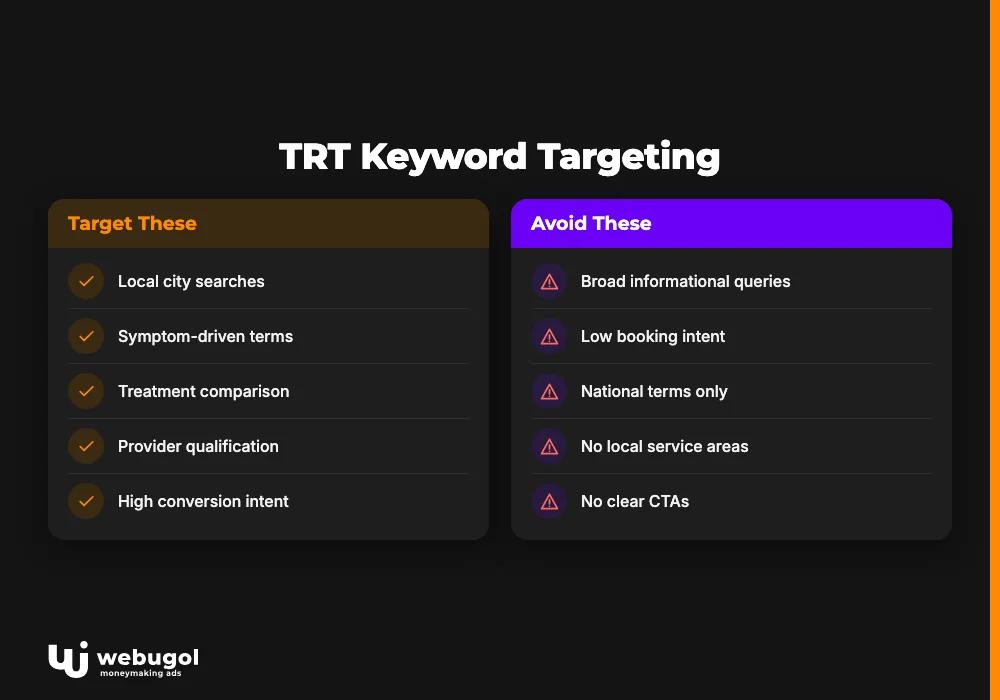
The keyword architecture for testosterone replacement therapy SEO separates clinics that attract qualified patient traffic from those that generate visits from people who will never book. Intent matters more than volume in this category.
| Keyword category | Example terms | Primary intent |
|---|---|---|
| Primary local | "TRT clinic [city]," "low T clinic near me" | Consultation booking |
| Symptom-driven | "low testosterone treatment," "testosterone therapy for low energy" | Treatment research |
| Treatment comparison | "TRT vs testosterone boosters," "bioidentical testosterone therapy" | Consideration stage |
| Provider qualification | "board-certified TRT doctor," "men's health testosterone clinic" | High trust, pre-booking |
Local is where the conversion happens. Search volume for "[city] testosterone clinic" is smaller than national terms. The conversion rate is dramatically higher. Patients searching with a city name are ready to book.
Local keyword research should map every service area: primary city, surrounding suburbs, and satellite clinic locations. Each location deserves a dedicated page targeting its specific geographic terms. For the full mechanics of how this framework applies across medical verticals, the local SEO for TRT clinics and medical practices guide covers implementation in depth.
Broad informational queries make sense only as awareness-stage content that funnels toward treatment pages with clear consultation CTAs. They attract traffic. They rarely drive consultations directly.
How do testosterone clinics rank on Google Maps?
Local SEO is where men's health clinic SEO produces the fastest patient acquisition results. The map pack captures the majority of "near me" and city-specific TRT searches. A practice appearing consistently in the top three positions holds an advantage that competitors can't close quickly.
The TRT clinics that close the map pack gap fastest integrate local presence as one component of a complete patient acquisition system, not as a standalone initiative handed to a single-channel vendor.
Google Business Profile optimization
The Google Business Profile is the most important local ranking factor for most TRT clinics. Getting each element right from the start prevents the category mismatches and citation inconsistencies that suppress local rankings. The elements that matter most:
- Primary category: "Men's Health Clinic" or "Medical Clinic," with secondary categories for hormone therapy relevance
- Service listings: individual services listed within GBP, each with keyword-relevant descriptions
- GBP description: 750-character description incorporating the clinic's core treatment focus, location, and key differentiators
- Regular photo updates: consistent new photos signal an active, operating practice to Google's local algorithm
- Review responses: responding to every review, positive or negative, contributes to the engagement signals that influence local rankings
Citation building and NAP consistency
NAP consistency (name, address, phone) across all directories is a foundational local SEO requirement for any testosterone clinic. For TRT practices, the highest-value citation sources are healthcare-specific: Healthgrades, Zocdoc, Vitals, RateMDs, WebMD's provider directory, and the American Urological Association directory. Healthcare-specific citations carry stronger relevance signals for medical practice rankings than general directories alone.
How long does it take to see SEO results for a testosterone clinic?
Map pack improvements can appear within 60 to 90 days when GBP optimization and citation building are executed correctly. Organic rankings for treatment pages in competitive markets typically require four to six months of consistent work. Content-driven authority compounds from there.
A TRT practice that starts its TRT clinic SEO investment today will have a durable competitive advantage over a practice that waits six months. That compounding is real. So is the revenue lost while delayed.
The content types that build TRT authority over time:
- Condition and symptom guides: comprehensive content targeting low testosterone symptoms, diagnosis criteria, and treatment options establishes relevance across the full patient research journey
- Treatment comparison content: pages comparing TRT protocols, delivery methods, and provider types rank for consideration-stage queries and capture patients comparing options before committing
- Provider thought leadership: clinical overview articles attributed to named physicians build the author authority signals that healthcare SEO for clinics rewards
- FAQ pages with schema: FAQ content targeting exact patient phrasing builds featured snippet and AI overview eligibility while reducing pre-booking friction
- Location content: city and neighborhood pages for each service area compete for local searches that convert at the highest rate
Rankings and organic traffic are inputs, not outcomes. TRT practices that convert their organic presence into measurable booked appointments share one structural advantage over those that plateau: their TRT clinic SEO investment is connected to the full revenue path. When a prospective patient clicks an organic listing and the booking flow doesn't convert, the intake lead isn't routed to the right channel, or follow-up doesn't fire, that search visibility produces traffic without appointments. Tracking end-to-end from the organic click to the confirmed booking, with funnel and CRM data in the same accountable system, is what makes organic investment compound into revenue rather than compete with paid channels for budget justification.
The technical layer runs underneath all of it. Core Web Vitals scores affect both rankings and patient experience on the mobile devices that drive most local health searches. HTTPS is a baseline requirement and a patient trust signal. MedicalOrganization, Physician, and LocalBusiness schema markup tells Google what the site represents and how to surface it in rich results. Before committing to content or link-building investment, a baseline SEO audit of your clinic's technical foundation establishes which gaps exist and where the highest-leverage work actually is.
For clinics that have grown their paid acquisition engine but haven't built a matching organic presence, the missing piece is usually the integrated system: credentialed content, structured local presence, and a technical foundation that lets both compound. Most TRT SEO services stop at rankings; Webugol builds the complete patient acquisition system, so clinic owners stop losing patient volume to competitors who invested in organic earlier.
Ready to close the organic gap?
If your testosterone clinic has grown through paid acquisition but organic search isn't keeping pace, you're ceding durable revenue to competitors who started earlier. Book a strategy call to diagnose where TRT clinic SEO is underperforming and what a complete patient acquisition system looks like for your market.
FAQ
What makes TRT clinic SEO different from regular healthcare SEO?
TRT content is classified by Google as YMYL (Your Money or Your Life), which triggers stricter quality evaluation than most industries. E-E-A-T signals, including medical author credentials, clinical accuracy, and site-level authority, carry more weight for TRT rankings than they do for a standard service business. Technical and on-page SEO still matter, but they work on top of a credentialing and content foundation that must be built correctly first.
How do testosterone clinics rank on Google Maps?
Map pack rankings depend primarily on Google Business Profile completeness, NAP consistency across healthcare directories, and ongoing engagement signals like photo updates and review responses. Healthcare-specific citations on Healthgrades, Zocdoc, and Vitals carry stronger local relevance signals than general directories. For most well-optimized TRT clinics, map pack improvements appear within 60 to 90 days.
What E-E-A-T signals does Google require for testosterone therapy content?
Google evaluates testosterone therapy content against four signals: named medical author credentials, a visible review date with a named reviewer, clinical accuracy without unsupported claims, and site-level trust signals including provider bios and accreditation details. All four are required together. A strong score on any one does not compensate for gaps in the others.
Which keywords should a TRT clinic target to attract patients?
The highest-converting keywords combine a treatment term with a geographic modifier, a symptom context, or a service qualifier. Local-intent terms like "TRT clinic [city]" and "low T clinic near me" convert at dramatically higher rates than national informational queries because those searchers have already decided they want treatment. Building keyword architecture around local intent, symptom-driven terms, and treatment comparison queries covers the full patient decision journey.
How long does it take to see SEO results for a testosterone clinic?
Map pack improvements typically appear within 60 to 90 days when GBP and citation work is executed correctly. Organic rankings for treatment pages in competitive markets require four to six months of consistent work. Content-driven authority compounds over time, so a clinic that starts today will hold a durable advantage over one that delays by six months.

