



Longevity clinic ads: what actually fills your calendar
Longevity clinic ads produce booked consultations when the campaign, landing page, and offer address the same patient decision. Most practices running paid campaigns drain budget because targeting, copy, and conversion flow were built as separate projects rather than a single system. Whether you are launching your first campaign or diagnosing why a substantial monthly spend has stopped filling your calendar, the structural failures look the same: broken attribution, generic creative, and pages built for browsing rather than booking. The fixes are predictable.
Why longevity patient acquisition demands a different approach
Longevity patients do not make quick decisions. They compare specific protocols, research provider credentials, and typically encounter several of these ads before booking a consultation. That buying pattern means generic healthcare ad templates, the kind built for urgent care or dental practices, consistently underperform in this category.
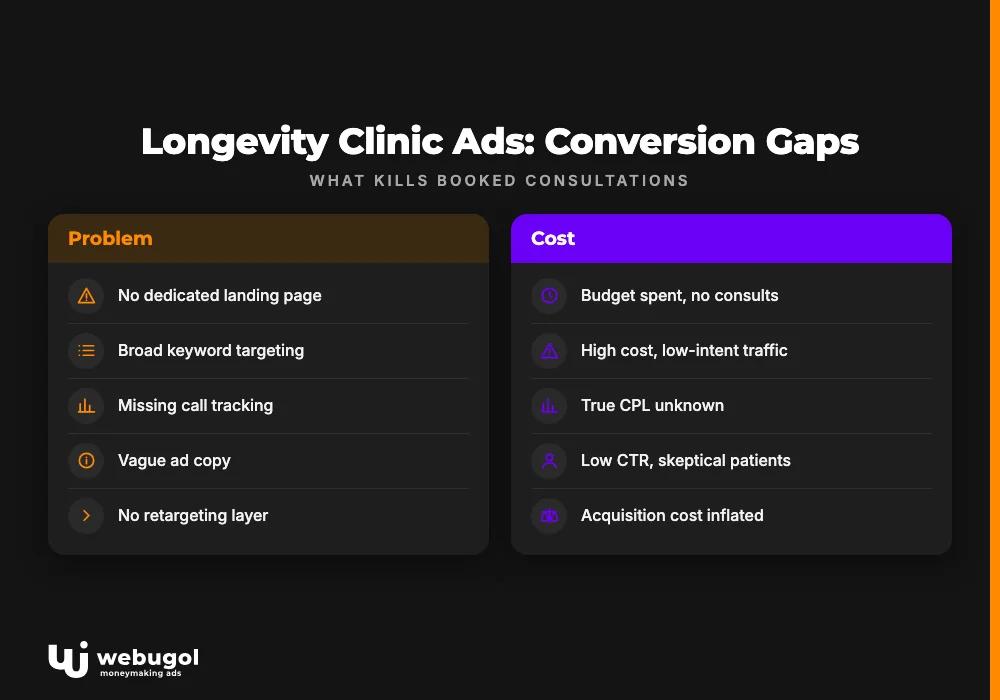
The gaps that kill conversion in this category follow a consistent pattern:
| Gap | What it looks like | What it costs |
|---|---|---|
| No dedicated landing page | Ad clicks land on a general homepage | Budget spent, no consults booked |
| Broad keyword targeting | One campaign covering every service | High cost, low-intent traffic |
| Missing call tracking | Phone consults disconnected from spend | True CPL unknown |
| Vague ad copy | Generic wellness claims, no protocol detail | Low CTR, skeptical patients |
| No retargeting layer | Warm visitors lost after one touchpoint | Acquisition cost inflated |
Fixing any two of these gaps typically moves booked-consultation volume faster than increasing the total budget.
What ad platforms work best for longevity practices?
Google Ads and Meta Ads serve different stages of the same longevity patient acquisition path. The strongest practices run both.
Google Ads capture patients the moment they search for a specific treatment or provider. Well-structured paid search campaigns outperform catch-all campaigns built around every service the practice offers. Wellness practice google ads that segment by protocol, such as hormone therapy, peptides, or longevity panels, deliver lower CPL and higher show rates than broad targeting.
Meta Ads reach patients before they have started searching. They build awareness of programs a patient did not know existed. Educational creative outperforms hard sales copy in this category. Running both platforms compounds results: the social layer builds familiarity that lifts conversion on branded and retargeting search terms downstream.
For context on how patients engage with providers before the search begins, see how social platforms build patient trust before the first click.
How to target longevity patients on Google Ads?
Segment these campaigns by intent tier, not by broad category. Separate high-intent terms from general awareness terms and allocate budget accordingly.
Patients searching for "hormone therapy clinic [city]" or "peptide therapy consultation" are far closer to booking than someone searching "longevity medicine." Running those terms in the same ad group with equal bids forces budget across different buyer stages. Segmenting them produces cost-per-lead data you can act on.
For practices with telehealth components, a dedicated telehealth advertising strategy campaign targeting national, non-geo terms often finds a different patient profile at lower competition than local campaigns. The two should not compete for the same budget.
How to write medical ad copy that converts without overpromising?
Lead with a specific, verifiable claim rather than a motivational headline. Copy that names the protocol, references realistic timelines, and states a clear next step outperforms lines like "transform your health today" in both click-through rate and lead quality.
The strongest longevity clinic ads headlines follow a simple pattern: protocol plus outcome plus action. "Personalized TRT consult, results reviewed at 60 days, book now" consistently outperforms "Reclaim your vitality" for this audience. Specific language also reduces compliance risk. Broad anti-aging or before-and-after framing triggers more automated policy flags than precise, protocol-level copy.
See words that get Google medical ads disapproved for the specific copy patterns that trigger ad disapprovals.
What compliance rules apply to hormone clinic advertising?
This category faces stricter automated review than general wellness messaging, because it frequently references biomarkers, hormone levels, or anti-aging outcomes that trigger platform policy flags. Hormone clinic advertising and medical spa paid ads sit in the same high-scrutiny zone.
Google and Meta restrict personalized health claims, guaranteed outcomes, before-and-after statements tied to conditions, and language that reads as a medical diagnosis. Campaigns that avoid these patterns stay approved and keep running. Your compliance approver should review creative before launch, not after the first disapproval.
HIPAA-compatible tracking and consent-mode configuration are non-negotiable for retargeting. Build retargeting audiences on site behavior. Building them on medical conditions violates platform policy and healthcare privacy rules simultaneously.
How much do longevity clinic ads cost per lead?
Budget varies by market, competition, and protocol mix. Most independent practices see meaningful booked-consultation volume from longevity clinic ads starting at a few thousand dollars per month, scaling as keyword and creative data accumulates.
The more relevant number is not what you spend but what you can trace. Clean analytics and attribution connects calls, form fills, and booking confirmations to specific keywords and creative. Without that layer, the question every clinic owner eventually asks, which campaigns are producing real appointments and at what cost, has no answer. That diagnostic gap is where most longevity marketing budget is lost long before any creative or bid decision is made.
A replicable approach to longevity clinic ads budget allocation follows this order:
- Define the offer as a specific consultation, assessment, or introductory program, not a vague invitation to learn more.
- Segment keywords by intent so budget does not split evenly across different buyer stages.
- Build a dedicated landing page that mirrors the ad promise and removes every unnecessary step before booking.
- Set up conversion tracking that connects calls, form fills, and bookings to specific spend.
- Layer in retargeting to reach visitors who did not convert on their first visit.
- Review weekly and reallocate monthly toward keywords and creative producing booked consultations, not just clicks.
Pairing paid campaigns with the organic search foundation that compounds growth for health practices reduces total acquisition cost over time. Ensuring that website design and landing pages are built for the traffic those campaigns send removes the friction that costs booked consultations even when the ads perform well.
How Webugol builds patient acquisition systems for longevity practices
Webugol owns accountability for the full revenue path from ad click to booked consultation, tracking, landing pages, ads, and booking flow built and managed as one system, for longevity, hormone, medical spa, and wellness practices across the US. Published work includes LifeRx MD, Invigor Medical, Aspire Elite, and Altas Men's Health. Every engagement follows the same principle: build measurement first, then tighten the funnel, then scale, with reporting tied to booked patients rather than surface-level clicks.
The pattern in underperforming longevity accounts is consistent. Spend has accumulated without a measurement foundation. Attribution is partially broken. The practice owner cannot say with confidence which campaigns produce real appointments. Building that visibility is always the first move, before any creative or bid change.
That discipline extends across health and wellness client work at every revenue stage.
Ready to see what your longevity clinic ads are actually producing?
If your paid campaigns are running but the calendar is not filling at the rate your spend should justify, the issue is almost never the budget amount. It is the gap between what the campaign reports and what the practice actually books. Book a Strategy Call to get a diagnostic review of where your current acquisition system is losing patients before they book.
FAQ
What makes longevity clinic ads different from typical healthcare ads?
Longevity patients compare specific protocols and provider credentials rather than making a quick decision, so messaging must address the credibility and protocol detail that generic healthcare copy does not provide. Campaigns built on broad wellness templates consistently underperform against campaigns built around the exact questions this patient asks before booking.
What ad platforms work best for longevity ads?
Google Ads produces the highest-intent leads by capturing active searches for specific treatments, while Meta Ads build awareness of programs patients did not know existed. Most practices see stronger results running both together, with search handling conversion demand and social handling earlier-stage familiarity.
How much budget do these campaigns usually require?
Most independent practices see meaningful booked-consultation volume starting at a few thousand dollars per month, scaling as keyword and creative data accumulates. Budget efficiency depends more on the measurement infrastructure behind the spend than on the total dollar amount.
How do I keep longevity ads compliant?
Avoid guaranteed outcome claims, unverified biomarker or before-and-after statements, and language that reads as a medical diagnosis. Have your compliance approver review creative before launch and build retargeting audiences on site behavior, not medical conditions.
How quickly do longevity ads produce results?
Well-built campaigns can generate booked consultations within the first one to two weeks, though performance typically improves over the following month as keyword and creative data accumulates. Practices with clean tracking in place see actionable optimization earlier because decisions are not delayed by attribution uncertainty.