



Organic traffic decrease: causes, impact, and how to fix it
An organic traffic decrease means fewer users reaching your site through unpaid search, and for a business generating leads or revenue from search, that gap hits the pipeline before it shows up in a board report. The drop usually traces to one of four root causes: a Google algorithm update, a technical SEO failure, a content quality gap, or a shift in user intent. Either way, the fix starts with diagnosis, not guesswork.
Organic search delivers compounding returns, but only while search engines trust your site. When a marketing director or business owner opens analytics to find a sustained downward trend, that trust has slipped and the recovery window is narrowing.
What is organic traffic?
Organic traffic is visitors who arrive through unpaid search results. They are actively searching for a solution, which is why they convert at higher rates than cold paid audiences. Maintaining this channel lowers customer acquisition cost. When an organic traffic decrease begins, it often shows up in revenue before it registers as a headline in your weekly analytics report.
Why did my organic traffic drop suddenly?
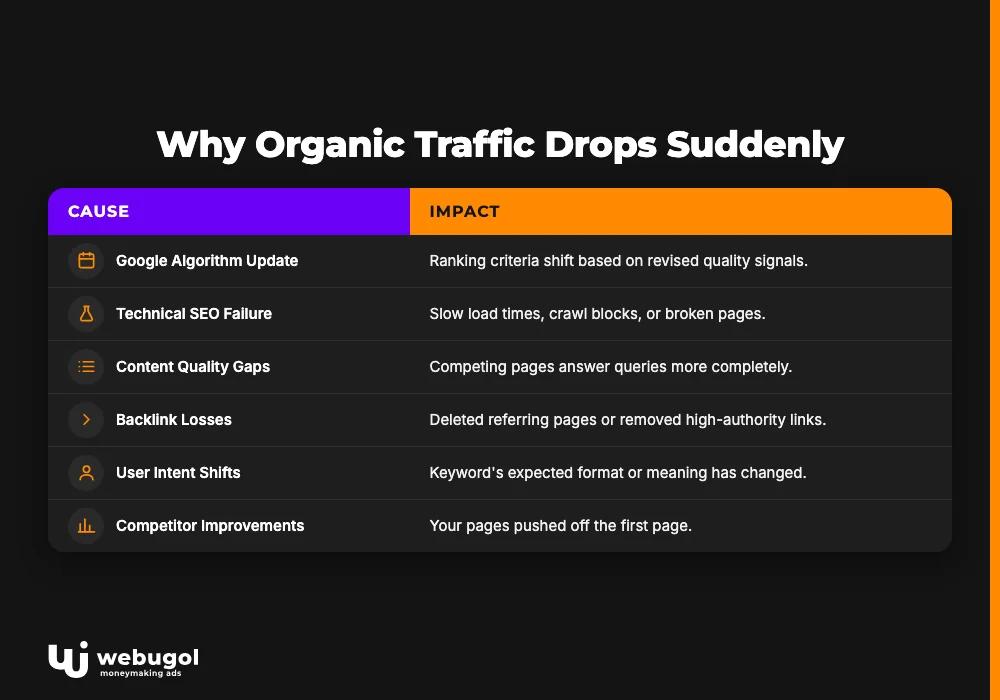
A sudden organic traffic decrease typically traces to a Google algorithm update, a crawl error introduced by a recent site change, or a significant backlink loss. The most common causes of website traffic decline fall into these categories:
- Google algorithm updates that shift ranking criteria based on revised quality signals
- Technical SEO failures such as slow load times, crawl blocks, or broken pages
- Content quality gaps where competing pages now answer the query more completely
- Backlink losses from deleted referring pages or removed high-authority links
- User intent shifts where the keyword's expected format or meaning has changed
- Competitor improvements that push your pages off the first page without affecting your absolute rankings
Running a quick Google Search Console check takes under ten minutes and will show whether the drop date aligns with a known update or a specific technical event.
Google algorithm updates
Google releases core updates several times a year, and each one broadly reconsiders expertise, authority, and trust signals across the web. If your organic traffic dropped around a publicly announced update date, your content likely no longer meets the revised criteria. This is not always a manual penalty. It often means a competing page now answers the query better than yours does. Historical examples include Panda, which focused on content quality, and Penguin, which targeted link quality; modern core updates evaluate these signals more holistically across an entire domain.
Technical SEO issues
Technical failures act upstream of everything else. A misconfigured robots.txt can remove hundreds of pages from Google's index within a single crawl cycle. Load times above three seconds correlate with sharply higher bounce rates and lower engagement signals. Broken links fragment authority flow. Google cannot rank what it cannot access and render, which makes technical problems among the fastest-moving causes of an organic traffic decrease.
Can technical SEO issues cause organic traffic loss?
Yes, and the damage can appear within days. A single accidental noindex tag or a broken redirect chain can produce a search ranking loss almost immediately after a crawl cycle picks it up. Running a technical SEO audit catches these issues before they compound: it maps every crawlability gap, speed bottleneck, and indexation error in one structured pass. Improving site speed is often the first fix that returns measurable ranking movement, since slow pages lose mobile rankings even when the content behind them is strong. Fix the technical layer before any content work begins.
Content quality and intent shifts
Content decays. A guide written two or three years ago may contain outdated statistics, replaced interface screenshots, or advice that top competitors have substantially improved upon. Thin pages with little unique value weaken domain authority across the entire site. Intent also shifts: a keyword that once returned how-to guides may now surface product comparison pages. A page whose format no longer matches the dominant intent drops regardless of its depth.
Backlink profile changes
Inbound links signal trust to search engines. An SEO traffic drop sometimes traces directly to link losses: if a high-authority referring page is deleted, you lose the ranking contribution it was providing. A sudden spike in low-quality inbound links from a negative SEO campaign can also trigger an algorithmic flag. Both scenarios can accelerate an organic traffic decrease that compounds over weeks if left unaddressed.
The real cost of a search ranking loss
A search ranking loss is a revenue problem, not just an analytics problem. For lead-generation businesses and e-commerce sites, a significant organic traffic decrease correlates with a proportional fall in qualified leads or sales. Dropping off the first page removes your site from new audiences entirely. Engagement also deteriorates in a feedback loop: traffic mismatched to current intent drives up bounce rates, which the algorithm reads as irrelevance and uses to push rankings down further.
How to recover organic traffic after a Google update
Recovery requires a structured sequence. No single fix covers every cause.
Audit before acting. Match the drop date to Google's public update timeline. A sharp single-day cliff suggests an update or a technical event; a gradual slope points to competition or content decay. A complete content and ranking audit identifies which pages and queries lost ground and tells you which problem class to address first.
Fix technical issues before touching content. Crawl errors and speed gaps undermine content work built on top of them. Resolve indexation blocks, fix broken links with 301 redirects, and verify mobile usability in Google Search Console's Mobile Usability report.
Refresh and expand content. Update statistics, replace outdated screenshots, and extend sections where competitors now provide substantially more depth. Check the live SERP for each target keyword before writing: the dominant format shows what Google currently rewards for that query.
Rebuild backlink authority. Reclaim links lost to page moves by contacting webmasters with the updated URL. Generate new authoritative citations through original research or resources others in your niche will reference.
Wait for the full rollout before making major changes. Core updates typically take two to three weeks to complete. Acting mid-rollout adds instability. Analyze the full picture first, then commit to a strategy shift.
How long does it take to recover lost organic traffic?
Recovery timelines after an organic traffic decrease depend on the cause. Technical fixes such as correcting a crawl error or removing a noindex tag typically show ranking improvement within two to four weeks. Content updates take longer: Google needs to recrawl, re-evaluate, and reflect movement in rankings, usually one to three months for meaningful change. Recovery after a Google algorithm update may not stabilize until the next core update, which Google has stated in official guidance. Backlink rebuilding operates on a longer horizon still. Realistic timelines to recover lost traffic are measured in quarters, not weeks.
Stop losing pipeline to a recoverable SEO problem
Every week an organic traffic decrease goes undiagnosed, qualified leads land on competitor pages instead of yours. Webugol builds and grows websites, so the same team that diagnoses the drop also owns the fix, from technical SEO and content to the site itself. When the audit reveals that an outdated platform or site architecture is the root cause, that same team extends the work from optimization into migration and rebuild, so the fix matches the actual problem. The outcome is recovered growth, not a standalone report.
Contact Webugol to schedule a site health review and get a clear picture of what is driving your traffic decline.
FAQ
Why did my organic traffic drop suddenly?
This most often follows a Google algorithm update, a crawl error, or a significant backlink loss. Open Google Search Console, check the Performance report for the date the drop began, and cross-reference it with Google's public update announcements to narrow the cause.
What are the most common causes of website traffic decline?
The leading causes of a website traffic decline are Google algorithm updates, technical SEO failures, content quality gaps, backlink losses, and competitor improvements. A technical SEO audit of crawl data and ranking movement typically identifies the primary cause within the first structured review.
Can technical SEO issues cause organic traffic loss?
Yes. A crawlability block, indexation error, or slow page load can cut organic traffic significantly because Google cannot fully evaluate a page it cannot access or render correctly. Technical issues are often the fastest to identify and the quickest to produce ranking recovery once resolved.
How long does it take to recover lost organic traffic?
Recovery from an organic traffic decrease depends on the cause. Technical fixes usually show results in two to four weeks. Content improvements take one to three months. Recovery after a Google core update may not fully stabilize until the next core update, according to Google's own guidance.
How to recover organic traffic after a Google update?
Audit which pages lost rankings and match the timing to the update. Fix technical SEO issues first, then refresh content to match current search intent. Avoid making sweeping changes while the update is still rolling out; wait for it to complete fully before adjusting your strategy.

