



Virtual Medical Receptionist: Fix Your answer rate before you buy more leads
A medical virtual receptionist handles inbound calls, appointment scheduling, patient intake, and after-hours routing without being physically present in your clinic. For practice owners and marketing leads managing paid acquisition, this is an operations lever with direct impact on answer rate, show rate, and cost per booked appointment. The right model depends on your call volume, vertical, and EHR stack. Before choosing a vendor, the more useful question is whether your gap is a staffing problem or a funnel problem. Webugol manages the handoffs between front-desk coverage, funnel performance, and booking confirmation as one integrated system, accountable for the result, not just the vendor recommendation.
What a virtual medical receptionist actually does
A virtual medical office receptionist covers the front-desk functions that determine whether a patient becomes a booking or a missed opportunity. The scope varies by model, but the core tasks are consistent across service types.
Core tasks: scheduling, intake, callbacks, and after-hours coverage
- Inbound call answering during business hours and for after-hours coverage
- New patient intake, collecting demographics, insurance details, and chief complaint
- Appointment scheduling and rescheduling written directly into your EHR
- Callback queue management for missed calls and unanswered voicemails
- FAQ deflection for routine questions about hours, directions, and eligibility
- Urgent call routing and on-call physician escalation
These six functions cover the gap between when a patient tries to reach your practice and when they hold a confirmed appointment slot. That gap costs appointments.
What a virtual receptionist does not fix
Low show rates and high CPA often persist even after answer rate improves. The failure is usually in the offer, the booking flow, or the follow-up sequence, not in phone coverage.
Signs your problem is a funnel leak, not a staffing gap:
- Answer rate is near capacity while show rate keeps lagging well behind it
- CPA on paid channels keeps rising even as inbound call volume increases
- Booked appointments are not confirmed 24–48 hours before the visit
- The booking flow requires more than two steps from ad click to confirmed slot
If two or more of these apply, adding front-desk coverage will improve operations without moving your acquisition cost. Most practices skip this diagnosis.

Three models: remote human, AI receptionist, and hybrid
Choosing the wrong model adds recurring cost without solving the underlying gap. Each model fits a different practice type and call-volume pattern.
Remote human receptionist
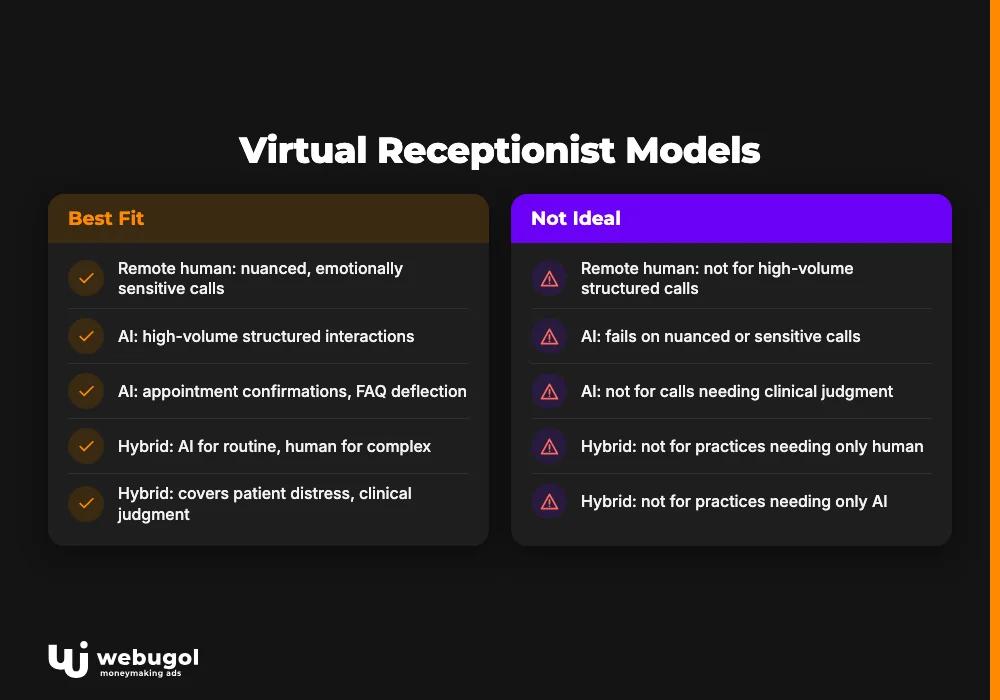
Remote human agents handle nuanced or emotionally sensitive calls where scripted automation fails. Mental health, high-complexity specialty, and any workflow where the patient expects a live person are the natural fit. For practices that need human coverage as the primary channel, the guide to live-agent answering services for healthcare practices covers that category in detail; this article focuses on the virtual and AI models.
AI receptionist for medical office
An AI receptionist automates high-volume structured interactions: appointment confirmations, intake capture, and FAQ deflection at a lower per-contact cost than a human agent. Telehealth practices with async-first workflows and outpatient clinics with predictable call patterns get the best unit economics here. The model choice matters.
Hybrid: AI routing with human escalation
The hybrid model uses AI to resolve routine contacts and routes immediately to a human agent when the interaction exceeds automation scope. It covers the edge cases, a patient in distress, a call requiring clinical judgment, that make practices hesitate to go fully automated.
| Model | Monthly cost | Setup time | HIPAA requirement | EHR integration depth | Best fit |
|---|---|---|---|---|---|
| Remote human | Higher per-contact; scales with call volume | Quick; vendor-dependent | BAA required | Varies by vendor | Mental health, complex specialty |
| AI receptionist | Lower per-contact; monthly seat or usage | Fastest of the three | BAA + encrypted channels | API or vendor portal | Telehealth, high-volume outpatient |
| Hybrid | Combined structure | Longest; integration-heavy | BAA + encrypted channels | API-level preferred | Multi-location, mixed call types |
How does a virtual medical receptionist affect your answer rate and CPA?
A higher answer rate compresses the speed-to-lead window, which directly raises show rate and lowers cost per booked appointment. This is an acquisition lever, not just an operations hire.
The answer rate to show rate chain
When a call goes unanswered and is not returned within minutes, the lead degrades. The appointment never gets confirmed. The chain is direct: answer rate drives speed-to-lead, which drives show rate, which sets your cost per acquisition. Understanding how speed-to-lead degrades lead quality and raises CPA gives you the metric language to justify front-desk investment before the next budget review.
What a 10-point lift in answer rate means for your cost per acquisition
Run the arithmetic on your own numbers: take monthly inbound calls, the current answer rate, and the booking rate on answered calls, then move the answer rate up ten points and watch the chain multiply through to booked visits. A virtual receptionist for medical practices that captures those calls changes the denominator on your CPA without touching the ad account.

Is a virtual medical receptionist HIPAA compliant by default?
No. Any virtual receptionist medical offices onboard must hold a signed BAA; compliance is structural, not automatic. A virtual receptionist that touches scheduling data over unencrypted channels or stores PHI outside a signed Business Associate Agreement creates direct exposure. Compliance is not optional.
For practices running paid acquisition on Meta or Google health categories, a PHI incident does not just create regulatory risk. It can trigger ad account suspension at the platform level, cutting off new patient flow entirely. Verify BAA coverage, encryption in transit and at rest, and access control logs before any vendor touches your scheduling stack. For a full evaluation checklist, the HIPAA-compliant scheduling software buyer's guide for 2026 covers vendor architecture requirements in detail.

5 questions to ask any virtual medical receptionist service before you sign
Generic vendor checklists miss the details that matter for specific verticals and stacks. These five questions reveal whether a service fits your EHR, call volume, escalation logic, and compliance architecture. Ask these before you commit.
- Does the service integrate directly with your EHR, or does it use a workaround? Athenahealth, Kareo, and eClinicalWorks have different integration depths; confirm API-level write access, not just read access.
- Can you see a copy of the BAA and evidence of a third-party security audit? A vendor that cannot produce both is not structurally HIPAA-compliant.
- How does the service handle a caller who signals distress or a clinical emergency? The routing logic for mental health and urgent care callers must be explicit and documented, not improvised by the agent.
- Does the service cover SMS and web chat, or only phone? Patients increasingly initiate contact through text; a phone-only solution leaves part of the funnel uncovered.
- How are handoffs measured and reported? You need call deflection rates, escalation rates, and time-to-confirm metrics, not just raw call volume counts.
What a virtual medical receptionist service costs and how to measure the first 90 days
Remote human and AI-based options carry different per-contact economics. Remote human services typically bill per minute or per call; AI services use monthly seat or usage-based pricing; hybrid models combine both structures. Your actual cost depends on call volume, hours of coverage, and EHR integration complexity.
The 90-day KPI framework for any virtual receptionist for medical practice owners:
- Days 1–30: Baseline answer rate, speed-to-lead (time from call to confirmed appointment), and missed-call callback rate.
- Days 31–60: Show rate delta versus the pre-deployment period; CPA movement on paid channels.
- Days 61–90: Cost per booked appointment trend; escalation rate from AI to human, since a high rate signals the automation scope needs tuning.
Track these from day one. If the gap is not in front-desk coverage but further up the acquisition funnel, the Month 1 diagnostic inside the Healthcare Growth System maps the full path from ad click to booked appointment before any new spend is committed.
Ready to fix your answer rate before you buy more leads?
The service solves the coverage gap. It does not fix a broken acquisition funnel on its own. A practice that adds front-desk coverage while the booking flow or offer is misaligned will improve operations and still miss its CPA target.
The Healthcare Growth System starts with a front-desk and funnel diagnostic in Month 1 of the 90-day sprint, so your practice knows exactly which lever to pull before adding cost. Book a Strategy Call with Webugol to start the diagnostic.
FAQ
What is a virtual medical receptionist?
It is a remote service, either a human agent, an AI system, or a hybrid of both, that handles inbound calls, appointment scheduling, patient intake, and after-hours routing for a medical practice. The service operates outside the physical clinic but integrates with the practice's phone system and EHR. It replaces or supplements the in-office front-desk role.
How much does a virtual medical receptionist cost?
Cost depends on the model: remote human services bill per minute or per call and scale with volume; AI-based options typically use a monthly seat or usage fee and cost less per contact. Hybrid models combine both structures. Setup fees and EHR integration work add to the initial investment and vary by vendor.
Is a virtual medical receptionist HIPAA compliant?
Not automatically. Compliance depends on the vendor's architecture: encrypted data paths, access controls, and a signed Business Associate Agreement are all required. Ask every vendor for a BAA and evidence of a third-party security audit before granting access to any scheduling or patient data.
What is the difference between AI and human virtual medical receptionist services?
Human services handle emotionally sensitive or high-complexity calls where a script fails, making them the right fit for mental health and specialty practices. AI services cost less per contact and scale without staffing constraints; configured as a medical receptionist virtual assistant, the system handles appointment confirmation and intake capture automatically. Hybrid models route by call type, using AI for routine contacts and escalating to a human when needed.
Can a virtual medical receptionist reduce patient no-shows?
A virtual receptionist improves answer rate and speed-to-lead, which raises show rate when those are the root cause of no-shows. If no-shows stem from a weak booking flow, absent confirmation sequences, or a misaligned offer, front-desk coverage alone will not move the number. Diagnose which part of the patient journey is causing the drop-off before attributing no-shows to coverage gaps.
What is the best virtual receptionist for medical offices?
The best virtual receptionist for medical offices depends on call volume, EHR stack, and whether the practice needs after-hours coverage. Practices with predictable, high-volume call patterns find AI-based or hybrid services most cost-efficient; practices with complex or emotionally sensitive calls benefit from remote human coverage. Evaluate vendors by BAA status, EHR integration depth, and escalation logic rather than price alone.