



What is speed to lead? The healthcare clinic's guide to faster lead response
Speed to lead is the elapsed time between a prospect submitting a form or ad inquiry and your clinic's first outbound response. In healthcare, that window directly determines whether a booked appointment is kept, not just whether the phone eventually gets answered. A paid inquiry from a patient considering a GLP-1 program or TRT consultation carries time-sensitive intent: the motivation behind the click fades within hours, not days. Every hour of lag compounds through contact rate, show rate, and recognized revenue before your ROAS dashboard shows any sign of trouble.
Key takeaways
- Speed to lead is the total gap between form submission and first genuine outbound contact attempt, not first connected call.
- For paid traffic, a sub-five-minute response window is the target; beyond 30 minutes, show rate impact in healthcare becomes measurable in the data.
- Most CRMs understate your real response time by excluding processing lag and failed call attempts from the reported figure.
- The handoff between marketing and intake is where the majority of lag accumulates in practice, and it typically belongs to neither team.
- HIPAA-compliant automation can achieve sub-60-second first responses without putting protected health information into AI-generated messages.
- Fixing the tool layer without fixing the accountability layer does not move show rate.
What is speed to lead?
Speed to lead meaning, in practical terms: how fast your team initiates contact after a new inquiry arrives. Most definitions stop there. In a healthcare intake context, the full picture is more precise. It is the total elapsed time from the moment a prospective patient submits a form, clicks an ad-to-call button, or sends a chat inquiry, until your clinic makes the first genuine outbound contact attempt, whether that is a phone call, an SMS, or a compliant email.
The phrase covers more ground than a callback timer. It includes the time a lead sits in a queue before any human or automated system touches it, routing delays, shift handoffs, and the untracked gap between form submission and CRM record creation. That last component, often invisible in standard reporting, is where the most costly delays accumulate in a busy clinic running paid acquisition.

Why the first five minutes decide the appointment
Patient intent is not static. Someone who just submitted a request for a telehealth consult is at peak motivation during the minutes after they click submit. The longer the gap before first contact, the lower the probability they confirm the appointment, show up, and ultimately pay.
This is not a generic sales principle. It reflects how healthcare decisions work: the emotional readiness to address a health concern is highest at the moment of action. An hour later, the patient is back in a meeting, the urgency has faded, and your competitor has already called. In healthcare, fast response is a clinical intake triage problem as much as it is a revenue optimization one.
What the data actually says
Speed to lead statistics cited most often across the industry come from a Harvard Business Review analysis of 2,241 US companies, which found that firms contacting prospects within an hour of inquiry were nearly seven times more likely to have a meaningful conversation than those waiting 60 minutes. The same research documents that qualification odds decrease by up to 21 times when response time extends from under five minutes to 30 minutes.
Healthcare leads decay faster than B2B leads, and faster than speed to lead real estate benchmarks typically show, because patient intent is emotionally driven and tied to a specific moment of readiness. Contact rates drop sharply once the five-minute window closes. In a high-ticket telehealth funnel where a single new patient represents thousands in program revenue, that decay curve carries direct financial consequences that your ad account reporting will not surface on its own.
How to calculate what a one-hour delay costs your clinic
The dollar math that most articles about response time skip is the revenue consequence for your specific clinic. Three inputs are enough: your average cost per consultation lead, your show rate for leads contacted within five minutes, and your average recognized revenue per program start. Pull each figure from last month's CRM and billing exports, not from industry averages.
Now compare the show rate on leads contacted within five minutes against leads that waited an hour, and multiply the gap by daily lead volume and revenue per program start. The result is the recognized revenue a single day of slow response leaves unrealized from the same ad budget. Most clinic operators running $30k per month in acquisition spend have never run that calculation at the intake level.
Speed to lead benchmarks: healthcare vs. B2B average
The table below reflects published benchmarks. It is the only healthcare-specific vertical comparison in the current top-10 search results for this keyword.
| Response window | Healthcare show rate impact | B2B qualification rate impact | Typical tool type |
|---|---|---|---|
| Under 5 minutes | Minimal drop from baseline | 7x better than 1-hour response | AI agent or auto-router |
| 5 to 15 minutes | Low drop for organic; meaningful for paid | 4x better than 1-hour response | CRM automation + rep alert |
| 15 to 30 minutes | Moderate drop; intent cools | 2x better than 1-hour response | Rep + SLA enforcement |
| 30 to 60 minutes | Significant drop across all sources | Below average for most sectors | Manual review queue |
| Over 1 hour | Severe drop; patient often unreachable | Near-bottom qualification rate | No system in place |
Best-practice response windows differ by channel and lead source. A paid social or search inquiry in telehealth requires sub-five-minute routing because the prospect clicked from a decision-stage intent signal. An organic or referral inquiry tolerates up to 15 minutes before meaningful drop-off begins, because the patient arrived with lower urgency and a longer consideration window. A single SLA applied across all sources creates false urgency on low-intent leads while high-intent paid ones cool.

How does speed to lead impact revenue generation?
Speed to lead is a revenue path metric, not a sales metric. Every hour of delay compounds through contact rate, show rate, and close rate, and each stage multiplies the cost forward. A one-hour delay in a well-run healthcare funnel shows up as a measurable drop in recognized revenue per lead. The size of that drop depends on the service line and average program value, which is why the number belongs in your own reporting rather than in a borrowed benchmark.
The reason most clinics do not feel this directly is that they measure the first handoff but not the downstream effects. A booked appointment that does not show is invisible to the ad account. The ROAS dashboard shows a cost per booking, not a cost per kept appointment. The revenue gap is real but unattributed, and the acquisition channel takes the blame for a problem that lives in intake.
From first response to show rate to revenue
The full revenue path runs from ad click to lead, to first contact, to booked appointment, to kept appointment, to recognized revenue. Every stage is a multiplier on the next. A well-executed paid acquisition strategy that reduces CPL at the channel level in telehealth and direct-response healthcare sets the baseline cost per lead, but follow-up speed determines what fraction of those leads converts into actual program revenue rather than evaporating at the intake stage.
Contact rate, show rate, and close rate are multiplicative. Improving contact rate from 40 percent to 60 percent by cutting response time does not add 20 percentage points to revenue; it multiplies the rest of the funnel by 1.5 times. For a clinic spending $50k per month in acquisition, the revenue impact of that ratio shift typically exceeds what most paid media optimizations produce.
Who is responsible for speed to lead: marketing, intake, or sales?
In most clinics, follow-up speed belongs to nobody. Marketing generates the lead and hands it off. Intake receives it when volume allows. No written SLA governs the gap, and no shared dashboard makes the lag visible to both teams at once.
Owning the full acquisition path from lead creation to first confirmed contact requires an accountable structure that spans the marketing-to-intake handoff. Without that structure, lag accumulates invisibly, the show rate erodes, and both teams report clean numbers within their own scope while the revenue gap widens between them.
How to measure speed to lead (and what your CRM hides)
Most CRM configurations in HubSpot, ActiveCampaign, and GoHighLevel report an optimistic figure. The reported number typically excludes processing lag, business-hours filters, and missed call attempts, creating a false baseline that prevents real improvement. You end up optimizing a number that does not reflect what prospective patients actually experience.
To find the real number, measure two components separately and add them.
Lead processing time vs. rep response time
Lead response time is the sum of two components: lead processing time and rep response time. Lead processing time is the elapsed time between form submission and CRM record creation. Rep response time is the elapsed time between record creation and the first genuine outbound attempt.
Most clinics track only the second component. In a typical GoHighLevel or HubSpot setup using a Zapier or webhook integration, processing lag can run from 30 seconds to several minutes per lead. During peak traffic, the integration queue can back up significantly. That invisible gap counts as zero in standard CRM reports, which systematically understates the real delay your intake team is working against every day.
Three CRM gaps that inflate your real speed to lead
Gap 1: Activity timestamp, not outreach timestamp. Most CRMs timestamp the first logged activity, which may be a note, a tag assignment, or an internal task, rather than the first genuine outbound call or message attempt. A rep who adds a note before dialing records a falsely fast response time.
Gap 2: Failed attempts excluded from averages. A call that goes to voicemail and is not logged as an attempt does not appear in the response average. Clinics with busy intake teams routinely under-log failed attempts because there is no workflow incentive to record them.
Gap 3: Business-hours filters. Standard HubSpot and GoHighLevel reports can exclude after-hours and weekend leads from the reported response average. A clinic running weekend campaigns with that filter enabled has no visibility into its actual performance on its highest-volume acquisition days.
To surface the real number, your CRM needs these fields and report settings:
- A form-submission timestamp field populated directly from the form webhook, not from CRM record creation time.
- A first-outbound-attempt timestamp that logs every call, SMS, and email attempt, including failed ones.
- Response time calculated as the difference between those two fields, not as time-to-first-logged-activity.
- Reports that include all leads regardless of submission time, with a separate breakdown by business-hours vs. after-hours.
- A daily SLA compliance rate showing the percentage of leads contacted within the target window, segmented by lead source.

Can speed-to-lead tools increase booking rates?
Yes. The right speed to lead software removes human lag from the first-response loop without removing the human from the relationship. For healthcare clinics, the core constraint is achieving that speed within HIPAA-compliant channels, which limits both the platforms and the message content that automation can use.
Response automation for healthcare intake spans three categories: AI intake agents for the first touch, CRM routing automation for assignment, and compliant multi-channel messaging sequences. Each addresses a different layer of the delay problem.
AI-powered response and GTM agents
AI-driven intake agents, including platforms like I Speed to Lead and similar intake automation frameworks, are among the best tools for speed to lead in a high-volume healthcare funnel. A properly configured AI agent can initiate a compliant, personalized first response within 60 seconds of form submission, handle initial qualification questions, present appointment slots, and route the lead to the correct intake rep before any human needs to act.
For clinics evaluating GTM agents for intake workflows, the key design constraint is keeping the AI in the pre-PHI stage. Initial outreach can confirm the inquiry and offer a next step without including any health information. The agent fills the response gap so the lead stays engaged until a rep is available. This approach removes the single most costly delay in most clinic funnels: the manual assignment step that adds three to eight minutes even in a well-run intake team.
Compliance-safe follow-up automation for healthcare
HIPAA consent requirements, platform opt-in rules, and state-level telehealth regulations constrain which channels can be automated and what those messages can contain. Standard marketing automation platforms are not HIPAA-covered by default. Any intake automation in a healthcare context requires a Business Associate Agreement with the platform vendor, and messages must stay free of protected health information until the patient completes proper onboarding consent.
The follow-up compliance structure for men's health, TRT, and high-ticket telehealth programs follows the same framework across most service lines. For platform selection decisions specifically, the 2026 buyer's guide to HIPAA-compliant scheduling software covers BAA coverage, consent flows, and integration requirements in detail.
A compliant follow-up sequence covers these channel checkpoints:
- Immediate (under 60 seconds): AI agent or automation sends a compliant SMS or email confirming receipt of the inquiry, with no health-specific content, and offers a scheduling link or callback option. Platform must have a signed BAA.
- Under 5 minutes: CRM routes the lead to the assigned intake rep with a high-priority alert. Rep attempts the first outbound call.
- 15 to 30 minutes: If no contact is made, send a second compliant touchpoint via a different channel (email if SMS was first, or vice versa).
- Same business day: Second manual call attempt logged as a separate outreach record for HIPAA audit trail purposes.
- SMS opt-in: Obtained at the form level with explicit consent language; form submission alone does not constitute opt-in under TCPA.
- Call timing: Respect TCPA windows (8 AM to 9 PM local time for marketing calls); document time-zone handling in the intake SOP.
- PHI in messages: No health condition, symptom, or treatment reference in AI-generated or templated messages before BAA-compliant onboarding is complete.
How to improve speed to lead in 5 steps (healthcare edition)
Improving response speed in a healthcare setting requires addressing routing, SLAs, intake handoffs, measurement, and compliance simultaneously. Fixing only the tool layer without fixing the accountability layer does not move show rate, because the tool surfaces the lead faster but no structure ensures the rep acts within the required window.
- Audit your real response time using the two-component formula. Measure lead processing time and rep response time separately. If your CRM does not capture form-submission timestamps independently from record creation, fix that instrumentation first.
- Automate routing based on lead source, service line, and geography. Paid social and high-ticket inquiries route immediately to the priority intake queue and trigger an AI first-touch response. Organic and referral leads route to the standard queue with a 15-minute SLA.
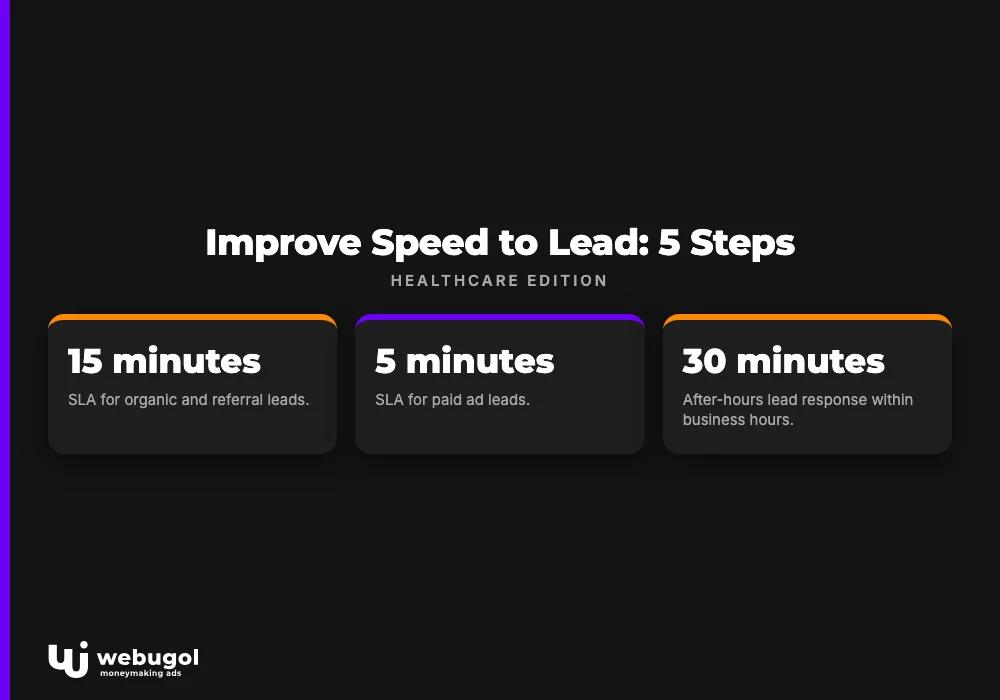
- Set written SLAs by lead source and enforce them in the CRM. Paid ads: under five minutes. Organic/referral: under 15 minutes. After-hours leads: automated first-touch sent immediately on submission, first available rep within 30 minutes of business hours opening.
- Build a shared pipeline view between marketing and intake. Both the Head of Marketing and the intake lead need real-time visibility into response time and SLA compliance by lead source. A weekly summary that arrives after the damage is done is not a system.
- Monitor diagnostic signals of lag daily and treat them as revenue alerts. Lead age in queue, the gap between submission and first-attempt timestamps, and after-hours automation logs tell you where the handoff is breaking before the problem shows up in show rate.
Step 1: Automate routing without breaking compliance
Lead routing logic should assign inbound leads to the correct intake rep or AI agent within seconds of form submission, based on lead source, service line, and geography. Each routing event should be logged with a timestamp for HIPAA auditing. The most common source of first-five-minute lag is manual assignment: a rep checks a shared inbox, identifies the lead, and decides where to route it. That decision adds three to eight minutes even in a functional team. Automated routing eliminates that delay entirely and creates an audit trail without additional process overhead.
Step 2: Set response SLAs by lead source
A paid social lead from a Meta weight-loss campaign and an organic blog visitor who submits a contact form carry different intent signals. They require different response windows and different first-touch messages. A single SLA applied across all sources creates false urgency on low-intent leads while high-intent paid ones cool.
Build a tiered SLA matrix in your CRM that triggers different response workflows by lead source tag. The intake team responds to priority classifications rather than making individual judgment calls on each new record. SLA compliance becomes a measurable metric your marketing team can track, report on, and defend in a budget conversation.
Step 3: Monitor and fix lag in the intake handoff
The handoff between marketing and intake is where most response time failures occur in practice. The gap is visible as the elapsed time between CRM record creation and the first logged outbound attempt. A Head of Marketing who monitors this gap daily can identify routing failures within hours rather than discovering them in a monthly show-rate review that arrives too late to act on.
Five diagnostic signals that indicate lag in the intake handoff:
- Lead-created timestamps clustering in batches rather than distributing individually, suggesting a manual import or delayed sync rather than real-time webhook delivery.
- A consistent gap of more than 10 minutes between record creation and first outbound attempt on paid leads, indicating no automated trigger is firing.
- First-attempt logs showing high voicemail rates without same-day follow-up attempts logged, indicating the sequence stops at the first miss.
- SLA compliance rate dropping below 80 percent on any single day without a documented staffing reason.
- After-hours submission volume not reflected in corresponding first-touch automation logs, indicating a broken trigger on the after-hours routing rule.
Ready to stop losing appointments before the first call?
If your clinic's response time is measured in hours rather than minutes, the show rate gap is predictable and fixable with the right routing, SLAs, and measurement in place. Most of that gap closes before any significant tool investment is needed, once the accountability structure between marketing and intake is established.
Webugol builds tracking-first, conversion-led acquisition systems for US healthcare providers, the full path from ad click to recognized revenue: tracking foundation, funnel, landing pages, CRM, campaigns, and intake operations managed as one accountable system. To diagnose where your acquisition path is leaking revenue and build the system your clinic needs to own the number from click to kept appointment, book a strategy call with our healthcare patient acquisition team.
FAQ
What is a good speed to lead for a healthcare clinic?
For paid traffic leads, the target response window is under five minutes; for organic or referral leads, under 15 minutes is acceptable before contact rates begin to drop meaningfully. Beyond 30 minutes, show rate impact in healthcare becomes clearly measurable in the data.
How does speed to lead affect show rate?
A slow first response reduces the likelihood the patient confirms and keeps the appointment, not just the likelihood of an initial booking. Leads contacted after one hour show at materially lower rates than leads contacted within the first five minutes of inquiry.
Who should own speed to lead in a clinic: marketing or intake?
Speed to lead requires a written SLA between whoever generates the lead and whoever works it, with enforcement built into the CRM pipeline. Without that structure, it defaults to neither team in practice, which is when lag accumulates and nobody is accountable for the number.
What is the difference between lead processing time and rep response time?
Lead processing time is the gap between form submission and CRM record creation; rep response time is the gap between record creation and the first outbound contact attempt. Clinics that only track the second number systematically understate their real response delay.
Can speed-to-lead automation be HIPAA-compliant?
Yes, but it requires using HIPAA-covered channels, obtaining proper consent before automated outreach, and keeping protected health information out of AI-generated messages. Standard marketing automation platforms are not HIPAA-covered by default and require a Business Associate Agreement to qualify.

