



Dental lead generation: how to build a steady patient pipeline
Dental lead generation is the process of attracting prospective patients, capturing their contact information, and converting them into booked appointments. It replaces unpredictable word-of-mouth with a measurable acquisition system. The core channels include local SEO, paid search, content marketing, and email nurture. Which combination works depends on your market, your service mix, and where your biggest conversion leaks are.
Established practices with real marketing spend often hit a plateau not because the channels are wrong but because the system around them is broken: tracking gaps, slow follow-up, landing pages that do not convert. That structural problem stops growth faster than any channel decision will fix it.
What is the difference between inbound and outbound dental leads?
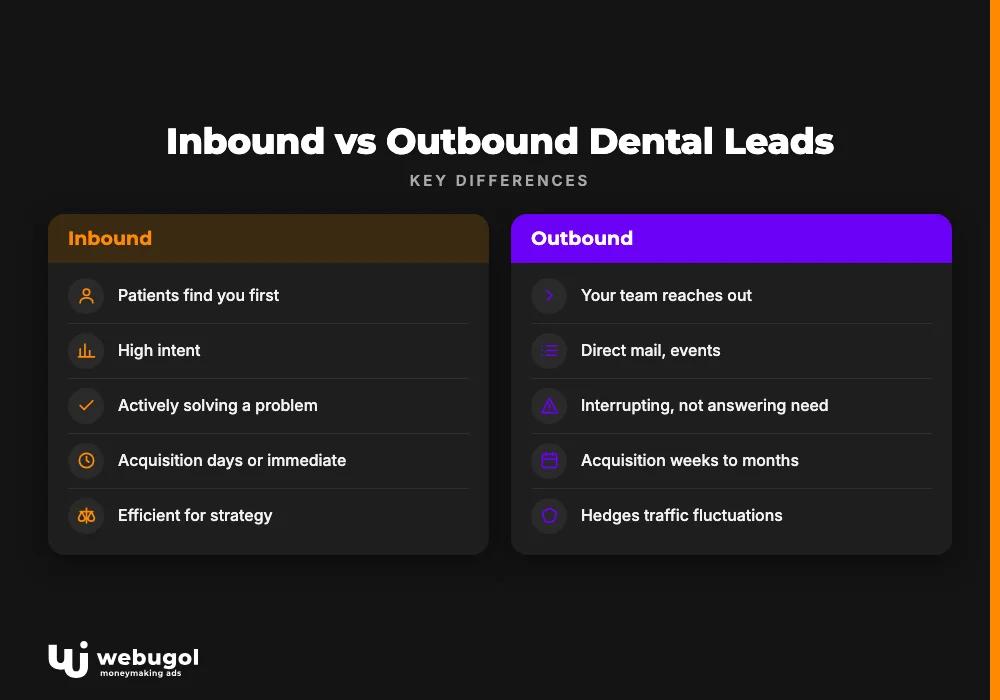
Inbound leads come from patients who find you first. A search for "emergency dentist near me" leads to your Google Business Profile or website. The patient calls or submits a form. High intent. Actively solving a problem right now.
Outbound leads come from your team reaching out first, through direct mail, referral campaigns, or community events. Conversion takes more effort because you are interrupting, not answering a need.
| Type | Source | Intent | Acquisition speed |
|---|---|---|---|
| Inbound | Organic search, GBP, referrals | High | Days (SEO) or immediate (PPC) |
| Outbound | Direct mail, events, referral asks | Medium | Weeks to months |
A sustainable dental inbound marketing strategy leans inbound for efficiency and uses outbound to hedge against traffic fluctuations. Neither alone is sufficient at scale.
How do dental practices generate leads online?
Five channels drive most dental patient acquisition results for established practices.
Local SEO and Google Business Profile. When someone searches "dentist near [city]," the local map pack appears above organic results. Your GBP listing, review count, and local citation consistency determine whether you appear there. This is where most dental lead generation volume originates. Deep-dive ranking tactics are covered in medical practice seo, where the same principles apply across healthcare verticals.
Website conversion. Traffic means nothing without a site that converts visitors. Fast load times, mobile-first design, visible contact options, and trust signals (patient reviews, credentials, before-and-after photos) determine whether a visitor becomes a lead. A poorly converting site leaks budget from every channel above it in the funnel.
Paid search (Google Ads). PPC delivers immediate visibility for high-intent queries. Effective dental clinic digital marketing via paid search means intent-based keywords, service-specific landing pages, and location targeting. Sending all ad traffic to your homepage is the single most common budget waste in dental PPC.
Social ads. Facebook and Meta ads work well for elective, visual procedures like cosmetic dentistry and implants. For urgent general dentistry needs, intent is already formed and patients go straight to search.
Content and email. Blog posts targeting patient questions build long-term organic reach. Email and SMS nurture sequences keep your practice visible to leads who are not ready to book today. Both lower your cost per acquisition over time.
What digital channels work best for dental patient acquisition?
For most practices, local SEO and Google Ads together produce the most bookable volume. Local SEO compounds: once rankings stabilize, cost per lead drops because you are not paying for every click. PPC fills the gap while SEO builds and handles demand surges.
The mistake most dentist marketing strategies share is running channels without end-to-end attribution. If you cannot trace a booked appointment back to its source, budget decisions are guesswork. You end up cutting what looks expensive on the ad platform while keeping what looks cheap, without knowing which actually produced revenue.
Tracking must run from ad click to booked appointment to show rate. Without that data, the goal to attract new dental patients becomes a hope strategy, not an acquisition system.

How much does dental lead generation cost?
There is no universal number. Cost per lead in dental PPC varies by market competition, procedure type, and service area. High-ticket procedures like implants attract more clicks and higher bids. Metro markets cost more than suburban ones.
What matters more than CPL is cost per booked appointment. For example (illustrative): a practice with a $60 CPL and a 20% booking rate pays $300 per new patient. One with the same CPL and a 50% booking rate pays $120. Improving conversion of existing lead flow is almost always faster than lowering CPL through channel changes alone.
The dental practice growth tips that move the needle fastest are rarely about spending more. They are about fixing what happens after the click.

How do you convert dental leads into booked appointments?
Speed of follow-up is the most underused lever in dental marketing. Leads contacted quickly after submitting an inquiry are far more likely to book than those reached hours later. This is not a marketing problem. It is an operations problem. Most practices have no system for fast follow-up during busy patient hours.
Three changes close this gap. First, automated confirmation texts or emails sent within seconds of a form submission. Second, a defined callback protocol with assigned ownership, not whoever happens to be free. Third, a nurture sequence that continues for five to seven days if the first contact does not reach the prospect.
No-shows are a separate drain. A lead that booked but does not appear costs you the appointment slot. SMS and email reminders sent 48 hours and two hours before a visit reduce no-shows without additional labor. These are not marketing improvements. They make your existing dental lead generation investment actually convert.
For practices scaling into additional service lines, medical doctor marketing covers the same conversion ops principles applied across medical specialties.
Build a dental lead generation system that scales
If your practice is spending on marketing and growth has stalled, the problem is almost never the channel. It is the absence of a connected system: tracking that tells you what actually converts, a funnel that handles the full path from click to chair, and operations that ensure leads do not slip through.
Webugol builds acquisition systems for dental and healthcare practices designed around that full path. The Healthcare Growth System is a 90-day engagement covering tracking setup, funnel build, paid and organic campaign execution, and daily performance optimization. Book a strategy call.
FAQ
How do dental practices generate leads online?
Dental practices generate leads primarily through local SEO, Google Business Profile optimization, PPC ads, and content marketing. Each channel targets patients at a different stage of their search, from urgent same-day need to longer consideration of elective procedures.
What is the difference between inbound and outbound dental leads?
Inbound leads come from patients who find the practice through search, reviews, or referrals and are actively looking for a solution. Outbound leads come from proactive outreach like direct mail or community events. Inbound tends to convert faster; outbound builds resilience when inbound traffic dips.
How much does dental lead generation cost?
Costs vary by market size, competition, and procedure type. The more useful metric is cost per booked appointment rather than cost per lead, since it reflects how well the practice converts inquiries into scheduled visits.
What digital channels work best for dental patient acquisition?
Local SEO and Google Ads together produce the most consistent new-patient volume for most practices. Facebook and Instagram ads perform better for high-ticket elective procedures. Attribution tracking across all channels reveals which combination actually earns the spend.
How do you convert dental leads into booked appointments?
Fast follow-up after inquiry is the biggest driver of booking rate. Automated confirmation messages, a defined callback protocol, and a multi-day follow-up sequence convert leads that would otherwise go cold. SMS reminders before scheduled appointments reduce no-shows.