



Podiatry Marketing: How to Attract and Retain More Patients
Good podiatry marketing converts online search intent into booked appointments. The foundation is a connected system: an optimized Google Business Profile, high-converting service pages, and a steady stream of verified reviews. Without that system, adding ad spend does not add patients. It accelerates spending on a leaky funnel.
Whether your practice is in its first year or stuck at a growth ceiling, the structural gaps are identical: spend you cannot trace end-to-end, a patient journey with friction points, and no program connecting a first visit to long-term retention. Those gaps exist at every scale. Closing them is what separates practices that grow consistently from ones that spend more and stay flat.
What does a podiatry marketing agency do?
A podiatry marketing agency builds and manages the systems that move a prospective patient from a Google search to a confirmed appointment, then keeps them returning. That includes local SEO, paid search, conversion-optimized landing pages, review generation, and email or SMS follow-up, managed as a single connected program rather than isolated tactics.
| Channel | Primary function |
|---|---|
| Local SEO | Ranks your practice in map searches and "near me" queries |
| Google Search Ads | Captures high-intent patients ready to book now |
| Website UX and CRO | Turns traffic into calls and form submissions |
| Reputation management | Builds the review volume that drives local ranking and trust |
| Email and SMS automation | Reduces no-shows, books recalls, and reactivates lapsed patients |
| Content marketing | Answers patient questions and supports organic search ranking |
The gap most practices miss: each channel can report green numbers while the system leaks patients between steps. A podiatry marketing agency that owns the full revenue path closes that gap. Without that ownership, you end up with multiple vendors, multiple dashboards, and no one accountable for why booking volume moved.
How do podiatrists attract new patients?
Podiatrists attract new patients primarily through local search visibility, referrals from existing patients, and targeted podiatry advertising. Local search drives the highest volume for most practices: a patient in pain searches "podiatrist near me" and books within hours of finding a practice they trust. The decision happens fast. Mapping the patient's decision path lets effective podiatry marketing reach them at the right moment.
Awareness
A person experiences heel pain but does not know who to see. Your job at this stage is to appear when they search symptoms.
- Write blog posts and service pages that explain conditions in plain, non-technical language.
- Target symptom-based searches alongside service-based ones.
- Connect common patient activities, such as running or standing for extended shifts, to specific foot conditions your practice treats.
Consideration
The patient is now comparing providers. They want proof you are qualified and that visiting will be easy.
- Publish clear information about accepted insurance plans.
- Display credentials, affiliations, and clinic standards prominently on your website.
- Show pricing transparency or financing options where possible.
Conversion
They are ready to book. Every extra click required is a patient lost.
- Place a visible "Book Now" button on every page.
- Offer a click-to-call number for mobile visitors.
- Use short contact forms. Two fields beat seven.
- Add an after-hours contact option for requests that arrive outside business hours.
Retention
The visit is complete. Your goal now is a recall, a referral, or a review.
- Send automated appointment reminders by SMS or email.
- Follow up with a HIPAA-compliant review request on the day of the appointment.
- Use recall reminders for annual check-ups and orthotics refitting.
Retention is where most podiatry marketing systems break down. For practices already running digital marketing for podiatrists, this stage is typically the highest-ROI opportunity because the acquisition cost is zero.
What is the best way to market a podiatry practice?
The best podiatry marketing approach combines local SEO with a converting website and a review program running in parallel. Local SEO puts you in front of patients already searching; a good website makes booking easy; reviews give new patients the confidence to choose you over the nearest competitor. All three must work together.
Local SEO for podiatrists
Local SEO determines whether your practice appears in the Google Map Pack when someone nearby searches for a podiatrist. Your Google Business Profile is the central asset.
Steps that move the needle:
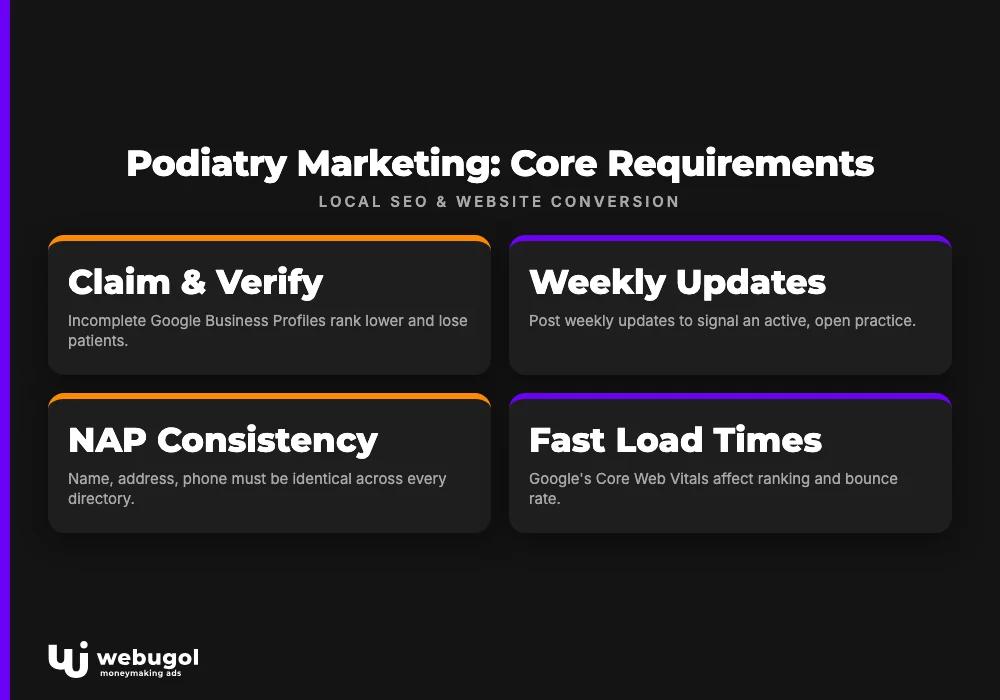
- Claim and verify your profile. Incomplete profiles rank lower and lose patients to fully-optimized competitors.
- Select the most specific primary category, such as podiatrist, not a general healthcare label.
- Add all services with individual descriptions.
- Upload clinic photos and add new ones regularly.
- Post weekly updates to signal an active, open practice.
- Monitor profile views, call clicks, and direction requests monthly to track local impact.
NAP consistency matters as much as the profile itself. Your practice name, address, and phone number must be identical across every directory where your practice appears. Inconsistencies suppress local ranking. The same applies to orthopedic marketing and other specialty practices competing in dense local markets.
Website performance and conversion
Your podiatry marketing system depends as much on conversion as on visibility. A website that ranks but does not convert wastes every dollar spent on SEO and ads.
Core requirements for podiatry patient acquisition:
- Fast load times. Google's Core Web Vitals affect both ranking and bounce rate. A slow site costs patients before they read a word.
- Mobile-first design. Most "podiatrist near me" searches happen on a phone.
- Accessibility. Readable fonts, sufficient contrast, and large tap targets serve both patients and ADA compliance requirements.
For current healthcare website design trends shaping patient expectations, the direction is toward cleaner pages with fewer steps between visitor and confirmed appointment.
Podiatry advertising: Google Ads structure
Paid podiatry advertising on Google reaches patients who are ready to book immediately. The structure that works for most practices:
- Service campaigns. One campaign per high-priority condition, such as plantar fasciitis, ingrown toenails, or orthotics.
- Brand campaign. A campaign on your practice name prevents competitors from capturing patients already searching for you.
- Call ads. Call-only formats reduce friction for patients seeking urgent care.
- Location assets. Link your Google Ads account to your Google Business Profile so your address appears directly in the ad.
Negative keyword management is as important as targeting. Without it, your budget flows to searches like "podiatry school" or "DIY foot care" that will never become appointments.
HIPAA-compliant review strategy
Reviews are the strongest local ranking signal and the most visible trust factor for new patients. The goal is consistent, sustainable volume, not a one-time push.
Send a short SMS or email review request on the day of the appointment, with a direct link to your Google review page. Respond to every review, positive and negative, without referencing any patient health information. That is the HIPAA guardrail most practices miss. In local search, recency and consistency outperform total volume alone, which means an automated steady cadence of review requests outperforms a periodic campaign no matter how aggressively you run it.

How to increase patient engagement in a podiatry practice?
Patient engagement in a podiatry practice increases when communication is timely, relevant, and low-friction. Podiatry marketing that stops at the first appointment misses the most profitable segment of your patient base. Automated email and SMS sequences are the most reliable way to maintain contact between visits without adding manual work for your team.
Engagement programs that move the numbers:
- Appointment reminders. A sequence sent 48 hours and again 2 hours before the visit reduces no-shows. No-show rate is a marketing metric. Treat it like one.
- Post-visit follow-up. A check-in message 3 to 5 days after treatment builds trust and surfaces patients who need a return visit.
- Recall campaigns. Annual check-up reminders, orthotics refitting notices, and seasonal campaigns for conditions like heel pain in summer keep lapsed patients returning.
- Re-engagement. Patients who have not visited in 12 months respond to a personalized message better than a mass broadcast.
Connecting these sequences to your CRM gives one place to see which patients are active, which are overdue, and which are at risk of churning. Without that visibility, podiatry patient engagement is managed on instinct, not data.
The connection between engagement and revenue is direct. A patient who returns for a second visit costs nothing in acquisition. A patient who refers a friend generates revenue at zero ad spend. Practices that track and optimize their retention programs systematically reduce the ad budget needed to maintain growth, because they stop replacing patients they should have kept.
Practices that offer care plans, orthotics subscriptions, or annual wellness programs have a built-in retention structure that reduces acquisition dependence. If those renewals are tracked in your CRM and triggered automatically, the revenue from existing patients becomes predictable. If they are not tracked, you end up spending on acquisition to cover a hole in renewal revenue that nobody owns.
The same structural argument applies to medical doctor marketing: practices that scale consistently are not the ones spending the most on acquisition. They are the ones that stopped hemorrhaging patients between visits.

How much does podiatry marketing cost?
Podiatry marketing costs depend on market competition, number of locations, and which channels you are running. A single-location practice in a mid-size metro running local SEO and focused Google Ads will have significantly different costs than a multi-location group competing in a major market.
The factors that drive costs up:
- High-competition markets. Dense metro areas with multiple established practices raise cost-per-click on paid search and slow organic ranking progress.
- Broad service scope. Each additional condition or service campaign adds management overhead and media spend.
- Poor conversion infrastructure. If your website converts at 1% instead of 5%, you need five times the traffic and five times the ad budget to book the same number of patients.
The last point is where most practices lose money on healthcare marketing for podiatrists. Fixing the conversion layer, your website, your booking flow, and your review volume, before scaling ad spend is the highest-leverage move available.
Every dollar in podiatry marketing spending must connect to a confirmed appointment to be defensible. Without end-to-end attribution linking ad spend to actual bookings, you cannot distinguish between campaigns that work and campaigns that look like they work. Practices at the growth plateau are usually not underinvesting in acquisition. They are investing in a system where the revenue path is invisible.
Build a patient acquisition system for your podiatry practice
Podiatry marketing that produces consistent growth is a system, not a checklist. It starts with accurate tracking to identify what is driving appointments and what is burning budget. It runs through a converting website, an active Google Business Profile, and a review program that builds trust automatically. It closes the loop with an email and SMS retention sequence that keeps patients returning.
If your current setup has any of those pieces missing or disconnected, you are losing appointments every week to practices with a tighter system.
Webugol builds patient acquisition systems for US healthcare providers. The Healthcare Growth System is the full-stack program: strategy, tracking, conversion assets, and daily optimization managed as one accountable engagement. Book a strategy call to map where your practice is leaking patients and what it would take to fix it.
FAQ
How do podiatrists attract new patients?
Podiatrists attract new patients most effectively through local SEO, Google Ads targeting high-intent searches, and a consistent review generation program. The combination of strong local visibility and a converting website drives the majority of new bookings for most practices.
What does a podiatry marketing agency do?
A podiatry marketing agency manages the systems that connect a prospective patient to a confirmed appointment: local SEO, paid search, website conversion, and reputation management. The best agencies manage these as one connected program and track results back to actual appointments, not just clicks or impressions.
How much does podiatry marketing cost?
Costs vary based on market competition, number of locations, and active channels. The more important question is cost-per-acquired-patient: a higher total budget can produce a lower cost per new patient when the conversion infrastructure is built to convert efficiently.
What is the best way to market a podiatry practice?
Start with local SEO and Google Business Profile optimization because they target patients who are already searching for a podiatrist. Add Google Ads for immediate volume, then build a review program and email retention sequence to lower long-term cost per patient.
How to increase patient engagement in a podiatry practice?
Automated appointment reminders, post-visit follow-ups, and annual recall campaigns are the highest-impact engagement tools for most practices. Connecting these sequences to your CRM gives clear visibility into which patients are active and which are at risk of lapsing.