



Digital marketing for franchises: strategies that scale
Digital marketing for franchises means managing one brand across dozens of independent local markets at once. When it is built as a coordinated system, you stop losing leads to independent competitors, wasting budget on uncoordinated location campaigns, and watching brand equity erode through inconsistent execution. This guide covers the structural decisions, channel strategies, and common failure points that determine whether a franchise network gains market share or falls behind.
Managing digital marketing for franchises at scale requires three things most franchise systems underestimate: standardized playbooks every franchisee can follow without deep marketing expertise, centralized technology that gives the franchisor visibility into every location's performance, and governance rules that define who controls what. Without all three, each location does something different, with no way to identify what is working or why.
The gap that limits a franchise owner managing 20 locations is the same one that slows any growing business the moment scale multiplies complexity: no coordinated system behind the channels, just multiplied effort that produces diminishing returns instead of compounding results.
How does digital marketing for franchises differ from standard business marketing?
A single-location business controls one website, one Google Business Profile, and one local audience. Digital marketing for franchises multiplies every variable. A network with 20 locations needs 20 optimized GBP listings, 20 location pages, 20 sets of local reviews, and paid campaigns spending efficiently across markets with very different competitive pressure and cost structures.
The core structural difference is governance. A solo business owner changes strategy on the fly. A franchise network requires documented protocols between the franchisor and franchisees. Without those protocols, marketing fragments, local execution diverges, and brand equity erodes one inconsistent post or unanswered review at a time.
The brand-versus-local tension
Franchise branding strategy lives at the intersection of two legitimate needs. The franchisor needs consistent brand recognition to protect the asset they have built. Each franchisee needs content and campaigns that speak to their specific city, neighborhood, or customer segment. Neither side wins when the other is ignored.
The practical resolution is a tiered structure. The franchisor controls brand assets, messaging guidelines, and campaign templates. Franchisees control local copy, local event promotion, and customer review responses.
When both sides respect that boundary, multi-location SEO improves because location pages contain genuinely distinct content rather than duplicate templates. Paid ads convert better because the copy reflects local context rather than generic brand messaging.
Franchisor-franchisee alignment in practice
Misalignment in digital marketing for franchises shows up in predictable patterns. Franchisees create social media pages with inconsistent logos, fragmenting brand search results. Franchisees run competing PPC campaigns in markets where the franchisor already operates network campaigns, inflating CPCs across the entire network. Negative reviews go unanswered for weeks because no one owns the response protocol at the location level.
Each pattern has a structural fix: shared tooling, documented guidelines, and regular performance reporting from franchisor to franchisee. The problem is never effort. It is always the absence of an agreed system.
Digital marketing for franchises: channel breakdown
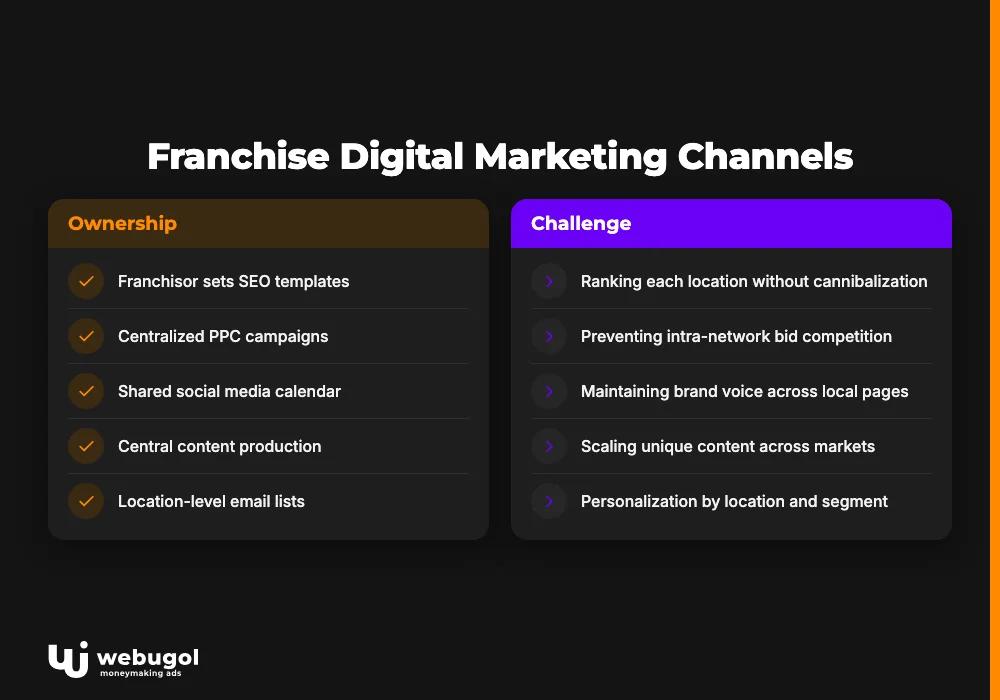
The table below maps the five core channels, the specific challenge each presents at franchise scale, and who should own execution for consistent results across the network.
| Channel | Franchise-specific challenge | Recommended ownership |
|---|---|---|
| Franchise local SEO | Ranking each location for "[service] near me" without cannibalizing adjacent locations | Franchisor sets page templates; franchisees contribute local content |
| PPC advertising | Preventing intra-network bid competition in overlapping markets | Centralized campaigns with location-level budget allocation |
| Social media | Maintaining brand voice across local pages | Shared content calendar with local customization permitted |
| Content marketing | Scaling unique content across many local markets | Central production, local distribution |
| Email marketing | Personalization by location and customer segment | Location-level lists, centralized templates |
How do you maintain a consistent brand across all franchise locations?
Consistent branding across all franchise locations requires a centralized brand kit accessible to every franchisee, combined with enforced NAP standardization across every online directory. These two elements prevent the fragmentation that erodes brand equity as the network grows.
The franchisor's brand kit should cover logo usage, color specifications, approved photography, taglines, and tone-of-voice guidelines. That kit should live in a shared, versioned repository. Not buried in an email chain.
Consistency in franchise online marketing also depends on matching NAP data, Name, Address, Phone number, across Google, Yelp, Bing, and every local directory. Inconsistent NAP is one of the most common causes of ranking drops in franchise local SEO, because it signals unreliable location data to search engines.
Centralized brand assets and local templates
Effective multi-location management builds a centralized asset library with pre-approved social media templates, ad creative in standard formats, blog post outlines, and email templates. Franchisees choose from approved assets rather than building from scratch. This reduces brand violations without micromanaging local operators, and it lowers the production barrier for franchisees who lack in-house marketing expertise.
For franchise online marketing, the library should include pre-approved landing page templates for each major service or product category. When a franchisee runs a PPC campaign, the traffic should land on a page that matches the ad creative and maintains brand standards. Using the generic homepage as a PPC destination is a consistent failure pattern across franchise networks and one of the fastest ways to waste paid media budget.
Local customization within brand standards
Localization does not mean redesigning the brand for each market. It means deploying approved assets with locally relevant copy. A franchise in Austin talks about Austin neighborhoods. A franchise in Denver talks about Denver. The logo, colors, and core messaging stay identical.
This matters directly for multi-location SEO. Search engines recognize each location page as distinct content rather than a duplicate template, which improves rankings across the network. The local details carry the differentiation. The brand assets carry the consistency.
How do you set up local SEO for multiple franchise locations?
Setting up local SEO for multiple franchise locations requires three parallel workstreams: dedicated location pages with structured data, fully optimized Google Business Profiles for each location, and a systematic review acquisition protocol. When all three are in place, each location ranks independently for local searches without competing against the rest of the network.
Done poorly, every location competes against every other, and none of them ranks well for anything.
Location pages with structured data
Each franchise location needs a dedicated page on the main domain or an approved subdomain. That page should include the location's address, phone number, business hours, services at that specific location, local landmarks or neighborhood references, and customer reviews pulled from verified sources.
The goal is giving search engines and users accurate, specific information tied to that physical location, not a copy-paste template with only the city name changed.
Schema markup accelerates local visibility. Using LocalBusiness schema on each location page with address, telephone, openingHours, and geo properties allows search engines to represent each location accurately in local pack results. This is standard practice in digital marketing for franchises and takes less implementation time per location than most network managers assume when planning the rollout.
Google Business Profile management at scale
Each franchise location needs a fully claimed and verified Google Business Profile. The profile must list accurate categories, hours, services, and photos. GBP posts are systematically underused across most franchise networks.
Posting about local promotions, seasonal offers, or upcoming events keeps each profile active and signals ongoing relevance to Google's local algorithm. For multi-location management across larger networks, a shared content calendar with location-specific customization slots makes GBP posting manageable without requiring each location to build a strategy from scratch.
GBP attributes, including service areas and category-specific details, should be audited quarterly, since inaccurate attributes reduce the precision of location matching in search results.
Building review signals across all locations
Reviews affect both local search ranking and conversion rate. Each franchise location needs a steady, ongoing flow of verified reviews on Google and on relevant industry platforms. The franchisor should provide a documented review request protocol: when to ask, which channels to use, and how to respond to both positive and negative reviews.
Response rate and response speed matter. An unanswered negative review at the top of a GBP listing reduces visit intent. Prompt, professional responses signal to prospective customers that the location is actively managed. Franchisees who invest in review velocity in the first months after opening rank faster in local searches than those who leave review acquisition to chance.
Paid advertising for multi-location franchise growth
PPC is where franchise online marketing gets complicated fast. Without coordination, franchisees in adjacent markets bid against each other, inflating costs for the entire network. The franchisor-managed model, where campaigns run centrally and budgets are allocated by location performance, outperforms decentralized approaches in most franchise verticals.
Understanding Google Ads account architecture is a useful starting point for the restructuring that franchise networks require: separate campaigns or ad groups per location, geo-targeted bid modifiers, and location extension links tied to individual GBP listings.
Budget allocation by location performance
Not every franchise location deserves equal ad spend. High-volume markets with proven conversion data should receive proportionally more budget. New locations entering competitive markets may need higher initial investment before organic channels begin contributing.
Track cost-per-acquisition by location, not only by overall campaign. Network-level averages hide underperforming locations that absorb a disproportionate share of total ad budget while generating a small share of network conversions. Monthly location-level reviews are what keep franchise paid media efficient over time rather than drifting toward the highest-spending locations regardless of return.
Geo-targeted campaigns and local copy
Each location's campaigns should target a defined radius or polygon that matches the realistic service area. Broad geo-targeting wastes budget on clicks from people outside the serviceable range.
For local marketing franchise campaigns, ad copy that references the specific city or neighborhood in headline one tends to outperform generic brand messaging in click-through rate, because it matches user search intent more precisely at the moment of the query.

Social media for franchise brand consistency
Social media for franchise branding strategy requires balancing centralized brand voice with local community engagement. The franchisor manages a primary brand account and produces shareable content. Each franchise location may maintain its own local page, but only with documented visual and copy guidelines in place.
Content that consistently performs across franchise social channels falls into predictable categories: local event highlights, customer spotlights, behind-the-scenes content from specific locations, and time-limited local offers. Local context drives engagement at the location page level. Generic brand content performs poorly there because it fails to connect to the specific community or give people a reason to engage beyond basic brand awareness.
Paid social for franchise marketing follows the same logic as PPC: geo-targeted campaigns at the location level, creative pulled from the centralized brand library, and conversion tracking tied to location-specific landing pages. Franchisors who provide templated, customizable ad creative to their franchisees see higher adoption rates than those who leave franchisees to build campaigns independently. Lower production barrier produces more consistent execution.
Review performance at the location level, not just the brand level. Engagement rates on local pages often differ from the brand page, and the content types that drive local engagement are rarely the same as what performs at the network brand account. Treat local social as a channel with its own metrics and objectives, not as a sub-feed of the main brand account.
Content marketing across franchise locations
Content marketing in digital marketing for franchises operates at two levels. At the brand level, the franchisor produces authoritative content that ranks for brand-related queries and builds domain authority that benefits all locations. At the local level, franchisees contribute or receive location-specific content targeting "[service] in [city]" queries.
The challenge is production volume. Creating quality localized content for 50 locations is not manageable with a single content team working manually. Effective franchise content systems use a template model: a central team builds structure and core messaging, while location-specific inputs populate from a data source. The result is unique content at scale.
For franchise networks managing content across many locations, headless CMS architecture makes it significantly more efficient to maintain, update, and publish location pages than running multiple separate WordPress installations. Blog content, local service pages, FAQ pages by location, and location-specific case studies all contribute to the content layer and compound authority for every location over time.
The key metric for franchise content marketing is not traffic at the brand level alone. It is organic traffic at the location level, measured per location against the competitive baseline for that specific market. A content strategy that drives traffic to the brand homepage but zero incremental traffic to the location pages is not serving franchise growth.
What mistakes do franchisees most often make in online marketing?
The most common online marketing mistakes in franchise networks are inconsistent NAP data, duplicate location pages, uncoordinated PPC campaigns, neglected review management, and treating local SEO as a completed project. These patterns surface in virtually every franchise network audit, and each is preventable with the right systems in place.
Inconsistent NAP data. A franchisee updates hours on Google but misses Yelp, Apple Maps, and the local chamber directory. Search engines detect the conflict and reduce confidence in the location's data, suppressing local pack rankings. The fix is a centralized listing management tool, not manual updates performed location by location.
Duplicate location pages. Two URLs pointing to the same physical address: one indexed from before a site redesign, one current. Split link equity and search engine confusion follow. A regular crawl audit at the network level catches this early, before it compounds across multiple locations.
Competing PPC campaigns. Franchisees running independent Google Ads in markets where the franchisor already runs network campaigns causes intra-brand bidding, higher CPCs, and degraded quality scores across the network. This requires a written policy and account-level controls, not just a recommendation in a training document.
Neglecting review management. Letting negative reviews accumulate without response damages both conversion rate and local ranking. Prospective customers interpret non-response as indifference. Prompt, professional responses to every review signal active management to both Google and undecided customers.
Treating local SEO as a one-time project. Franchise local SEO degrades without ongoing maintenance. Competitors earn new reviews, update content, and strengthen their technical signals continuously. Location pages optimized once and left untouched lose ground steadily.
The common thread across all five patterns: digital marketing for franchises without centralized oversight defaults to the lowest common denominator of local execution. Each franchisee doing their best independently produces worse collective results than a system that coordinates the basics consistently across every location.

How much does digital marketing for franchises cost?
Franchise digital marketing costs vary widely by network size, competitive market, and channels activated, with no single figure applying across different franchise types. The structural cost components are consistent, however: local SEO maintenance per location, paid media budget by location, content production, and management fees for agency or in-house team.
Franchisors typically cover brand-level costs centrally. Franchisees contribute to a local marketing fund, often structured as a percentage of location revenue, that covers location-level execution. The right balance between central investment and local contribution depends on how much standardization the franchisor wants to enforce versus how much flexibility franchisees need to serve their specific markets.
The most common budget mistake in franchise digital marketing is underfunding new location launches. A new location in a competitive market needs an initial investment to build search signals and review volume before organic channels begin contributing. Without that investment, new locations underperform for months before the franchisor identifies why the location is not generating leads at the expected rate.
The largest cost variable is not per-location spend. It is the management layer that coordinates strategy, tools, and reporting across the network. Franchisors who underinvest in coordination end up paying for it through duplicated effort, inconsistent execution, and campaigns that require constant firefighting rather than gradual improvement.
Build a marketing system that compounds growth
What business owners and franchise operators stop losing when digital marketing for franchises is built as a coordinated system: scattered search rankings that hand leads to local competitors, diluted brand equity from inconsistent execution across locations, and advertising budgets consumed by intra-network bidding.
Webugol works with multi-location businesses and franchise networks to build the website architecture and marketing systems that make growth compound rather than fragment. From location page architecture and local SEO systems to centralized campaign management and content production at scale, every element is designed to work as an integrated system rather than a collection of independent tactics.
If your business has reached the point where growth is multiplying complexity rather than compounding results, that is the conversation to have. Book a free strategy session to identify where the structural gaps are and what closing them is worth to your growth.
FAQ
Do franchise locations need separate websites or just separate location pages?
Dedicated location pages on the main franchise domain outperform separate microsites for most networks because they consolidate domain authority rather than fragmenting it across multiple properties. Each location page should be fully unique with local content, accurate structured data, and a distinct URL slug. Separate subdomains are acceptable for very large networks where the technical management overhead justifies the complexity.
Who should manage PPC campaigns in a franchise: the franchisor or each franchisee?
Centralized management by the franchisor or a designated franchise marketing agency produces better results than franchisee-run campaigns in most cases. When franchisees run independent campaigns in overlapping markets, intra-brand bidding drives up CPCs for the entire network. The franchisor should control campaign architecture and allocate budgets based on each location's conversion performance.
How long does local SEO take to produce results for a new franchise location?
A new franchise location typically needs several months of consistent optimization before local search rankings stabilize. The timeline depends on competitive pressure in the local market, the completeness of the GBP listing, review velocity, and the main domain's authority. Launch-phase investment in reviews and locally relevant page content shortens this window considerably.
What is the most common reason franchise local SEO underperforms?
Inconsistent NAP data across directories is the most common technical cause, combined with location pages that are identical templates with only the city name changed. Both problems signal low-quality information to search engines. Fixing them requires a systematic audit of every location's listings and page content, not a single update pass.

